

You want efficiency gains that stick. Over 80% of enterprises deploying agentic AI report measurable economic returns within their first year. Unlike traditional automation, agentic AI reasons through multi-step workflows, plans adaptively, and executes end to end without constant human prompting. This guide shows you what agentic AI actually does, why it outperforms rule-based tools, and how mid-market companies implement it successfully in 2026.
Table of Contents
- Introduction To Agentic Ai And Office Automation
- How Agentic Ai Enhances Workflow Efficiency And Operational Outcomes
- Key Use Cases And Integration Strategies
- Challenges, Security, And Governance In Agentic Ai Deployment
- Transforming Human Roles: Collaboration Between Staff And Agentic Ai
- Advanced Architectures: Multi-Agent Collaboration And Scalability
- Common Misconceptions About Agentic Ai In Office Automation
- Practical Steps For Implementing Agentic Ai In Mid-Market Companies
- Empower Your Office Automation With Ailerons’ Agentic Ai Solutions
- Frequently Asked Questions
Key Takeaways
| Point | Details |
|---|---|
| Autonomous execution | Agentic AI completes multi-step workflows independently, reducing manual intervention. |
| Proven ROI | 80% of organizations see measurable returns from agentic AI deployments within year one. |
| Multi-agent collaboration | Coordinated AI agents improve scalability, reliability, and exception handling. |
| Evolving human roles | Staff shift from repetitive tasks to supervision, strategic decisions, and exception management. |
| Implementation essentials | Success requires integration planning, governance frameworks, and workflow redesign. |
Introduction to Agentic AI and Office Automation
Agentic AI is autonomous software that executes complex, multi-step workflows by reasoning, planning, and making decisions without fixed scripts. Traditional automation follows rigid if/then rules. Agentic AI adapts to context, handles exceptions, and coordinates across platforms.
Enterprise adoption is accelerating. 57% of surveyed enterprises deploy AI agents for multi-stage workflows, and 16% operate cross-functional processes spanning multiple teams. This shift reflects a move from task automation to end-to-end process ownership.
Agentic AI can replace multi-step human workflows by managing approvals, roles, and platform updates autonomously. It bridges CRM, ERP, scheduling, accounting, and document systems, executing work that once required multiple handoffs.
Key capabilities distinguish agentic AI from robotic process automation:
- Goal-oriented reasoning: Determines how to achieve an outcome, not just execute predefined steps.
- Dynamic planning: Adjusts actions based on real-time data and changing conditions.
- Cross-functional execution: Manages workflows spanning departments, platforms, and approval chains.
- Exception handling: Escalates issues to humans only when necessary, maintaining workflow continuity.
These features make agentic AI suitable for tasks like coordinating calendars across executives, processing invoices with approval routing, updating customer records across systems, and monitoring compliance requirements. The potential to transform office operations is significant when workflows involve multiple steps, systems, or decision points.
Exploring AI trends in office operations reveals how companies leverage these capabilities for competitive advantage. The 2026 State of AI Agents Report and Agentic AI for Back-Office Operations provide deeper implementation insights.
How Agentic AI Enhances Workflow Efficiency and Operational Outcomes
Agentic AI reduces the time and friction inherent in manual work by autonomously executing full workflows. When a document needs approval, the AI routes it, tracks responses, sends reminders, updates records, and notifies stakeholders without human coordination.

Quantified outcomes demonstrate real impact. 80% of organizations experience measurable economic returns from agentic AI deployments. Early adopters report 85% reduction in cost per contact and over 80% improvement in satisfaction scores in automated internal services.
Here’s how tangible benefits emerge:
- Speed: AI processes requests instantly, eliminating queue delays and manual handoffs.
- Accuracy: Consistent logic reduces data entry errors and approval routing mistakes.
- Capacity: Autonomous execution frees staff to focus on strategic priorities and complex problem solving.
- Scalability: Adding workflows doesn’t require proportional staff increases.
Consider scheduling. An agentic AI reviews calendars, proposes times, confirms attendance, books rooms, updates systems, and sends reminders. A human supervisor intervenes only when conflicts arise or priorities shift.
Document approvals follow similar patterns. The AI reads submission content, verifies completeness, routes to appropriate approvers based on business rules, tracks status, escalates delays, and archives finalized documents. Each step happens automatically, maintaining audit trails.
Cost savings up to 85% and satisfaction improvements exceeding 80% reflect systemic efficiency gains that compound over time.
These outcomes drive ROI by reducing operational overhead and improving service delivery. Staff capacity shifts from execution to judgment calls and strategic initiatives. Improving workflows with AI automation and AI in business process management explore practical deployment strategies. External data on measurable returns from agentic AI and case studies on cost reduction validate these trends.
Key Use Cases and Integration Strategies
Agentic AI excels in office scenarios involving repetitive multi-step processes. Autonomous management of scheduling coordination, document processing, approvals, and compliance tasks integrated with CRM, ERP, and accounting systems delivers immediate value.
Common use cases include:
- Meeting coordination: Analyzing availability, proposing times, booking resources, and updating participants.
- Invoice processing: Extracting data, validating against purchase orders, routing for approval, and posting to accounting systems.
- Compliance monitoring: Tracking regulatory requirements, flagging gaps, initiating corrective actions, and logging evidence.
- Onboarding workflows: Creating accounts, assigning training, scheduling orientations, and tracking completion.
- Document approvals: Routing contracts, tracking signatures, escalating delays, and archiving signed copies.
Integration necessitates connectivity with existing systems. Agentic AI must authenticate, read, write, and orchestrate actions across platforms. APIs and middleware enable this connectivity, allowing AI to function as a digital worker with appropriate permissions.
Best practices for seamless orchestration:
- Use API-first platforms that support programmatic access.
- Implement identity management so AI operates with appropriate roles and permissions.
- Establish shared data standards for consistent information flow.
- Monitor AI actions with logging and audit trails for transparency.
Strategic integration follows a sequential approach:
- Map existing workflows to identify manual steps, decision points, and system touchpoints.
- Prioritize high-impact processes where automation yields clear ROI and measurable outcomes.
- Design AI agent roles specifying responsibilities, decision authority, and escalation triggers.
- Build integrations connecting AI to necessary platforms via secure APIs.
- Test and refine workflows in controlled pilots before scaling organization-wide.
End-to-end connectivity and data consistency matter. If an AI updates a CRM record but the change doesn’t sync to accounting, workflows break. Unified data architecture prevents these gaps.
AI business process management strategies and workflow improvement with AI offer detailed deployment guidance. External resources on agentic AI office automation use cases provide implementation examples.
Challenges, Security, and Governance in Agentic AI Deployment
Implementation hurdles exist. Common pitfalls include automating inefficient processes, poor system integration, and insufficient governance. Automating a broken workflow simply makes mistakes happen faster.
Security considerations are critical. Agentic AI accesses sensitive data, executes financial transactions, and interacts with customers. Statistics show significant adoption challenges and strategy gaps in agentic AI deployments. Embedding compliance and transparency from the start avoids costly rework.
Key security and governance elements:
- Data protection: Encrypt data in transit and at rest, enforce access controls, and audit AI data usage.
- Regulatory compliance: Align AI actions with industry regulations like GDPR, HIPAA, or SOC 2.
- Transparency: Log all AI decisions and actions for review, debugging, and compliance validation.
- Continuous monitoring: Track AI performance, error rates, and anomalies to catch issues early.
Governance frameworks establish accountability. Define who owns AI agents, who approves workflow changes, and how exceptions escalate. Without clear ownership, AI deployments drift and lose business alignment.
Technical infrastructure requirements include reliable APIs, scalable compute, secure identity management, and monitoring tools. Risk management strategies involve phased rollouts, fallback procedures, and human oversight for high-stakes decisions.
Pro Tip: Embed compliance checkpoints and audit trails into your AI workflows from day one. Retrofitting governance after deployment costs significantly more and introduces risk. Design transparency into the system architecture, not as an afterthought.
Compliance in AI automation, secure AI systems compliance, and agentic AI compliance workflows address regulatory and security implementation. External data on agentic AI adoption challenges highlights common obstacles.
Transforming Human Roles: Collaboration Between Staff and Agentic AI
Agentic AI shifts human roles from manual task execution to oversight and strategic leadership, enhancing workforce satisfaction and effectiveness. When AI handles repetitive work, employees focus on exceptions, judgment calls, and innovation.
This transition redefines collaboration. Humans supervise AI agents, intervene when workflows encounter edge cases, and make decisions requiring context or empathy. AI executes predictable tasks, escalates ambiguity, and learns from human feedback.
Examples of cooperative workflows:
- Scheduling: AI proposes meeting times; humans resolve conflicts involving external stakeholders or strategic priorities.
- Approvals: AI routes standard requests; humans review exceptions requiring policy interpretation or risk assessment.
- Customer inquiries: AI handles routine questions; humans manage escalations involving dissatisfaction or custom solutions.
Employee satisfaction improves when tedious tasks disappear. Staff spend time on work that leverages their expertise and creativity. Morale increases, turnover decreases, and organizational capacity for strategic initiatives grows.
Pro Tip: Train your teams not just on using AI tools, but on supervising autonomous agents effectively. Teach staff to review AI decisions, provide feedback, and recognize when escalation is necessary. Cross-functional collaboration skills become more valuable as AI handles execution and humans focus on coordination and judgment.
Office operations automation trends explore workforce transformation in depth. External insights on agentic AI and human collaboration provide additional context.
Advanced Architectures: Multi-Agent Collaboration and Scalability
Sophistication levels in agentic AI range from single-agent systems to coordinated multi-agent teams. Level 3 agentic systems use multiple specialized AI agents collaborating with shared memory to self-heal and escalate exceptions, enhancing reliability and scalability.
Single-agent systems handle linear workflows. Multi-agent architectures distribute responsibilities across specialized agents, each managing a domain like scheduling, approvals, or compliance. Agents share context through shared memory, enabling coordinated action.
Benefits of multi-agent collaboration:
- Role specialization: Each agent optimizes for specific tasks, improving performance.
- Workflow cross-checking: Agents validate each other’s outputs, reducing errors.
- Self-healing: Agents detect and correct failures autonomously before escalating.
- Escalation handling: Complex exceptions route to appropriate human experts automatically.
| Approach | Automation Type | Flexibility | Scalability | Exception Handling |
|---|---|---|---|---|
| Traditional RPA | Rule-based scripts | Low | Limited | Manual intervention required |
| Level 1 Agentic AI | Single autonomous agent | Moderate | Moderate | Basic escalation to humans |
| Level 3 Multi-Agent | Coordinated AI teams | High | High | Self-healing with intelligent escalation |
Multi-agent systems scale more effectively. Adding workflows involves deploying specialized agents rather than rewriting monolithic automation. Reliability improves because failure in one agent doesn’t cascade system-wide.
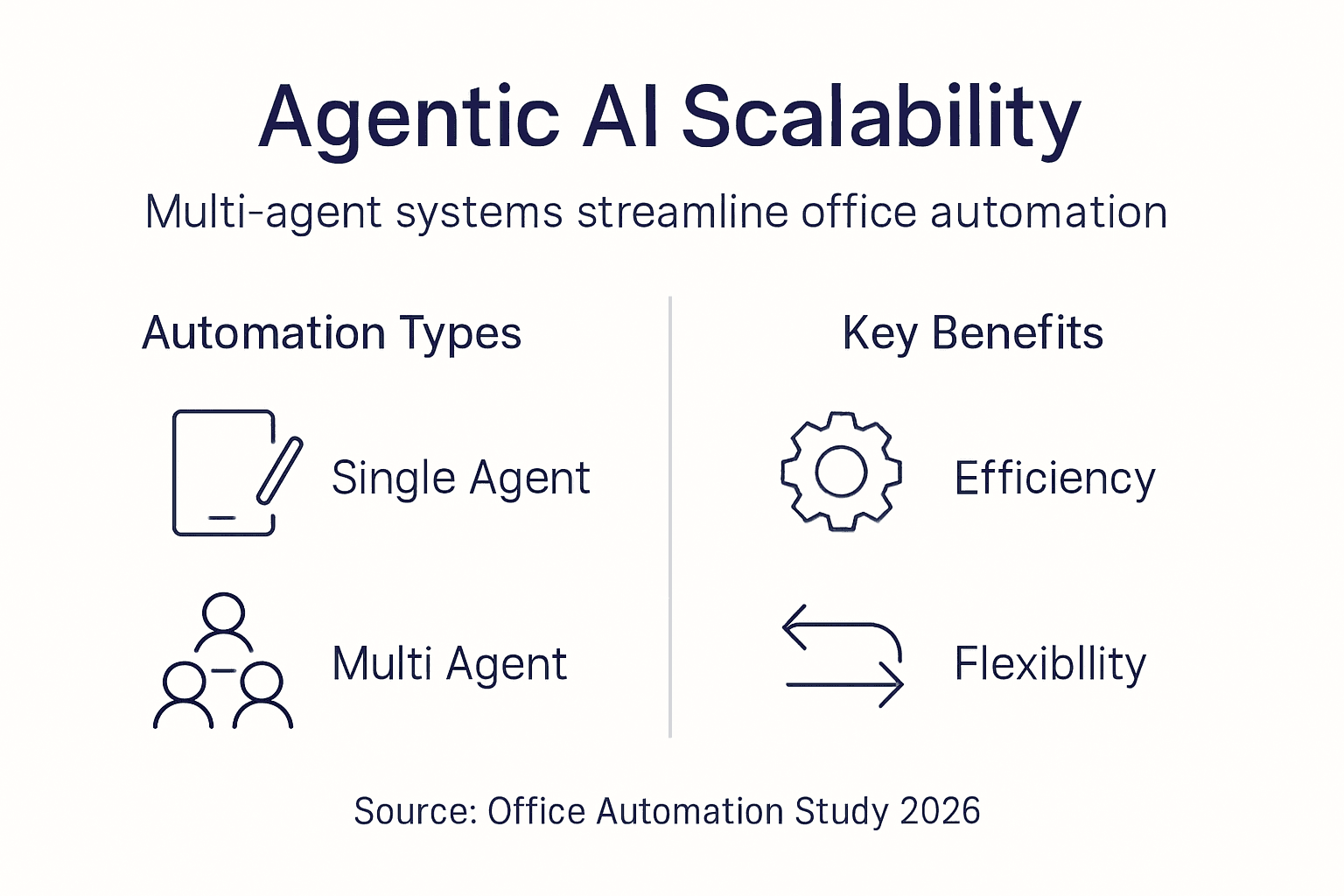
Consider a procurement workflow. One agent handles vendor inquiries, another validates purchase orders, a third routes approvals, and a fourth updates accounting. Each operates independently but shares context, creating a resilient end-to-end process.
Advanced architectures prepare organizations for complex office workflows involving multiple departments, systems, and decision points. Future of operational AI explores emerging capabilities. External research on agentic AI multi-agent architectures details implementation patterns.
Common Misconceptions About Agentic AI in Office Automation
Clarity matters. Several misconceptions impede adoption by setting unrealistic expectations or underestimating strategic requirements.
Misconception: Agentic AI is just advanced scripting or RPA. Reality: Agentic AI reasons and plans dynamically. RPA executes fixed scripts. The difference is adaptability and decision-making capability.
Misconception: AI will replace human workers immediately. Reality: AI augments staff by handling repetitive tasks. Humans focus on exceptions, strategy, and judgment. Workforce transformation takes time and requires change management.
Misconception: Deploying agentic AI delivers instant ROI. Reality: ROI requires strategic workflow redesign, integration effort, and governance. While 80% of organizations see measurable returns within a year, upfront planning determines success.
Misconception: AI agents function as isolated tools. Reality: Advanced implementations use multi-agent teams that collaborate, share context, and coordinate actions. Isolated agents limit scalability and reliability.
Recognizing these realities helps avoid common pitfalls. Agentic AI is powerful but requires thoughtful deployment, integration, and ongoing governance. Companies that approach implementation strategically achieve better outcomes than those expecting plug-and-play solutions.
AI-driven automation success guide addresses these misconceptions in detail.
Practical Steps for Implementing Agentic AI in Mid-Market Companies
Mid-market companies can implement agentic AI effectively by following a structured approach. Success depends on assessing readiness, planning integration, enforcing governance, piloting workflows, and scaling with support.
-
Assess current workflows for AI suitability. Identify processes involving repetitive steps, multiple systems, and clear decision logic. Prioritize workflows where automation delivers measurable time savings or error reduction.
-
Develop integration plan for enterprise systems. Map required connections to CRM, ERP, accounting, scheduling, and document platforms. Confirm API availability and security requirements.
-
Implement governance and security controls. Define AI agent roles, permissions, and escalation rules. Establish logging, monitoring, and compliance checkpoints.
-
Pilot AI on defined workflows and gather feedback. Launch controlled pilots with small user groups. Collect data on performance, errors, and user satisfaction. Refine workflows based on results.
-
Scale with training, change management, and optimization. Roll out successful pilots organization-wide. Train staff on AI supervision and exception handling. Continuously optimize workflows based on performance metrics.
Pro Tip: Start small with high-impact workflows that demonstrate clear ROI quickly. Success builds organizational confidence and secures executive support for broader deployment. Avoid the temptation to automate everything at once.
Metrics to track success include:
- Time savings: Hours reclaimed per week by automating manual tasks.
- Error rates: Reduction in data entry mistakes, missed approvals, or routing failures.
- User satisfaction: Staff and customer feedback on service quality and responsiveness.
- Cost per transaction: Financial efficiency gains from autonomous execution.
AI integration checklist for businesses provides detailed implementation planning resources.
Empower Your Office Automation with Ailerons’ Agentic AI Solutions
Ailerons specializes in deploying agentic AI for mid-market companies seeking to scale office operations without proportional staff increases. Our consulting services assess workflows, design integrations, and establish governance frameworks tailored to your business.
We leverage proven architectures and cutting-edge multi-agent systems to deliver:
- Increased efficiency: Autonomous workflows reduce manual overhead and accelerate task completion.
- Cost savings: Measurable ROI through reduced labor costs and improved resource utilization.
- Scalable solutions: Multi-agent architectures grow with your business without major rework.
- Compliance-ready design: Built-in governance, audit trails, and security controls aligned with industry standards.
Ailerons transforms office automation from task execution to intelligent orchestration, enabling mid-market companies to compete with enterprise-scale efficiency.
Explore how we help organizations implement future of operational AI 2026 capabilities, adopt AI trends transforming office operations, and achieve success with our guide to AI-driven office automation success.
Frequently Asked Questions
What is agentic AI and how does it differ from traditional automation?
Agentic AI autonomously executes complex workflows with reasoning and planning, unlike scripted automation which follows fixed rules. It adapts to context, handles exceptions, and coordinates across systems. Traditional automation breaks when conditions change; agentic AI adjusts dynamically.
What are common challenges in deploying agentic AI in mid-market office environments?
Challenges include integrating agentic AI with existing systems, ensuring security and compliance, and redesigning workflows to fit autonomous automation. Poor integration and insufficient governance cause deployment failures. Embedding compliance frameworks early prevents costly rework and regulatory risk.
How does agentic AI affect human roles in the office?
Agentic AI automates routine tasks, freeing staff to focus on exception management and strategic work, enhancing job satisfaction. Humans collaborate with AI rather than being replaced. Roles shift from execution to supervision, judgment, and innovation. Workforce transformation requires training and change management.
What are the best practices for implementing agentic AI effectively?
Start by assessing workflow suitability, integrate carefully with existing systems, enforce governance, pilot workflows, and scale with user training. Track metrics like time savings, error reduction, and employee engagement. Begin with high-impact processes that demonstrate ROI quickly to build organizational confidence and secure executive support for broader deployment.
Recommended
- AI Trends in 2026: Transforming Office Operations | Ailerons IT Consulting
- Office Operations Automation Trends: Agentic AI Impact | Ailerons IT Consulting
- Intelligent Automation Cuts Admin Overhead 72% in 2026 | Ailerons IT Consulting
- Step-by-Step Guide to AI-Driven Office Automation Success | Ailerons IT Consulting
- SeeRM | Affärssystemtrender 2026: AI minskar administration 40%
- Welcome3 AI Setup Guide