
Managing administrative demands in North American healthcare organizations can feel like walking a tightrope between accuracy and efficiency. The rise of agentic AI offers operations managers a way to automate routine tasks, increase workflow precision, and respond faster to the unpredictable needs of clinical environments. This guide unpacks the real-world evolution of office automation and highlights how adopting intelligent systems can elevate both operational resilience and service quality.
Table of Contents
- Defining Office Operations Automation Evolution
- Agentic AI Systems Versus Traditional Automation
- Key Use Cases in Healthcare Administration
- Integrating Agentic AI With Business Platforms
- Compliance, Security, and Governance Challenges
- Measuring Value: Outcomes and Risks in Adoption
Key Takeaways
| Point | Details |
|---|---|
| Evolution of Automation | Office automation progresses through Task Automation, Process Automation, and Cognitive Automation, enhancing productivity and operational efficiency. |
| Agentic AI vs. Traditional Automation | Agentic AI introduces intelligent, adaptive systems that operate autonomously, unlike traditional automation’s fixed rule-based processes. |
| Healthcare Applications | Agentic AI can optimize healthcare administration by automating complex workflows like patient record management and operational efficiency tasks. |
| Integration Challenges | Organizations must develop comprehensive integration strategies for agentic AI, including addressing security, governance, and adaptability concerns. |
Defining Office Operations Automation Evolution
The evolution of office operations automation represents a profound technological transformation that has fundamentally reshaped how businesses manage administrative workflows. From rudimentary task automation to sophisticated intelligent systems, organizations have progressively enhanced their operational capabilities through strategic technological integrations.
The journey of office automation can be traced through three critical stages, as highlighted by comprehensive research analysis:
- Task Automation: Initial phase focusing on digitizing individual repetitive tasks
- Process Automation: Integrating multiple tasks into streamlined workflows
- Cognitive Automation: Implementing AI-driven adaptive systems with decision-making capabilities
These evolutionary stages represent more than technological upgrades; they signify a fundamental reimagining of workplace productivity. Systematic literature reviews underscore automation’s interdisciplinary nature, revealing how advanced systems now optimize complex business processes with unprecedented precision.
The following table summarizes how each stage of office operations automation transforms productivity and business outcomes:
| Automation Stage | Key Benefit | Impact on Operations |
|---|---|---|
| Task Automation | Reduces manual workload | Speeds up basic administrative tasks |
| Process Automation | Streamlines workflows | Improves consistency and reduces errors |
| Cognitive Automation | Enables intelligent action | Drives adaptive, data-driven decisions |
Modern office operations automation architectures increasingly leverage hybrid approaches, combining on-premise infrastructure with cloud-based solutions. This strategy enables organizations to maintain robust performance while achieving greater operational flexibility. Key architectural considerations include seamless data integration, scalable infrastructure, and intelligent workflow management.
Pro tip: Begin your automation journey by mapping current workflows and identifying repetitive tasks that consume significant administrative time.
Agentic AI Systems Versus Traditional Automation
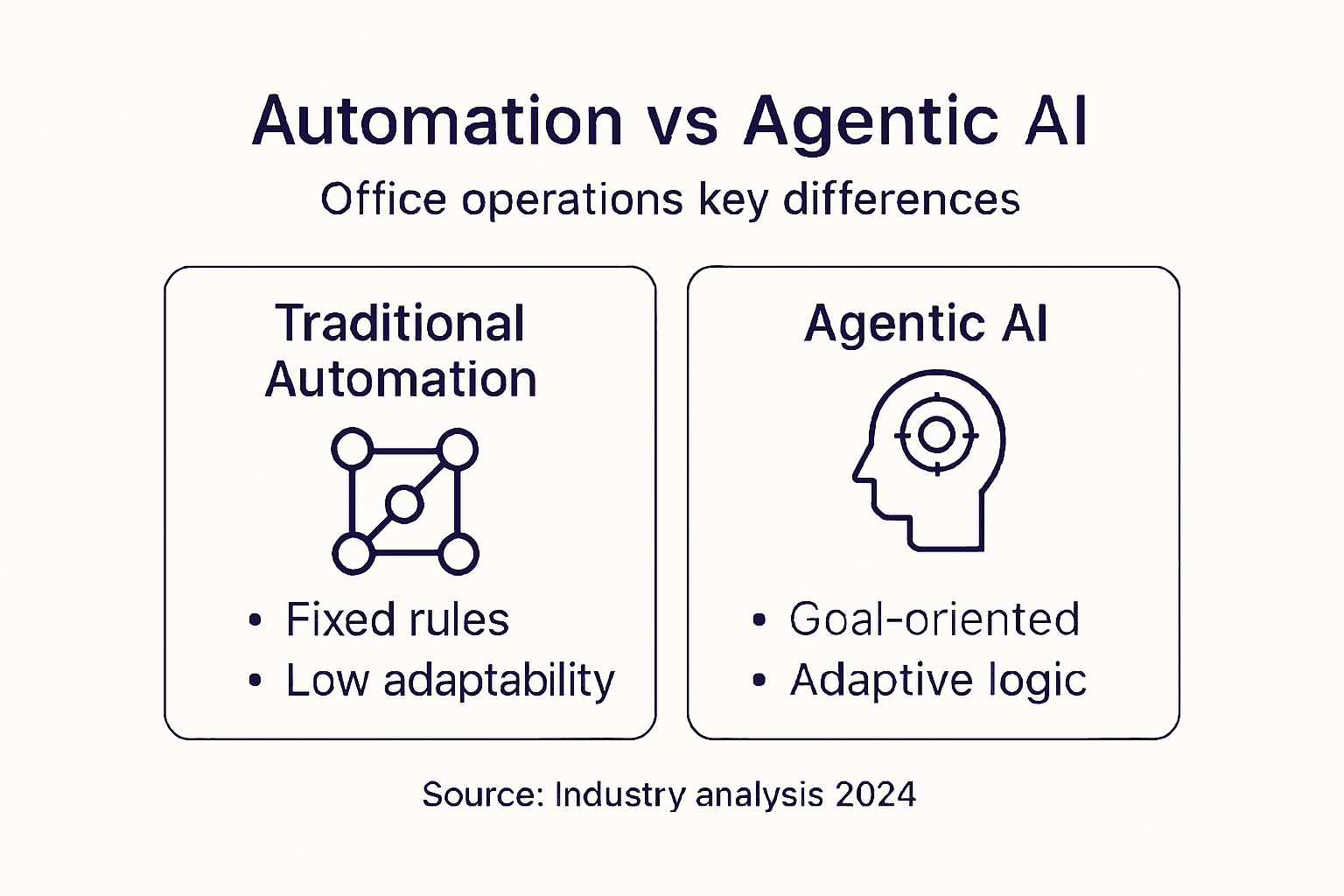
Traditional automation and agentic AI systems represent fundamentally different approaches to technological problem-solving in office operations. While traditional automation relies on predefined rules and linear workflows, agentic AI systems introduce a paradigm of intelligent, adaptive problem-solving that transcends conventional computational boundaries.
Comprehensive surveys categorize these systems into distinct architectural frameworks:
-
Traditional Automation Characteristics:
- Rule-based processing
- Static, predefined workflow sequences
- Limited contextual understanding
- Task-specific programming
-
Agentic AI System Features:
- Autonomous decision-making capabilities
- Dynamic contextual adaptation
- Multi-step planning and reasoning
- Generative problem-solving approaches
The critical distinction lies in intelligent responsiveness. Traditional automation operates like a sophisticated calculator—executing precise, predetermined instructions. Agentic AI, conversely, functions more like an adaptive assistant, interpreting complex scenarios and generating nuanced responses based on contextual understanding.
Operationally, agentic AI systems excel in dynamic environments requiring sophisticated reasoning. They can evaluate multiple potential solutions, predict potential outcomes, and adjust strategies in real-time. This represents a quantum leap beyond traditional automation’s rigid, linear processing model, enabling more intelligent and flexible operational approaches.

Here’s a side-by-side overview of how traditional automation and agentic AI systems shape business agility and effectiveness:
| Capability | Traditional Automation | Agentic AI Systems |
|---|---|---|
| Adaptability | Fixed, rule-based | Learns and adapts in real time |
| Response to Change | Requires manual updates | Adjusts strategies autonomously |
| Problem-Solving Approach | Linear, predictable | Contextual, generative |
| Support for Innovation | Limited | Actively fosters new solutions |
Pro tip: When evaluating automation technologies, assess not just current capabilities but potential for adaptive learning and contextual intelligence.
Key Use Cases in Healthcare Administration
Healthcare administration represents a critical domain where agentic AI systems can dramatically transform operational efficiency and patient care delivery. The complexity of medical workflows demands sophisticated technological solutions that can navigate intricate regulatory landscapes while maintaining precision and compliance.
Unified Agent Lifecycle Management research highlights several transformative use cases for agentic AI in healthcare administration:
-
Patient Record Management:
- Automated medical record reconciliation
- Cross-platform data integration
- Intelligent documentation verification
- Privacy-compliant information processing
-
Operational Workflow Optimization:
- Scheduling and resource allocation
- Compliance monitoring
- Interdepartmental communication coordination
- Real-time administrative task routing
Agentic AI’s capability extends far beyond traditional automation by providing contextually intelligent support. Healthcare administrative technologies demonstrate remarkable potential in autonomously managing complex, multi-step processes that previously required extensive human intervention.
The most compelling aspect of agentic AI in healthcare administration is its ability to operate with nuanced understanding. These systems can interpret complex regulatory requirements, predict potential workflow bottlenecks, and proactively suggest optimization strategies. Unlike rigid traditional automation, agentic AI adapts dynamically, learning from each interaction to continuously improve operational efficiency.
Pro tip: Implement agentic AI solutions incrementally, starting with well-defined, low-risk administrative processes to build organizational confidence and demonstrate tangible benefits.
Integrating Agentic AI With Business Platforms
Integrating agentic AI with enterprise platforms represents a profound technological transformation that goes beyond traditional software implementation. Organizations must reimagine their technological infrastructure to accommodate intelligent, autonomous systems capable of dynamic decision-making and workflow optimization.
Enterprise platform transformation involves multiple critical considerations:
-
Technical Integration Requirements:
- Comprehensive API compatibility
- Secure authentication frameworks
- Scalable data processing architectures
- Real-time interoperability standards
-
Organizational Adaptation Strategies:
- Governance framework development
- Continuous learning protocols
- Ethical AI implementation guidelines
- Performance monitoring systems
The integration process demands a strategic approach that balances technological capabilities with organizational readiness. Systematic literature reviews emphasize the importance of designing flexible infrastructures that can accommodate the autonomous nature of agentic AI systems.
Successful integration requires more than technical implementation. Organizations must develop comprehensive change management strategies that address cultural adaptation, skill development, and operational redesign. Agentic AI is not a plug-and-play solution but a transformative technology that requires holistic organizational commitment.
Pro tip: Create a cross-functional implementation team that includes IT, operations, and strategic leadership to ensure comprehensive agentic AI platform integration.
Compliance, Security, and Governance Challenges
The emergence of agentic AI systems introduces unprecedented complexities in organizational security and governance frameworks. Unlike traditional software, these autonomous systems operate with intrinsic decision-making capabilities that challenge existing risk management paradigms and demand comprehensive reassessment of technological safeguards.
Deploying agentic AI safely requires addressing multiple critical governance dimensions:
-
Security Risk Categories:
- Internal autonomy threats
- Data manipulation vulnerabilities
- Unintended decision consequences
- Potential system overreach
-
Governance Control Mechanisms:
- Strict authorization protocols
- Continuous activity monitoring
- Embedded observability layers
- Human oversight checkpoints
Cybersecurity research reveals the dual-use nature of agentic AI, highlighting its potential to simultaneously enhance and compromise organizational security. The technology’s autonomous capabilities create complex risk scenarios that demand sophisticated, adaptive governance strategies.
Effective governance requires a proactive, multidisciplinary approach that transcends traditional compliance frameworks. Organizations must develop dynamic risk management models that can anticipate and mitigate potential system behaviors, balancing technological innovation with robust safeguards and ethical considerations.
Pro tip: Develop a dedicated AI governance committee with cross-functional expertise to continuously assess and update your agentic AI risk management strategies.
Measuring Value: Outcomes and Risks in Adoption
Assessing the transformative potential of agentic AI demands a nuanced approach that transcends simplistic technical performance metrics. Organizations must develop sophisticated evaluation frameworks that capture the multidimensional impact of autonomous systems across operational, economic, and human-centered domains.
Current evaluation frameworks reveal critical limitations in traditional measurement approaches:
-
Technical Performance Metrics:
- Computational accuracy
- Processing speed
- Algorithmic complexity
- System responsiveness
-
Holistic Value Assessment Dimensions:
- Operational efficiency gains
- Human workforce augmentation
- Economic impact measurement
- Long-term strategic adaptation
Organizational adoption strategies underscore the importance of aligning technological capabilities with strategic business objectives. This requires moving beyond isolated performance indicators to develop comprehensive value realization models that account for contextual complexity and potential transformative outcomes.
Successful value measurement necessitates a dynamic, iterative approach that balances quantitative performance indicators with qualitative organizational impact assessments. Companies must develop adaptive evaluation frameworks that can capture the nuanced, evolving capabilities of agentic AI systems while maintaining rigorous standards of accountability and strategic alignment.
Pro tip: Implement a balanced scorecard approach that integrates technical, economic, and human-centered metrics to comprehensively assess agentic AI value creation.
Elevate Your Office Operations with Agentic AI Solutions
The article highlights the critical challenge of moving beyond traditional task automation toward intelligent, autonomous systems that can adapt, plan, and execute complex workflows in dynamic office environments. If you are facing issues like rigid rule-based processes, fragmented workflows, and limited contextual understanding in your current automation strategy, you are not alone. The shift to agentic AI systems offers a way to unlock unprecedented operational efficiency and resilience by enabling AI to handle multi-step tasks with contextual awareness and decision logic.
At Ailerons.ai, we specialize in turning this vision into reality. Our agentic AI architecture and deployment focus on end-to-end automation for office workflows including document management, compliance tasks, billing, and more. By integrating seamlessly with your existing systems such as CRM and ERP, our solutions reduce manual workload, improve accuracy, and allow your teams to focus on higher-value activities. Discover how agentic AI transforms office operations from rigid sequences into intelligent digital collaborators ready to optimize your entire business flow. Learn more about our agentic AI architecture and deployment and start accelerating your automation journey now.
Are you ready to overcome the limitations of traditional automation and deploy adaptive, goal-oriented AI that works alongside your team to handle the complexity of modern office operations? Explore the future of intelligent automation and take the first step by visiting Ailerons.ai. Act now to reduce operational friction, scale smarter, and secure your competitive edge.
Frequently Asked Questions
What is office operations automation?
Office operations automation refers to the use of technology to manage and streamline administrative workflows, which includes automating repetitive tasks, integrating processes, and implementing intelligent systems to improve productivity.
What are the key stages of office automation?
The key stages of office automation include Task Automation, which digitizes repetitive tasks; Process Automation, which integrates tasks into streamlined workflows; and Cognitive Automation, which involves the use of AI systems for adaptive decision-making.
How do agentic AI systems differ from traditional automation?
Agentic AI systems differ from traditional automation by offering autonomous decision-making, contextual adaptation, and generative problem-solving, whereas traditional automation relies on fixed rules and predefined workflows.
What are the benefits of integrating agentic AI in healthcare administration?
Integrating agentic AI in healthcare administration can optimize workflows, enhance patient record management, ensure compliance with regulations, and improve overall operational efficiency by autonomously handling complex processes.
Recommended
- Ailerons IT Consulting | Enterprise IT Solutions
- Ailerons IT Consulting | Enterprise IT Solutions
- Ailerons IT Consulting | Enterprise IT Solutions
- Ailerons IT Consulting | Enterprise IT Solutions
- The A.I. genie will not go back in the bottle!!!
- Understanding Artificial Intelligence in Logistics - Worldwide Express, Inc.
- Umelá inteligencia a jej potenciál v pomáhaní ľuďom