

Managing complex healthcare workflows often means facing endless paperwork and mounting compliance demands. The rise of agentic AI is setting a new benchmark in 2026, offering autonomous systems that proactively plan, adapt, and collaborate across departments. These intelligent agents can handle multi-stage tasks, freeing staff for higher-value work and strengthening organizational compliance. Discover how integrating agentic AI unlocks smarter approaches to reducing administrative overhead and optimizing efficiency for healthcare operations worldwide.
Table of Contents
- Agentic Ai In 2026: Defining A New Standard
- Key Types Of Agentic Ai Systems
- How Agentic Ai Orchestrates Office Workflows
- Integration With Business Platforms And Compliance
- Risks, Cost Implications, And Change Management
Key Takeaways
| Point | Details |
|---|---|
| Emergence of Agentic AI | Agentic AI signifies a shift toward autonomous systems capable of proactive planning and collaboration, improving organizational efficiency. |
| Architectural Diversity | The sector is defined by distinct approaches: Symbolic/Classical and Neural/Generative, with hybrid models likely providing optimal solutions. |
| Transforming Workflows | Agentic AI can autonomously manage complex office workflows, enhancing productivity and decision-making processes. |
| Risk Management | Organizations must navigate technical, organizational, and regulatory risks with robust governance and continuous adaptation strategies. |
Agentic AI in 2026: Defining a New Standard
The landscape of artificial intelligence is undergoing a fundamental transformation with the emergence of agentic AI - a new paradigm that moves beyond traditional task-specific automation toward truly autonomous systems. Unlike previous generations of AI that required explicit programming for every scenario, agentic AI represents a quantum leap in machine intelligence, enabling systems to proactively plan, adapt, and collaborate.
Research from leading academic institutions reveals two primary architectural approaches defining this emerging field. Comprehensive survey frameworks demonstrate that agentic AI can be categorized into two distinct yet complementary paradigms:
-
Symbolic/Classical Approach
- Algorithmic planning with persistent state tracking
- Deterministic decision-making processes
- Strong emphasis on logical reasoning
-
Neural/Generative Approach
- Stochastic generation and prompt-driven orchestration
- Dynamic learning from environmental feedback
- Probabilistic reasoning capabilities
The most advanced agentic AI systems will likely emerge from strategic integration of these two approaches, creating hybrid architectures that combine the precision of symbolic methods with the adaptability of neural networks. Systematic architectural reviews emphasize that successful implementations will prioritize safety, contextual understanding, and autonomous collaboration.
Key capabilities that distinguish agentic AI from traditional automation include:
- Proactive planning beyond immediate instructions
- Contextual memory retention
- Dynamic tool utilization
- Adaptive behavior based on complex environmental signals
- Autonomous decision-making with human-like reasoning
Agentic AI represents more than technological advancement - it signifies a fundamental reimagining of artificial intelligence as a collaborative partner rather than a mere computational tool.
Pro tip: When evaluating agentic AI solutions, focus on systems demonstrating genuine contextual awareness and adaptive learning capabilities, not just impressive one-off performance metrics.
Key Types of Agentic AI Systems
Agentic AI systems represent a sophisticated evolution in artificial intelligence, moving far beyond traditional computational models. Comprehensive classification frameworks reveal three primary architectural models that define the landscape of intelligent autonomous systems in 2026.
The primary categories of agentic AI systems include:
-
Symbolic/Classical Systems
- Rule-based algorithmic planning
- Deterministic decision processes
- Strong logical reasoning capabilities
- High predictability and transparency
-
Neural/Generative Systems
- Stochastic learning mechanisms
- Dynamic adaptation from environmental signals
- Probabilistic reasoning approaches
- High flexibility in complex scenarios
-
Hybrid Architectural Systems
- Integrated symbolic and neural approaches
- Balanced computational reasoning
- Adaptive learning with structured logic
- Optimized for multiple operational domains
Comparative taxonomies of AI systems demonstrate that each architectural model exhibits distinct levels of autonomy, ranging from simple task execution to complex multi-agent collaboration. The selection of an appropriate agentic AI system depends critically on specific operational requirements, complexity of tasks, and desired outcomes.
Each architectural approach offers unique advantages across different domains:
Here’s a comparison of agentic AI architectural models and their ideal business uses:
| AI Model | Ideal Domain | Distinct Advantage |
|---|---|---|
| Symbolic/Classical | Healthcare | Reliable rule enforcement |
| Neural/Generative | Financial Trading | Rapid data pattern adaptation |
| Hybrid Architecture | Manufacturing | Adaptive logic with operational rigor |
| Generative/Integrated | Customer Service | Context-aware human-like interaction |
- Healthcare: Symbolic systems prioritize strict protocol adherence
- Financial Trading: Neural systems excel in rapid pattern recognition
- Manufacturing: Hybrid systems provide balanced adaptive control
- Customer Service: Generative systems enable nuanced interaction
- Research & Development: Integrated architectures support complex problem-solving
Successful implementation of agentic AI requires understanding the specific strengths and limitations of each architectural model, rather than adopting a one-size-fits-all approach.
Pro tip: When selecting an agentic AI system, conduct thorough scenario testing across multiple operational contexts to ensure alignment with your specific performance requirements and organizational goals.
How Agentic AI Orchestrates Office Workflows
The landscape of office operations is experiencing a radical transformation through agentic AI systems that can autonomously coordinate complex, multi-stage workflows across different organizational functions. Enterprise deployment strategies reveal how these intelligent systems are redefining workplace productivity by handling intricate tasks that previously required extensive human coordination.
Agentic AI’s workflow orchestration capabilities encompass several critical operational domains:
-
Cross-Functional Task Management
- Automated handoff between departmental processes
- Real-time coordination of team activities
- Intelligent routing of information and tasks
- Dynamic resource allocation
-
Decision Support Systems
- Contextual reasoning across complex scenarios
- Predictive analysis of potential workflow bottlenecks
- Automated escalation and exception handling
- Continuous process optimization
-
Integrated System Coordination
- Seamless interaction between disparate software platforms
- Automatic data synchronization
- Intelligent API and system integration
- Secure cross-platform communication protocols
These AI agents demonstrate remarkable capabilities in translating strategic objectives into executable workflows, effectively functioning as intelligent digital coordinators that understand organizational context and operational nuances.
Key workflow orchestration scenarios include:
- Automated report generation and distribution
- Cross-departmental project tracking
- Compliance documentation management
- Resource allocation optimization
- Intelligent communication routing
Agentic AI transforms workflow management from a series of disconnected tasks to a holistic, intelligently coordinated ecosystem of organizational productivity.
Pro tip: Implement agentic AI workflow systems incrementally, starting with well-defined, repeatable processes to build organizational trust and demonstrate tangible efficiency gains.

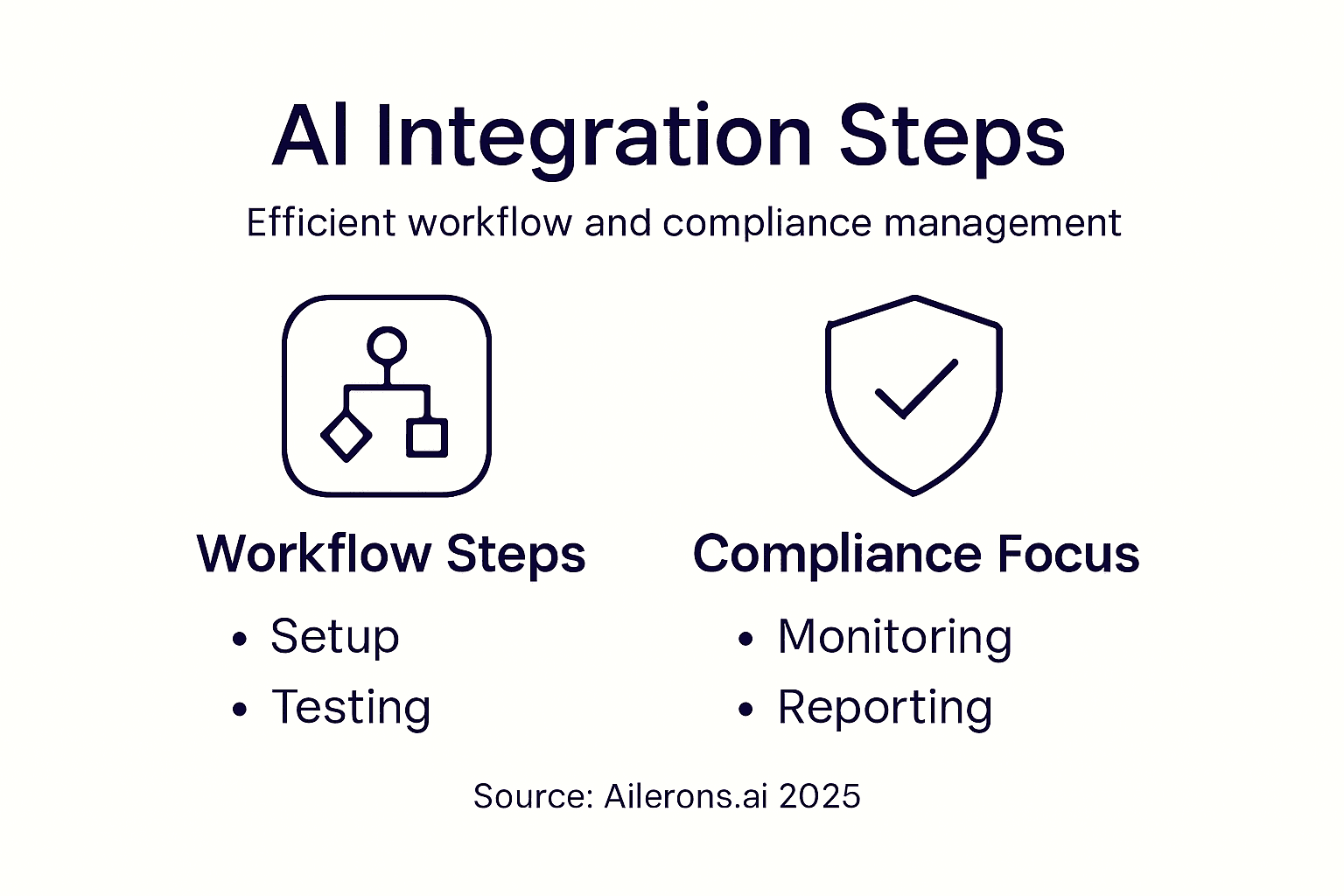
Integration With Business Platforms and Compliance
The evolving landscape of enterprise technology is witnessing a transformative integration of agentic AI with core business platforms, fundamentally reshaping how organizations approach technological infrastructure and regulatory compliance. Enterprise application predictions indicate that by 2026, nearly 40% of enterprise applications will feature embedded AI agents capable of autonomous collaboration and intelligent workflow management.
The critical integration domains for agentic AI across business platforms include:
-
Compliance Management
- Automated regulatory monitoring
- Real-time policy interpretation
- Continuous risk assessment
- Adaptive governance frameworks
-
Platform Interoperability
- Seamless data exchange protocols
- Cross-system authentication
- Intelligent API connectivity
- Dynamic system configuration
-
Governance and Control
- Transparent decision tracing
- Granular access management
- Automated compliance reporting
- Predictive regulatory alignment
Advanced enterprise solutions are now integrating AI with governance systems that enable intelligent agents to autonomously interpret complex legal and regulatory information while maintaining rigorous control standards.
Key integration strategies encompass:
- Establishing robust AI governance frameworks
- Implementing comprehensive access controls
- Creating transparent AI decision-making processes
- Developing adaptive compliance mechanisms
- Ensuring continuous regulatory alignment
Successful agentic AI integration requires a delicate balance between technological innovation and stringent organizational governance.
Pro tip: Develop a phased integration approach that prioritizes compliance, implements robust monitoring mechanisms, and maintains human oversight during AI agent deployment.
Risks, Cost Implications, and Change Management
The adoption of agentic AI introduces a complex landscape of strategic risks and economic considerations that organizations must carefully navigate. Economic metrics for AI adoption reveal critical dimensions organizations must address to ensure sustainable technological transformation.
Key risk domains for agentic AI implementation include:
-
Technical Risks
- Unpredictable system behaviors
- Potential decision cascade failures
- Complex error propagation scenarios
- Algorithmic bias and drift
-
Organizational Risks
- Workforce skill obsolescence
- Potential productivity disruptions
- Cultural resistance to AI adoption
- Retraining and change management challenges
-
Regulatory Compliance Risks
- Evolving legal frameworks
- Data privacy considerations
- Accountability for AI-driven decisions
- Cross-jurisdictional regulatory alignment
Systemic risk assessments underscore the importance of dynamic governance to mitigate potential negative consequences of autonomous AI systems.
Prioritized risk mitigation strategies include:
The following table summarizes major risk categories and recommended mitigation strategies for agentic AI adoption:
| Risk Category | Key Concern | Leading Mitigation Approach |
|---|---|---|
| Technical | Unexpected behaviors | Continuous system monitoring |
| Organizational | Workforce disruption | Proactive staff reskilling |
| Regulatory | Complex compliance requirements | Adaptive governance frameworks |
- Establishing comprehensive AI governance frameworks
- Implementing continuous monitoring systems
- Creating transparent decision-making protocols
- Developing robust human-AI collaboration models
- Investing in ongoing workforce reskilling
Successful agentic AI integration requires a balanced approach that prioritizes technological innovation while maintaining rigorous risk management and organizational adaptability.
Pro tip: Develop a phased implementation strategy with clear metrics for AI performance, human oversight mechanisms, and continuous learning opportunities to minimize organizational disruption.
Elevate Your Office Operations with Agentic AI Today
The article highlights a major challenge facing businesses in 2026: transforming office workflows from fragmented task execution into intelligent, autonomous coordination. If your organization struggles with manual handoffs, compliance complexities, and inefficient cross-functional collaboration, agentic AI offers a revolutionary solution. These next-generation AI systems go beyond simple automation by bringing goal orientation, contextual memory, and dynamic tool use to everyday operations. They proactively plan and adapt, turning chaotic workflows into streamlined processes.
At Ailerons.ai, we specialize in designing agentic AI solutions that integrate seamlessly with your existing business platforms like CRM, ERP, and accounting systems. Our offerings deliver end-to-end workflow orchestration that reduces operational friction and elevates accuracy and scalability while maintaining strict compliance and security. Ready to embrace the future of office automation where AI becomes your trusted digital collaborator? Discover how our agentic AI architecture and deployment can transform your business operations from manual execution to intelligent orchestration. Visit Ailerons.ai today and start your journey toward smarter, autonomous office workflows.
Frequently Asked Questions
What is agentic AI?
Agentic AI refers to a new generation of artificial intelligence that transcends traditional automation by enabling systems to proactively plan, adapt, and collaborate autonomously, rather than requiring explicit programming for each task.
How does agentic AI enhance office workflows?
Agentic AI enhances office workflows by autonomously coordinating complex, multi-stage tasks, managing real-time decision-making, and enabling seamless integration among different business platforms, ultimately improving overall productivity.
What are the key benefits of hybrid architectural systems in agentic AI?
Hybrid architectural systems in agentic AI combine the precision of symbolic methods with the flexibility of neural networks, allowing for adaptive logic, improved contextual understanding, and greater operational efficiency across various domains.
What risks should organizations consider when implementing agentic AI?
Organizations should consider technical risks, such as unpredictable system behaviors, organizational risks like workforce skill obsolescence, and regulatory compliance risks involving evolving legal frameworks and data privacy when implementing agentic AI.