

Managing complex administrative workflows can leave even skilled operations teams searching for smarter alternatives. The challenge is clear—manual processes drain time and energy that could be better spent on patient care and strategic growth. Adopting an AI-driven process evaluation framework gives you a practical path to pinpoint which office tasks are best suited for automation, helping your organization achieve higher efficiency, reliability, and cost control.
Table of Contents
- Step 1: Evaluate Office Processes For AI-Driven Automation
- Step 2: Design Agentic AI Workflows Tailored To Your Needs
- Step 3: Integrate Agentic AI With Office Systems Securely
- Step 4: Deploy And Manage Automated Workflows Organization-Wide
- Step 5: Verify Automation Performance And Optimize Outcomes
Quick Summary
| Key Insight | Explanation |
|---|---|
| 1. Evaluate Processes for Automation | Systematically analyze workflows to identify tasks for AI automation that improve efficiency. |
| 2. Design Modular AI Workflows | Create adaptable AI workflows that can autonomously manage tasks while ensuring precision. |
| 3. Implement Security Measures | Secure integration of AI requires access control and monitoring to protect sensitive data. |
| 4. Centralize AI Governance | Develop a governance structure to oversee AI deployment and ensure consistent performance. |
| 5. Continuously Monitor Performance | Utilize performance metrics to verify and optimize AI workflows for enhanced results. |
Step 1: Evaluate office processes for AI-driven automation
Evaluating your organization’s office processes for potential AI automation requires a strategic and systematic approach. By carefully analyzing existing workflows, you can identify prime candidates for intelligent automation that will significantly improve operational efficiency and accuracy.
Start by conducting a comprehensive process mapping exercise to document each administrative task currently performed manually. Focus on identifying repetitive, rule-based activities that consume significant staff time. Government AI adoption strategies recommend examining processes with these key characteristics:
- High transaction volume
- Consistent decision-making rules
- Structured data inputs
- Predictable workflow steps
- Minimal complex human judgment required
Your evaluation should assess potential automation candidates across multiple dimensions. Look for processes where AI can deliver measurable improvements by analyzing:

Here’s a quick reference comparing key criteria for selecting office processes suitable for AI-driven automation:
| Evaluation Dimension | Why It Matters | Impact of High Score |
|---|---|---|
| Time Spent on Task | Reveals where staff are busiest | Greater efficiency gains |
| Error Rate | Shows risk for manual mistakes | More consistency and quality |
| Decision Logic Complexity | Easier for AI to replicate | Faster deployment, fewer issues |
| Data Availability | Ensures AI can access needed info | Reduces integration challenges |
| Potential Cost Savings | Justifies investment | Faster ROI realization |
- Current time spent on manual tasks
- Error rates in existing workflow
- Complexity of decision-making logic
- Data availability and quality
- Potential cost savings
Effective process evaluation requires a holistic view of your organization’s operational landscape and a deep understanding of AI’s transformative potential.
While conducting your assessment, prioritize transparency and continuous monitoring. Research on administrative AI integration emphasizes the importance of establishing clear performance metrics and maintaining human oversight during the automation transition.
Pro tip: Create a detailed spreadsheet tracking each process’s automation potential, scoring them based on complexity, volume, and potential efficiency gains to systematically prioritize your AI implementation strategy.
Step 2: Design agentic AI workflows tailored to your needs
Designing custom agentic AI workflows requires a strategic approach that transforms complex administrative processes into intelligent, adaptable systems. Your goal is to create modular, flexible workflows that can autonomously manage and execute tasks while maintaining high precision and organizational alignment.
Production-grade workflow design begins with comprehensive process decomposition. Break down each administrative workflow into discrete, manageable components that can be independently handled by specialized AI agents. This approach enables more granular control and easier optimization of individual workflow segments.
Key considerations for designing effective agentic AI workflows include:
- Identifying specific task boundaries
- Defining clear decision-making parameters
- Establishing communication protocols between agents
- Creating fallback and human intervention mechanisms
- Ensuring robust error handling and logging
UK Government Digital Service guidelines recommend developing workflows with the following architectural principles:
- Modular agent design
- Dynamic adaptability
- Transparent decision tracking
- Scalable infrastructure
- Continuous performance monitoring
Successful agentic AI workflow design requires balancing technological capability with organizational context and strategic objectives.
Each workflow should incorporate intelligent routing mechanisms that enable agents to dynamically adjust their approach based on real-time data and unexpected changes. This ensures your AI system remains responsive and efficient across varying operational scenarios.
Pro tip: Start by mapping your most repetitive administrative workflows in granular detail, identifying precise decision points where AI agents can take autonomous action while maintaining clear human oversight boundaries.
Step 3: Integrate agentic AI with office systems securely
Securing the integration of agentic AI with your existing office systems requires a comprehensive approach that balances technological innovation with robust cybersecurity protocols. Your primary objective is to create a seamless yet protected digital environment where intelligent agents can operate effectively without compromising sensitive organizational data.
Cybersecurity challenges in AI integration demand a multifaceted strategy focusing on comprehensive access control and continuous monitoring. Each AI agent must be configured with granular permissions that strictly limit its operational scope and prevent unauthorized system interactions.
Key security integration strategies include:
- Implementing multi-factor authentication for AI agents
- Establishing role-based access controls
- Creating encrypted communication channels
- Developing real-time threat detection mechanisms
- Maintaining detailed interaction logs
Public administration AI governance recommends implementing these critical security frameworks:
- Identity verification protocols
- Comprehensive data anonymization
- Regular security audits
- Transparent decision-making trails
- Configurable intervention thresholds
Successful AI system integration requires a delicate balance between technological autonomy and rigorous security management.
Each integration point should incorporate intelligent security checkpoints that validate agent actions, cross-reference permissions, and immediately halt potentially suspicious activities. This approach ensures your AI workflows remain both efficient and protected against potential vulnerabilities.
Pro tip: Create a dedicated security sandbox environment where new AI agents can be thoroughly tested and validated before full system integration, allowing you to identify and mitigate potential risks proactively.
Step 4: Deploy and manage automated workflows organization-wide
Deploying agentic AI workflows across your entire organization requires a strategic, methodical approach that balances technological innovation with operational consistency. Your goal is to create a standardized framework that enables intelligent automation while maintaining centralized governance and performance monitoring.
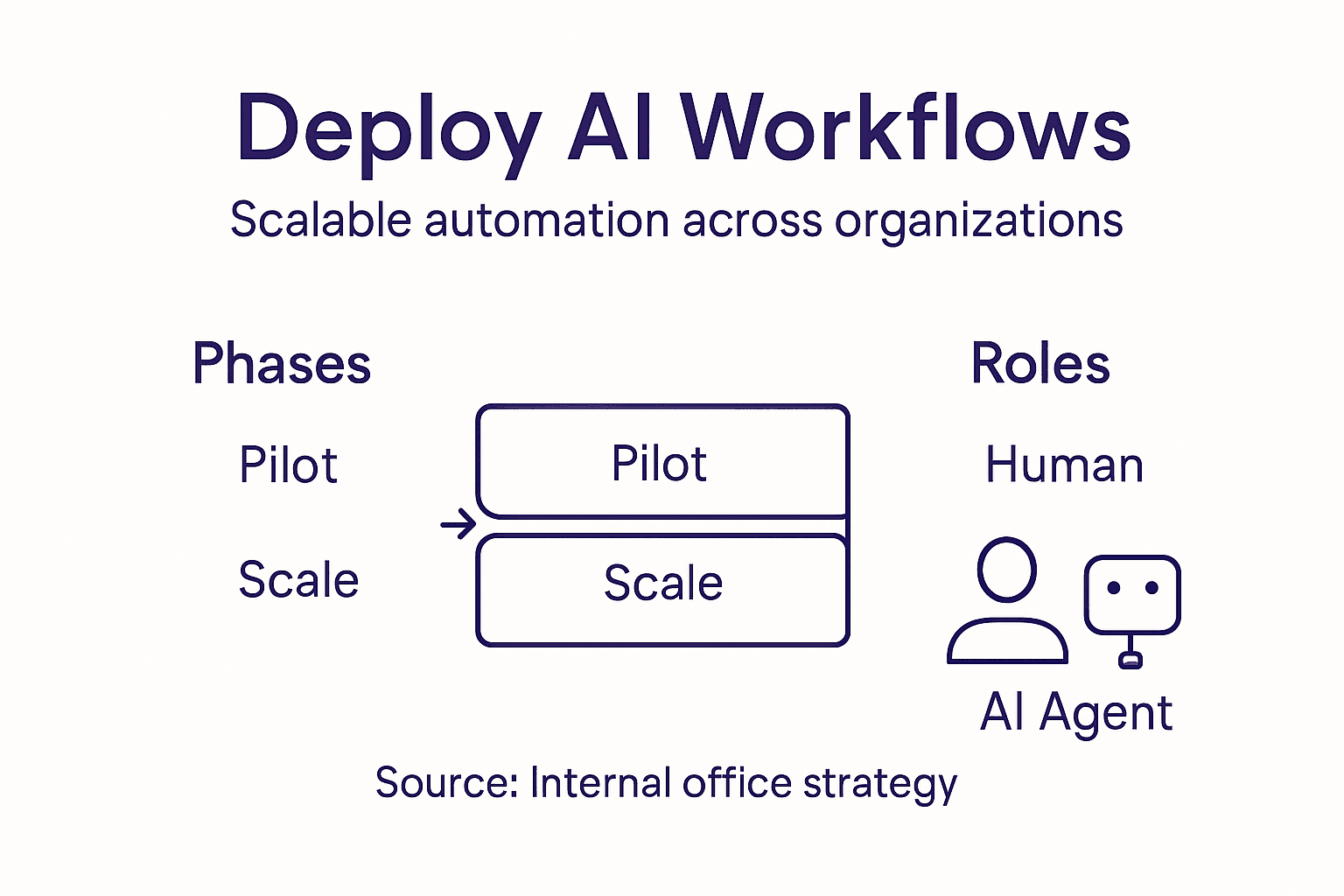
Microsoft’s AI workload management guidance emphasizes establishing a centralized AI governance structure that provides comprehensive oversight and support for organizational automation initiatives. This approach ensures systematic deployment, performance tracking, and continuous improvement of your AI-driven workflows.
Key organizational deployment strategies include:
- Creating a dedicated AI center of excellence
- Developing standardized deployment templates
- Establishing consistent performance metrics
- Implementing cross-departmental training programs
- Building scalable governance frameworks
Critical steps for successful workflow deployment involve:
- Conducting pilot testing in controlled environments
- Developing comprehensive documentation
- Creating role-specific training modules
- Establishing clear escalation protocols
- Implementing continuous monitoring systems
Effective workflow automation requires a holistic approach that balances technological capability with organizational culture and operational readiness.
Each workflow deployment should incorporate adaptive implementation strategies that allow for incremental scaling, enabling your organization to rapidly adjust and optimize AI-driven processes based on real-world performance and feedback.
Compare core responsibilities during agentic AI workflow deployment phases:
| Phase | Human Role | AI Agent Role |
|---|---|---|
| Initial Design | Define objectives, set rules | Learn rules, propose solutions |
| Integration | Oversee security, set permissions | Operate within set boundaries |
| Organization-wide Rollout | Conduct training, monitor outcomes | Scale operations, adapt workflows |
| Performance Optimization | Analyze reports, refine goals | Self-optimize, suggest tweaks |
Pro tip: Develop a phased rollout strategy that begins with low-complexity workflows in a single department, using documented learnings to refine and expand automation capabilities across the entire organization.
Step 5: Verify automation performance and optimize outcomes
Verifying and optimizing the performance of your AI-driven workflows requires a systematic, data-driven approach that continuously assesses and refines your automation strategies. Your objective is to develop a robust evaluation framework that ensures your intelligent systems consistently deliver high-quality, efficient results across different operational contexts.
AI output quality evaluation methods demand comprehensive performance monitoring that goes beyond traditional metrics. This approach involves tracking multiple dimensions of automation effectiveness, including accuracy, speed, complexity handling, and overall operational impact.
Key performance verification strategies include:
- Establishing baseline performance indicators
- Implementing real-time monitoring systems
- Conducting periodic comprehensive audits
- Creating comparative analysis frameworks
- Developing adaptive optimization protocols
Bureaucratic productivity research recommends tracking these critical performance metrics:
- Transaction processing time
- Error reduction percentages
- Resource utilization efficiency
- Complexity of handled tasks
- Cost savings and operational improvements
Performance optimization is an iterative process that requires continuous learning, adjustment, and strategic refinement of AI-driven workflows.
Each automation workflow should incorporate intelligent performance feedback loops that enable rapid identification of potential improvements, allowing your AI systems to dynamically adapt and enhance their operational capabilities.
Pro tip: Develop a standardized performance scorecard that captures both quantitative metrics and qualitative insights, enabling a holistic approach to measuring and improving your AI automation effectiveness.
Transform Your Office Automation with Agentic AI That Truly Works for You
The journey to AI-driven office automation success is filled with critical steps like evaluating processes, designing adaptive workflows, and securing integration. If you are seeking to overcome challenges such as complex decision logic, inefficient manual tasks, and fragmented systems, then you need more than conventional automation. The guide highlights the importance of agentic AI workflows that dynamically plan and execute multi-step operations with transparency and human oversight.
At Ailerons.ai, we specialize in building intelligent agentic AI solutions that go beyond rigid scripting. Our systems manage complicated office and operational workflows end to end—handling scheduling, document processing, approvals, and exception escalation—all while securely integrating with your existing CRM, ERP, and document platforms. By shifting work from manual execution to autonomous orchestration, you gain remarkable improvements in efficiency, accuracy, and scalability.
Are you ready to eliminate operational friction and empower your teams with AI that truly understands your business needs? Explore how our agentic AI architecture and deployment can redefine your office automation. Take the first step toward intelligent automation today and visit Ailerons.ai to discover tailored solutions designed for your organization’s success.
Frequently Asked Questions
How do I evaluate my office processes for AI-driven automation?
To evaluate your office processes, conduct a comprehensive process mapping exercise. Document each manual task, focusing on repetitive activities, and assess factors like time spent, error rates, and data availability.
What key characteristics should I look for in processes suitable for AI automation?
Look for processes with a high transaction volume, consistent decision-making rules, and structured data inputs. These characteristics indicate where AI can effectively improve efficiency and accuracy.
How can I design effective AI workflows for my organization?
To design effective AI workflows, break down each administrative task into manageable components and establish clear decision-making parameters. Focus on creating modular workflows that allow for dynamic adaptability and clear communication protocols between AI agents.
What security measures should I implement when integrating AI systems?
Implement multi-factor authentication and role-based access controls to secure AI system integration. Create encrypted communication channels and maintain detailed interaction logs to monitor AI actions and ensure data protection.
How do I verify the performance of automated workflows?
To verify the performance of automated workflows, establish baseline performance indicators and implement real-time monitoring systems. Conduct regular audits and develop adaptive optimization protocols to continually enhance automation effectiveness.
What steps can I take to deploy AI workflows organization-wide?
Begin by creating a centralized AI governance structure and develop standardized deployment templates. Conduct pilot testing in controlled environments and establish clear escalation protocols to ensure successful organizational rollout.