

Managing regulatory demands in healthcare often means navigating shifting requirements, tight resources, and rising expectations for transparency. For compliance officers, keeping up with technological advances while maintaining strong oversight is not just challenging but crucial. By understanding structured compliance in AI automation, organizations can create responsible, audit-ready systems that support patient safety, ethical standards, and operational efficiency across every stage of deployment.
Table of Contents
- Defining Compliance In AI Automation
- Key Regulatory Standards For Healthcare
- How Agentic AI Enhances Compliance
- Managing Risks And Ensuring Auditability
- Building Trust With Secure AI Integration
Key Takeaways
| Point | Details |
|---|---|
| Compliance in AI Automation | Establish structured frameworks to manage risks while ensuring ethical adherence in AI systems. |
| Healthcare Regulatory Standards | Develop holistic approaches that balance innovation with patient safety and ethical deployment in healthcare AI. |
| Agentic AI’s Role | Implement intelligent systems that proactively identify and mitigate regulatory risks in compliance management. |
| Building Trust with Secure AI | Focus on creating transparent, accountable, and secure AI systems to foster public confidence and organizational integrity. |
Defining Compliance in AI Automation
Compliance in AI automation represents a structured approach to managing technological risks while ensuring ethical and regulatory adherence across organizational workflows. At its core, compliance encompasses establishing clear guidelines, implementing robust monitoring mechanisms, and creating accountability frameworks that govern how artificial intelligence systems operate within predetermined boundaries.
Research highlights the complex dynamics of AI compliance, particularly examining mechanisms influencing organizational policy adherence. The process involves understanding multiple interconnected elements that shape technological governance:
- Regulatory Framework: Defining legal and ethical standards
- Performance Monitoring: Tracking AI system behaviors
- Risk Assessment: Identifying potential algorithmic biases
- Accountability Protocols: Establishing clear responsibility channels
Understanding AI compliance requires recognizing its multi-stage approach. Regulatory frameworks emphasize staged oversight, which typically includes three critical phases:
- Pre-training evaluation
- Pre-deployment assessment
- Post-deployment monitoring
Each stage demands specific scrutiny to ensure the AI system meets predefined standards and organizational objectives. Effective compliance isn’t about restricting innovation but creating structured environments where technological advancement occurs responsibly.
Key Compliance Considerations:
- Transparent decision-making processes
- Consistent algorithmic performance
- Measurable risk mitigation strategies
- Continuous system auditing
Pro tip: Develop comprehensive documentation tracking every stage of your AI system’s development, deployment, and operational performance to maintain robust compliance records.
Key Regulatory Standards for Healthcare
Healthcare regulatory standards for AI represent a complex framework designed to protect patient safety, ensure ethical technological deployment, and maintain high-quality medical outcomes. These standards go beyond traditional compliance mechanisms, encompassing a holistic approach to technological governance that balances innovation with rigorous oversight.
The American Heart Association has developed a risk-tiered framework for evaluating AI tools that provides critical guidance for healthcare organizations. This framework emphasizes several key dimensions:
- Strategic alignment with organizational goals
- Ethical evaluation protocols
- Clinical usefulness assessment
- Financial impact monitoring
- Bias detection and mitigation
Moreover, FDA guidelines outline 10 fundamental principles for responsible AI implementation in healthcare, focusing on critical aspects of technological deployment:
- Human-centric design approach
- Risk-based regulatory strategies
- Comprehensive data governance
- Transparency in algorithmic processes
- Continuous performance monitoring
Key Regulatory Components include comprehensive documentation, transparent decision-making processes, and robust validation mechanisms. Healthcare organizations must develop systematic approaches that demonstrate not just technical compliance, but a genuine commitment to patient safety and technological integrity.
Regulatory standards are not obstacles to innovation, but guardrails that enable responsible technological advancement in healthcare.
Healthcare AI regulatory frameworks typically address complex intersections between technological capability, ethical considerations, and patient protection. They require ongoing adaptation as AI technologies evolve, demanding continuous learning and proactive risk management strategies.
Pro tip: Implement a cross-functional governance team that includes medical professionals, data scientists, legal experts, and ethics specialists to ensure comprehensive AI regulatory compliance.
How Agentic AI Enhances Compliance
Agentic AI represents a transformative approach to compliance management, moving beyond traditional rule-based systems to create intelligent, adaptive frameworks that proactively identify, assess, and mitigate potential regulatory risks. Unlike conventional automation tools, agentic AI systems can reason, plan, and execute complex compliance tasks with unprecedented sophistication and nuance.
Emerging research on public-sector compliance oversight highlights critical governance needs that agentic AI uniquely addresses:
- Cross-departmental coordination
- Continuous real-time evaluation
- Integrated security protocols
- Autonomous risk detection
- Dynamic compliance adaptation
The FDA has been at the forefront of implementing agentic AI tools that autonomously conduct multi-step compliance tasks. These advanced systems demonstrate remarkable capabilities:
- Autonomous task planning
- Contextual reasoning
- Embedded human oversight
- Reliable outcome generation
- Scalable compliance management
Agentic AI transforms compliance from a reactive checklist to a proactive, intelligent governance system.
Key Compliance Enhancement Mechanisms include sophisticated pattern recognition, predictive risk assessment, and the ability to learn and adapt from historical regulatory interactions. By integrating contextual understanding with rule-based frameworks, agentic AI creates more nuanced and responsive compliance strategies.
Healthcare and regulatory organizations can leverage these technologies to develop more robust, intelligent compliance frameworks that transcend traditional limitations. The result is a more agile, responsive approach to managing complex regulatory requirements.
Here’s a comparison of traditional compliance methods versus agentic AI approaches in regulatory environments:
| Aspect | Traditional Compliance | Agentic AI Compliance |
|---|---|---|
| Responsiveness | Periodic, often delayed | Real-time, dynamic adaptation |
| Oversight Approach | Manual audits | Autonomous, continuous evaluation |
| Risk Detection | Reactive after issues arise | Proactive risk identification |
| Scalability | Limited by resources | Easily scales with system demands |
Pro tip: Develop a staged implementation strategy for agentic AI compliance tools, starting with low-risk processes and gradually expanding to more complex regulatory domains.
Managing Risks and Ensuring Auditability
Risk management and auditability represent critical cornerstones of responsible AI deployment, requiring systematic approaches that go beyond traditional compliance mechanisms. Organizations must develop comprehensive strategies that transparently track, evaluate, and validate AI system performance across multiple dimensions of operational integrity.
Government-mandated AI auditing frameworks emphasize the importance of establishing rigorous oversight protocols that cover three primary domains:
- Data Audit: Examining input quality and potential biases
- Model Audit: Analyzing algorithmic decision-making processes
- Deployment Audit: Assessing real-world system performance
Key Risk Management Components include developing robust documentation, implementing continuous monitoring systems, and creating transparent accountability mechanisms. Organizations need comprehensive approaches that address potential vulnerabilities:
- Identifying potential algorithmic bias
- Tracking system performance variations
- Establishing clear escalation protocols
- Maintaining detailed operational logs
- Creating independent verification processes
Effective auditability transforms risk management from a reactive process to a proactive governance strategy.
The goal of risk management in AI is not to eliminate technological innovation but to create structured environments where intelligent systems can operate with maximum reliability and minimal unintended consequences. This requires a multilayered approach that combines technical sophistication with human oversight.

Healthcare and regulatory organizations must develop comprehensive frameworks that allow for granular tracking of AI system behaviors, ensuring that each decision can be traced, validated, and understood within its specific contextual framework.
Pro tip: Create a centralized AI governance committee with cross-functional expertise to develop, implement, and continuously refine your organization’s risk management and auditability protocols.
Building Trust With Secure AI Integration
Secure AI integration represents a sophisticated approach to building organizational confidence through transparent, ethical technological deployment. Trust is not a singular outcome but a complex ecosystem of interconnected technological, ethical, and human-centered design principles that require deliberate, strategic implementation.
Federal policies for acquiring AI systems emphasize critical trust-building mechanisms:
- Comprehensive risk assessment protocols
- Unbiased AI principles
- Transparent decision-making frameworks
- Fairness validation processes
- Continuous performance monitoring
Fundamental Trust Architecture requires organizations to develop multidimensional strategies that address technological reliability and human expectations:
- Establishing clear accountability channels
- Implementing robust security measures
- Creating transparent operational guidelines
- Developing continuous learning mechanisms
- Enabling human oversight capabilities
Trust in AI is not granted; it must be systematically earned through consistent, demonstrable integrity.
Academic research on responsible AI systems highlights key building blocks for fostering societal confidence, including technological auditability, comprehensive governance frameworks, and integration of ethical principles that safeguard fundamental rights.
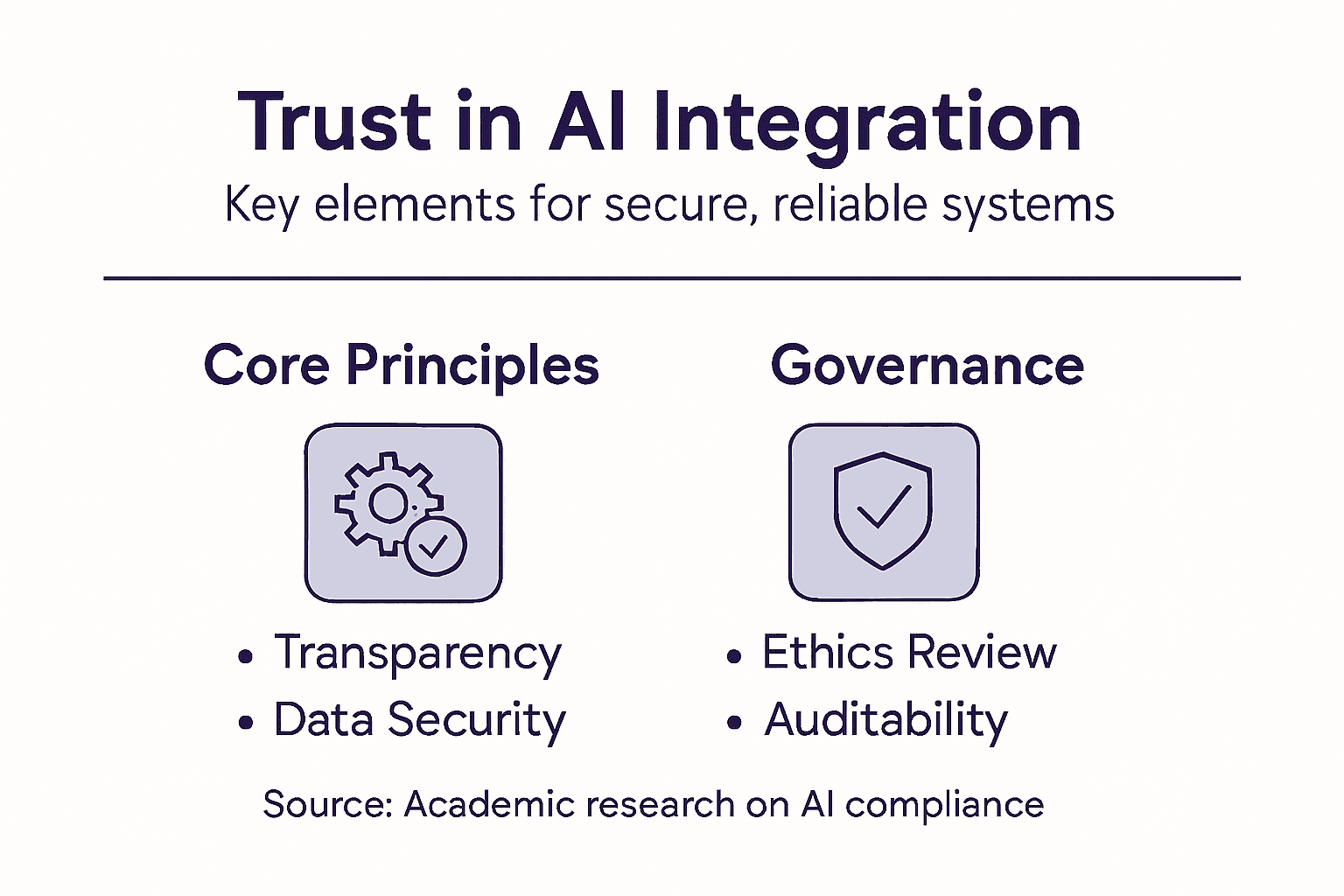
Healthcare and regulatory organizations must move beyond technical compliance, creating AI systems that are not just functionally effective but fundamentally trustworthy. This requires a holistic approach that balances technological capability with human-centered design principles.
The following table summarizes essential requirements for building trust in AI system integration:
| Trust Element | Why It Matters | Example Practice |
|---|---|---|
| Accountability | Ensures clear responsibility | Maintain operation logs |
| Security Measures | Protects against breaches | Regular system vulnerability checks |
| Transparency | Builds user and public confidence | Publish decision rationales |
| Human Oversight | Enables error correction | Human-in-the-loop review process |
Pro tip: Develop a cross-functional AI ethics review board that includes diverse perspectives to continuously evaluate and refine your organization’s AI trust and security strategies.
Transform Compliance Challenges Into Intelligent Opportunities with Agentic AI
The article highlights the growing complexity of compliance in AI automation, emphasizing risks around ethical oversight, continuous monitoring, and dynamic regulatory adherence. Organizations face critical demands for real-time risk assessment, transparent accountability, and adaptive governance frameworks to reduce operational friction and build lasting trust. If these challenges resonate with your current compliance pain points, agentic AI offers a revolutionary path forward.
At Ailerons.ai, we develop agentic AI solutions that do more than automate tasks. Our systems reason, plan, and execute multi-step workflows with context awareness and goal orientation. This means you gain a smart digital collaborator capable of handling compliance-driven processes across office and operational workflows, boosting accuracy and consistency while continuously adapting to evolving regulatory needs. With secure, compliant AI design aligned to modern standards, you can confidently integrate technology that scales without sacrificing trust or control.
Discover how to move beyond static compliance checklists toward intelligent, proactive risk management by exploring our agentic AI expertise. Take the first step to transform your compliance framework by visiting Ailerons.ai today and learn how our end-to-end workflow automation can empower your organization to reduce risk and ensure ethical AI governance.
Frequently Asked Questions
What is compliance in AI automation?
Compliance in AI automation refers to a structured approach for managing technological risks while ensuring adherence to ethical and regulatory standards in organizational workflows. It involves setting guidelines, monitoring AI behaviors, and establishing accountability frameworks.
Why is risk assessment important in AI compliance?
Risk assessment is crucial in AI compliance because it helps identify potential algorithmic biases and other risks that could affect the performance of AI systems, ensuring ethical use and adherence to regulations.
How does agentic AI improve compliance management?
Agentic AI enhances compliance management by creating adaptive frameworks that proactively identify, assess, and mitigate regulatory risks in real time, allowing for continuous evaluation and optimized governance processes.
What are key components of effective AI risk management?
Key components of effective AI risk management include data audits to check input quality, model audits to analyze decision-making processes, deployment audits for real-world performance assessment, and the establishment of clear accountability protocols.
Recommended
- Ailerons IT Consulting | Enterprise IT Solutions
- Ailerons IT Consulting | Enterprise IT Solutions
- Ailerons IT Consulting | Enterprise IT Solutions
- Ailerons IT Consulting | Enterprise IT Solutions
- Email Privacy Explained: Impact on Brand Trust – Atriomail
- Step-by-Step Guide to Compliant AI Translation Success