

Managing healthcare operations often feels like juggling a growing mix of schedules, paperwork, and compliance checks. For operations managers, these routine tasks can drain valuable time and create inefficiencies that impact patient services. The rise of agentic AI systems offers a practical way forward, delivering sophisticated workflow management with minimal oversight. This article clarifies the difference between traditional automation and agentic AI, and outlines how smart systems can transform administrative processes for healthcare organizations worldwide.
Table of Contents
- Defining Operational AI and Agentic Systems
- Categories of Agentic AI for Operations
- How Agentic AI Manages Complex Workflows
- Integrating AI with Business Systems in 2026
- Compliance, Security, and Risk Considerations
Key Takeaways
| Point | Details |
|---|---|
| Operational AI Evolution | Operational AI represents a significant shift towards autonomous intelligence, enabling proactive planning and execution with minimal human involvement. |
| Agentic AI Characteristics | Unlike traditional systems, agentic AI possesses dynamic adaptability and independent decision-making capabilities that enhance operational efficiency. |
| Workflow Management Transformation | Agentic AI allows for sophisticated workflow management through task decomposition and adaptive execution, reducing complexity and promoting agility. |
| Integration and Governance | Successful integration of agentic AI requires a comprehensive strategy addressing technical, ethical, and security considerations to enhance organizational capabilities responsibly. |
Defining Operational AI and Agentic Systems
Operational AI represents a transformative leap in technological capabilities, moving beyond traditional automation toward systems with genuine autonomous intelligence. These advanced systems go far beyond scripted responses, demonstrating the ability to proactively plan, adapt, and execute complex workflows with minimal human intervention.
Agentic AI systems fundamentally differ from traditional automation by exhibiting key characteristics that enable more sophisticated performance. Comprehensive research on agentic systems reveals two primary paradigms of operational intelligence:
-
Symbolic/Classical Systems
- Use algorithmic planning techniques
- Maintain persistent computational state
- Execute predefined logical workflows
-
Neural/Generative Systems
- Leverage stochastic generation methods
- Utilize prompt-driven orchestration
- Adapt dynamically to changing contextual information
The core distinction lies in their approach to problem-solving. Traditional AI systems operate through rigid, pre-programmed instructions, while agentic systems can:
Here’s a quick comparison of traditional automation and agentic AI for operations:
| Aspect | Traditional Automation | Agentic AI |
|---|---|---|
| Decision-Making | Follows strict rules | Makes autonomous choices |
| Adaptability | Limited context awareness | Dynamic and context-aware |
| Workflow Handling | Linear, fixed sequences | Flexible, adaptive plans |
| Human Involvement | Frequent oversight | Minimal, mainly strategic |
| Learning Ability | Static, non-learning | Learns from each cycle |
- Interpret complex contextual signals
- Generate strategic responses
- Make independent decisions
- Learn and improve from each interaction
Agentic AI represents a fundamental shift from reactive task completion to proactive, intelligent workflow management.
Healthcare operations present an ideal environment for implementing these advanced AI systems. By integrating agentic AI, organizations can transform administrative processes, reduce human error, and allocate human talent toward more strategic initiatives.

Pro tip: Start small by identifying repetitive administrative tasks with clear outcome parameters when introducing agentic AI into your operational workflow.
Categories of Agentic AI for Operations
Understanding the diverse landscape of operational AI systems requires a nuanced approach to categorization. Comprehensive typological frameworks reveal that agentic AI can be classified across multiple dimensions, reflecting the complexity of modern technological ecosystems.
Researchers have developed sophisticated models for categorizing agentic AI systems, with research highlighting distinct architectural approaches based on operational domains and system capabilities:
-
IT Operations AI
- Automated network management
- Predictive infrastructure maintenance
- Security monitoring and threat detection
-
Business Process AI
- Workflow optimization
- Resource allocation planning
- Cross-departmental coordination
-
Healthcare AI
- Patient scheduling systems
- Administrative workflow management
- Compliance documentation processing
-
Financial Operations AI
- Transaction monitoring
- Risk assessment algorithms
- Automated reporting systems
The categorization extends beyond domain specialization into deeper architectural classifications:
- Task Autonomy Level
- Reasoning Complexity
- Adaptive Capabilities
- Environmental Interaction Sophistication
Agentic AI systems are not monolithic but represent a spectrum of intelligent computational approaches tailored to specific operational requirements.
Understanding these categories helps organizations strategically implement AI solutions that align precisely with their operational objectives, enabling more intelligent and efficient workflow management.
This table summarizes how agentic AI adds value across operational domains:
| Operational Domain | Example AI Enhancement | Organizational Benefit |
|---|---|---|
| IT Operations | Predictive maintenance | Fewer outages, lower costs |
| Business Processes | Intelligent workflow automation | Higher efficiency and accuracy |
| Healthcare | Optimized scheduling | Better resource use, fewer delays |
| Finance | Automated risk detection | Improved compliance, faster reporting |
Pro tip: Assess your operational needs across multiple dimensions before selecting an agentic AI system to ensure optimal alignment with organizational goals.
How Agentic AI Manages Complex Workflows
Operational complexity demands intelligent systems capable of dynamic adaptation, and agentic AI provides unprecedented workflow management capabilities. Multi-agent collaboration strategies enable these systems to decompose intricate tasks with remarkable precision and autonomy.
The workflow management process in agentic AI involves several sophisticated mechanisms:
-
Task Decomposition
- Breaking complex processes into manageable subtasks
- Dynamic goal reallocation
- Continuous progress tracking
-
Contextual Memory Management
- Retaining relevant historical information
- Adapting strategies based on past performance
- Maintaining comprehensive workflow context
-
Adaptive Execution
- Real-time plan modification
- Autonomous decision-making
- Handling unexpected operational challenges
Autonomous goal pursuit frameworks reveal how these systems operate through interconnected stages:
- Data Collection and Analysis
- Strategic Decision Processing
- Execution and Monitoring
- Continuous Learning and Refinement
Agentic AI transforms workflow management from rigid, linear processes to dynamic, intelligent ecosystems of continuous adaptation.
By leveraging advanced reasoning capabilities, these systems can navigate uncertainty, coordinate multiple computational agents, and maintain operational effectiveness with minimal human intervention.
Pro tip: Implement incremental testing and gradual system integration to effectively validate and optimize your agentic AI workflow management strategies.
Integrating AI with Business Systems in 2026
The integration of agentic AI with enterprise systems represents a transformative leap in organizational capabilities. Enterprise AI integration strategies are fundamentally reshaping how businesses approach workflow automation and operational efficiency.
Successful AI integration requires a comprehensive approach across multiple organizational domains:
-
IT Infrastructure
- Seamless system compatibility
- Secure API connections
- Scalable architectural frameworks
-
Operational Workflows
- Automated process optimization
- Real-time performance monitoring
- Dynamic task reallocation
-
Data Management
- Centralized information repositories
- Intelligent data processing
- Continuous learning mechanisms
Vertical AI agent deployment involves critical integration components:
- Orchestration layer development
- API integration protocols
- Continuous learning modules
- Performance validation frameworks
Agentic AI integration is not about replacing human workers, but augmenting organizational capabilities through intelligent automation.
By 2026, organizations will need robust strategies that balance technological innovation with practical implementation, ensuring seamless AI adoption across complex business ecosystems.
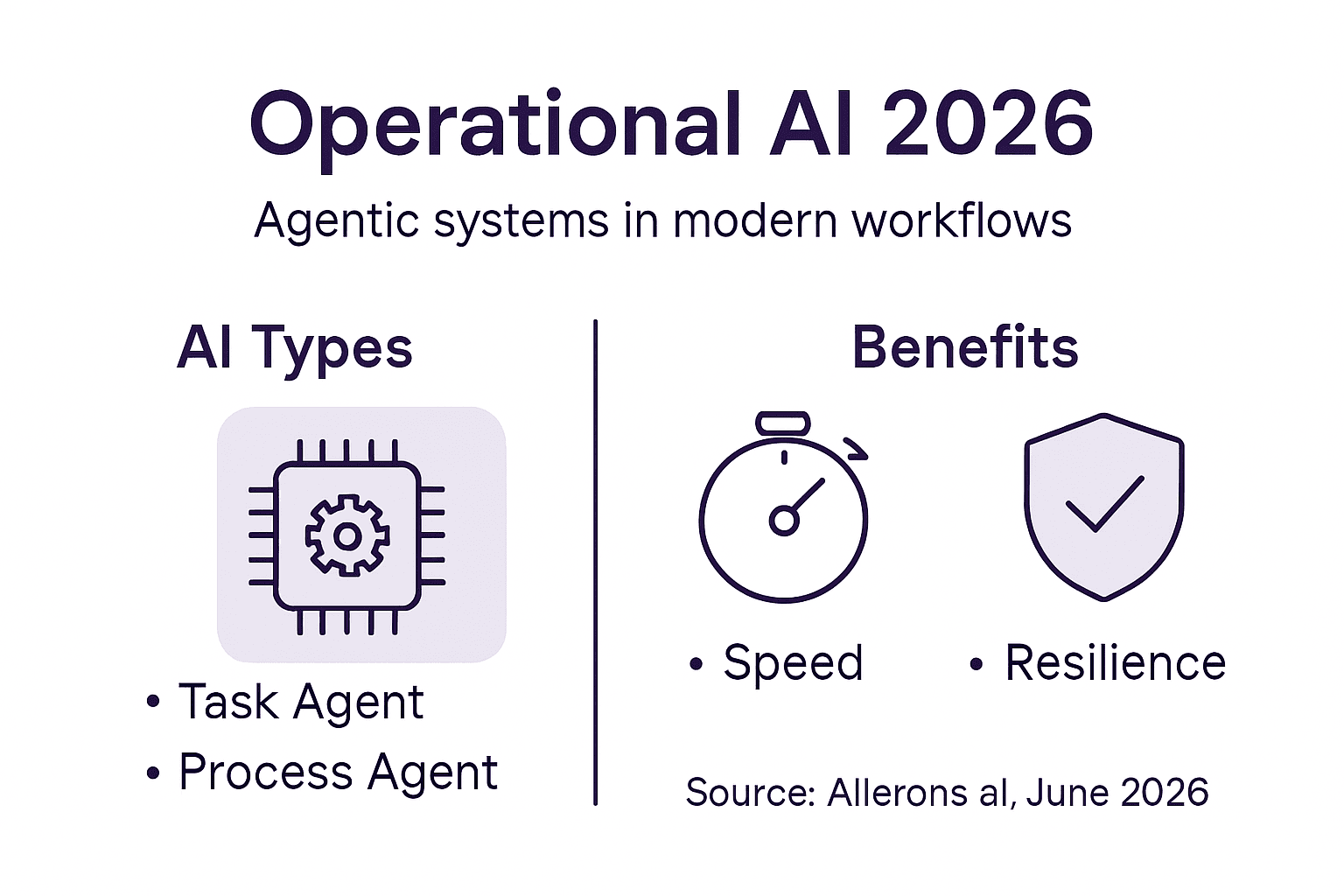
Pro tip: Develop a phased integration roadmap that starts with low-risk, high-value operational areas to build organizational AI integration confidence.
Compliance, Security, and Risk Considerations
Navigating the complex landscape of agentic AI governance requires a comprehensive approach to managing organizational risks and maintaining robust security protocols. Best practices for governing agentic systems emphasize the critical need for proactive risk management and continuous monitoring.
Key compliance and security considerations include:
-
Operational Risk Management
- Task suitability evaluation
- Action space constraints
- Behavioral legibility
- Continuous performance monitoring
-
Data Protection
- Encryption protocols
- Access control mechanisms
- Data anonymization techniques
- Regulatory compliance frameworks
-
Ethical Governance
- Transparent decision-making processes
- Human oversight mechanisms
- Bias detection and mitigation
- Accountability frameworks
Security frameworks for small enterprises recommend implementing comprehensive risk mitigation strategies:
- Develop robust incident response protocols
- Establish clear accountability mechanisms
- Implement continuous monitoring systems
- Align with international regulatory standards
Effective agentic AI governance balances technological innovation with rigorous safety and ethical considerations.
Organizations must adopt a holistic approach that addresses technical, legal, and ethical dimensions of autonomous AI systems, ensuring responsible and secure implementation.
Pro tip: Create a cross-functional governance team that combines technical expertise, legal knowledge, and ethical oversight to develop comprehensive AI risk management strategies.
Unlock the Power of Agentic AI to Transform Your Business Operations
The article highlights the challenges of managing complex workflows with traditional automation that lacks adaptability and autonomous decision-making. If you are facing operational inefficiencies, limited context awareness, and frequent human oversight, then agentic AI offers the breakthrough you need. By understanding concepts such as dynamic task decomposition, strategic decision processing, and continuous learning, you can move beyond rigid scripted bots to AI systems that reason, plan, and act independently.
At Ailerons.ai, we specialize in deploying agentic AI designed to seamlessly integrate with your existing business systems, empowering your teams with intelligent orchestration across administrative, billing, scheduling, and compliance workflows. Our solutions reduce operational friction, improve accuracy, and enable scalability without increasing headcount.
Discover how you can begin the shift from reactive task execution to proactive autonomous collaboration by exploring agentic AI architecture and deployment and learn about our secure, compliant integration strategies. Take the first step to future-proof your operations and achieve exceptional efficiency today by visiting Ailerons.ai. Start your transformation now for a competitive edge in 2026 and beyond.
Frequently Asked Questions
What is operational AI, and how do agentic systems differ from traditional automation?
Operational AI refers to intelligent systems that automate complex workflows and make autonomous decisions with minimal human intervention. Agentic systems differ from traditional automation by being context-aware, adaptable, and capable of making independent choices rather than simply following pre-programmed rules.
How can agentic AI enhance operational efficiency in businesses?
Agentic AI can optimize workflows, reduce human error, and improve decision-making processes across various organizational domains, such as IT operations, business processes, and healthcare. By learning from interactions and making real-time adaptations, these systems streamline operations and enhance overall efficiency.
What are the key components to consider when integrating agentic AI into existing business systems?
Key components for successful integration include ensuring system compatibility, developing secure API connections, optimizing operational workflows, and managing data effectively. A phased approach starting with low-risk areas is recommended for building confidence in AI integration.
What compliance and security measures should organizations implement for agentic AI?
Organizations should focus on operational risk management, data protection measures like encryption and access control, and ethical governance strategies to oversee decision-making processes. Continuous monitoring and adherence to regulatory standards are crucial for ensuring safe and responsible AI deployment.
Recommended
- Ailerons IT Consulting | Enterprise IT Solutions
- Ailerons IT Consulting | Enterprise IT Solutions
- Ailerons IT Consulting | Enterprise IT Solutions
- Ailerons IT Consulting | Enterprise IT Solutions
- 7 types de transformation digitale à connaître en entreprise