

Managing administrative workflows in healthcare often involves juggling complex tasks across multiple systems while maintaining compliance and efficiency. The rapid shift toward advanced agentic AI is changing how organizations approach these challenges, blending intelligent automation with adaptive, real-time problem-solving. This article highlights how agentic AI systems empower healthcare operations managers to optimize processes, enhance collaboration, and reduce manual workload through autonomous, context-aware technologies.
Table of Contents
- Agentic AI In Business Process Management Explained
- Types Of Agentic AI Systems For Office Operations
- How Agentic AI Transforms Workflow Automation
- Integrating AI Agents With Business Platforms
- Ensuring Security, Compliance, And Human Oversight
- Risks, Costs, And Common Implementation Challenges
Key Takeaways
| Point | Details |
|---|---|
| Agentic AI Redefines BPM | Agentic AI systems shift Business Process Management from static rule-based automation to dynamic, intelligent ecosystems that enhance human-machine collaboration. |
| Governance and Ethics are Crucial | Implementing agentic AI requires robust governance frameworks to ensure transparency, accountability, and ethical compliance throughout operational processes. |
| Plan for Integration Challenges | Successful integration of AI agents with existing platforms necessitates careful consideration of compatibility, security, and scalability to optimize performance and minimize risks. |
| Address Financial and Cultural Barriers | Organizations must prepare for initial financial investments and cultural resistance while viewing implementation challenges as opportunities for transformation. |
Agentic AI in Business Process Management Explained
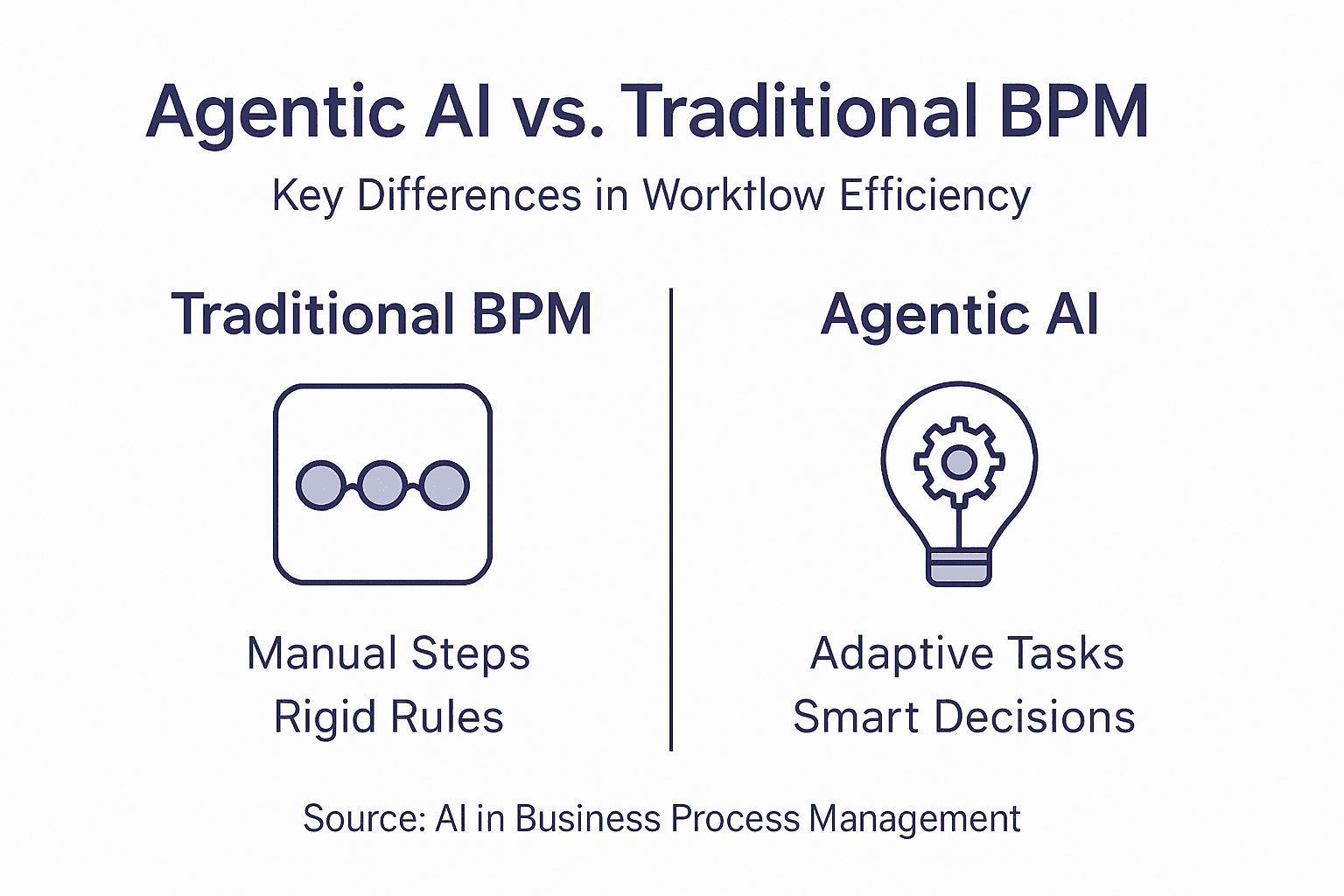
Business Process Management (BPM) is undergoing a profound transformation through agentic AI systems that shift traditional automation paradigms toward autonomous, intelligent process management. Unlike conventional workflow tools, agentic AI introduces adaptive decision-making capabilities that fundamentally reimagine how organizations handle complex operational tasks.
Agentic AI represents a significant leap beyond rule-based automation by integrating advanced cognitive capabilities. These intelligent systems can sense, reason, and learn, enabling them to autonomously manage process states and dynamically optimize performance. Key characteristics of agentic AI in business process management include:
- Independent decision-making without constant human intervention
- Adaptive learning and continuous process optimization
- Contextual understanding of complex organizational workflows
- Real-time problem-solving and exception handling
- Intelligent collaboration between human teams and AI systems
Agentic AI transforms business process management from a static, rules-driven approach to a dynamic, intelligent ecosystem of human-machine collaboration.
Hybrid human-AI collaboration emerges as a critical framework where AI systems complement human expertise. This approach doesn’t replace human workers but empowers them by handling repetitive, complex tasks with unprecedented speed and accuracy. AI agents can continuously analyze process performance, identify bottlenecks, and recommend strategic improvements.
Governance and ethical considerations become paramount in implementing agentic AI systems. Organizations must develop robust frameworks that ensure transparency, accountability, and alignment with strategic objectives. This requires a multidisciplinary approach involving technical experts, process managers, and ethical oversight teams.
Pro tip: Start small by identifying one repetitive, data-intensive process in your organization where an agentic AI system could demonstrate immediate value and minimal risk.
Here’s a comparison of traditional workflow tools versus agentic AI systems in business process management:
| Aspect | Traditional Workflow Tools | Agentic AI Systems |
|---|---|---|
| Automation Style | Rule-based scripts | Adaptive, intelligent actions |
| Human Involvement | Frequent supervision | Minimal intervention |
| Adaptability | Static processes | Dynamic optimization |
| Problem Handling | Predefined responses | Real-time exception resolution |
| Collaboration | Limited with humans | Seamless human-AI teamwork |
Types of Agentic AI Systems for Office Operations
Agentic AI systems in office operations have evolved into sophisticated frameworks with diverse capabilities and complexity levels. Interconnected autonomous agents now collaborate to transform traditional workplace productivity, offering unprecedented operational flexibility and intelligence.
These systems can be categorized into several distinct types based on their functionality and autonomy:
- Generative Workflow Agents: Create and modify process documentation
- Decision Support AI: Analyze complex data and recommend strategic actions
- Collaborative Coordination Systems: Manage cross-departmental communication
- Compliance and Governance AI: Monitor and ensure regulatory adherence
- Predictive Performance Agents: Forecast operational bottlenecks and efficiency opportunities
Automated workflow managers represent a critical subset of agentic AI systems, capable of executing multistep tasks with minimal human intervention. These intelligent systems operate across a spectrum of autonomy, ranging from human-assisted automation to fully independent process execution.
Agentic AI systems are not replacements for human workers, but powerful collaborative tools that augment and enhance human capabilities.
The sophistication of these systems varies significantly. Conversational AI agents can interpret context, engage in nuanced communication, and execute complex instructions. Meanwhile, data quality improvement agents continuously validate and refine organizational information, ensuring accuracy and reliability.
Implementing these systems requires careful strategic planning, focusing on compatibility with existing technological infrastructure and alignment with organizational goals. Technical teams must assess each system’s learning capabilities, integration potential, and long-term scalability.
Pro tip: Conduct a comprehensive audit of your current workflow processes to identify specific areas where agentic AI can provide the most immediate and measurable improvements.
How Agentic AI Transforms Workflow Automation
Agentic AI is revolutionizing workflow automation by fundamentally reshaping how organizations approach complex operational processes. Unlike traditional automation tools that follow rigid, predefined scripts, these intelligent systems can dynamically plan, learn, and adapt in real-time, creating a more responsive and intelligent workflow ecosystem.
The transformation of workflow automation through agentic AI involves several critical capabilities:
- Autonomous Decision Making: Independent problem-solving without constant human oversight
- Adaptive Learning: Continuous process optimization based on real-time performance data
- Contextual Intelligence: Understanding nuanced business environments and operational constraints
- Proactive Workflow Modification: Automatically adjusting processes to improve efficiency
- Cross-System Integration: Seamlessly coordinating tasks across multiple organizational platforms
Autonomous enterprise resource planning represents a significant breakthrough in workflow automation. These systems can interpret complex data streams, initiate strategic actions, and adapt to changing business conditions without requiring constant human intervention.
Agentic AI transforms workflow automation from a mechanical process into an intelligent, self-optimizing ecosystem.
The most profound impact emerges in hybrid human-AI collaboration models. Intelligent workflow agents don’t replace human workers but augment their capabilities by handling repetitive, complex tasks with unprecedented precision and speed. They can analyze intricate patterns, predict potential bottlenecks, and recommend strategic improvements that human managers might overlook.

Implementing these advanced systems requires a strategic approach that balances technological capabilities with organizational readiness. Technical teams must carefully assess integration potential, develop robust governance frameworks, and create clear guidelines for human-AI interaction.
Pro tip: Begin your agentic AI workflow transformation by piloting the technology in a low-risk, well-defined operational process to demonstrate value and build organizational confidence.
Integrating AI Agents with Business Platforms
Robust governance frameworks are critical when integrating AI agents with existing business platforms. This process goes beyond simple technological implementation, requiring a strategic approach that balances technological capabilities with organizational readiness and risk management.
Successful integration involves several key considerations:
- Platform Compatibility: Ensuring seamless technical interoperability
- Security Protocols: Implementing rigorous access and data protection mechanisms
- Customization Capabilities: Adapting AI agent behaviors to specific organizational needs
- Scalability Potential: Designing integration frameworks that support future growth
- Performance Monitoring: Establishing continuous evaluation and optimization processes
Enterprise system interfacing represents a complex challenge that demands sophisticated technical and organizational alignment. AI agents must be carefully configured to interact with workflow engines, enterprise resource planning systems, and data analytics platforms while maintaining security and operational integrity.
Successful AI agent integration requires viewing these systems as collaborative partners, not just technological tools.
The integration process involves creating intelligent middleware layers that enable smooth communication between AI agents and existing business platforms. These middleware solutions act as translation and coordination mechanisms, allowing AI systems to understand and interact with legacy enterprise software while maintaining data integrity and operational consistency.
Organizations must develop comprehensive implementation strategies that address technical, cultural, and governance challenges. This includes creating clear guidelines for human-AI collaboration, establishing ethical frameworks, and developing robust training programs that help employees understand and work effectively alongside intelligent agents.
Pro tip: Start your AI agent integration with a pilot project in a well-defined, low-risk operational area to demonstrate value and build organizational confidence.
Below is a summary of planning priorities for integrating agentic AI with business platforms:
| Priority Area | Why It Matters | Planning Action |
|---|---|---|
| Platform Compatibility | Prevents integration failures | Map current system interfaces |
| Security Protocols | Protects sensitive data | Enforce access controls |
| Customization | Aligns AI with goals | Define process-specific rules |
| Scalability | Supports future demands | Choose modular solutions |
| Performance Monitoring | Ensures ongoing value | Set up evaluation metrics |
Ensuring Security, Compliance, and Human Oversight
Comprehensive governance frameworks are essential when deploying agentic AI systems in business environments. These frameworks must balance technological autonomy with robust security protocols, ensuring that intelligent agents operate within carefully defined ethical and operational boundaries.
Key security and compliance considerations include:
- Access Control: Implementing multi-layered authentication mechanisms
- Data Privacy: Protecting sensitive organizational and customer information
- Algorithmic Transparency: Enabling clear understanding of AI decision-making processes
- Continuous Monitoring: Establishing real-time threat detection systems
- Ethical Guidelines: Creating clear boundaries for AI agent behavior
Hybrid human-AI collaboration models represent a critical strategy for maintaining accountability. These approaches ensure that human oversight remains a central component of AI-driven processes, allowing for immediate intervention and strategic guidance.
Effective AI governance is not about restricting technology, but about creating intelligent, adaptive control mechanisms.
The risk mitigation strategy involves developing comprehensive fallback protocols that allow immediate human intervention. This includes creating transparent decision trails, establishing clear escalation procedures, and implementing automatic pause mechanisms when AI systems detect potential anomalies or ethical breaches.
Organizations must invest in developing sophisticated oversight infrastructure that combines technological safeguards with human expertise. This involves creating specialized teams trained in AI governance, developing advanced monitoring tools, and establishing clear ethical frameworks that guide AI agent behavior.
Pro tip: Develop a comprehensive AI governance charter that clearly defines acceptable behaviors, decision-making boundaries, and intervention protocols before deploying any agentic AI system.
Risks, Costs, and Common Implementation Challenges
Complex implementation challenges underscore the critical need for strategic planning when adopting agentic AI systems. Organizations must navigate a sophisticated landscape of technological, financial, and organizational obstacles that can significantly impact successful deployment.
Key risks and implementation challenges include:
- Financial Investment: High initial infrastructure and training costs
- Technical Complexity: Intricate system integration requirements
- Stakeholder Resistance: Cultural barriers to AI adoption
- Performance Uncertainty: Unpredictable AI system behaviors
- Cybersecurity Vulnerabilities: Potential operational risk exposures
Comprehensive risk management strategies are essential for mitigating potential disruptions. These strategies must address technological limitations, human resource adaptation, and the potential for unintended consequences in AI-driven workflows.
Successful agentic AI implementation requires viewing challenges as opportunities for organizational transformation, not insurmountable barriers.
The cost structure of implementing agentic AI systems extends beyond immediate technological investments. Organizations must factor in ongoing expenses such as continuous training, system updates, governance frameworks, and potential workforce reskilling initiatives.
Technical teams must develop robust contingency planning that includes detailed risk assessment, periodic system audits, and flexible adaptation mechanisms. This approach ensures that AI implementations remain aligned with organizational objectives while maintaining operational resilience.
Pro tip: Conduct a comprehensive organizational readiness assessment before AI deployment, identifying potential technical, cultural, and operational challenges specific to your business context.
Unlock True Efficiency in Business Process Management with Agentic AI
The article highlights critical challenges businesses face with traditional workflow tools, such as limited adaptability, frequent human supervision, and static processes. These pain points often lead to operational friction, inefficiency, and slow decision-making. The shift toward agentic AI systems promises adaptive learning, autonomous decision-making, and seamless human-AI collaboration, transforming complex workflows into intelligent, self-optimizing ecosystems.
At Ailerons.ai, we specialize in these advanced agentic AI solutions that go beyond rigid automation. Our technology enables your organization to reason, plan, and execute multi-step tasks across business operations with minimal intervention. From coordinating schedules and managing compliance-driven workflows to integrating with your existing CRM, ERP, and accounting platforms, our systems reduce operational friction and boost accuracy.
Ready to move your business past static automation toward intelligent, autonomous process management? Discover how our agentic AI architecture and deployment can empower your workforce and scale efficiency without proportional staff increases. Learn more about transforming your front-office and administrative workflows through end-to-end automation and experience the future of business process management today.
Frequently Asked Questions
What is agentic AI in business process management?
Agentic AI refers to intelligent systems that autonomously manage and optimize business processes by integrating advanced cognitive capabilities, allowing for independent decision-making, adaptive learning, and collaboration with human teams.
How does agentic AI improve workflow automation?
Agentic AI enhances workflow automation by enabling real-time decision-making, adaptive learning, contextual understanding, and proactive modifications to processes, transforming static automation into a dynamic and responsive ecosystem.
What are the key types of agentic AI systems for office operations?
Key types of agentic AI systems include generative workflow agents, decision support AI, collaborative coordination systems, compliance and governance AI, and predictive performance agents, each serving specific functions to enhance office productivity.
What are the main challenges in implementing agentic AI in business?
Key challenges include high financial investments, technical complexity in system integration, cultural resistance from stakeholders, unpredictable performance, and cybersecurity vulnerabilities, necessitating comprehensive planning and risk management strategies.
Recommended
- Ailerons IT Consulting | Enterprise IT Solutions
- Ailerons IT Consulting | Enterprise IT Solutions
- Ailerons IT Consulting | Enterprise IT Solutions
- Ailerons IT Consulting | Enterprise IT Solutions
- Role of Automation in Email Hosting – Enhancing Efficiency and Scale – Atriomail
- AMO immobilier vs IA : l’illusion dangereuse de l’optimisation parfaite