

Regulations from the United States, European Union, and Asia place heavy demands on every compliance operation. Many financial services firms are buried in document workflows with layers of approvals and complex audit requirements. Agentic AI compliance means autonomous workflows that still maintain transparency and accountability. This guide shows how to assess your compliance needs, architect secure integrations, and validate AI performance so your operation meets global standards with human oversight intact.
Table of Contents
- Step 1: Assess Workflow Requirements And Compliance Needs
- Step 2: Design Agentic AI Architecture For Target Processes
- Step 3: Integrate AI With Document And Business Systems
- Step 4: Test And Validate Automated Workflow Performance
Quick Summary
| Key Point | Explanation |
|---|---|
| 1. Assess Workflows and Compliance Needs | Map current compliance workflows and regulatory obligations to identify areas for AI integration and necessary human oversight. |
| 2. Design AI Architecture for Compliance | Create an AI architecture that defines decision logic, governance layers, and transparency for regulatory adherence and effective exception handling. |
| 3. Integrate AI with Business Systems | Ensure AI connects with existing systems to access essential data and maintain compliance while upholding data security and accessibility. |
| 4. Test AI Performance Rigorously | Conduct structured testing to validate decision accuracy, compliance with regulations, and ability to handle exceptions before full deployment. |
| 5. Establish Clear Success Metrics | Define what success looks like for compliance improvements early on to measure AI performance against specific objectives. |
Step 1: Assess Workflow Requirements and Compliance Needs
Before deploying agentic AI into your compliance operations, you need a clear picture of what your workflows actually look like and where regulatory requirements apply. This assessment phase prevents costly missteps and ensures your AI system operates within proper guardrails from day one.
Start by mapping your current compliance workflows end to end. Document every step involved in your high-volume processes—whether that’s KYC reviews, transaction monitoring, policy updates, or regulatory reporting. Identify which tasks consume the most time and which ones carry the highest compliance risk.
Look for these critical workflow characteristics:
- Task complexity: Which steps require judgment calls versus pure data processing?
- Data sources: Where does information come from, and how many systems are involved?
- Decision points: Where do humans currently need to intervene or approve actions?
- Handoff dependencies: Which teams wait on output from other teams?
- Exception handling: How do you manage edge cases or flagged items?
Next, audit your compliance obligations across all relevant jurisdictions. Regulatory requirements for AI systems now span data privacy, transparency, and accountability for autonomous decisions. Map regulations like GDPR, HIPAA, SOX, or local requirements to specific workflows. Identify where you need continuous audit trails, explainability, or human approval loops.
Identify your data privacy and security boundaries. Agentic AI systems need to understand what data they can access, where it can flow, and what restrictions apply. Document sensitivity levels and any cross-border data movement constraints.
Assess your current control environment. Where do you have strong controls already? Which areas lack visibility or consistency? Understanding your baseline helps you design AI governance that actually reinforces compliance instead of creating blind spots.
Your assessment should reveal not just what tasks AI can automate, but which tasks need human judgment and which governance safeguards must stay in place.
Define success metrics early. What does compliance improvement look like for your operation? Faster processing times? Fewer missed flags? Better audit readiness? Clearer decision reasoning? Anchor your goals here because you’ll measure against them later.
Here’s a quick reference for mapping workflow steps to compliance needs:
| Workflow Phase | Typical Compliance Focus | Guiding Question |
|---|---|---|
| Data Collection | Privacy, Data Minimization | What data is essential to collect? |
| Decision Making | Transparency, Explainability | How is each decision justified? |
| Exception Handling | Accountability, Auditability | Are special cases properly logged? |
| Task Handoffs | Consistency, Authorization | Who needs to approve transfers? |
Pro tip: Create a compliance requirements matrix that cross-references each workflow step against specific regulations and data handling rules—this becomes your blueprint for configuring AI guardrails and approval workflows.
Step 2: Design Agentic AI Architecture for Target Processes
Now that you understand your workflows and compliance requirements, it’s time to design the AI system that will execute them. Your architecture blueprint determines how the AI makes decisions, stays within compliance boundaries, and handles exceptions when they arise.

Start by defining the core decision logic for your target processes. What information does the AI need to assess before taking action? For KYC reviews, this might include customer risk scoring, document verification, and sanction list matching. For transaction monitoring, it could involve behavioral analysis, threshold detection, and pattern recognition. Map these decision points clearly so you know exactly what reasoning the AI must perform.
Design your governance and control layers. Agentic AI architecture integrates autonomous decision-making with real-time feedback to ensure alignment with policies and regulations. Your system needs to know which decisions it can make independently and which require human approval. Define escalation rules explicitly.
Consider these architectural components:
- Data integration points: Which systems does the AI read from, and how frequently?
- Decision boundaries: Where does the AI stop and require human judgment?
- Audit logging: What actions and reasoning must be recorded for compliance proof?
- Exception handling: How does the system flag unusual situations?
- Feedback loops: How does the AI learn from human corrections and regulatory changes?
Build in transparency from the start. Your compliance team needs to understand why the AI made each decision. Design the system to capture and document reasoning for every action, especially high-risk decisions. This becomes your defense if regulators question the system’s judgment.
Define your approval workflows carefully. Some decisions can be fully automated. Others need a single approval. Critical decisions might need multiple stakeholders. Map this explicitly in your architecture so there’s no ambiguity during deployment.
Compare automated versus human-in-the-loop AI workflows:
| Workflow Style | Main Advantage | Ideal For |
|---|---|---|
| Fully Automated AI | Fastest processing, low overhead | Routine, low-risk compliance tasks |
| Human-in-the-Loop AI | Strong oversight, nuanced review | High-risk or judgment-driven tasks |
Strong agentic AI architecture separates what the system can decide autonomously from what needs human oversight, with clear reasoning captured at every step.
Plan for continuous adaptation. Compliance rules change. Market conditions shift. Your architecture should allow the AI to update its policies and decision logic without requiring a complete redesign.
Pro tip: Document your architecture as decision trees and process flows that your compliance team can validate before you code anything—this prevents expensive rework after deployment.
Step 3: Integrate AI With Document and Business Systems
Your agentic AI system needs access to the data and tools your compliance team actually uses. Integration is where architecture becomes real, connecting your AI to document repositories, case management platforms, databases, and approval workflows. Without proper integration, your AI sits isolated and powerless.
Start by cataloging your critical business systems. Which platforms hold customer data, transaction records, and compliance documents? Map out your CRM, ERP, document management system, banking core, and any specialized compliance tools. Identify the key data flows between these systems and where the AI needs to read or write information.
Design your data access patterns carefully. The AI needs read access to customer profiles, transaction history, regulatory databases, and policy documents. For many processes, it also needs write access to update case statuses, log decisions, or file reports. But access must be controlled. Enterprise agentic automation integrates AI agents with business applications through orchestrated workflows, enabling data extraction and regulatory reporting while maintaining secure data sharing and governance.
Prioritize these integration points:
- Document repositories: Where are contracts, policies, and customer files stored?
- Transaction systems: How does the AI access transaction data and historical records?
- Approval platforms: Which systems handle case routing and human sign-off?
- Data warehouses: Where can the AI pull analytics and reporting data?
- Regulatory databases: How does it access sanction lists, watch lists, and compliance rules?
Address authentication and access control upfront. Your AI should authenticate securely, use role-based permissions, and maintain audit trails of every data access. This protects sensitive information and gives regulators proof that the system respects data boundaries.
Test integration in a controlled environment first. Create test datasets that let you verify the AI can read and write correctly without touching production data. Run end-to-end workflows in a sandbox before going live.
Proper integration means the AI accesses only the data it needs, records every action it takes, and escalates to humans when it encounters situations outside its authority.
Build in error handling for integration failures. What happens if the AI cannot reach a critical system? Design your workflows so the system gracefully degrades, notifies administrators, and queues work for manual processing if needed.
Pro tip: Use API gateways and middleware layers between your AI and core systems—this gives you flexibility to update integrations without retraining your AI model.
Step 4: Test and Validate Automated Workflow Performance
Before your agentic AI touches real compliance work, you need proof it performs reliably and makes sound decisions. Testing is not optional. It is your protection against costly errors, regulatory violations, and loss of stakeholder trust.
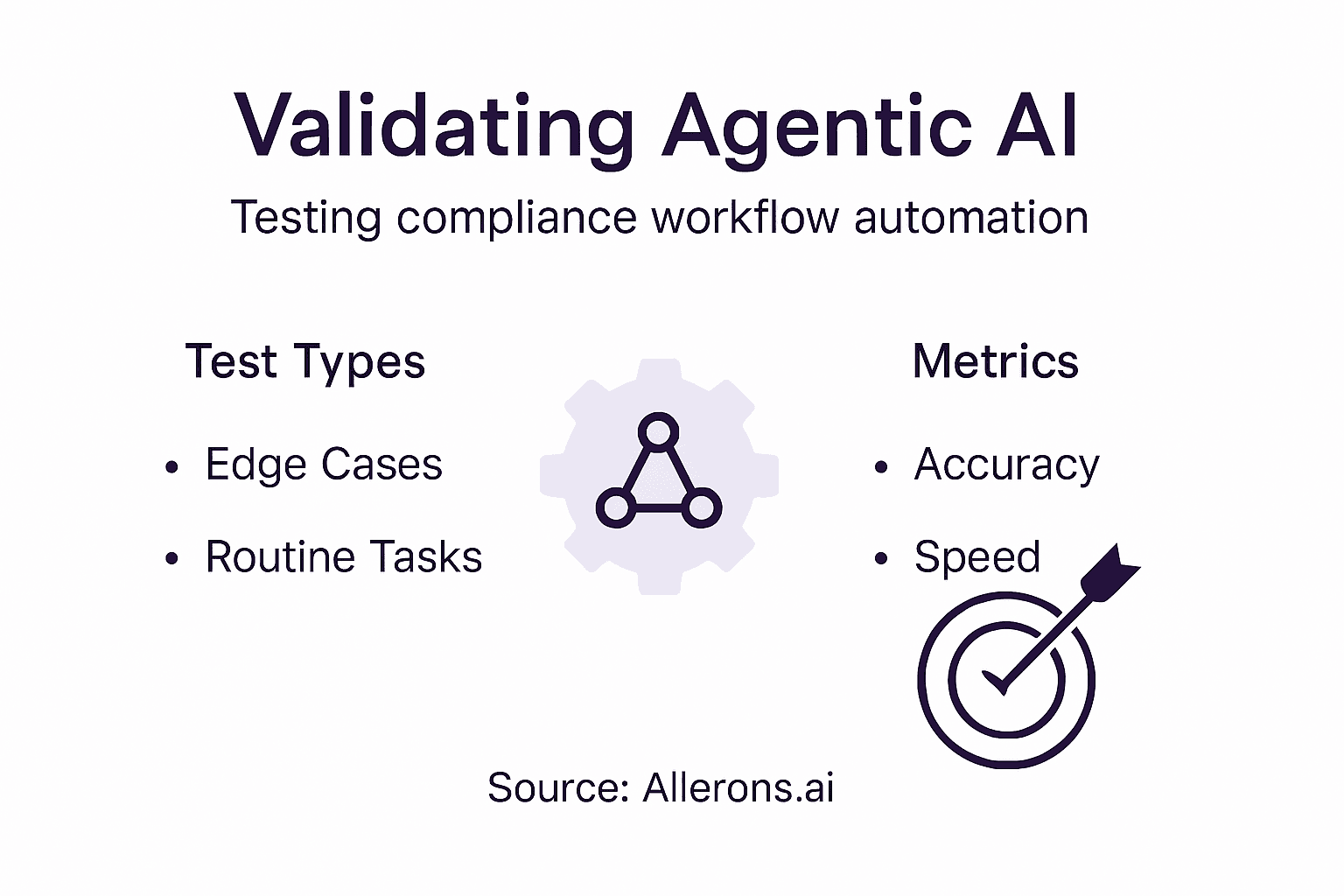
Start with structured test scenarios that cover your most common workflows plus edge cases. Run your AI through normal transaction processing, unusual customer profiles, high-risk situations, and system failures. Include scenarios where the AI should escalate to humans and situations where it should decide independently. Document expected outcomes for each scenario before testing begins.
Focus heavily on decision quality. Effective validation of agentic automation includes structured testing for security, scalability, and verification of AI decision rationale. For every decision the AI makes, verify that the reasoning is sound and defensible. Can your compliance team explain why the AI rejected a customer or flagged a transaction? If not, that decision fails validation.
Build your testing plan around these areas:
- Accuracy testing: Does the AI identify risk correctly across diverse scenarios?
- Consistency testing: Does it make the same decision for similar cases every time?
- Compliance testing: Does it follow all regulatory requirements and internal policies?
- Integration testing: Does it read data correctly from all connected systems?
- Exception handling: Does it gracefully handle system failures and edge cases?
- Performance testing: Can it handle your expected volume without bottlenecks?
Involve your compliance team in validation. They understand the nuances of your policies better than anyone. Have them review test results, challenge the AI’s decisions, and identify blind spots you may have missed during design.
Create detailed audit trails during testing. Human oversight checkpoints and tamper-proof audit trails are crucial for regulatory acceptance, ensuring workflows align with organizational policies and external regulations. Document every decision, the data inputs, the reasoning, and the outcome.
Validation succeeds when your compliance team confidently says, “I understand this decision, I trust this reasoning, and I would make the same call.”
Set clear pass-fail criteria before testing starts. What accuracy rate do you need? What percentage of decisions require human review? What performance targets must you hit? Document these standards so you have objective measures of readiness.
Pro tip: Run a parallel pilot where your AI processes a sample of real cases alongside your current manual process, then compare decisions side-by-side to identify where your AI needs adjustment before full deployment.
Unlock True Compliance Efficiency with Agentic AI
The challenge of automating complex compliance workflows requires more than simple bots or rigid scripts. As highlighted in the article “Process Automation Tutorial for Agentic AI in Compliance Workflows,” organizations must design AI systems that understand decision logic, maintain audit trails, and balance automation with human oversight. Pain points like managing exception handling, integrating multiple data sources, and ensuring transparent decision-making are critical to overcome.
At Ailerons.ai, we specialize in creating agentic AI solutions that reason, plan, and execute multi-step compliance tasks with precision and context awareness. Our systems seamlessly integrate with your existing business platforms and enforce secure, compliant processes aligned with regulations. With capabilities designed for end-to-end workflow automation, you can reduce operational friction, improve audit readiness, and scale your compliance efforts confidently.
Ready to transform your compliance operations from rule-based scripts to autonomous digital collaborators? Explore how our agentic AI architecture and deployment empowers your team to automate intelligently while maintaining strict governance. Visit Ailerons.ai today and start building your compliant AI-powered future.
Frequently Asked Questions
What are the first steps to assess compliance workflows for agentic AI?
Start by mapping your current compliance workflows to understand each task and where regulatory requirements apply. Document high-volume processes and identify areas that consume the most time or carry the highest compliance risk to ensure accurate AI deployment.
How can I determine which tasks within compliance workflows agents can automate?
Analyze your workflows by identifying tasks that involve pure data processing versus those that require human judgment. Focus on mapping decision points and areas needing human intervention to clarify where automation can be applied effectively.
What key compliance regulations should I consider when designing agentic AI systems?
You should consider regulations such as GDPR, HIPAA, SOX, and any local requirements that might affect your operational workflows. Audit your compliance obligations and ensure that your AI system incorporates necessary audit trails, data privacy measures, and human approval loops.
How do I integrate agentic AI with existing business systems?
Catalog all critical business systems that hold relevant data for compliance, such as CRM and transaction records. Design data access patterns to ensure the AI has the necessary permissions to read and write data while maintaining secure data sharing and governance.
What metrics should I focus on when validating the performance of agentic AI in compliance tasks?
Focus on metrics such as accuracy, consistency, compliance with regulations, and the efficiency of integration with existing systems. Set clear pass-fail criteria for testing to ensure that the AI meets defined performance standards, aiming for accurate decision-making in at least 90% of scenarios.
How can I ensure that the decisions made by agentic AI are reliable and defensible?
Establish a robust testing plan that includes structured scenarios to assess decision quality. Ensure that every decision made by the AI is logged with documented reasoning, which allows your compliance team to validate and understand AI decisions confidently.