

Operations managers wrestling with mounting administrative overhead face a stark reality: manual workflows consume up to 40% more time than necessary. Agentic AI orchestrates complex workflows autonomously by integrating reasoning, planning, and decision logic, transforming how mid-sized companies handle everything from approvals to document processing. This guide reveals how agentic AI differs from traditional automation, delivers measurable efficiency gains, and integrates seamlessly with your existing systems to reduce friction and scale operations without adding headcount.
Table of Contents
- Efficiency And Productivity Gains From Agentic Ai
- Comparing Agentic Ai And Traditional Automation
- Integration Capabilities And Benefits
- Common Misconceptions About Ai In Workflow Automation
- Security And Compliance In Ai Workflow Automation
- Practical Implementation Considerations For Operations Managers
- Use Cases And Examples In Office And Administrative Workflows
- Discover Agentic Ai Solutions For Your Workflows
- Frequently Asked Questions About Agentic Ai In Workflow Automation
Key takeaways
| Point | Details |
|---|---|
| Autonomous multi-step workflows | Agentic AI executes end-to-end processes across CRM, ERP, scheduling, and accounting platforms without human intervention. |
| Measurable efficiency gains | Reduces manual task time by 40%, improves accuracy by 30%, and accelerates decision turnaround by 20%. |
| Dynamic exception handling | Adapts to workflow variations and escalates issues intelligently, unlike rigid traditional automation scripts. |
| Enhanced data consistency | Boosts cross-platform data accuracy by 25% through seamless integration and automated synchronization. |
| Compliance-ready architecture | Aligns with ISO/IEC 27001 and SOC 2 standards, maintaining audit trails and secure sensitive data handling. |
Introduction to agentic AI and workflow automation
Agentic AI represents a fundamental shift from task-based automation to intelligent orchestration. Unlike traditional robotic process automation that executes predetermined scripts, agentic AI functions as an autonomous digital collaborator capable of reasoning through complex scenarios and adjusting its approach based on context.
Traditional automation tools handle repetitive, single-purpose tasks with rigid logic. If conditions change or exceptions arise, these systems break down and require human intervention. They lack the contextual awareness needed to navigate the nuances of real office work.
Agentic AI operates differently. It maintains awareness of broader workflow goals, plans multi-step sequences, and makes decisions when faced with variations. Rather than following a fixed script, it adapts its execution path based on the specific situation at hand.
Key features that distinguish agentic AI include:
- Autonomous operation across multiple platforms and systems
- Context-aware decision logic that handles exceptions without stopping
- Integration with CRM, ERP, scheduling, and accounting platforms
- Goal-oriented planning that optimizes workflow paths dynamically
- Continuous learning from outcomes to improve future performance
This AI automation workflow guide explores implementation patterns that help operations managers understand where agentic AI delivers the most value. For companies new to automation, this business automation guide for SMB provides foundational steps to prepare your organization for intelligent workflow systems.
Efficiency and productivity gains from agentic AI
The operational impact of agentic AI extends well beyond simple time savings. Mid-sized companies implementing these systems report transformative changes in how work flows through their organizations.
Agentic AI reduces decision turnaround by 20% by autonomously managing approvals and escalating exceptions only when human judgment is truly needed. This acceleration compounds across departments, removing bottlenecks that traditionally slowed critical processes.
Accuracy improvements prove equally significant. When AI handles data entry, document processing, and cross-system updates, error rates drop by roughly 30%. These systems don’t experience fatigue, distraction, or the inconsistencies that plague manual workflows.
Staff productivity transforms as teams shift focus from repetitive tasks to strategic work. Instead of spending hours on data entry or chasing approvals, your team can concentrate on analysis, relationship building, and problem-solving that drives business growth.
Core benefits include:
- 40% reduction in time spent on manual administrative tasks
- 30% improvement in data accuracy across workflows
- 20% faster processing of approvals and routine decisions
- Elimination of data entry bottlenecks that delay downstream processes
- Consistent execution that maintains quality regardless of workload volume
Pro Tip: Start by measuring baseline performance metrics for your most time-consuming workflows before implementing AI. Document current cycle times, error rates, and staff hours invested so you can quantify improvements accurately and justify expansion.
These AI trends in office operations demonstrate how early adopters gain competitive advantages through faster, more reliable processes. This AI office automation success guide outlines proven approaches for maximizing returns from your automation investment.
Comparing agentic AI and traditional automation
Understanding the technological gap between agentic AI and conventional RPA clarifies why many organizations find traditional automation disappointing while agentic approaches deliver transformative results.
Traditional automation follows predetermined decision trees. It executes the same sequence of actions regardless of context. When workflows deviate from expected patterns, these systems fail and generate error alerts requiring human resolution.
Agentic AI evaluates each situation dynamically. It recognizes when standard procedures apply and when exceptions require alternative approaches. This adaptability means workflows continue without interruption even when conditions vary.
| Feature | Traditional RPA | Agentic AI |
|---|---|---|
| Context awareness | None; follows fixed scripts | Full situational understanding |
| Exception handling | Stops and alerts humans | Adapts approach or escalates intelligently |
| Multi-platform orchestration | Limited to pre-mapped integrations | Navigates complex system interactions |
| Scalability | Requires new scripts for variations | Learns and extends capabilities |
| Decision logic | Rule-based only | Reasoning with goal optimization |
Key distinctions include:
- RPA breaks when workflows change; agentic AI adapts to variations
- Traditional tools need constant script updates; agentic systems generalize from patterns
- RPA handles single-system tasks; agentic AI coordinates across platforms
- Conventional automation escalates frequently; agentic AI resolves most exceptions independently
This AI business process management resource explores how agentic approaches transform process design by removing the rigid constraints that limit traditional automation ROI.
Integration capabilities and benefits
Seamless integration with existing enterprise systems forms the foundation of effective agentic AI deployment. These systems don’t replace your current platforms; they orchestrate workflows across them.

Agentic AI connects with the tools your team already uses daily. CRM systems, ERP platforms, scheduling applications, accounting software, and document management solutions all become part of an integrated workflow ecosystem.
Data consistency improvements deliver immediate value. When AI handles information flow between systems, manual entry errors disappear. Organizations typically see a 25% improvement in cross-platform data accuracy within the first quarter of implementation.
Key integration points include:
- Customer relationship management for automated follow-ups and data updates
- Enterprise resource planning for inventory, procurement, and resource allocation
- Scheduling platforms for coordinating meetings, assignments, and deadlines
- Accounting systems for invoice processing, expense tracking, and reconciliation
- Document platforms for version control, approval routing, and archiving
The operational impact extends beyond error reduction. Synchronized data means reports reflect current reality across all systems. Decision makers access accurate information without waiting for manual consolidation or dealing with conflicting data sources.
Pro Tip: Map your current data flow between systems before designing AI integrations. Identify where information gets manually transferred or where delays occur due to disconnected platforms. These pain points represent your highest-value integration opportunities.
This AI automation integration guide provides frameworks for planning phased integration approaches that minimize disruption while building toward comprehensive workflow automation.
Common misconceptions about AI in workflow automation
Several persistent myths create unnecessary hesitation around agentic AI adoption. Clarifying these misunderstandings helps operations managers make informed decisions based on realistic capabilities and limitations.
The replacement myth suggests AI eliminates human workers. In practice, agentic AI augments staff by handling routine execution while humans focus on judgment, strategy, and relationship work. Your team shifts from task execution to oversight and exception resolution.
Another misconception treats all automation as equivalent. Many assume traditional RPA can handle workflow variations if properly configured. Reality proves different. Rule-based systems lack the contextual reasoning needed for dynamic workflows. Agentic AI’s adaptive capabilities represent a genuine technological advance, not just marketing spin.
Security concerns often assume AI introduces new vulnerabilities. Well-designed agentic systems actually reduce risk by enforcing consistent processes, maintaining detailed audit trails, and eliminating the inconsistencies that create compliance gaps in manual workflows.
Key clarifications:
- AI augments rather than replaces human workers in most operational contexts
- Traditional automation cannot match agentic AI’s adaptive, context-aware capabilities
- Properly designed AI systems enhance security and compliance rather than undermining them
- Implementation requires change management, not just technology deployment
- ROI timelines vary based on workflow complexity and integration scope
This AI automation myths and facts resource addresses additional misconceptions that commonly create adoption barriers for mid-sized organizations.
Security and compliance in AI workflow automation
Robust security and regulatory compliance remain non-negotiable for office automation systems handling sensitive business data. Agentic AI architectures address these requirements through design rather than afterthought.
Alignment with established cloud security frameworks provides the foundation. Systems built to ISO/IEC 27001 and SOC 2 standards incorporate security controls at every layer, from data storage to inter-system communication to access management.
Compliance-driven administrative tasks benefit particularly from AI automation. Maintaining audit trails, enforcing approval sequences, and documenting process execution become automatic rather than reliant on staff diligence. This consistency reduces compliance risk while eliminating the overhead of manual documentation.
Key security elements include:
- Encryption for data at rest and in transit across all integrated systems
- Role-based access controls that limit AI operations to appropriate scope
- Comprehensive audit logging of all actions and decisions
- Automated compliance checking against regulatory requirements
- Secure identity management aligned with modern authentication standards
Risk mitigation extends beyond technical controls. Well-designed workflows include validation checkpoints, exception escalation protocols, and human oversight triggers for high-impact decisions. The AI handles routine execution while ensuring appropriate human involvement at critical junctures.
This agentic AI compliance tutorial explores specific implementation patterns for regulated industries. Healthcare organizations face unique requirements detailed in this AI automation compliance in healthcare guide.
Practical implementation considerations for operations managers
Successful agentic AI deployment requires more than technical configuration. Operations managers must navigate organizational change, staff training, and phased rollout to achieve sustainable adoption.
- Assess current workflows to identify high-value automation candidates with clear metrics
- Prioritize processes with high volume, repetitive steps, and measurable cycle times
- Design pilot projects that demonstrate value without requiring enterprise-wide changes
- Establish baseline metrics before implementation to quantify improvements
- Plan integration architecture with IT to ensure security and system compatibility
- Develop staff training programs that build AI literacy and new workflow competencies
- Implement monitoring and feedback systems to identify issues early
- Scale gradually based on pilot results and organizational capacity
Common failure points include:
- Underestimating integration complexity with legacy systems
- Overreliance on AI without appropriate human oversight
- Inadequate staff training leading to resistance or misuse
- Security design gaps that create compliance vulnerabilities
- Unrealistic timeline expectations that rush deployment
Change management deserves particular attention. Staff concerns about job security, workflow changes, and new skill requirements can derail even technically sound implementations. Clear communication about AI’s augmentation role, combined with training that builds confidence, creates the foundation for successful adoption.
Pro Tip: Identify internal champions who understand both operational needs and technology capabilities. These advocates bridge the gap between IT implementation and operational adoption, translating technical capabilities into practical workflow improvements that resonate with end users.
Measure success through specific metrics: task completion time, error rates, staff hours freed for strategic work, and employee adoption rates. These quantifiable results justify expansion and guide continuous improvement.
This future of agentic AI in operations article explores emerging capabilities that will expand automation possibilities over the next several years.
Use cases and examples in office and administrative workflows
Concrete examples clarify how agentic AI transforms common office processes that consume significant staff time and create bottlenecks.
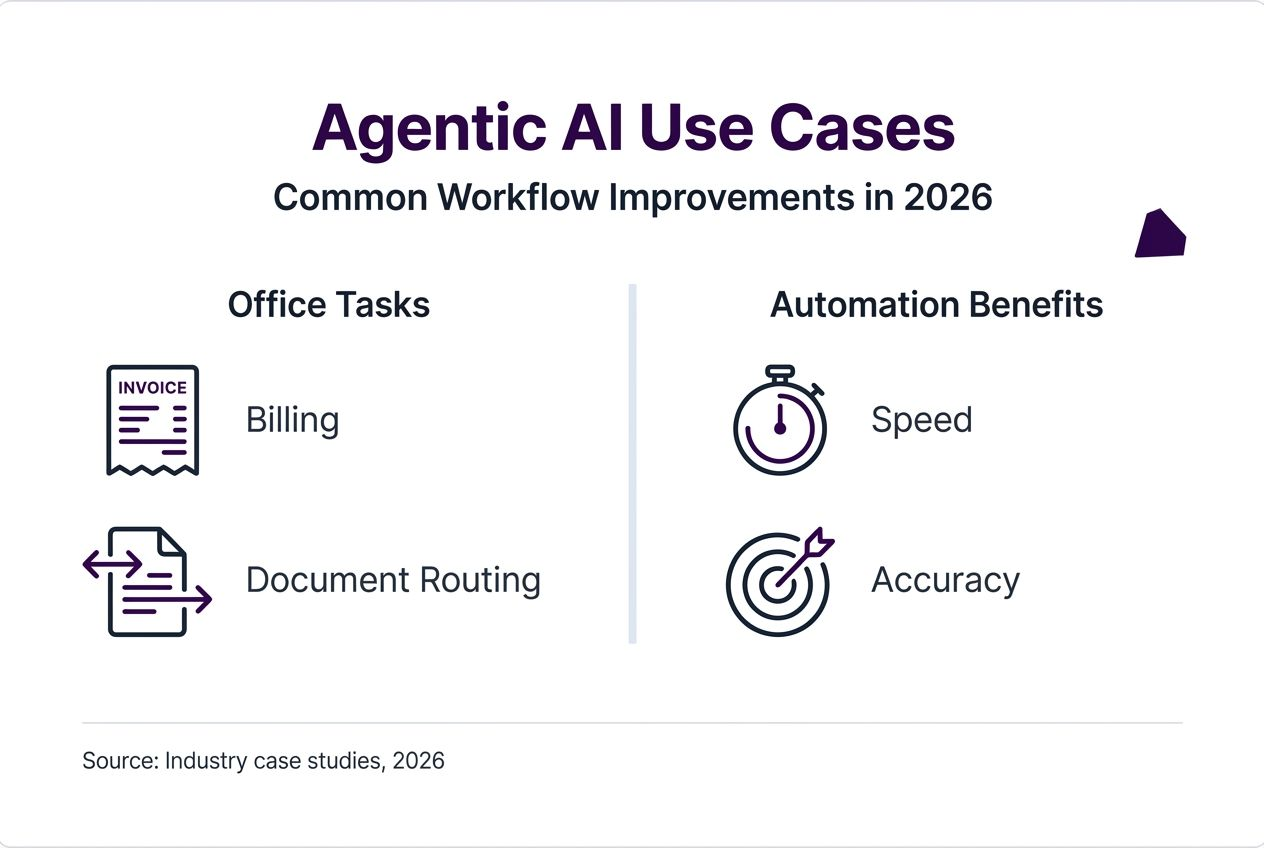
Billing and accounting workflows benefit immediately from intelligent automation. AI systems process invoices, match them against purchase orders, route approvals based on amount thresholds, and update accounting records across platforms. When exceptions arise such as mismatched amounts or missing approvals, the system escalates to appropriate staff with context rather than simply generating error messages.
Document management represents another high-value application. Agentic AI organizes incoming documents, extracts relevant data, routes files to appropriate team members, tracks version control, and ensures compliance with retention policies. The system maintains awareness of document relationships, flagging inconsistencies and coordinating updates across related files.
Internal communications automation handles routine coordination tasks. Meeting scheduling across multiple participants, status update collection and distribution, deadline reminders, and approval request routing all operate autonomously. The AI understands priorities, resolves scheduling conflicts intelligently, and ensures appropriate stakeholders stay informed.
| Workflow Type | AI Role | Efficiency Gain |
|---|---|---|
| Invoice processing | Automated matching, approval routing, exception escalation | 35% faster cycle time |
| Document routing | Intelligent classification, stakeholder identification, tracking | 40% reduction in manual sorting |
| Meeting coordination | Multi-party scheduling, conflict resolution, reminder management | 50% less scheduling time |
| Expense approval | Policy checking, routing, reconciliation, reporting | 45% faster processing |
| Contract management | Deadline tracking, renewal alerts, approval coordination | 30% fewer missed deadlines |
Common applications include:
- Automated vendor onboarding with data collection and validation
- Employee request processing from submission through approval
- Report generation combining data from multiple systems
- Compliance documentation with automatic audit trail maintenance
- Resource allocation based on availability and project requirements
These AI workflow improvement examples demonstrate additional applications across various operational contexts and company sizes.
Discover agentic AI solutions for your workflows
Real-world implementations demonstrate how mid-sized companies achieve measurable workflow improvements through intelligent automation. Exploring detailed agentic AI case studies reveals specific approaches, challenges encountered, and results achieved across various industries and operational contexts.
Ailerons.ai specializes in designing and deploying agentic AI systems tailored to your specific workflow requirements. Rather than forcing your processes into rigid templates, we architect solutions that adapt to how your organization actually operates while introducing efficiencies that scale.
Our implementation approach includes:
- Comprehensive workflow assessment identifying high-value automation opportunities
- Custom integration design for your existing CRM, ERP, scheduling, and accounting platforms
- Secure, compliant architecture aligned with ISO/IEC 27001 and SOC 2 standards
- Phased deployment that proves value through pilots before enterprise rollout
- Ongoing optimization as your workflows evolve and capabilities expand
Whether you’re exploring initial automation opportunities or seeking to expand existing implementations, Ailerons.ai automation solutions provide the expertise and technology to transform your operational efficiency. Contact us to discuss pilot projects that demonstrate measurable improvements in your most time-consuming workflows.
Frequently asked questions about agentic AI in workflow automation
Can agentic AI completely replace human workers?
No, agentic AI augments rather than replaces staff. It handles routine execution, data processing, and workflow coordination while humans focus on judgment, strategy, relationship management, and exception resolution. The technology shifts your team’s work from task execution to oversight and high-value activities that require human insight.
How does agentic AI handle exceptions in workflows?
Agentic AI evaluates exceptions based on context and severity. Minor variations get resolved autonomously by adapting the workflow approach. Significant exceptions that require human judgment trigger intelligent escalation to appropriate staff with full context about the situation. This differs from traditional automation that simply stops and generates error alerts without attempting resolution.
What enterprise systems does agentic AI integrate with?
Agentic AI connects with standard business platforms including Salesforce, Microsoft Dynamics, SAP, Oracle NetSuite, QuickBooks, Xero, Google Workspace, Microsoft 365, Slack, and major scheduling tools. Custom integrations accommodate proprietary systems through APIs and standard protocols.
Is AI workflow automation secure and compliant with regulations?
Properly designed agentic AI systems enhance security and compliance through consistent process enforcement, comprehensive audit trails, and alignment with standards like ISO/IEC 27001 and SOC 2. Encryption, role-based access controls, and automated compliance checking reduce risk compared to manual workflows where human error creates vulnerabilities.
What are the first steps to implement agentic AI in my company?
Start by identifying high-volume, repetitive workflows with measurable cycle times where automation would deliver clear value. Document current performance metrics to establish baselines. Design a pilot project focused on one workflow that demonstrates results without requiring enterprise-wide changes. Success with a limited scope builds organizational confidence and provides lessons for broader deployment.
Recommended
- AI Trends in 2026: Transforming Office Operations | Ailerons IT Consulting
- Improving Business Workflows with AI: Achieve Automation | Ailerons IT Consulting
- Future of Operational AI 2026: Agentic Systems Transforming Work | Ailerons IT Consulting
- Agentic AI Workflow Automation in Modern Healthcare | Ailerons IT Consulting