

Managing multi-step administrative tasks across various departments can feel overwhelming as your business grows. For many SMB operations managers in the United States and Canada, pinpointing the right automation opportunities is now a priority to keep workflows efficient and teams focused. By understanding and mapping repetitive, rule-based tasks, you set the stage for AI-driven solutions that reduce manual effort and improve productivity throughout your organization.
Table of Contents
- Step 1: Analyze Office Workflows For Automation
- Step 2: Define Agentic AI Goals And Requirements
- Step 3: Integrate AI With Existing Business Systems
- Step 4: Deploy Agentic Automation Across Workflows
- Step 5: Test And Refine Automated Processes
Quick Summary
| Key Insight | Explanation |
|---|---|
| 1. Conduct a workflow audit | Audit current administrative tasks to identify processes suitable for automation, aiming for efficiency. |
| 2. Define AI performance goals | Set specific objectives and metrics for your agentic AI to ensure it meets your operational needs. |
| 3. Map integration strategies | Strategically link AI solutions with existing systems to improve workflows without major disruptions. |
| 4. Implement automation incrementally | Start with pilot programs in departments to test and demonstrate AI’s effectiveness before wider rollout. |
| 5. Continuously monitor and refine | Establish ongoing testing and feedback mechanisms to optimize AI performance and adapt to changing needs. |
Step 1: Analyze office workflows for automation
To successfully streamline your organization’s administrative processes, you’ll need a strategic approach to identifying automation opportunities. This involves carefully mapping out your current workflows, pinpointing repetitive tasks, and understanding how AI can transform operational efficiency.
Start by conducting a comprehensive workflow audit. Gather your team and document every administrative task performed across different departments. Create a detailed workflow map that tracks each step from initiation to completion. Look for specific characteristics that signal high automation potential:
- Tasks that are repetitive and rule-based
- Processes with standardized decision trees
- Activities involving manual data entry
- Routine communication and scheduling tasks
- Compliance and reporting procedures that follow consistent patterns
Next, quantify the time and resources currently consumed by these tasks. Calculate the total hours spent on manual work and estimate potential productivity gains. By applying an iterative project management approach, you can systematically evaluate which workflows are most suitable for intelligent automation.

Here’s a summary of potential automation signals and their impact on office productivity:
| Automation Signal | Example Scenario | Business Impact |
|---|---|---|
| Repetitive rule-based tasks | Invoice processing | Reduces manual input, faster output |
| Standardized decision trees | Approval workflows | Increases accuracy, saves time |
| Manual data entry | HR record updates | Cuts errors, improves reliability |
| Routine communication | Meeting scheduling | Streamlines coordination, boosts efficiency |
| Compliance reporting | Regulatory data submissions | Ensures consistency, lowers risk |
The goal isn’t to replace humans but to free them from mundane tasks, enabling them to focus on higher-value strategic work.
Pro tip: Create a detailed spreadsheet tracking task duration, frequency, and complexity to objectively prioritize your automation targets.
Step 2: Define agentic AI goals and requirements
Defining clear goals and requirements for your agentic AI system is crucial to ensuring it meets your organization’s specific operational needs. Your objective is to create a precise blueprint that outlines the exact capabilities and performance expectations for your intelligent automation solution.
Begin by identifying the core strategic objectives for implementing agentic AI. These might include reducing administrative overhead, improving data accuracy, or enabling more complex workflow management. Focus on developing comprehensive performance benchmarks for office automation that align with your business processes. Key requirements to consider include:
- Multi-application integration capabilities
- Context-aware decision-making skills
- Long-horizon planning and execution
- Minimal human supervision requirements
- Adaptive learning and workflow optimization
Document these requirements with extreme specificity. Create a detailed matrix that breaks down each desired capability, including precise metrics for performance evaluation. This approach ensures your agentic AI solution can handle complex tasks with the nuance and flexibility your business demands.
Successful agentic AI implementation requires viewing the system as a collaborative digital teammate, not just a sophisticated automation tool.
Pro tip: Conduct workshops with team members from different departments to capture comprehensive workflow complexity and potential AI interaction points.
Step 3: Integrate AI with existing business systems
Successfully integrating agentic AI into your current business ecosystem requires a strategic and methodical approach. Your goal is to seamlessly connect intelligent automation with your existing software infrastructure without causing disruption or requiring extensive system overhauls.
Begin by mapping intelligent document and workflow strategies that align with your current technological landscape. Identify the critical systems and applications that will interact with your AI solution, focusing on:
- Enterprise resource planning (ERP) platforms
- Customer relationship management (CRM) systems
- Document management software
- Communication and collaboration tools
- Accounting and financial management applications
Next, evaluate the technical compatibility of your chosen agentic AI solution. Conduct thorough integration testing to ensure smooth data exchange, authentication protocols, and workflow continuity. Pay special attention to API connection points and potential data transfer bottlenecks that might impede system performance.
Here’s a quick comparison of agentic AI integration strategies and their organizational benefits:
| Integration Strategy | Main Advantage | Possible Challenge | Business System Example |
|---|---|---|---|
| Direct API integration | Seamless data flows | Technical bottlenecks | ERP, CRM platforms |
| Middleware orchestration | Flexibility | Maintenance complexity | Document management software |
| Modular rollout by department | Customization | Coordination across teams | Accounting apps |
Successful AI integration is not about replacing existing systems but enhancing their capabilities through intelligent orchestration.
Pro tip: Engage your IT team early in the integration process to identify potential technical challenges and develop comprehensive compatibility strategies.
Step 4: Deploy agentic automation across workflows
Deploying agentic AI automation requires a strategic, phased approach that transforms your administrative processes with minimal disruption. Your objective is to systematically implement intelligent automation across different departmental workflows, ensuring smooth integration and measurable productivity gains.
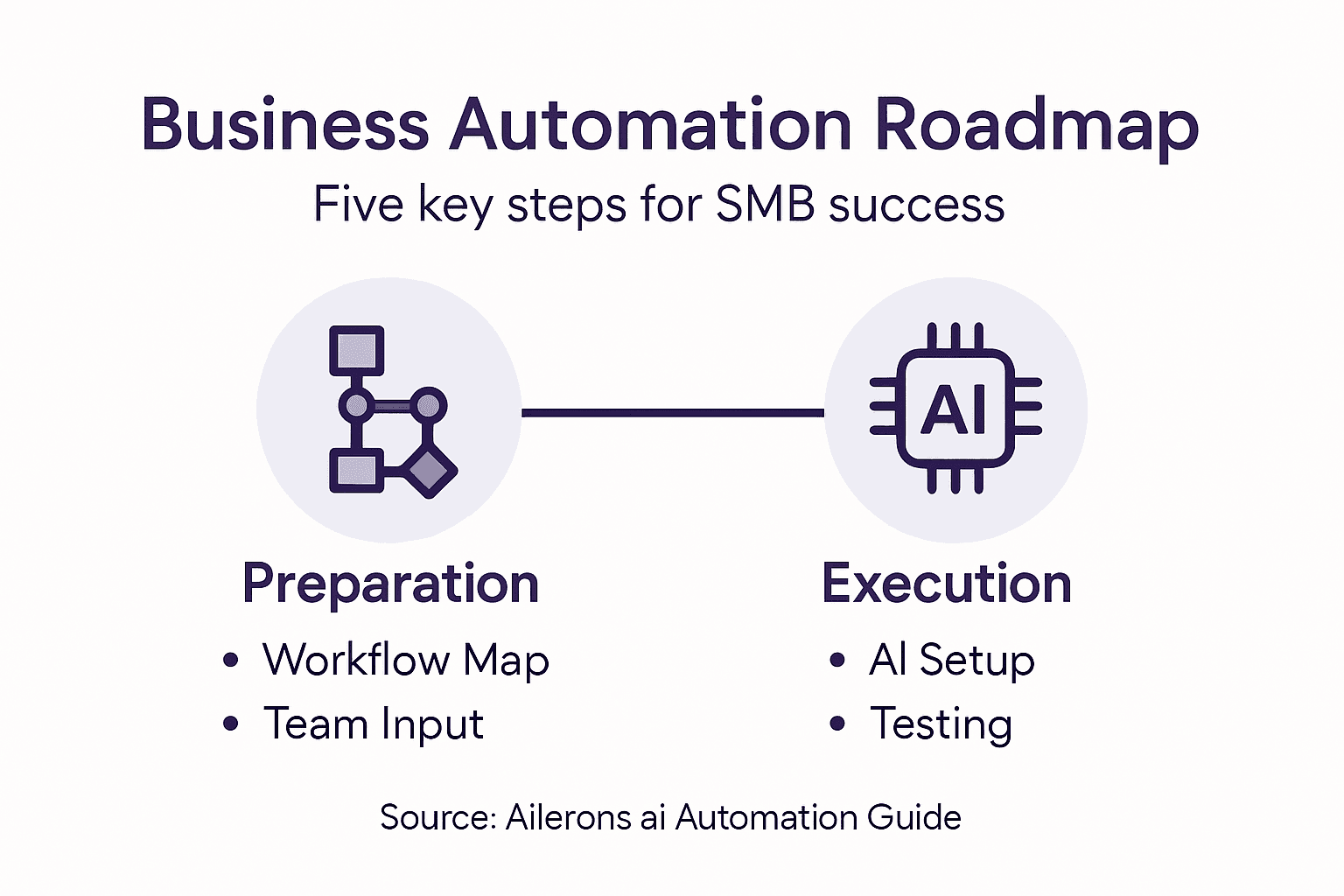
Start by implementing AI-powered workflow automation through a carefully planned rollout strategy. Begin with pilot departments that have well-defined, repeatable processes. Focus on workflows with clear performance metrics and minimal complexity to build initial momentum and demonstrate tangible value.
Key deployment considerations include:
- Incremental implementation approach
- Comprehensive staff training programs
- Continuous performance monitoring
- Flexible task routing mechanisms
- Robust error handling protocols
Establish clear governance frameworks to manage AI task execution. Configure your agentic automation system to provide transparent reporting, enable human oversight, and maintain strict data privacy and security standards. This approach ensures your AI solution operates with accountability and aligns with organizational objectives.
Successful deployment transforms AI from a technological tool into an intelligent organizational collaborator.
Pro tip: Create a dedicated cross-functional team to monitor AI performance, gather feedback, and continuously refine automation strategies.
Step 5: Test and refine automated processes
Testing and refining your agentic AI automation requires a systematic and detailed approach to ensure optimal performance and reliability. Your goal is to create a robust validation framework that continuously evaluates and improves your automated workflows.
Begin by implementing comprehensive workflow testing strategies that simulate real-world scenarios and edge cases. Develop a rigorous testing protocol that examines the AI’s performance across multiple dimensions:
- Accuracy and precision metrics
- Error rate and exception handling
- Processing speed and efficiency
- Adaptability to complex scenarios
- Consistency of decision-making
Establish continuous monitoring systems that track performance in real-time. Create detailed reporting mechanisms that capture key performance indicators, allowing your team to identify improvement opportunities quickly. Pay special attention to scenarios where the AI might struggle or deviate from expected outcomes, using these insights to refine its decision-making algorithms.
Effective testing transforms automation from a rigid system into an adaptive, intelligent workflow solution.
Pro tip: Create a dedicated feedback loop that captures both quantitative performance metrics and qualitative insights from team members who interact with the automated processes.
Unlock True Business Automation with Agentic AI from Ailerons.ai
The step-by-step guide highlights the challenges SMBs face when automating complex office workflows that require reasoning, planning, and multi-step task execution. If you struggle with repetitive manual data entry, fragmented decision-making processes, or integrating AI across diverse platforms like ERP and CRM systems, you are not alone. The article stresses the need for agentic AI systems that go beyond simple rule-based bots by providing context-aware, adaptive automation that collaborates with your teams instead of replacing them.
Ailerons.ai specializes in transforming these pain points into scalable solutions. Our advanced agentic AI architecture empowers SMBs to automate administrative processes, compliance tasks, document management, and internal communications seamlessly. We focus on outcome-driven deployment that integrates securely with your existing business systems to reduce errors, accelerate workflows, and free your staff for higher-value activities.
Ready to break free from the limits of traditional automation? Discover how agentic AI automation can elevate your office operations with smarter, goal-driven workflows. Take the next step toward operational excellence and visit Ailerons.ai today to learn more about our tailored AI solutions designed specifically for SMBs committed to efficiency and growth.
Frequently Asked Questions
How can I analyze office workflows for automation in SMBs?
To analyze office workflows for automation, start by conducting a comprehensive workflow audit. Gather your team, document all administrative tasks, and create a workflow map to identify repetitive tasks that signal high automation potential.
What are the key goals for implementing agentic AI in small and medium businesses?
The key goals for implementing agentic AI include reducing administrative overhead, improving data accuracy, and enhancing workflow management. Clearly define these objectives to create a precise blueprint that aligns with your operational needs.
How do I integrate AI with existing business systems effectively?
To integrate AI with existing business systems, map out your current software landscape and identify applications that will interact with the AI solution. Ensure technical compatibility by conducting thorough integration testing on API connection points to facilitate smooth data exchange.
What steps should I take to deploy agentic automation across my workflows?
For deploying agentic automation, begin with a carefully planned rollout in pilot departments that have well-defined processes. Establish training programs for staff and implement robust monitoring systems to measure performance and successes of the AI initiatives.
How can I test and refine automated processes in my business?
To test and refine automated processes, implement comprehensive testing strategies that simulate various real-world scenarios. Continuously monitor the AI’s performance using key metrics to identify improvement opportunities and adapt its decision-making algorithms accordingly.
What are common signals that indicate automation potential in office workflows?
Common signals of automation potential include repetitive rule-based tasks, standardized decision trees, and manual data entry processes. Identifying these characteristics can help prioritize automation opportunities that will significantly improve productivity.