

Mid-market companies implementing intelligent automation achieve a 72% reduction in administrative overhead within their first year. Operations managers and IT leaders consistently report gains that reshape how teams handle scheduling, document processing, approvals, and cross-platform updates. This guide explains intelligent automation fundamentals, clarifies common misconceptions, and provides actionable implementation steps to help you reduce friction and scale efficiently without adding staff.
Table of Contents
- Introduction To Intelligent Automation And Agentic AI
- Mechanisms Of Agentic AI In Reducing Administrative Overhead
- Quantified Benefits Of Intelligent Automation For Mid-Market Companies
- Common Misconceptions About AI Automation And Their Corrections
- Comparative Framework: Traditional Automation Vs Agentic AI
- Integration With Existing Business Systems And Compliance Considerations
- Practical Implementation Guidance For Mid-Market Companies
- Conclusion And Future Outlook On Intelligent Automation Adoption
- Unlock Intelligent Automation With Ailerons IT Consulting
Key Takeaways
| Point | Details |
|---|---|
| Overhead Reduction | Intelligent automation delivers 72% admin overhead reduction within 12 months for mid-market companies. |
| Agentic AI Advantage | Agentic AI automates multi-step processes with reasoning capabilities, unlike rigid rule-based traditional automation. |
| Myth Debunking | Common fears about job loss, complexity, and disruption are contradicted by evidence showing staff redeployment and phased implementation success. |
| Compliance Integration | Secure architectures aligned with identity and cloud standards enable compliant integration with existing CRM, ERP, and document systems. |
| Phased Implementation | Pilot projects with clear KPIs minimize disruption and accelerate identification of high-impact automation opportunities. |
Introduction to Intelligent Automation and Agentic AI
Intelligent automation represents a shift from task execution to goal-driven orchestration. Unlike traditional automation built on static rules, intelligent automation uses context awareness and decision logic to manage complex workflows from start to finish. Agentic AI automates multi-step processes with reasoning capabilities, unlike rigid rule-based traditional automation.
Agentic AI systems reason through scenarios, plan sequences of actions, and execute tasks autonomously. When you need to coordinate schedules across departments, process invoices with variable approval paths, or update records in multiple platforms simultaneously, agentic AI handles these workflows without human intervention. Traditional automation would require separate scripts for each variation, creating maintenance nightmares and brittle systems.
The core difference lies in adaptability. Traditional automation follows if/then logic you program in advance. If conditions change or exceptions arise, the system stops and waits for human input. Agentic AI capabilities enable systems to assess context, adjust plans, and continue executing toward defined goals even when faced with variations.
For mid-market operations teams, this means freedom from constant firefighting. Your staff stops spending hours on repetitive coordination tasks and starts focusing on strategic work that drives growth. The technology handles routine administrative overhead while escalating only genuine exceptions that require human judgment.
Key capabilities that distinguish intelligent automation:
- Context awareness that interprets situations based on current business state
- Goal orientation that keeps systems focused on outcomes rather than rigid steps
- Multi-step planning that sequences actions across integrated systems
- Exception handling that escalates appropriately while continuing other work
- Decision logic that applies business rules dynamically as conditions change
Mechanisms of Agentic AI in Reducing Administrative Overhead
Agentic AI task execution operates through three core mechanisms: contextual reasoning, autonomous planning, and intelligent escalation. Understanding these mechanisms helps you identify where automation delivers maximum administrative relief.
Contextual reasoning enables systems to interpret situations dynamically. When processing expense reports, agentic AI examines submission timing, policy compliance, approval history, and budget status simultaneously. It routes items appropriately without requiring you to predefine every possible scenario. Traditional automation would fail when encountering new expense categories or policy updates.
Agentic AI supports multi-step task execution and autonomous management of admin processes to increase efficiency. The planning mechanism sequences actions across platforms. Scheduling a client meeting might involve checking calendars, reserving conference rooms, sending invitations, updating CRM records, and preparing briefing documents. Agentic AI coordinates these steps without manual intervention between each action.
Intelligent escalation ensures robustness. When the system encounters genuine exceptions requiring human judgment, it flags them appropriately while continuing other workflow elements. You receive alerts only for items that truly need your attention, not for routine variations the system handles autonomously.
Implementation follows a logical sequence:
- Map your current administrative workflows to identify repetitive multi-step processes.
- Define desired outcomes and success criteria for each workflow.
- Configure agentic AI systems with business rules and escalation thresholds.
- Integrate with existing platforms to enable cross-system coordination.
- Monitor initial executions to refine reasoning parameters.
- Scale to additional workflows as confidence builds.
Pro Tip: Design workflows with human-in-the-loop checkpoints for high-stakes decisions during initial deployment, then reduce intervention as the system proves reliable.
The cumulative effect transforms operations. Tasks that previously consumed hours of coordination time now complete automatically. Your team shifts from execution mode to oversight mode, focusing energy on strategic priorities rather than administrative mechanics.

Quantified Benefits of Intelligent Automation for Mid-Market Companies
Data from mid-market implementations demonstrates consistent patterns of improvement. 72% of mid-market companies report admin overhead reductions; efficiency gains reach approximately 30%; error reduction averages 50%.
| Metric | Traditional Process | With Intelligent Automation | Improvement |
|---|---|---|---|
| Administrative Overhead | 100% baseline | 28% remaining | 72% reduction |
| Operational Efficiency | 100% baseline | 130% output | 30% gain |
| Process Error Rate | 8-12% typical | 4-6% typical | 50% reduction |
| Scaling Cost | Linear with headcount | Flat infrastructure | 60-80% savings |
Efficiency improvements manifest across multiple dimensions. Invoice processing that previously required three business days now completes within hours. Schedule coordination involving multiple stakeholders resolves in minutes rather than email chains spanning days. Document routing that created bottlenecks flows continuously through approval chains.
Error reduction delivers compound benefits. Fewer mistakes mean less rework, reduced compliance risk, and improved customer experience. When systems handle data entry and cross-platform updates consistently, you eliminate the transcription errors and version conflicts that plague manual processes.
“We automated our front-office coordination workflows and saw administrative overhead drop by 68% within nine months. Our team now handles 40% more client interactions without adding staff, and response times improved dramatically.” - Operations Director, Mid-Market Professional Services Firm
Cost control becomes predictable. Traditional scaling requires proportional headcount increases. Intelligent automation enables you to handle growth through infrastructure that scales at marginal cost. You invest in systems once, then benefit from capacity expansion without recurring salary expenses.
Quantified automation benefits extend beyond direct cost savings:
- Faster response times improve customer satisfaction and competitive positioning
- Consistent execution strengthens compliance and reduces audit risk
- Staff redeployment to strategic work enhances innovation capacity
- Predictable workflows enable better resource planning and forecasting
Common Misconceptions About AI Automation and Their Corrections
Four persistent myths prevent mid-market companies from capturing automation benefits. Evidence contradicts each misconception.
Myth: AI automation eliminates jobs and displaces workers.
Reality: Research shows agentic AI offloads repetitive tasks but enables employees to focus on higher-value work, not eliminate jobs. Organizations redeploy staff to strategic initiatives, customer relationships, and innovation projects. Administrative automation frees capacity rather than cutting headcount.
Myth: Intelligent automation requires massive investment and technical complexity beyond mid-market capabilities.
Reality: Cloud-based agentic AI platforms reduce upfront costs and implementation barriers significantly. You avoid capital expenses for infrastructure and access sophisticated capabilities through subscription models. Pilot projects start small and scale based on demonstrated ROI.
Myth: Traditional automation and intelligent automation deliver equivalent results.
Reality: Traditional rule-based automation handles predefined tasks in isolation. Agentic AI manages complex, multi-step workflows with contextual reasoning and autonomous planning. The capability gap translates directly to operational impact and administrative overhead reduction.
Myth: Automation projects disrupt business operations and create implementation chaos.
Reality: Phased pilot implementations minimize disruption by targeting specific workflows initially. You validate approaches, train teams, and refine configurations before broader deployment. Well-designed change management ensures smooth transitions.
Pro Tip: Engage change management early in your automation planning to address staff concerns proactively and build adoption momentum.
Addressing these misconceptions opens opportunities. When you recognize that automation enhances rather than replaces your team, investment becomes strategic rather than threatening. When you understand implementation can proceed incrementally, risk becomes manageable. When you distinguish intelligent automation from traditional approaches, you set appropriate expectations and make informed technology choices.
Comparative Framework: Traditional Automation vs Agentic AI
Understanding technology differences helps you evaluate solutions and set realistic expectations. Agentic AI automates multi-step tasks with reasoning and autonomy, unlike rigid traditional automation.
| Dimension | Traditional Automation | Agentic AI |
|---|---|---|
| Task Scope | Single, predefined actions | Multi-step, goal-oriented workflows |
| Adaptability | Breaks on unexpected inputs | Reasons through variations dynamically |
| Integration | Point-to-point connections | Orchestrates across platforms |
| Exception Handling | Stops and alerts immediately | Continues execution, escalates selectively |
| Maintenance | Requires recoding for changes | Adjusts to new conditions autonomously |
| Complexity Limit | Simple, repetitive tasks | Complex workflows with dependencies |
Adaptability represents the critical differentiator. Traditional automation executes programmed sequences. When inputs vary or conditions change, systems fail and generate alerts. You spend time troubleshooting and updating scripts continuously.
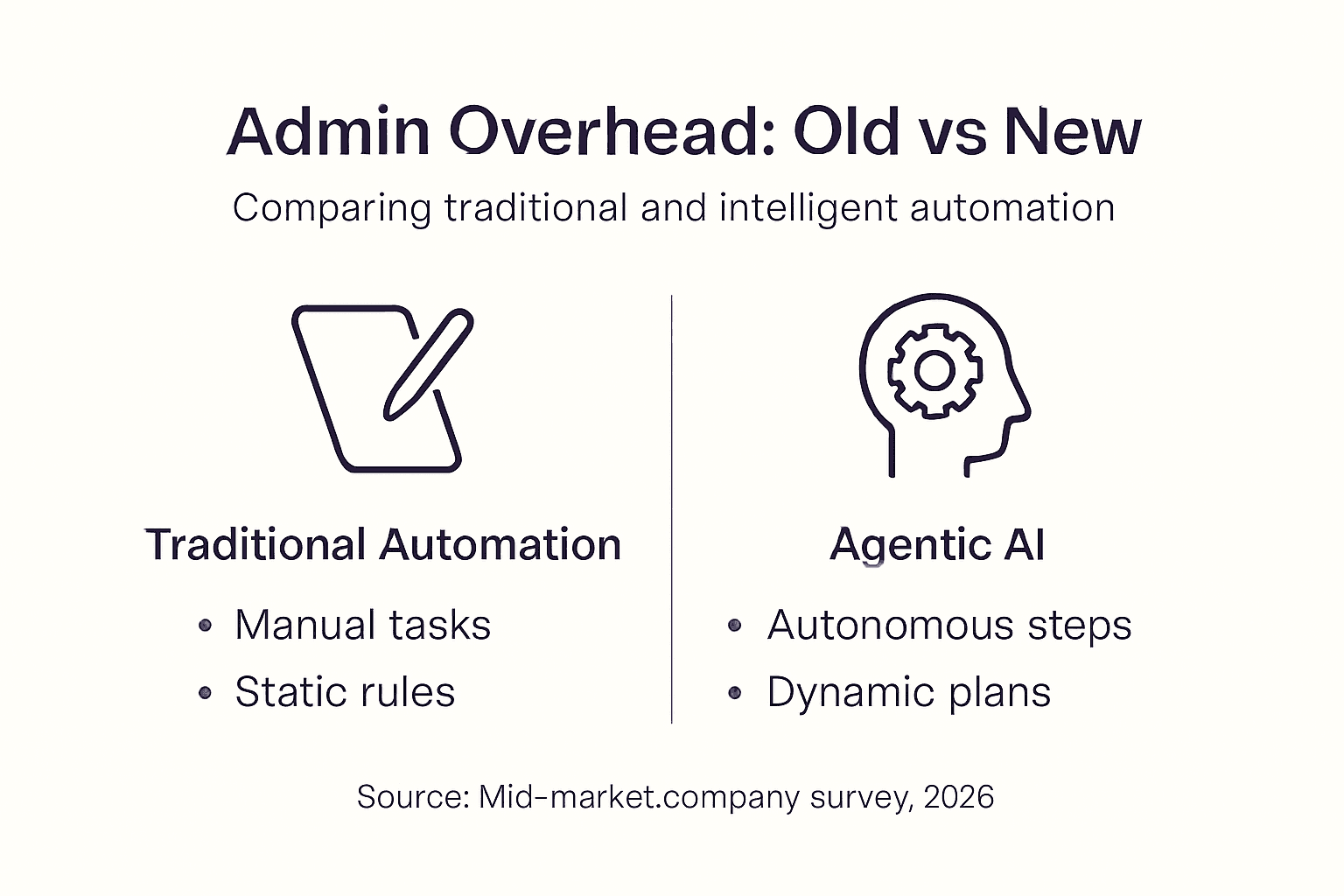
Agentic AI vs traditional automation shows intelligent systems assess situations and adjust execution paths. Invoice processing handles new vendors, expense categories, and approval routing without reconfiguration. Schedule coordination manages participant availability changes and priority conflicts dynamically.
Scope differences determine appropriate applications:
- Use traditional automation for stable, high-volume tasks with minimal variation
- Deploy agentic AI for complex workflows requiring contextual decisions
- Combine approaches where simple triggers initiate intelligent orchestration
- Reserve human attention for strategic decisions and relationship management
Integration flexibility matters for mid-market companies with diverse technology stacks. Traditional automation creates point-to-point connections that multiply integration complexity. Each system pair requires separate configuration. Agentic AI platforms orchestrate across multiple systems through unified interfaces, reducing integration burden substantially.
Operational autonomy levels reflect maturity. Early automation assists with individual tasks. Advanced agentic AI systems manage entire processes end to end, from initiation through completion and exception resolution. This progression determines how much administrative overhead you actually eliminate.
Integration with Existing Business Systems and Compliance Considerations
Successful automation requires secure, compliant integration with your existing CRM, ERP, document management, and communication platforms. Secure architectures aligned with identity and cloud standards enable compliant integration of agentic AI.
Avoid creating data silos. Comprehensive integration ensures information flows bidirectionally between systems. When agentic AI updates customer records, those changes reflect immediately in your CRM, billing system, and support platforms. Consistency across systems prevents conflicts and ensures single sources of truth.
Regulatory considerations vary by industry but share common themes. Financial services firms must maintain audit trails and data sovereignty. Healthcare organizations need HIPAA compliance. Professional services require client confidentiality. Your automation architecture must address these requirements from initial design.
Cloud and identity standards provide foundation:
- OAuth and SAML enable secure authentication across integrated systems
- Role-based access control ensures appropriate permissions throughout workflows
- Encryption protects data in transit and at rest across platforms
- API gateways standardize integration patterns and security policies
Automation integration best practices include thorough testing of security controls, regular audits of access patterns, and continuous monitoring of compliance metrics. You must validate that automated workflows respect data governance policies and regulatory requirements consistently.
Integration challenges typically involve legacy systems with limited API capabilities, inconsistent data formats across platforms, and authentication complexity. Solutions include middleware layers that normalize interfaces, data transformation rules that ensure consistency, and phased migration strategies that modernize systems progressively.
Practical Implementation Guidance for Mid-Market Companies
Deploying intelligent automation follows a structured approach that minimizes risk and maximizes learning. This roadmap applies regardless of your starting point.
-
Assess current administrative processes to identify automation candidates. Map workflows, quantify time consumption, document pain points, and prioritize based on impact potential and implementation feasibility.
-
Choose agentic AI solutions compatible with your existing technology stack. Evaluate integration capabilities, security features, scalability characteristics, and vendor support quality before committing.
-
Launch pilot deployments targeting specific workflows with clear success metrics. Define KPIs for efficiency, accuracy, cost reduction, and user satisfaction. Monitor closely and iterate rapidly.
-
Invest in staff training and change management. Your team must understand how to work alongside intelligent automation effectively. Address concerns transparently and celebrate early wins publicly.
-
Scale automation broadly based on pilot learnings. Expand to additional workflows systematically, applying lessons from initial deployments to accelerate subsequent implementations.
-
Establish continuous monitoring and optimization processes. Track performance metrics, gather user feedback, refine configurations, and identify new automation opportunities as your organization evolves.
Pro Tip: Engage technical experts early to plan integration architecture and prepare staff for workflow changes, ensuring smooth deployment and rapid adoption.
Success factors include executive sponsorship, clear communication of benefits, realistic timelines, and commitment to iterative improvement. Organizations that treat automation as ongoing capability development outperform those pursuing one-time projects.
Conclusion and Future Outlook on Intelligent Automation Adoption
Intelligent automation delivers measurable administrative overhead reduction, efficiency gains, and error reduction for mid-market companies. The 72% overhead reduction, 30% efficiency improvement, and 50% error decrease documented across implementations represent transformative operational benefits.
Future trends point toward greater context awareness and seamless AI collaboration. Systems will interpret increasingly complex situations, coordinate across broader workflow scopes, and integrate more deeply with human decision-making processes. Natural language interfaces will make automation accessible to non-technical staff, democratizing capability development.
Early adoption provides competitive advantage. Organizations building automation capabilities now establish operational efficiency that competitors struggle to match. You gain experience, refine approaches, and compound benefits while others delay.
Start small with pilot projects targeting high-impact workflows. Build confidence through measurable results. Scale systematically as capabilities mature. The journey from manual administration to intelligent orchestration reshapes what your team accomplishes and how your organization competes.
Unlock Intelligent Automation with Ailerons IT Consulting
Ailerons IT Consulting specializes in agentic AI operational solutions tailored for mid-market companies seeking measurable overhead reduction. Our experts guide you through assessment, solution selection, pilot deployment, and scaling. We ensure seamless integration with existing CRM, ERP, and document systems while maintaining compliance standards.
Our approach combines technical expertise with operational understanding. We help you identify high-impact automation opportunities, design secure architectures, and implement AI trends in office operations that deliver results. Case studies demonstrate business process automation efficiencies averaging 68-75% overhead reduction within 12 months.
FAQ
What is the main difference between traditional automation and intelligent automation?
Traditional automation executes predefined rule-based tasks in isolation using static if/then logic. Intelligent automation employs AI reasoning and context awareness to manage complex, multi-step workflows dynamically. Agentic AI handles exceptions, adjusts plans based on changing conditions, and orchestrates actions across integrated platforms autonomously.
How soon can mid-market companies expect to see reductions in administrative overhead?
Most organizations observe measurable overhead reductions within 12 months of implementing intelligent automation. Pilot projects accelerate this timeline by quickly identifying high-impact automation areas and validating approaches. Early wins in specific workflows often appear within 60-90 days, building momentum for broader deployment.
Are intelligent automation solutions costly and complex to implement for mid-market firms?
Cloud-based agentic AI reduces upfront costs and complexity significantly through subscription models that eliminate capital expenses. Phased, pilot-driven approaches ease implementation by targeting specific workflows initially, minimizing disruption while demonstrating ROI. Technical barriers have decreased substantially as platforms mature and integration standards evolve.
How does intelligent automation integrate with existing CRM and ERP systems?
Intelligent automation uses secure architectures aligned with identity and cloud standards to integrate with existing business systems. API-based connections enable bidirectional data flow while maintaining security and compliance. Modern platforms avoid data silos by orchestrating across multiple systems through unified interfaces, reducing integration complexity compared to point-to-point traditional automation approaches.
Recommended
- Master the Administrative Task Automation Process Today | Ailerons IT Consulting
- Intelligent Automation: Empowering Healthcare Operations | Ailerons IT Consulting
- Blog | Ailerons IT Consulting
- Office Operations Automation Trends: Agentic AI Impact | Ailerons IT Consulting
- Role of Automation in Talent Acquisition Success
- Processo di Automazione Logistica: Efficienza e Controllo