
Over 70% of companies still underutilize AI-driven digital collaboration beyond simple communication tools. Most organizations rely on basic digital platforms for messaging and file sharing but miss the transformative potential of agentic AI systems. This gap represents a critical opportunity for business leaders to optimize workflows, reduce operational friction, and scale efficiently without proportional headcount increases.
Table of Contents
- Understanding Digital Collaboration: Foundations And Evolution
- Agentic AI: The Game-Changer In Digital Collaboration
- Common Misconceptions About Digital Collaboration And AI
- Frameworks To Understand And Measure Digital Collaboration Efficacy
- Real-World Applications And Best Practices For Agentic AI Collaboration
- Bridging Understanding To Practical AI-Enabled Collaboration
- Discover Tailored Agentic AI Collaboration Solutions
Key takeaways
| Point | Details |
|---|---|
| Digital collaboration evolution | Evolved from manual methods to synchronous tools, basic automation, and now agentic AI systems that reason and plan autonomously. |
| Agentic AI advantages | Reduces manual task handling by up to 40% through context-aware, goal-oriented execution of multi-step workflows. |
| Common misconceptions | AI augments rather than replaces human roles, and collaboration extends far beyond messaging or video calls. |
| Maturity frameworks | Five-stage models help organizations assess collaboration readiness and track measurable improvements in efficiency and accuracy. |
| Practical adoption | Phased rollouts, early team engagement, and continuous monitoring ensure successful agentic AI integration. |
Understanding digital collaboration: foundations and evolution
Digital collaboration refers to integrated digital technologies that enable cooperative workflows across teams, departments, and systems. It encompasses far more than email or video conferencing.
The evolution has progressed through distinct phases. Manual methods dominated for decades, relying on paper-based processes and face-to-face coordination. Synchronous digital tools emerged next, introducing real-time messaging and shared documents. Basic automation followed, handling repetitive tasks through rigid scripts. Today, agentic AI represents the latest leap, bringing autonomous reasoning and adaptive decision-making to office operations.
Adoption rates vary significantly. While most companies use basic collaboration platforms, frameworks classifying digital collaboration by autonomy level help organizations identify appropriate technology adoption stages. Understanding these stages prevents premature investments and ensures strategic alignment.
The collaboration maturity continuum provides a roadmap. Organizations typically start with manual processes, advance to connected tools, adopt workflow automation, implement intelligent systems, and finally embrace agentic AI. Each stage builds on the previous foundation.
Common digital collaboration technologies include:
- Communication platforms for messaging and video conferencing
- Document management systems for version control and shared access
- Project management tools for task tracking and coordination
- Customer relationship management systems for client interactions
- Enterprise resource planning platforms for cross-functional processes
- Workflow automation tools for rule-based task execution
- Agentic AI systems for autonomous multi-step orchestration
Technology transforms workflow efficiency by eliminating manual handoffs, reducing errors, and accelerating decision cycles. The shift from human-dependent processes to AI-orchestrated workflows enables organizations to scale operations without proportional staff increases. This foundation sets the stage for understanding how agentic AI elevates collaboration to unprecedented levels.
Agentic AI: the game-changer in digital collaboration
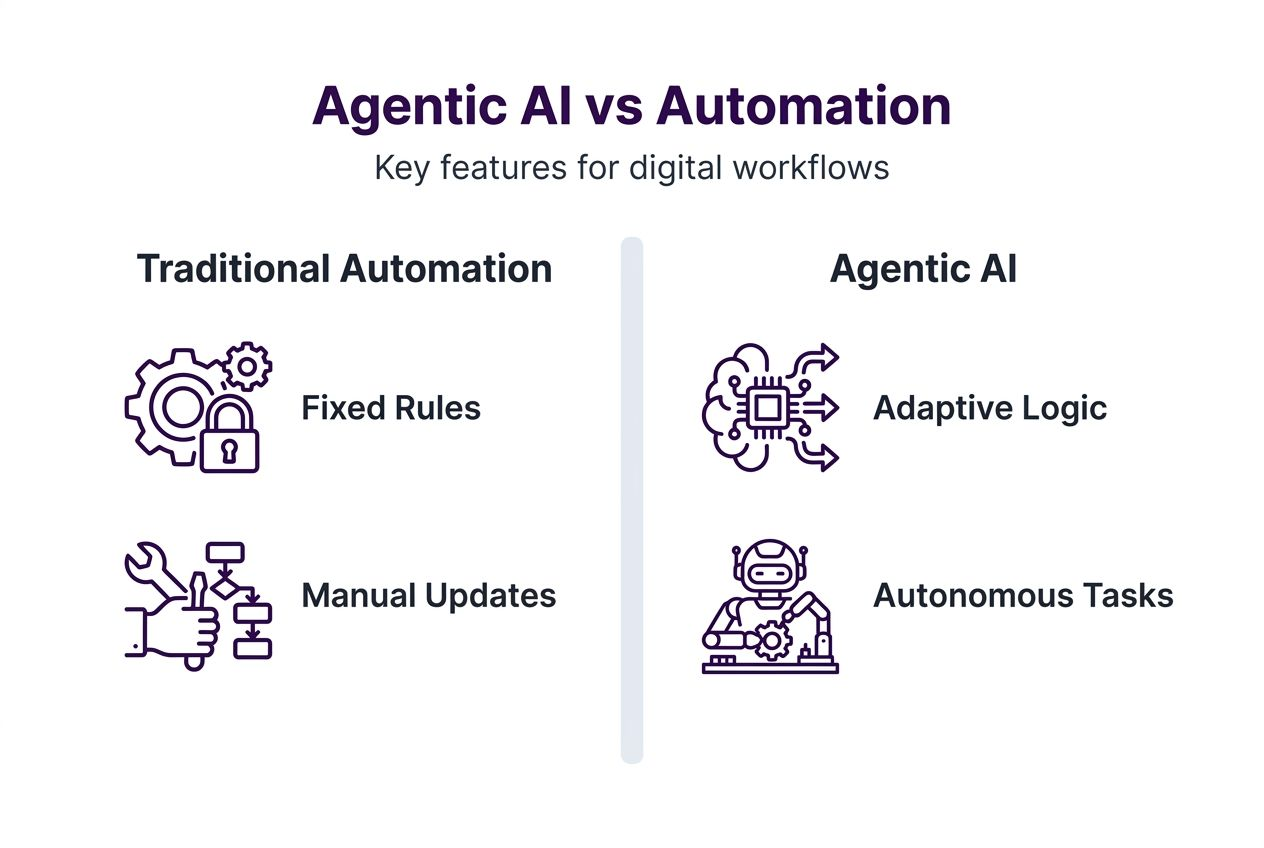
Agentic AI represents autonomous, goal-oriented systems capable of reasoning, planning, and executing complex tasks without constant human intervention. Unlike traditional automation that follows fixed scripts, agentic AI adapts to context, handles exceptions, and makes informed decisions across multi-step workflows.

The contrast with legacy automation is stark. Traditional systems execute predefined rules: if X happens, do Y. Agentic AI can reduce manual task handling time by up to 40% in office workflows by understanding goals, evaluating options, and adjusting approaches based on real-time conditions. This flexibility transforms how organizations manage everything from document processing to approval chains.
| Feature | Traditional Automation | Agentic AI |
|---|---|---|
| Decision Logic | Fixed rules only | Context-aware reasoning |
| Task Scope | Single, predefined steps | Multi-step orchestration |
| Exception Handling | Stops or errors out | Adapts and escalates intelligently |
| Learning Capability | Static scripts | Improves through experience |
| Integration Complexity | Point-to-point connections | Cross-platform coordination |
Efficiency gains extend beyond time savings. Agentic AI improves accuracy by maintaining consistency across processes, reduces operational friction by eliminating manual handoffs, and enhances scalability by handling volume increases without additional staff.
Pro Tip: Start with pilot projects focused on repetitive complex tasks like invoice processing or scheduling coordination for faster ROI and clearer performance metrics.
Agentic AI capabilities that drive these outcomes include:
- Context awareness across multiple data sources and systems
- Exception handling that routes issues appropriately without stopping workflows
- Adaptive decision-making based on real-time business conditions
- Goal orientation that prioritizes outcomes over rigid process adherence
- Multi-platform integration coordinating actions across CRM, ERP, and document systems
- Autonomous execution from task initiation through completion and verification
These systems function as digital collaborators within business operations. They coordinate schedules, process documents, update records across platforms, handle approvals, and escalate exceptions when human judgment is needed. The shift from task-based automation to intelligent orchestration represents a fundamental change in how AI trends 2026 office operations evolve.
Understanding agentic AI’s unique value proposition helps leaders recognize where to apply this technology for maximum impact. The next step involves addressing common misconceptions that can hinder adoption.
Common misconceptions about digital collaboration and AI
Several myths prevent organizations from fully embracing AI-enhanced collaboration. Clarifying these misunderstandings accelerates adoption and builds workforce confidence.
Digital collaboration is not just messaging or video calls. Many leaders equate collaboration with communication platforms, missing the deeper workflow integration that drives efficiency. True digital collaboration connects systems, automates handoffs, and orchestrates multi-step processes across departments.
AI will not replace human jobs wholesale. The fear of workforce displacement overshadows AI’s actual role: augmenting human capabilities. Agentic AI handles repetitive, rule-based tasks, freeing employees for strategic work requiring creativity and judgment. Organizations implementing AI typically redeploy staff to higher-value activities rather than reducing headcount.
Most companies underuse AI potential. Despite widespread awareness, many organizations limit AI to simple chatbots or basic analytics. The transformative applications in AI-driven office automation success remain untapped because leaders don’t understand implementation pathways or fear complexity.
Resistance stems from predictable causes:
- Lack of understanding about AI capabilities and limitations
- Fear of job loss or role changes among employees
- Cultural attachment to established processes and workflows
- Concerns about technology complexity and integration challenges
- Uncertainty about ROI and performance measurement
- Insufficient change management and communication
Addressing workforce concerns requires transparent communication. Leaders should explain how AI augments roles, provide concrete examples of employee benefits, involve teams in pilot projects, and demonstrate commitment to reskilling. Framing AI as a tool that eliminates frustrating repetitive work while enhancing job satisfaction builds acceptance.
Emphasizing accuracy improvements also helps. Agentic AI reduces human error in data entry, document processing, and compliance tasks. Employees appreciate systems that prevent mistakes and reduce rework, shifting perception from threat to valuable assistant.
By dispelling these misconceptions, organizations create the foundation for successful AI adoption. The next step involves establishing frameworks to measure and optimize collaboration efficacy.
Frameworks to understand and measure digital collaboration efficacy
Structured models help organizations assess current collaboration maturity and track AI adoption progress. The five-stage model of collaboration maturity widely used in IT management frameworks provides clear benchmarks.
Stage 1: Manual processes rely on email, spreadsheets, and individual effort with minimal system integration. Stage 2: Connected tools introduce shared platforms but require manual coordination. Stage 3: Workflow automation handles routine tasks through scripted rules. Stage 4: Intelligent systems use AI for pattern recognition and recommendations. Stage 5: Agentic AI orchestrates end-to-end processes with autonomous decision-making.
Key performance indicators enable quantitative assessment:
- Process cycle time from initiation to completion
- Error rates in data processing and task execution
- User engagement measured by system adoption and utilization
- Cost per transaction or workflow instance
- Compliance adherence in regulated processes
- Employee satisfaction with workflow tools
| Maturity Stage | Avg Cycle Time | Error Rate | Automation Level |
|---|---|---|---|
| Manual | 5-7 days | 8-12% | 0-10% |
| Connected | 3-5 days | 5-8% | 10-30% |
| Automated | 1-3 days | 2-5% | 30-60% |
| Intelligent | 0.5-1 day | 1-2% | 60-80% |
| Agentic AI | Hours | <1% | 80-95% |
Benchmarking performance improvements post-deployment requires baseline measurements before AI implementation. Track the same KPIs monthly to identify trends and quantify ROI. Organizations implementing AI business process management efficiency strategies typically see measurable improvements within 60-90 days.
Best practices for continuous monitoring include:
- Automated dashboards tracking real-time workflow metrics
- Regular stakeholder reviews comparing performance against targets
- Exception analysis identifying patterns in AI escalations
- User feedback loops capturing employee experience insights
- Iterative refinements based on performance data and business changes
Data-driven decision-making refines collaboration workflows over time. AI systems generate detailed logs of every action, decision point, and exception. Analyzing this data reveals bottlenecks, optimization opportunities, and areas where human judgment adds most value.
These frameworks and metrics transform AI adoption from abstract technology investment into measurable business improvement. With clear assessment criteria established, organizations can confidently move to practical implementation.
Real-world applications and best practices for agentic AI collaboration
Practical examples demonstrate how mid-sized companies deploy agentic AI to transform office operations. A financial services firm reduced loan processing time by 45% while cutting error rates from 6% to under 1%. The agentic AI system coordinated document collection, credit checks, compliance verification, and approval routing autonomously, escalating only complex exceptions to human underwriters.
Integration with existing systems drives these results. Agentic AI connects seamlessly with CRM platforms to update customer records, ERP systems to trigger procurement workflows, and document management tools to process invoices. This cross-platform coordination eliminates manual data entry and ensures information consistency.
A stepwise adoption roadmap minimizes risk and accelerates value:
- Assess current workflows identifying repetitive, multi-step processes with clear business rules
- Select pilot use cases with measurable outcomes and manageable scope
- Pilot implementation testing AI performance and gathering user feedback
- Scale successful pilots across departments and geographies
- Measure continuously tracking KPIs and refining based on results
Common pitfalls include ignoring integration complexity, underestimating change management needs, and deploying too broadly before proving value. Organizations succeed by starting small, documenting learnings, and building internal expertise before enterprise-wide rollouts.
Pro Tip: Engage teams early to build buy-in and train users for smooth transitions. Involve employees in use case selection and pilot testing to surface concerns and incorporate frontline insights.
Agentic AI handles sophisticated scenarios autonomously. In multi-step approvals, it routes requests based on amount thresholds, compliance requirements, and approver availability. For front-office coordination, it schedules meetings across time zones, prepares briefing materials, and sends reminders without human intervention. When exceptions arise, like conflicting calendar entries or missing documents, it notifies appropriate staff while continuing other workflow steps.
Real examples from Ailerons case studies show manufacturing companies automating purchase order processing, professional services firms streamlining client onboarding, and healthcare organizations managing patient scheduling. Each implementation follows proven patterns adapted to specific business contexts.
The path to improving workflows with AI automation requires balancing ambition with pragmatism. Organizations that combine clear business objectives, phased deployment, and continuous learning achieve sustainable results. External resources like future-ready with AI practical process provide additional frameworks for strategic planning.
These applications demonstrate that agentic AI collaboration is not theoretical but proven in diverse operational contexts. The technology exists, integration patterns are established, and measurable benefits are achievable with disciplined implementation.
Bridging understanding to practical AI-enabled collaboration
Digital collaboration has evolved from manual coordination to agentic AI systems that reason, plan, and execute autonomously. The journey from basic tools to intelligent orchestration delivers measurable benefits: efficiency gains up to 40%, error reductions below 1%, and scalability without proportional headcount increases.
Agentic AI’s advantages over traditional automation stem from context awareness, adaptive decision-making, and multi-step task coordination. Organizations that embrace these capabilities position themselves to compete effectively in increasingly automated business environments.
Business leaders should adopt agentic AI collaboration deliberately and strategically. Start with clear use cases, measure outcomes rigorously, and scale based on demonstrated value. The frameworks and best practices outlined here provide a roadmap from assessment through implementation.
Continuous learning matters as AI capabilities advance. Staying current with office automation trends agentic AI and understanding the future of operational AI 2026 ensures organizations maintain competitive advantages.
The transition from task-based automation to AI-enabled collaboration represents a fundamental shift in how work gets done. Organizations that master this transition reduce operational friction, improve consistency, and scale efficiently. The tools, knowledge, and proven implementation patterns exist today for leaders ready to act.
Discover tailored agentic AI collaboration solutions
Ailerons.ai specializes in designing and deploying agentic AI systems for mid-sized company office operations. Our expertise spans front-office coordination, administrative processes, document management, and compliance-driven workflows. We help organizations transition from manual execution to intelligent orchestration through proven methodologies and end-to-end business automation AI frameworks.
Explore practical success stories demonstrating measurable improvements in efficiency, accuracy, and scalability at Ailerons case studies. Our consulting services assess your collaboration maturity, identify high-impact use cases, and guide phased implementations that deliver ROI within months. Visit Ailerons.ai to access step-by-step guides, expert insights, and implementation support for your agentic AI journey.
Frequently asked questions
What is digital collaboration and how does it differ from traditional teamwork?
Digital collaboration uses integrated digital technologies to streamline workflows, automate handoffs, and coordinate tasks across systems. Unlike traditional teamwork that relies on manual coordination and face-to-face interaction, digital collaboration connects platforms and enables asynchronous work with real-time visibility.
How does agentic AI improve office workflow automation compared to standard automation?
Agentic AI autonomously reasons through multi-step tasks, adapts to exceptions, and coordinates actions across platforms without rigid scripts. Standard automation follows fixed rules and stops when encountering unexpected conditions. This increased context awareness reduces errors and handles complex workflows that traditional systems cannot manage.
What are common obstacles when implementing agentic AI in digital collaboration?
Technical integration complexity across legacy systems, workforce resistance from fear of job displacement, and overambitious deployment scope represent primary obstacles. Successful organizations mitigate these through phased rollouts starting with pilot projects, transparent employee engagement explaining AI’s augmentation role, and dedicated change management resources.
How can organizations measure the success of agentic AI-enhanced collaboration?
Track KPIs including process cycle time, error rates, cost per transaction, and user adoption rates. Establish baseline measurements before implementation and monitor monthly trends. Benchmark progress against collaboration maturity models to assess advancement from manual processes toward autonomous orchestration. Ongoing monitoring and data-driven refinements ensure continuous improvement.
Recommended
- AI Trends in 2026: Transforming Office Operations | Ailerons IT Consulting
- Future of Operational AI 2026: Agentic Systems Transforming Work | Ailerons IT Consulting
- AI Trends in Professional Services 2026: Beyond Automation | Ailerons IT Consulting
- Agentic AI Workflow Automation in Modern Healthcare | Ailerons IT Consulting
- AI‑Free Branding and Human‑AI Collaboration: Finding the Right Balance | AI and Digital Marketing Service by MCNM