

Every Operations Manager in healthcare knows the pressure of juggling countless repetitive administrative tasks while trying to maintain high standards and control operational costs. The challenge is not just keeping up, but finding solutions that help your organization work smarter. End-to-end business automation offers a new way to connect systems and people, turning disconnected manual routines into seamless, efficient workflows that reduce manual errors and free up your staff for more meaningful work.
Table of Contents
- What Is End-to-End Business Automation?
- How Agentic AI Differs from Traditional Automation
- Key Capabilities of Agentic AI in Operations
- Integrating Agentic AI with Business Systems
- Security, Compliance, and Change Management
- Measurable Outcomes and Common Pitfalls
Key Takeaways
| Point | Details |
|---|---|
| Holistic Automation | End-to-end business automation digitizes and interconnects entire processes, enhancing efficiency and reducing manual intervention. |
| Agentic AI Advantage | Agentic AI offers dynamic decision-making and adaptability, surpassing traditional automation in handling complex tasks. |
| Implementation Strategy | Successful integration of agentic AI involves thorough system assessments and incremental deployments to minimize disruption. |
| Change Management | Comprehensive change management, including training and stakeholder engagement, is essential for a smooth transition to advanced automation. |
What Is End-to-End Business Automation?
End-to-end business automation represents a transformative approach to streamlining organizational workflows by comprehensively digitizing and interconnecting business processes. Unlike traditional automation strategies that focus on isolated tasks, this method encompasses entire operational sequences from initial trigger to final outcome.
At its core, end-to-end business automation leverages multiple technologies to create seamless, intelligent workflow ecosystems. Advanced process integration techniques enable businesses to coordinate complex interactions across systems and human teams with unprecedented efficiency.
Key characteristics of end-to-end business automation include:
- Holistic process coverage from start to finish
- Intelligent decision-making capabilities
- Automated handoffs between different operational stages
- Reduced manual intervention
- Enhanced operational consistency and accuracy
- Real-time tracking and performance monitoring
Modern end-to-end automation goes beyond simple task replacement. It integrates sophisticated technologies like artificial intelligence, machine learning, and robotic process automation to create adaptive, intelligent workflow management systems. These systems can dynamically adjust processes, learn from interactions, and optimize operational performance.
Businesses implementing comprehensive automation strategies typically experience significant benefits:
- Dramatically reduced operational overhead
- Faster process execution times
- Improved data accuracy
- Enhanced scalability of business operations
- Better compliance and standardization
Pro tip: Start your end-to-end automation journey by mapping your most repetitive, high-volume business processes to identify optimal initial automation candidates.
How Agentic AI Differs from Traditional Automation
Traditional automation and agentic AI represent fundamentally different approaches to business process management, with the latter introducing unprecedented levels of intelligence and adaptability. While traditional automation relies on predefined rules and rigid workflows, cognitive capabilities transform intelligent systems by enabling dynamic decision-making and contextual understanding.
The core distinctions between traditional automation and agentic AI emerge across several critical dimensions:
- Flexibility: Traditional systems operate within strict predefined parameters
- Decision-making: Agentic AI can reason and adapt autonomously
- Data handling: Intelligent systems process unstructured information effectively
- Learning capabilities: Continuous improvement through machine learning
- Exception management: Dynamic response to unexpected scenarios
Traditional robotic process automation (RPA) functions like a digital assembly line worker, executing repetitive tasks with mechanical precision. In contrast, agentic AI functions more like an intelligent collaborator, capable of analyzing complex situations, making nuanced decisions, and even anticipating potential challenges before they arise.

Here’s a comparison of traditional automation and agentic AI across major business criteria:
| Criteria | Traditional Automation | Agentic AI |
|---|---|---|
| Workflow Adaptability | Fixed rules, limited change | Dynamic, learns and adapts |
| Task Complexity | Simple, repetitive tasks | Handles complex, variable tasks |
| Error Handling | Minimal exception management | Sophisticated anomaly detection |
| Human Role | High involvement for exceptions | Low involvement, autonomous decisions |
| Data Handling | Structured data only | Unstructured and structured data supported |
Businesses leveraging agentic AI can expect transformative operational benefits:
- Enhanced process complexity management
- Reduced human intervention requirements
- More intelligent workflow optimization
- Sophisticated anomaly detection
- Adaptive performance improvement
Agentic AI represents a paradigm shift from rule-based automation to intelligent, context-aware systems that can learn, reason, and act with minimal human supervision.
Pro tip: Evaluate your current automation strategies by identifying processes with high variability and complexity as prime candidates for agentic AI implementation.
Key Capabilities of Agentic AI in Operations
Agentic AI represents a sophisticated technological approach that transcends traditional automation by introducing advanced operational capabilities. Intelligent document processing transforms complex workflows through remarkable computational intelligence and adaptive decision-making mechanisms.
The core operational capabilities of agentic AI encompass several transformative dimensions:
- Autonomous Task Execution: Independently managing multi-step processes
- Predictive Analytics: Leveraging machine learning for proactive insights
- Dynamic Workflow Adaptation: Real-time process optimization
- Intelligent Exception Handling: Resolving unexpected operational challenges
- Contextual Decision Support: Making nuanced judgments based on comprehensive data analysis
Unlike traditional automation systems that follow rigid scripts, agentic AI operates with remarkable flexibility. These intelligent systems can recognize complex document patterns, classify information based on sophisticated policy frameworks, and dynamically adjust operational strategies in response to emerging scenarios.
Businesses implementing agentic AI can unlock significant operational advantages:
- Enhanced process accuracy and consistency
- Reduced manual intervention requirements
- Faster operational response times
- Improved compliance and risk management
- Scalable intelligent automation across departments
Agentic AI transforms operational workflows from mechanical task execution to intelligent, context-aware system management that continuously learns and improves.
Pro tip: Prioritize processes with high variability and complexity when initially implementing agentic AI to maximize operational transformation potential.
Integrating Agentic AI with Business Systems
Successful integration of agentic AI into business systems requires a strategic, comprehensive approach that goes beyond simple technological implementation. Holistic integration frameworks transform operational connectivity by creating seamless bridges between intelligent AI systems and existing technological infrastructures.
The critical components of effective agentic AI integration include:
- API Connectivity: Establishing robust communication protocols
- Middleware Optimization: Enabling smooth data flow between systems
- Architectural Compatibility: Ensuring flexible system design
- Security Layer Integration: Maintaining comprehensive data protection
- Adaptive Configuration: Supporting dynamic system interactions
Business systems integration involves multiple sophisticated stages that demand careful planning and execution. Organizations must develop comprehensive strategies that align AI capabilities with existing technological ecosystems, ensuring minimal disruption and maximum operational efficiency.
Key implementation strategies for successful integration encompass:
Summarizing the main stages for successful agentic AI integration:
| Stage | Purpose | Key Consideration |
|---|---|---|
| Architecture Assessment | Ensure compatibility | Identify system gaps and strengths |
| Incremental Deployment | Minimize disruption | Test and iterate implementation |
| Performance Monitoring | Track improvements | Set clear performance metrics |
| Configuration Management | Enable flexibility | Update workflows as needed |
| Collaboration | Enhance adoption | Engage cross-department teams |
- Comprehensive system architecture assessment
- Incremental AI deployment
- Continuous performance monitoring
- Adaptive configuration management
- Cross-departmental collaboration
Effective agentic AI integration transcends technical implementation, representing a fundamental reimagining of organizational workflow and technological potential.
Pro tip: Conduct a thorough technological ecosystem audit before implementing agentic AI to identify potential integration challenges and optimize deployment strategies.
Security, Compliance, and Change Management
Implementing agentic AI technologies requires a robust framework of security, compliance, and strategic change management to mitigate organizational risks and ensure seamless technological adoption. Proactive governance strategies protect operational integrity by establishing comprehensive protocols that address technological, regulatory, and human factors.
Critical security and compliance dimensions include:
- Data Protection: Implementing encryption and access controls
- Regulatory Alignment: Ensuring adherence to industry standards
- Risk Management: Developing comprehensive mitigation strategies
- Audit Trail Maintenance: Documenting system interactions
- Continuous Monitoring: Tracking performance and potential vulnerabilities
Successful change management involves addressing both technological and human elements of organizational transformation. Enterprises must develop comprehensive strategies that not only integrate advanced AI systems but also prepare workforce populations for significant operational shifts, emphasizing communication, training, and cultural adaptation.
Key change management strategies encompass:
- Transparent communication about technological transitions
- Comprehensive workforce training programs
- Phased implementation approaches
- Stakeholder engagement and feedback mechanisms
- Continuous skills development initiatives
Effective security and change management transcend technical implementation, representing a holistic approach to organizational transformation.
Pro tip: Develop a cross-functional change management team that includes representatives from IT, operations, human resources, and compliance to ensure comprehensive technological integration.
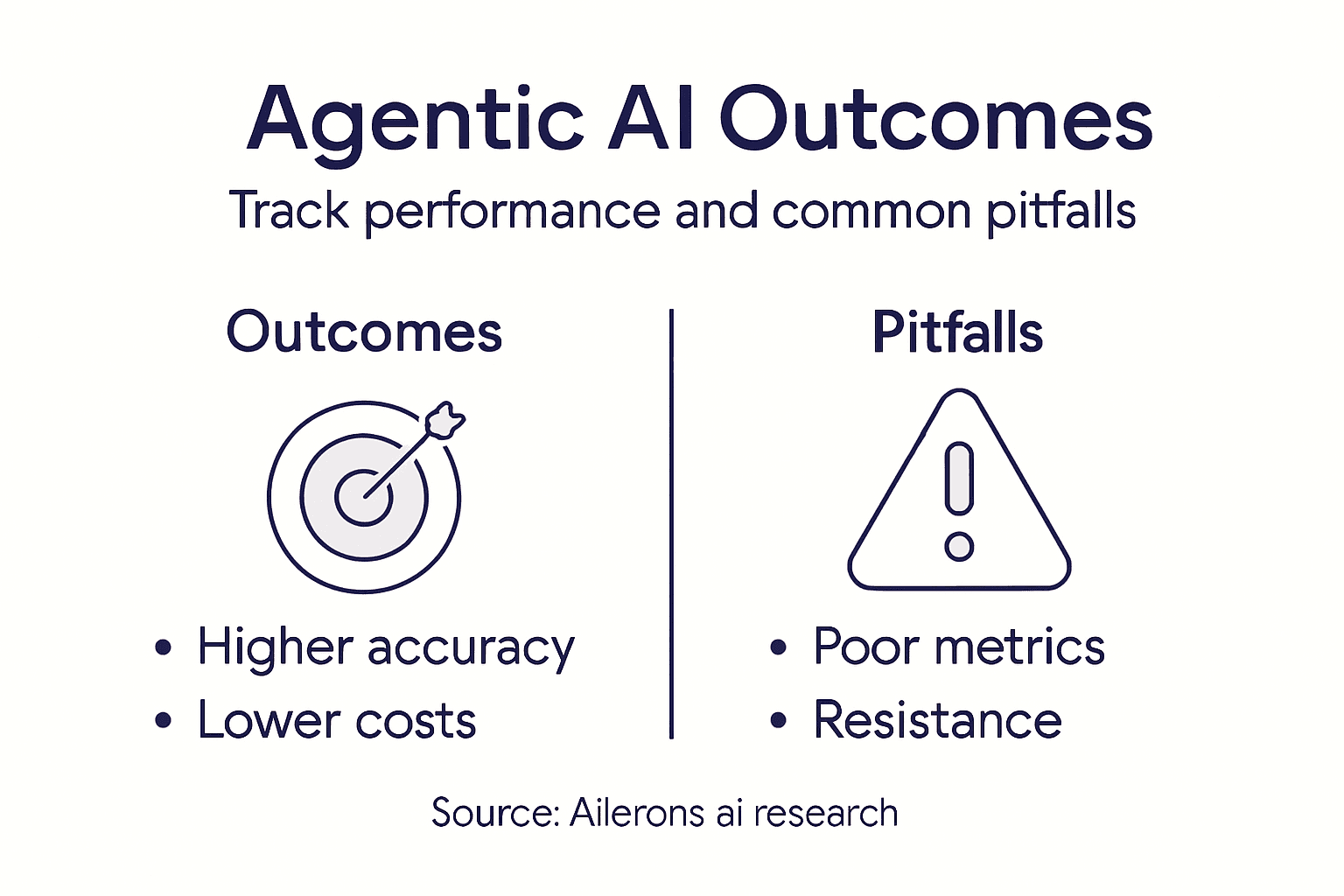
Measurable Outcomes and Common Pitfalls
Agentic AI implementation delivers significant organizational benefits, but requires strategic planning to maximize potential and mitigate inherent risks. Comprehensive performance measurement strategies enable businesses to quantify the transformative impact of intelligent automation across multiple operational dimensions.
Key measurable outcomes of successful agentic AI integration include:
- Operational Efficiency: Dramatic reduction in processing times
- Error Rate Reduction: Minimizing human-induced mistakes
- Cost Optimization: Lowering overall operational expenses
- Compliance Enhancement: Improving regulatory adherence
- Scalability: Enabling rapid workflow expansion
Businesses must remain vigilant about potential implementation challenges that can undermine automation strategies. Understanding and anticipating common pitfalls allows organizations to develop robust mitigation approaches that protect their technological investments and strategic objectives.
Critical pitfalls to avoid during agentic AI implementation include:
- Insufficient strategic alignment
- Inadequate stakeholder engagement
- Overlooking process complexity
- Neglecting data quality standards
- Underestimating change management requirements
Successful agentic AI implementation transcends technological deployment, requiring a holistic approach that balances technical capabilities with organizational readiness.
Pro tip: Establish clear, measurable key performance indicators before launching your agentic AI initiative to track meaningful progress and demonstrate tangible value.
Unlock True Operational Excellence with Agentic AI from Ailerons.ai
If you are facing challenges with outdated, rule-based automation that fails to adapt to complex, variable workflows this article highlights exactly why agentic AI is the game changer your business needs. The frustrations of rigid scripts, frequent manual interventions, and limited exception handling keep holding operations back. You deserve a system that can reason, learn, and execute multi-step tasks from end to end while seamlessly integrating with your existing CRM, ERP, and document platforms.
At Ailerons.ai, we specialize in advanced agentic AI systems designed precisely to overcome these pain points by transforming your office and operational workflows into intelligent, autonomous digital collaborators. Our solutions enable you to reduce operational friction, improve accuracy, and scale efficiently without proportionally increasing staff. Explore how we build secure, compliant, and outcome-focused AI architectures on our main site and discover the future of automation with end-to-end workflow orchestration.
Don’t let your business be stuck with static automation. Experience the power of agentic AI that thinks, adapts, and executes in real time. Visit Ailerons.ai today and take the first step toward revolutionizing your business operations.
Frequently Asked Questions
What is end-to-end business automation?
End-to-end business automation involves comprehensively digitizing and interconnecting an organization’s workflows from start to finish. It aims to streamline operations by leveraging advanced technologies to create seamless and intelligent workflow ecosystems.
How does agentic AI differ from traditional automation?
Agentic AI differs from traditional automation in that it incorporates cognitive capabilities allowing for dynamic decision-making and adaptability. Traditional automation operates on fixed rules, while agentic AI can analyze complex scenarios, learn from interactions, and adjust its processes autonomously.
What are the key benefits of using agentic AI in business operations?
The key benefits of using agentic AI in business operations include enhanced process complexity management, reduced human intervention requirements, intelligent workflow optimization, sophisticated anomaly detection, and adaptive performance improvements that lead to better efficiency and decision-making.
What challenges should be considered when implementing agentic AI?
When implementing agentic AI, organizations should be cautious of common pitfalls such as insufficient strategic alignment, inadequate stakeholder engagement, overlooking process complexity, neglecting data quality, and underestimating change management requirements.