

Traditional office automation tools fail because they can’t adapt to real-world complexity. They follow rigid scripts, break when exceptions occur, and require constant human intervention. Agentic AI changes this by combining reasoning, context awareness, and autonomous decision-making to handle end-to-end workflows. This guide shows you exactly how to deploy agentic AI systems that transform your office operations with measurable results.
Table of Contents
- Introduction To Agentic Ai In Office Operations
- Prerequisites And Preparation For Automation
- Implementation Steps For Agentic Ai In Office Automation
- Common Mistakes And Troubleshooting
- Expected Results And Success Metrics
- Security And Compliance Considerations
- Alternative Approaches And Tradeoffs
- Conclusion And Next Steps
- Unlock Your Office Automation Potential With Ailerons Ai Consulting
- FAQ
Key Takeaways
| Point | Details |
|---|---|
| Manual task reduction | Agentic AI reduces manual office tasks by over 70% through autonomous multi-step workflows. |
| Organizational readiness | Success requires thorough workflow audits, clear KPIs, and cross-department stakeholder alignment. |
| Pilot testing essential | Start with controlled pilots, establish exception handling, and scale gradually with continuous monitoring. |
| Security and compliance | Implement strict identity controls and regulatory adherence from day one to mitigate operational risks. |
| Measurable outcomes | Track efficiency gains, cost reductions, and workflow improvements within 6-9 months of deployment. |
Introduction to Agentic AI in Office Operations
Agentic AI represents a fundamental shift from task-based automation to intelligent orchestration. Unlike traditional automation that follows predetermined scripts, agentic AI systems reason through problems, adapt to context, and execute multi-step processes autonomously. When a scheduling conflict arises or an invoice needs approval routing, agentic AI evaluates the situation, considers business rules, and takes appropriate action without human input.
The difference shows up in real office scenarios. Traditional automation might trigger an email when a form is submitted. Agentic AI reviews the form, validates data across multiple systems, routes it through approval chains based on content and value, updates CRM records, schedules follow-up tasks, and escalates exceptions to the right person with full context. This agentic AI impact in office automation transforms how work gets done.
Consider billing operations. Manual processing involves data entry, validation checks, approval routing, system updates, and exception handling. Each step requires human judgment and cross-referencing multiple platforms. Agentic AI handles this entire workflow autonomously, processing invoices from receipt through payment scheduling while flagging anomalies for review.

The efficiency gains are substantial. Organizations deploying agentic AI for office operations report 60-80% reductions in manual task time, faster processing cycles, and fewer errors. These systems work continuously, maintaining consistency across shifts and scaling without proportional staff increases.
Pro tip: Start by mapping your most repetitive multi-step workflows. The best candidates for agentic AI involve predictable business logic but require contextual decisions at each stage.
Key capabilities that differentiate agentic AI:
- Context awareness across systems and historical data
- Goal-oriented task planning and execution
- Dynamic exception handling and escalation
- Multi-platform integration and data synchronization
- Continuous learning from outcomes and feedback
Prerequisites and Preparation for Automation
Successful agentic AI deployment starts long before implementation. You need clear visibility into current workflows, defined success metrics, and organizational buy-in. This preparation phase determines whether your automation delivers transformative results or becomes another abandoned technology project.
Begin with comprehensive workflow audits. Document how work moves through your organization, identifying bottlenecks, manual handoffs, and decision points. Map integration requirements with existing systems like CRM, ERP, accounting platforms, and document management. This audit reveals automation opportunities and technical dependencies.
Define measurable business objectives and KPIs before selecting solutions. Are you reducing processing time, cutting operational costs, improving accuracy, or scaling capacity? Specific targets like “reduce invoice processing time by 50%” or “handle 3x transaction volume without additional staff” guide implementation decisions and provide clear success benchmarks.
Stakeholder engagement across departments prevents resistance and ensures practical design. Include operations teams who understand daily workflows, IT staff who manage integrations, compliance officers who know regulatory requirements, and executives who approve budgets. Early involvement builds support and surfaces concerns before they become blockers.
Your IT infrastructure assessment should evaluate system compatibility, API availability, data accessibility, and security architecture. Agentic AI needs to read from and write to multiple platforms seamlessly. Identifying integration gaps now prevents costly surprises during deployment. The AI integration planning checklist helps structure this technical review.
Establish security and compliance policies aligned with industry regulations. Define access controls, data handling protocols, audit logging requirements, and exception escalation procedures. These safeguards must be designed into your agentic AI architecture from the start, not added later. Organizations that embed security early achieve successful AI-driven automation without compliance incidents.
Critical preparation elements:
- Complete workflow documentation and process mapping
- Defined KPIs tied to business outcomes
- Cross-functional stakeholder alignment and support
- Technical integration assessment and gap analysis
- Security policies and compliance framework establishment
Implementation Steps for Agentic AI in Office Automation
Deploying agentic AI follows a structured approach that minimizes risk while building organizational confidence. Each phase validates assumptions before committing additional resources, creating a path from pilot to enterprise-wide automation.
-
Conduct workflow audits and identify targets. Map current processes in detail, measuring time, cost, error rates, and complexity. Select initial automation candidates based on high volume, clear business rules, and measurable impact. Focus on workflows that cause bottlenecks or consume disproportionate staff time.
-
Define business goals and establish KPIs. Translate operational challenges into specific, measurable targets. Set baseline metrics for processing time, error rates, cost per transaction, and staff hours. These benchmarks prove ROI and guide optimization decisions throughout deployment.
-
Design integration architecture. Plan how agentic AI connects to existing systems. Document API requirements, data flows, authentication methods, and fallback procedures. Address security controls, compliance requirements, and audit logging. This architecture blueprint prevents integration failures that derail projects.
-
Deploy controlled pilot projects. Start with a single well-defined workflow in a contained environment. Build the agentic AI system to handle the complete process, including exception scenarios. Test thoroughly with real data and edge cases. Validate that autonomous decisions match business logic and regulatory requirements. The AI-driven automation guide walks through pilot best practices.
-
Implement dynamic exception handling. Program your agentic AI to recognize when situations exceed its decision authority or encounter unexpected conditions. Define escalation paths, notification procedures, and context handoff to human reviewers. Strong exception management prevents workflow breakdowns and builds user trust.
-
Scale gradually with monitoring. After pilot validation, expand to additional workflows incrementally. Deploy monitoring dashboards tracking KPIs, error rates, and system performance. Establish feedback loops where operations teams report issues and suggest improvements. This measured scaling approach follows proven business automation steps while maintaining quality.
-
Tune performance continuously. Review metrics weekly during initial deployment, adjusting business rules, improving exception handling, and optimizing integration performance. Agentic AI improves through feedback, so capture learnings from every workflow execution. Organizations implementing agentic AI compliance workflow automation see ongoing efficiency gains through systematic tuning.
Pro tip: Document every business rule and decision logic explicitly. When agentic AI makes unexpected choices, clear documentation helps you understand why and adjust appropriately.
| Implementation Phase | Timeline | Key Activities | Success Indicators |
|---|---|---|---|
| Audit and Planning | 2-4 weeks | Workflow mapping, KPI definition, stakeholder alignment | Complete process documentation, approved metrics |
| Architecture Design | 2-3 weeks | Integration planning, security design, compliance review | Technical blueprint, security approval |
| Pilot Deployment | 4-8 weeks | Build, test, validate single workflow | Successful autonomous execution, exception handling |
| Scaling | 3-6 months | Expand to additional workflows, continuous monitoring | KPI achievement, operational adoption |
| Optimization | Ongoing | Performance tuning, rule refinement, capability expansion | Sustained efficiency gains, reduced exceptions |
For detailed technical setup guidance, reference this agentic AI setup guide covering architecture patterns and integration approaches.
Common Mistakes and Troubleshooting
Most agentic AI deployments fail due to preventable mistakes rather than technical limitations. Understanding these pitfalls helps you avoid costly delays and implementation failures.
Weak exception handling causes the most frequent breakdowns. When your agentic AI encounters unexpected situations without clear escalation logic, workflows stall and errors propagate. Design robust exception recognition from the start, defining specific conditions that trigger human review and ensuring smooth context handoff. Systems without dynamic exception management become glorified scripts that fail under real-world complexity.
Insufficient integration testing contributes to approximately 40% of deployment breakdowns, according to Audit Firms AI Deployment Study. Organizations skip thorough testing of system connections, data validation, and edge cases, discovering integration failures only after production deployment. Test every integration point extensively with realistic data volumes and scenarios before scaling. The AI integration checklist prevents common integration oversights.
Missing or poorly defined KPIs prevent you from measuring success or identifying problems early. Without baseline metrics and targets, you can’t determine if your agentic AI delivers value or needs adjustment. Establish measurement frameworks before deployment, capturing pre-automation performance data for comparison.
Stakeholder resistance derails projects when operations teams feel excluded or threatened. Users who don’t understand how agentic AI works or fear job loss resist adoption, undermining efficiency gains. Involve affected teams early, communicate transparently about goals and roles, and provide training that builds confidence. Position agentic AI as a tool that eliminates tedious work, not replaces people.
Delaying security and compliance design creates vulnerabilities and regulatory risks. Organizations that add security controls after building workflows face expensive rework and potential data breaches. Embed identity management, access controls, audit logging, and compliance checks into your initial architecture.
Common troubleshooting strategies:
- Review exception logs systematically to identify patterns and improve handling logic
- Validate data flows across integrations when workflows produce unexpected results
- Adjust business rules incrementally based on operational feedback rather than wholesale changes
- Monitor performance metrics continuously to detect degradation before users report issues
- Maintain detailed documentation of every configuration change for troubleshooting context
For detailed information on deployment errors and prevention, see this analysis of audit firm AI deployment errors.
Expected Results and Success Metrics
Agentic AI delivers measurable operational improvements when deployed systematically. Understanding realistic benchmarks helps you set appropriate expectations and recognize when performance falls short.
Typical organizations achieve 60-80% reductions in manual task execution for automated workflows within the first six months. Tasks that previously required human attention at every step run autonomously, freeing staff for higher-value work. Processing time for workflows like invoice approval, document routing, or scheduling coordination drops by 50-70%.
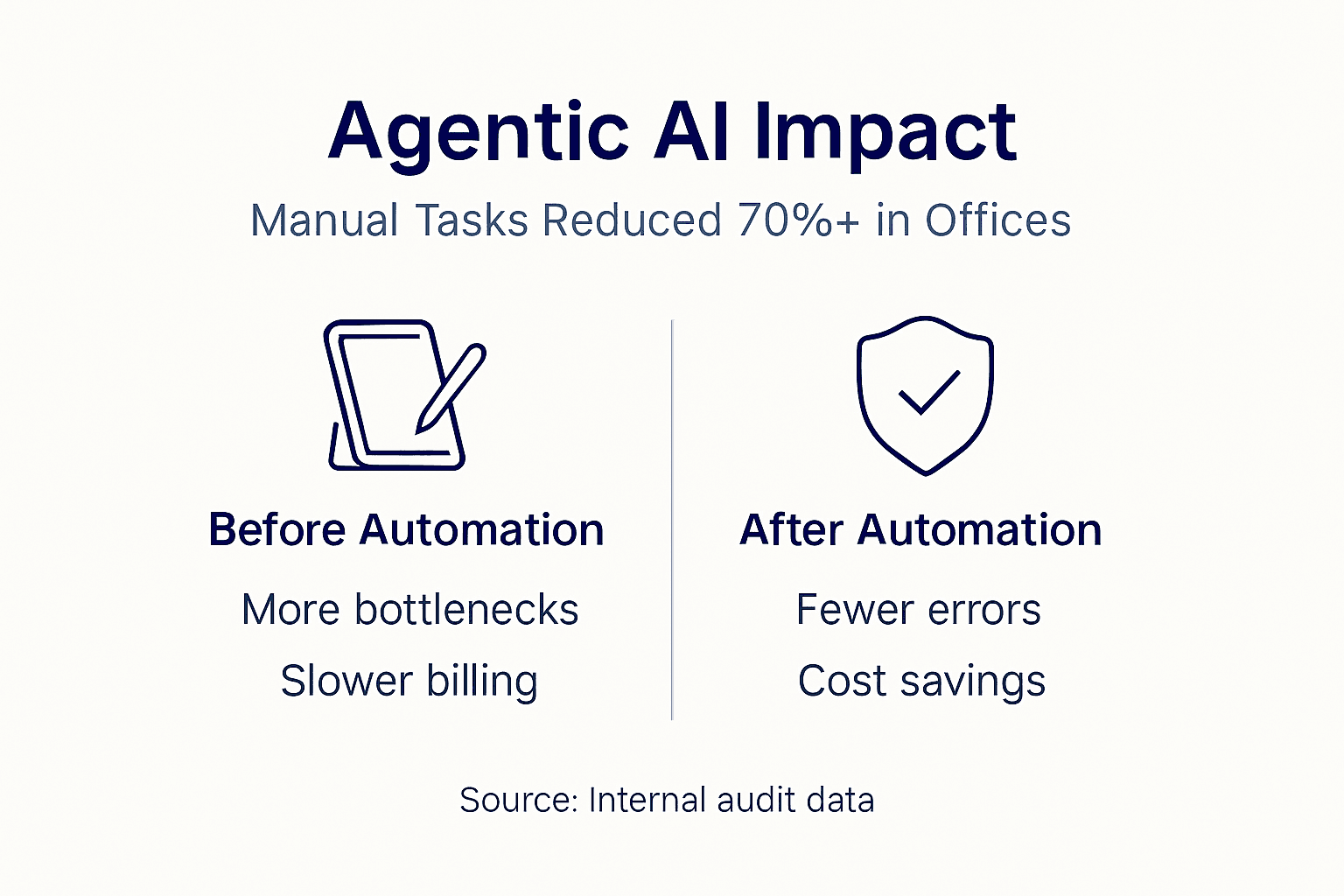
Operational cost savings average 40-60% for fully automated workflows, primarily through reduced labor hours and faster throughput. These savings compound as you scale automation across additional processes. Organizations handling increased transaction volumes without proportional staff growth demonstrate agentic AI’s scalability advantage.
Workflow efficiency metrics show substantial improvement:
| Metric | Pre-Automation Baseline | Post-Automation (6 months) | Improvement |
|---|---|---|---|
| Invoice processing time | 4-6 hours | 15-30 minutes | 85% reduction |
| Scheduling conflicts resolved | 60% manual intervention | 95% autonomous | 35% improvement |
| Document routing accuracy | 92% (human errors) | 99.5% (consistent logic) | 7.5% improvement |
| Exception escalation time | 2-3 hours average | 5-10 minutes | 95% reduction |
KPI achievement typically requires 6-9 months from initial pilot to scaled deployment. The timeline varies based on workflow complexity, integration challenges, and organizational readiness. Organizations that follow structured implementation phases and address issues proactively reach targets faster.
Security incident reduction occurs when agentic AI enforces consistent compliance checks that humans might skip under time pressure. Automated audit logging and systematic exception handling improve risk management and regulatory adherence. Learn more about efficiency measurement at business process management efficiency.
Did you know? Organizations monitoring agentic AI performance weekly during the first six months achieve 25-30% better outcomes than those reviewing monthly, according to deployment tracking data.
Continuous performance monitoring remains essential beyond initial deployment. Track leading indicators like exception rates, processing times, and integration failures to identify issues before they impact operations. Regular review cycles support ongoing optimization, ensuring your agentic AI adapts to changing business requirements.
Security and Compliance Considerations
Agentic AI systems handling office workflows access sensitive data and make consequential business decisions. Robust security and compliance frameworks protect your organization while enabling autonomous operation.
Strict identity and access management forms the foundation. Implement role-based access controls that limit what each agentic AI instance can read, write, and execute. Use service accounts with minimal necessary privileges rather than broad system access. Require multi-factor authentication for administrative functions and regular credential rotation.
Regulatory compliance requirements vary by industry and geography but share common principles. Maintain complete audit trails documenting every action your agentic AI takes, including decision inputs, logic applied, and outcomes. Ensure data handling practices meet standards like GDPR, HIPAA, or SOC 2 depending on your sector. Design data retention and deletion procedures that satisfy legal requirements.
Cloud security best practices apply when deploying agentic AI on cloud platforms. Encrypt data in transit and at rest. Segment networks to isolate AI systems from unnecessary resources. Monitor for unusual access patterns or data exfiltration attempts. Use cloud-native security tools for threat detection and automated response.
Risk assessment identifies potential vulnerabilities specific to AI systems. Evaluate risks like unauthorized access, data poisoning, adversarial inputs, or unintended consequences from autonomous decisions. Implement controls addressing each identified risk, balancing security with operational efficiency.
Building user trust requires transparency about how agentic AI operates. Document decision logic, explain automation boundaries, and provide visibility into actions taken. Users who understand what the system does and why are more likely to accept and effectively collaborate with autonomous workflows.
Pro tip: Implement a security review gate before scaling each new workflow. A 30-minute security assessment catches configuration issues that could create vulnerabilities in production.
Essential security elements:
- Role-based access controls with least-privilege principles
- Comprehensive audit logging of all system actions
- Encryption for data protection in transit and storage
- Regular security assessments and penetration testing
- Incident response procedures specific to AI systems
- Compliance validation against relevant regulatory standards
Alternative Approaches and Tradeoffs
Agentic AI isn’t the only office automation option. Understanding alternatives helps you choose the right approach for your specific needs and constraints.
Low-code and no-code platforms offer faster initial deployment for simple workflows. You can build basic automation without extensive technical expertise, connecting applications through visual interfaces. These tools work well for straightforward tasks like form submissions or notification triggers. However, they struggle with complex multi-step processes requiring contextual decisions and lack the autonomous reasoning that defines agentic AI.
Traditional robotic process automation mimics human interactions with software interfaces. RPA handles repetitive tasks efficiently but breaks when interfaces change or exceptions occur. It requires constant maintenance and can’t adapt to new situations without reprogramming. Agentic AI’s reasoning capability allows it to handle variations and exceptions dynamically.
Custom software development provides complete control but demands significant time and resources. Building bespoke automation gives you exactly what you need but requires ongoing maintenance and updates. Agentic AI platforms offer comparable capability with faster deployment and built-in improvement mechanisms.
| Approach | Deployment Speed | Reasoning Capability | Exception Handling | Integration Depth | Best For |
|---|---|---|---|---|---|
| Agentic AI | Medium (2-4 months pilot) | High (autonomous decisions) | Dynamic (context-aware) | Deep (multi-system) | Complex workflows requiring judgment |
| Low-Code/No-Code | Fast (days to weeks) | Low (predetermined logic) | Limited (predefined rules) | Moderate (API-based) | Simple, linear processes |
| RPA | Fast (1-2 weeks) | None (scripted actions) | Poor (breaks on exceptions) | Surface (UI-based) | Repetitive, stable tasks |
| Custom Development | Slow (3-6 months) | Variable (as designed) | Variable (as designed) | Complete (as designed) | Unique requirements, full control needed |
Selection criteria depend on your workflow complexity. Choose agentic AI when processes involve multiple decision points, require cross-system coordination, or encounter frequent exceptions. Opt for simpler tools when workflows follow rigid paths without variation.
Long-term ROI favors agentic AI despite higher initial implementation effort. The autonomous adaptation and scalability deliver compounding returns as you expand automation across your organization. Initial deployment may take longer, but you avoid the constant maintenance and limitation walls that plague simpler approaches.
Consider these tradeoffs:
- Deployment speed versus long-term capability
- Initial cost versus ongoing maintenance burden
- Technical complexity versus operational flexibility
- Vendor lock-in versus custom development control
- Autonomous intelligence versus predictable scripting
Conclusion and Next Steps
Agentic AI transforms office automation from rigid scripting to intelligent orchestration. By enabling autonomous reasoning, context awareness, and dynamic exception handling, these systems handle complete workflows that previously required constant human supervision. The 60-80% reductions in manual tasks and substantial efficiency gains justify the investment for organizations ready to move beyond traditional automation limits.
Successful deployment requires thorough preparation. Complete workflow audits, define clear KPIs, engage stakeholders across departments, and design robust security from the start. Follow structured implementation phases starting with controlled pilots, validating performance before scaling gradually. Monitor continuously and tune based on operational feedback to sustain improvements.
Start your journey with a single high-impact workflow. Prove the value, build organizational confidence, and expand systematically. The measured approach minimizes risk while delivering tangible results that fund broader automation initiatives. Organizations that embrace pilot testing and commit to continuous improvement achieve the transformational outcomes agentic AI enables.
Invest time in understanding your unique requirements, selecting appropriate technology partners, and building internal capability. The shift to agentic AI represents a strategic advantage, positioning your organization to scale operations without proportional cost increases. Take the first step by mapping your automation candidates and defining success metrics today.
Unlock Your Office Automation Potential with Ailerons AI Consulting
Ailerons specializes in designing and deploying agentic AI systems for office operations. Our expertise covers workflow analysis, integration architecture, security design, and scaled implementation tailored to your business. We guide you from initial assessment through production deployment, ensuring your automation delivers measurable efficiency gains and ROI. Discover how future of operational AI 2026 trends shape strategic planning. Explore our proven methodology in the AI-driven office automation success guide. Contact AILERONS IT consulting services to start your transformation with professional guidance built on enterprise deployment experience.
FAQ
What is the key difference between agentic AI and traditional office automation?
Agentic AI autonomously plans and executes complex workflows by reasoning through context and making decisions at each step. Traditional automation follows fixed scripts without adapting to exceptions or changing conditions. This reasoning capability allows agentic AI to handle real-world complexity that breaks scripted approaches.
How can organizations prepare before implementing agentic AI office automation?
Conduct comprehensive workflow audits documenting current processes, bottlenecks, and integration requirements. Define specific KPIs and success metrics tied to business outcomes. Engage cross-functional stakeholders early to build support and surface practical requirements. Assess IT infrastructure compatibility and establish security policies before deployment begins.
What are common pitfalls to avoid during deployment?
Never skip thorough integration testing and pilot validation phases, as 40% of failures stem from insufficient testing. Implement robust exception handling logic from the start so your agentic AI knows when and how to escalate situations beyond its authority. Establish clear KPIs before deployment to measure success and identify issues early.
Which metrics best measure agentic AI automation success?
Track reductions in manual task execution hours and processing time for automated workflows. Monitor accuracy rates, exception frequencies, and cost per transaction compared to pre-automation baselines. Measure workflow throughput capacity and staff time freed for higher-value activities. Review these metrics within 6-9 months to validate ROI.
How is security ensured in AI-driven office automation?
Implement strict role-based access controls limiting each agentic AI instance to minimum necessary privileges. Maintain comprehensive audit logs of all system actions for compliance and troubleshooting. Encrypt data in transit and at rest while following cloud security best practices. Conduct regular security assessments and validate compliance with relevant regulatory standards throughout operation.
Recommended
- Step-by-Step Guide to AI-Driven Office Automation Success | Ailerons IT Consulting
- Office Operations Automation Trends: Agentic AI Impact | Ailerons IT Consulting
- AI Trends in 2026: Transforming Office Operations | Ailerons IT Consulting
- AI in Business Process Management: Unlocking Efficiency | Ailerons IT Consulting
- Amlogy at TedAI Vienna 2025: Exclusive Insights