

Many mid-sized companies investing in autonomous AI hit a sobering reality: only a small percentage advance beyond prototypes, with most agents requiring frequent human intervention. The gap between vendor promises and operational outcomes leaves executives confused about what autonomous AI can realistically deliver. This guide cuts through the hype to show you exactly what works in office operations today. You will learn proven implementation models, measurable ROI data, practical risk controls, and a clear roadmap to start autonomous AI initiatives that actually scale. Whether you manage IT infrastructure or operational workflows, understanding these fundamentals separates successful deployments from expensive experiments.
Table of Contents
- What Autonomous AI Means For Office Operations In 2026
- Proven Use Cases And ROI From Autonomous AI In Operations
- Operational Challenges And Risk Management For Autonomous AI Deployments
- Practical Roadmap To Adopt Autonomous AI In Mid-Sized Office Operations
- Explore How Ailerons Empowers Your AI Transformation
- FAQ
Key takeaways
| Point | Details |
|---|---|
| Efficiency gains | Autonomous AI delivers 70% cost reductions and 30% efficiency improvements in targeted workflows like invoice processing and supply chain operations. |
| Implementation approach | Successful deployments require structured pilots, human-in-the-loop architecture, and governance guardrails rather than full autonomy from day one. |
| ROI performance | Mid-sized businesses achieve median returns of 159.8% over 24 months, with some reaching nearly 2000% ROI in high-volume operational areas. |
| Risk mitigation | Edge cases and model drift remain challenges, making hybrid augmentation strategies more reliable than complete automation in 2026. |
| Scaling strategy | Starting with well-defined workflows and expanding incrementally with active monitoring produces higher success rates than broad deployments. |
What autonomous AI means for office operations in 2026
Autonomous AI differs fundamentally from traditional automation by making goal-oriented decisions rather than following rigid scripts. Where rules-based systems execute predefined steps, autonomous AI combines sensors, reasoning engines, action execution, and learning loops enabling adaptive responses to changing conditions. This architecture allows systems to handle complex, dynamic workflows without constant human reprogramming.
The core components work together seamlessly. Data intake sensors monitor documents, emails, system events, and user requests across your operational environment. Reasoning engines analyze this information against business logic and historical patterns to determine optimal actions. Execution agents carry out decisions by updating records, routing approvals, triggering notifications, or escalating exceptions. Feedback loops capture outcomes and refine future decision-making, creating systems that improve over time.
Office operations benefit particularly from this adaptive capability because workflows rarely follow perfect patterns. Consider invoice processing: autonomous AI recognizes vendor variations, matches purchase orders with delivery confirmations, flags discrepancies for review, and routes approvals based on amount thresholds and departmental authority. The system adjusts to new vendors, changing approval hierarchies, and regulatory updates without manual rule modifications. Understanding these types of AI automation helps you identify where autonomous approaches add the most value.
A critical misconception persists that autonomous AI eliminates human oversight entirely. In reality, successful deployments augment human judgment rather than replacing it. Systems handle routine decisions within defined confidence thresholds while escalating edge cases, unusual patterns, or high-stakes choices to human operators. This hybrid model maintains operational safety while freeing your team from repetitive tasks.
Pro Tip: Start with workflow components that have clear success criteria and measurable outcomes. Invoice matching, IT ticket routing, and document classification build confidence in autonomous decision-making before tackling more complex processes.
“The most successful autonomous AI deployments in 2026 focus on augmentation, not replacement. Systems that know when to ask for help outperform those designed for complete independence.”
Key characteristics distinguishing autonomous AI in operations:
- Goal-directed behavior that adapts strategies to achieve defined outcomes
- Context awareness across multiple data sources and business systems
- Decision-making within learned parameters and confidence boundaries
- Continuous improvement through feedback integration and pattern recognition
- Graceful escalation when encountering unfamiliar scenarios or low-confidence predictions
Proven use cases and ROI from autonomous AI in operations
Real-world deployments demonstrate measurable business impact across core operational areas. The most successful implementations target high-volume, repetitive processes where autonomous AI delivers immediate efficiency gains and cost reductions. These applications provide concrete evidence for building your business case.

Invoice processing leads adoption with documented results. Systems achieve over 90% accuracy with 70% cost reduction by automating data extraction, validation, matching, and routing. Autonomous agents handle vendor variations, currency conversions, tax calculations, and approval workflows without manual intervention. Processing time drops from days to minutes while error rates fall below human baseline performance.
HR onboarding automation eliminates administrative bottlenecks. Autonomous AI coordinates across systems to provision accounts, assign training modules, schedule orientations, order equipment, and track completion milestones. New employees experience consistent, personalized onboarding while HR teams focus on relationship building rather than checklist management. Time to productivity decreases by 40% in documented implementations.
IT incident response benefits from intelligent triage and resolution. Systems analyze tickets, classify severity, match against known solutions, execute remediation scripts, and escalate complex issues with full context. Customer service costs drop by 60% while mean time to resolution improves dramatically. Understanding business process management with AI reveals how these efficiencies compound across operations.
| Use Case | Cost Reduction | Time Savings | Accuracy Improvement | | — | — | — | | Invoice Processing | 70% | 85% faster | 90%+ accuracy | | Supply Chain Optimization | 40% | 30% efficiency gain | 25% fewer stockouts | | Customer Service Automation | 60% | 50% faster resolution | 35% higher satisfaction | | IT Incident Management | 45% | 65% faster MTTR | 80% first-contact resolution | | HR Onboarding | 55% | 40% faster productivity | 90% compliance rate |
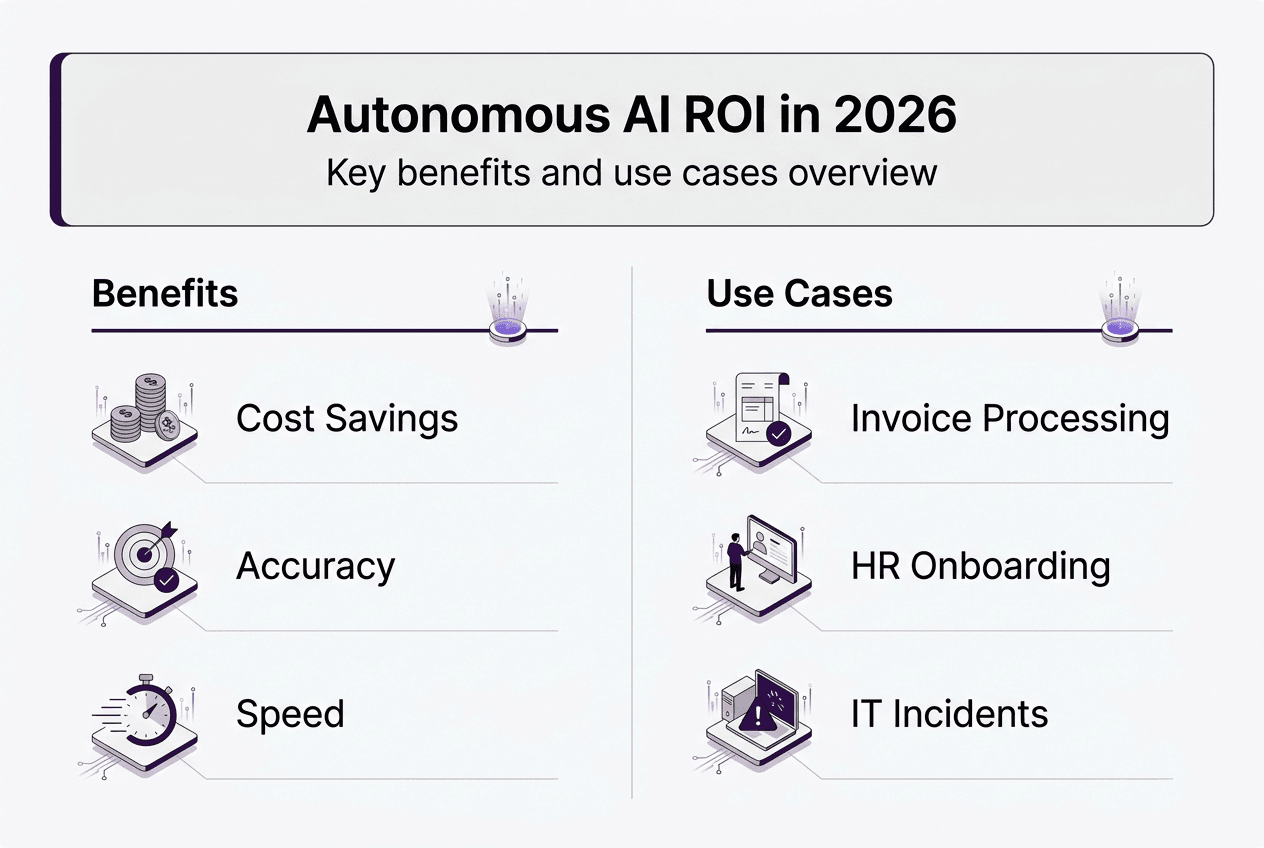
Financial returns justify investment quickly. Median ROI from B2B autonomous AI deployments reaches 159.8% over 24 months, with small and mid-sized businesses seeing returns up to 1893% in high-volume scenarios. Many deployments break even within 8 months as efficiency gains and cost reductions accumulate. The key lies in selecting processes with clear metrics and substantial manual effort.
Payback periods vary by use case complexity and deployment scale. Simple automation like document classification delivers returns within 3 months. Complex multi-system workflows require 6 to 12 months for full ROI realization. Organizations tracking relevant KPIs demonstrate value faster and gain stakeholder support for expansion. Current automation trends in office operations show accelerating adoption as success stories multiply.
Pro Tip: Track operational KPIs like mean time to resolution, processing cost per transaction, and error rates before deployment. Baseline measurements prove ROI and identify optimization opportunities as you scale autonomous AI initiatives.
“The businesses achieving highest ROI focus on processes with measurable volume, clear success criteria, and significant manual effort. Start where impact is obvious and expand from proven wins.”
Critical success factors for ROI:
- Clear process definition with measurable outcomes and success metrics
- Sufficient transaction volume to justify development and deployment costs
- Existing data quality supporting accurate AI decision-making
- Stakeholder alignment on goals, metrics, and acceptable performance thresholds
- Phased rollout allowing iterative refinement before full-scale deployment
Operational challenges and risk management for autonomous AI deployments
Deployment challenges emerge as systems move from controlled pilots to production environments. Understanding these risks and implementing appropriate controls separates successful long-term deployments from expensive failures. Mid-sized companies must balance innovation speed with operational stability.
Common failure modes include model drift, low-confidence predictions, sensor malfunctions, and distribution shifts. Model drift occurs when business processes evolve but AI decision logic remains static, gradually degrading performance. Low-confidence predictions happen when systems encounter scenarios outside training data, potentially triggering incorrect actions. Sensor failures from API changes, data format updates, or system integrations breaking cause autonomous agents to operate on incomplete information. Distribution shifts drop success rates from 95% in lab environments to 80% in production as real-world complexity exceeds test scenarios.
| Approach | Advantages | Disadvantages | Best Use Cases |
|---|---|---|---|
| Full Autonomy | Maximum efficiency, minimal human intervention, scales infinitely | Higher risk, edge case failures, requires extensive testing | High-volume, low-stakes, well-defined processes |
| Human-in-the-Loop | Reliable performance, graceful handling of exceptions, builds trust | Lower efficiency gains, requires human availability, scaling constraints | Complex decisions, high-stakes outcomes, evolving workflows |
Hybrid architectures dominate successful deployments. 88.5% of top AI projects integrate human-in-the-loop systems, enabling autonomous handling of routine cases while escalating edge scenarios. This approach maintains operational safety without sacrificing efficiency gains. Systems learn from human decisions on escalated cases, continuously expanding autonomous capability.
Best practices for risk mitigation:
- Implement active learning loops that flag low-confidence predictions for human review and model refinement
- Deploy runtime monitoring tracking prediction confidence, processing times, error rates, and escalation frequency
- Establish guardrails defining acceptable decision boundaries, escalation triggers, and fallback procedures
- Create governance policies specifying approval workflows, audit requirements, and performance thresholds
- Design graceful degradation allowing systems to operate in reduced capacity when components fail
- Maintain human oversight for high-stakes decisions regardless of system confidence levels
Reliability engineering principles become essential. Systems must detect failures, execute fallback procedures, and alert operators without causing operational disruption. Autonomous invoice processing should queue transactions for manual review rather than reject payments when confidence drops. IT incident response should escalate tickets rather than attempt uncertain remediation. Organizations exploring future operational AI 2026 capabilities must prioritize reliability alongside capability.
Pro Tip: Deploy incrementally with extensive monitoring during initial rollout phases. Catching edge cases early prevents costly operational disruptions and builds organizational confidence in autonomous systems.
The AI deployment gap between prototype success and production reliability requires deliberate risk management:
- Comprehensive testing across realistic scenarios including edge cases and failure modes
- Staged rollout starting with low-risk processes before expanding to critical workflows
- Continuous validation comparing autonomous decisions against human baselines
- Regular model retraining incorporating new data and evolving business logic
- Clear escalation paths ensuring human experts handle uncertain or high-stakes situations
“The gap between lab performance and production reliability stems from underestimating real-world complexity. Successful deployments assume edge cases will occur and design systems to handle them gracefully.”
Practical roadmap to adopt autonomous AI in mid-sized office operations
Successful implementation follows a structured approach balancing ambition with pragmatism. This roadmap guides you from initial pilots through scaled deployment, ensuring measurable value at each stage while managing risk appropriately.
Step-by-step deployment process:
- Define specific problems with clear success metrics and baseline performance measurements
- Map current workflows documenting decision points, data sources, system interactions, and exception handling
- Design pilot deployments with human-in-the-loop architecture and limited scope
- Implement monitoring capturing prediction confidence, processing times, error rates, and escalation patterns
- Measure results against baseline KPIs and refine models based on operational feedback
- Scale gradually expanding to additional workflows while maintaining governance controls
- Establish continuous improvement processes incorporating new data and evolving requirements
Problem selection determines pilot success. Start small targeting repetitive, high-volume workflows where autonomous AI delivers obvious value. Invoice processing, IT ticket routing, and document classification provide measurable wins building organizational confidence. Avoid complex, high-stakes processes until you have proven capability and established governance.
Key implementation components:
- Clear problem definition with quantifiable success criteria and acceptable performance thresholds
- Comprehensive workflow mapping identifying automation opportunities and necessary human touchpoints
- Pilot design incorporating human validation, feedback loops, and performance monitoring
- Technology selection balancing capability, integration requirements, and operational constraints
- Governance framework specifying approval workflows, audit procedures, and escalation protocols
- Stakeholder alignment ensuring business owners, IT teams, and end users support deployment
Iterative learning accelerates capability development. Each deployment cycle generates insights about edge cases, integration challenges, and user adoption patterns. Capture these learnings systematically to inform subsequent rollouts. Organizations treating autonomous AI as an ongoing capability rather than a one-time project achieve better long-term results. Exploring approaches for improving business workflows with AI reveals optimization opportunities across operations.
Guardrails maintain operational safety as you scale. Define confidence thresholds triggering human review, establish approval requirements for high-value decisions, and implement circuit breakers halting processing when error rates spike. These controls prevent isolated failures from cascading into operational crises while allowing autonomous systems to handle routine cases efficiently.
Pro Tip: Resist pressure to deploy full autonomy initially. Hybrid human-in-the-loop approaches deliver better outcomes in early stages, building trust and capability before expanding autonomous decision-making authority.
Measure success objectively using operational metrics:
- Mean time to resolution for IT incidents and customer service requests
- Processing cost per transaction across invoice, HR, and administrative workflows
- Error rates and rework frequency compared to manual baseline performance
- Employee satisfaction and adoption rates among users interacting with autonomous systems
- Time to value measuring how quickly new capabilities reach production
Stakeholder communication ensures sustained support. Share wins visibly, acknowledge challenges transparently, and demonstrate continuous improvement. Executive sponsors need ROI evidence, operational teams need reliability assurance, and end users need clear value from reduced manual work. Successful deployments address all three audiences consistently. Understanding end-to-end business automation possibilities helps frame long-term vision while maintaining focus on incremental progress.
“The most successful autonomous AI deployments start with boring, repetitive processes and expand systematically. Flashy use cases make great demos but often fail in production. Focus on operational fundamentals first.”
Explore how Ailerons empowers your AI transformation
Navigating autonomous AI deployment requires both technical expertise and operational insight. Ailerons specializes in helping mid-sized companies bridge this gap, designing and implementing agentic AI systems that deliver measurable business outcomes. Our approach focuses on practical value rather than theoretical capability, ensuring your autonomous AI initiatives succeed in production environments.
We have guided organizations across industries through successful deployments, from initial pilots to scaled operations. Our AI case studies showcase real implementations delivering documented ROI, efficiency gains, and operational improvements. These examples demonstrate how autonomous AI transforms office workflows when deployed with appropriate architecture, governance, and risk controls.
Ready to explore how autonomous AI can optimize your operations? Ailerons AI consulting provides tailored guidance matching your specific workflows, systems, and business objectives. We help you identify high-value opportunities, design reliable implementations, and scale successfully while managing risk appropriately. Contact us to discuss your autonomous AI strategy and accelerate your transformation with expert support.
FAQ
What are common use cases for autonomous AI in office operations?
Invoice processing, IT incident management, HR onboarding, customer service automation, and supply chain optimization represent the most proven applications. These workflows benefit from autonomous AI’s ability to handle routine decisions while escalating exceptions, delivering measurable cost reductions of 40% to 70% and time savings of 30% to 85%. Success comes from targeting high-volume, repetitive processes with clear decision criteria.
How can mid-sized companies reduce risks when deploying autonomous AI?
Start with human-in-the-loop pilots that validate decisions before execution, implement comprehensive monitoring tracking confidence levels and error rates, and establish governance guardrails defining escalation triggers. Deploy incrementally beginning with low-stakes workflows, maintain active learning loops incorporating human feedback, and design graceful degradation for component failures. Gradual scaling with continuous validation mitigates edge case risks and model drift while building organizational confidence.
What ROI can businesses expect from autonomous AI in office workflows?
Typical returns range from 150% to nearly 2000% over one to three years depending on use case selection and deployment scale. Mid-sized businesses achieve median ROI of 159.8% over 24 months, with many deployments breaking even within 3 to 8 months as efficiency gains accumulate. Highest returns come from high-volume processes with substantial manual effort, clear success metrics, and existing data quality supporting accurate decision-making.
What is the difference between autonomous AI and traditional automation?
Traditional automation follows predefined rules executing fixed steps regardless of context, while autonomous AI makes goal-oriented decisions adapting to changing conditions. Autonomous systems combine reasoning engines, learning loops, and execution agents enabling them to handle variations, exceptions, and evolving workflows without constant reprogramming. This adaptive capability makes autonomous AI suitable for complex office operations where rigid scripts fail.
Recommended
- Future of Operational AI 2026: Agentic Systems Transforming Work | Ailerons IT Consulting
- AI Trends in 2026: Transforming Office Operations | Ailerons IT Consulting
- Top 5 AI Solutions for Office Operations 2026 | Ailerons IT Consulting
- Intelligent Automation Cuts Admin Overhead 72% in 2026 | Ailerons IT Consulting
- Point Of Sale Trends 2026: Enhancing Retail Efficiency