

Manual financial operations drain resources and introduce costly errors. Mid-sized companies face mounting pressure to process invoices, reconcile accounts, and manage payments with speed and precision. Traditional approaches struggle to keep pace with growing transaction volumes and regulatory demands. Automation powered by agentic AI offers a transformative path forward, enabling systems to reason through complex workflows, adapt to exceptions, and execute multi-step processes autonomously. This guide walks you through the complete automation journey: preparing your organization, executing implementation strategically, and verifying outcomes to ensure sustainable efficiency gains throughout 2026.
Table of Contents
- Understanding The Challenges In Financial Operations And Preparing For Automation
- Executing Financial Operations Automation: Step-By-Step Guide
- Verifying And Optimizing Automated Financial Operations
- Discover Expert Financial Automation Solutions With Ailerons
Key takeaways
| Point | Details |
|---|---|
| Automation drives accuracy | Automated financial processes reduce manual errors by up to 80% while accelerating transaction cycles. |
| Preparation ensures success | Documenting workflows, aligning stakeholders, and assessing technology readiness create a solid foundation. |
| Agentic AI adapts intelligently | Unlike rigid scripts, agentic AI reasons through exceptions and coordinates complex multi-step financial tasks. |
| Verification sustains benefits | Monitoring KPIs and refining algorithms maintains automation accuracy and uncovers optimization opportunities. |
| Tool selection matters | Choosing platforms with integration capabilities and AI decision logic determines long-term scalability. |
Understanding the challenges in financial operations and preparing for automation
Most mid-sized companies wrestle with fragmented financial processes that span multiple systems and require constant manual intervention. Invoice processing alone can involve data entry across three platforms, email approvals, spreadsheet tracking, and payment reconciliation. Each handoff introduces delay and error risk. Payment mismatches, duplicate entries, and compliance gaps become routine frustrations that consume staff time and erode trust.
Digital transformation is pivotal in improving financial operations efficiency in technology sectors. Before launching automation, you need clear visibility into current workflows. Map every step of your accounts payable cycle: who receives invoices, how approvals flow, where data gets entered, and which systems require updates. This documentation reveals bottlenecks, redundancies, and dependencies that automation must address.
Stakeholder alignment proves equally critical. Finance teams worry about losing control, IT leaders question integration complexity, and department managers fear workflow disruption. Schedule working sessions where each group voices concerns and contributes requirements. When people help shape the automation strategy, they become advocates rather than resisters.
Your technology infrastructure determines what automation approaches will succeed. Audit existing systems for API availability, data quality, and integration points. Can your ERP export transaction data in standard formats? Do accounting platforms support webhook triggers? Are customer records consistent across CRM and billing systems? Gaps in these areas create friction that undermines automation value.
Data quality deserves special attention. Automation amplifies existing data problems at scale. Review vendor records for duplicates, validate chart of accounts mappings, and standardize payment terms before automating processes that depend on this information. Clean data enables AI systems to make accurate decisions without constant human correction.
Pro Tip: Involve end users from finance, procurement, and operations in early planning sessions. Their daily experience with process pain points surfaces practical requirements that executives and consultants often miss, leading to automation designs that actually solve real problems.
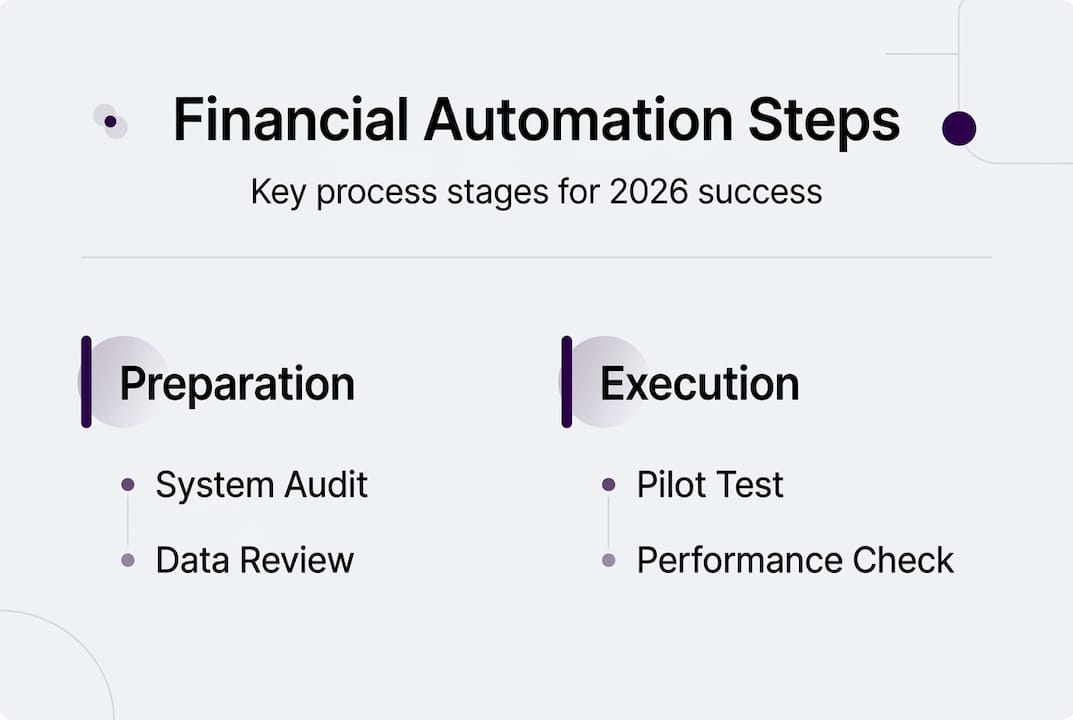
Preparation activities to prioritize:
- Document current state workflows with process maps showing decision points and system touchpoints
- Identify high-volume, repetitive tasks that consume the most staff hours
- Assess data quality across financial systems and create cleanup plans
- Establish baseline metrics for processing time, error rates, and costs
- Define success criteria that align with business objectives
The small business digital transformation guide offers additional frameworks for preparing organizations to adopt new technologies effectively. Thorough preparation reduces implementation risks and accelerates time to value once automation deployment begins.
Executing financial operations automation: step-by-step guide
Successful execution follows a structured approach that builds capability incrementally while managing risk. Start by selecting financial processes with clear rules, high volume, and measurable impact. Accounts payable invoice processing typically offers the strongest initial return because it combines repetitive data entry, approval routing, and system updates into a single workflow.
Choosing the right automation platform requires evaluating both technical capabilities and AI sophistication. Traditional robotic process automation handles simple, scripted tasks but fails when exceptions arise. Agentic AI platforms bring reasoning and adaptability, allowing systems to interpret invoice variations, route unusual requests appropriately, and learn from corrections. AI tasks in professional firms, including financial automation, can reduce manual errors and increase operational speed.
- Define automation scope with specific process boundaries and success metrics
- Select platform based on integration capabilities, AI decision logic, and vendor support
- Configure workflows using actual transaction samples to test edge cases
- Build approval routing that mirrors existing authority structures
- Create exception handling protocols for scenarios requiring human judgment
- Establish monitoring dashboards tracking volume, accuracy, and processing time
- Train staff on new workflows and exception management procedures
Pilot programs prove automation value while limiting exposure. Choose a single department or vendor segment for initial deployment. Run automated and manual processes in parallel for two weeks, comparing accuracy and efficiency. This parallel operation reveals configuration gaps and builds confidence before full rollout.
Measure pilot performance against baseline metrics established during preparation. Track invoice processing time, approval cycle duration, data entry errors, and staff hours required. Document specific scenarios where automation struggled and refine decision logic accordingly. Strong pilot results create momentum for broader adoption.

Scaling automation across departments requires balancing speed with stability. Add new process areas monthly rather than attempting enterprise-wide deployment simultaneously. Each expansion provides learning opportunities and allows IT resources to address integration challenges without overwhelming support capacity.
| Automation Platform | Best For | AI Capabilities | Integration Depth | Typical ROI Timeline |
|---|---|---|---|---|
| Traditional RPA | High-volume scripted tasks | Rule-based only | Surface-level UI automation | 3-6 months |
| Workflow automation | Approval routing and notifications | Limited decision logic | API-based connections | 4-8 months |
| Agentic AI platforms | Complex multi-step processes | Reasoning and adaptation | Deep system integration | 6-12 months |
| Hybrid solutions | Mixed process portfolios | Configurable intelligence | Customizable by workflow | 5-10 months |
The top digital transformation tools comparison provides deeper analysis of platform capabilities and selection criteria for different organizational contexts.
Pro Tip: Deploy automation in phases starting with read-only monitoring where AI observes workflows and flags potential issues without taking action. This builds trust and allows refinement before granting systems autonomous execution authority.
Configuration details matter significantly. Map data fields precisely between source documents and destination systems. A single misaligned field can cause batch processing failures that require manual cleanup. Test with diverse document formats, vendor variations, and edge cases that represent real-world complexity rather than idealized scenarios.
Change management determines whether automation delivers promised benefits. Staff need clear communication about how roles evolve, what new responsibilities emerge, and how performance expectations shift. Frame automation as eliminating tedious work rather than replacing people, emphasizing how freed capacity enables higher-value analysis and strategic projects.
Verifying and optimizing automated financial operations
Automation deployment marks the beginning of continuous improvement, not the end of implementation work. Verification ensures systems perform as designed while optimization uncovers opportunities to expand capabilities and refine decision logic. Establish monitoring routines that track both technical performance and business outcomes.
Key performance indicators should measure accuracy, efficiency, and business impact. Monitor transaction processing accuracy rates, aiming for 98% or higher straight-through processing without human intervention. Track average cycle times from invoice receipt to payment posting. Measure exception rates to identify process areas requiring logic refinement or additional training data.
Common automation pitfalls emerge during the first 90 days of operation. Payment processing errors often stem from vendor master data inconsistencies that weren’t apparent during pilot testing. Invoice matching failures occur when purchase order formats vary across departments. Approval routing breaks down when organizational changes aren’t reflected in workflow configurations. Each issue provides learning opportunities to strengthen automation resilience.
Improving business workflows with AI automation is key to driving operational efficiency and error reduction. Regular performance reviews identify patterns in exceptions and errors. If certain vendor invoices consistently require manual intervention, investigate whether AI training needs additional examples or if process standardization with that vendor would eliminate variation.
| Verification Approach | Manual Process | Automated Process |
|---|---|---|
| Transaction accuracy check | Sample 50 invoices monthly | System validates 100% of transactions in real time |
| Approval compliance audit | Quarterly review of approval logs | Continuous monitoring with automatic alerts |
| Payment reconciliation | Week-end manual three-way matching | Daily automated matching with exception reporting |
| Data quality assessment | Annual vendor master cleanup | Ongoing duplicate detection and standardization |
| Process cycle time tracking | Manual timesheet analysis | Automated workflow analytics and bottleneck identification |
Optimization strategies focus on expanding automation scope and improving decision accuracy. As confidence builds, gradually increase the transaction value thresholds for autonomous processing. Start with invoices under $1,000, then raise limits as error rates remain consistently low. This progressive approach manages risk while scaling automation benefits.
AI systems improve through feedback loops. When staff override automated decisions or correct errors, capture those interventions as training examples. Modern agentic AI platforms learn from corrections, refining decision logic without requiring manual reprogramming. This adaptive capability distinguishes intelligent automation from rigid scripted approaches.
Operational benefits realized through sustained automation:
- Staff capacity redirected from data entry to analysis and strategic planning
- Processing cycle times reduced by 60 to 75% for routine transactions
- Month-end close accelerated through real-time reconciliation and reporting
- Audit trail completeness improved with automatic documentation of all actions
- Compliance risk reduced through consistent application of approval policies
- Vendor relationships strengthened by faster, more predictable payment cycles
The bookkeeping process for startups demonstrates how systematic approaches to financial operations create scalability foundations that automation can amplify.
Continuous refinement requires balancing automation expansion with stability. Introduce new capabilities quarterly rather than constantly changing workflows. This cadence allows staff to adapt, provides time to measure impact, and maintains operational predictability. Document configuration changes and maintain rollback procedures for scenarios where updates introduce unexpected issues.
Governance structures ensure automation remains aligned with business needs as both evolve. Establish a steering committee with finance, IT, and operations representatives who review performance metrics, prioritize enhancement requests, and approve scope expansions. Regular governance prevents automation from becoming a black box that operates independently of business strategy.
Discover expert financial automation solutions with Ailerons
Implementing financial operations automation requires both technical expertise and deep understanding of business workflows. Ailerons specializes in designing and deploying agentic AI systems that manage complex office operations from end to end. Our approach goes beyond simple task automation to create intelligent systems that reason through exceptions, coordinate across platforms, and adapt to changing business needs.
Explore our financial automation case studies to see how mid-sized companies achieved measurable efficiency gains while maintaining accuracy and control. Each implementation reflects our outcome-focused methodology: understanding your specific challenges, designing tailored automation architectures, and ensuring seamless integration with existing systems. Whether you’re automating accounts payable, revenue recognition, or comprehensive financial close processes, our team brings proven frameworks and agentic AI capabilities to accelerate your transformation journey with confidence and precision.
FAQ
What are the most common financial processes to automate?
Invoicing, accounts payable, accounts receivable, expense management, bank reconciliation, and financial reporting represent the highest-value automation targets. These processes combine high transaction volumes with clear business rules, making them ideal candidates for agentic AI deployment. Most organizations start with accounts payable because it delivers quick wins through reduced data entry and faster approval cycles.
How does agentic AI improve financial operations automation?
Agentic AI brings reasoning and decision-making capabilities that traditional automation lacks. Rather than following rigid scripts, these systems interpret variations in invoices, route exceptions intelligently, and learn from corrections to improve accuracy over time. This adaptability means automation handles real-world complexity instead of breaking when transactions don’t match exact templates.
What are key challenges when automating financial operations?
Aligning stakeholders across finance, IT, and operations requires careful change management and clear communication about evolving roles. Ensuring data quality across disparate systems demands cleanup efforts before automation can deliver reliable results. Selecting tools with appropriate AI capabilities and integration depth determines whether automation scales beyond initial pilot success.
How can companies ensure accuracy after financial automation?
Establish KPIs tracking processing accuracy, cycle times, and exception rates with regular performance reviews. Perform routine validation checks comparing automated outputs against manual samples during the first 90 days. Refine AI decision logic based on error patterns and staff corrections, creating feedback loops that continuously improve system performance and adapt to changing business conditions.
Recommended
- Master the Administrative Task Automation Process Today | Ailerons IT Consulting
- 6 Steps for an Effective AI Automation Checklist 2026 | Ailerons IT Consulting
- Blog | Ailerons IT Consulting
- Improving Business Workflows with AI: Achieve Automation | Ailerons IT Consulting
- Complete Workflow for Financial Year End: Step-by-Step Guide