

Traditional workflow automation promises efficiency but often delivers fragmented systems requiring constant human oversight. Most platforms struggle with context awareness, break when conditions change, and demand extensive manual intervention to handle exceptions. Agentic AI workflows represent a fundamental shift from rigid rule-based systems to intelligent agents that reason, adapt, and execute complex multi-step processes autonomously. This guide shows operations managers how to implement agentic AI for true end-to-end automation that scales with your business needs while reducing operational friction.
Table of Contents
- The Evolution And Current Challenges Of Workflow Automation
- Agentic AI: A Transformative Approach To End-To-End Workflow Automation
- Engineering Production-Grade Agentic AI Workflows: Best Practices And Pitfalls
- Measuring ROI And Demonstrating Operational Impact Of Agentic AI Workflows
- How Ailerons IT Consulting Can Accelerate Your AI Workflow Automation Journey
- Frequently Asked Questions About Agentic AI Workflow Automation
Key takeaways
| Point | Details |
|---|---|
| Automation evolution | Business process automation has evolved from mainframe batch processing through enterprise systems to modern agentic AI workflows. |
| Legacy limitations | Traditional platforms suffer from human-centric design, limited context, brittle integrations, and inflexible rule-based logic. |
| Agentic AI advantage | Autonomous agents orchestrate workflows with contextual reasoning, dynamic decision-making, and reduced human dependency. |
| Engineering best practices | Nine core practices including tool-first design, single-responsibility agents, and containerized deployment ensure production reliability. |
| Measurable ROI | Time sampling methodology combined with ROI formulas demonstrates concrete productivity gains and justifies automation investments. |
The evolution and current challenges of workflow automation
Understanding where automation stands today requires looking at its four-decade journey. Business process automation has evolved through distinct technological phases since the 1960s, each bringing new capabilities but also new constraints.
The automation timeline reveals four major eras:
- Mainframe batch processing automated repetitive calculations and data entry but required overnight runs and manual intervention between steps
- Integrated enterprise systems like ERP and CRM connected departments but locked workflows into vendor-specific configurations
- Workflow orchestration platforms enabled visual process design yet still demanded human decision points at every exception
- Robotic process automation mimicked human clicks but broke whenever interface elements changed or unexpected scenarios emerged
Despite decades of advancement, today’s automation platforms suffer from four fundamental limitations. Human-centric design assumes people will handle exceptions rather than building systems that resolve issues independently. Limited context means platforms cannot understand the broader business situation surrounding each task. Brittle integrations fail when APIs change or data formats shift slightly. Rule-based logic cannot adapt to new scenarios without manual reprogramming.
These constraints directly impact operational efficiency in measurable ways. Teams spend hours monitoring automated processes to catch failures. Exception handling creates bottlenecks that negate time savings from automation. System maintenance consumes IT resources that could drive strategic initiatives. Scaling requires proportional increases in oversight staff rather than true leverage.
“The fundamental problem is that traditional automation treats workflows as static sequences rather than dynamic processes that require judgment and adaptation.”
These persistent gaps explain why many organizations struggle to move beyond automating simple, repetitive tasks. The need for systems that can reason through complexity, maintain context across steps, and handle exceptions autonomously drives the shift toward agentic AI workflows that fundamentally reimagine how automation operates.
Agentic AI: A transformative approach to end-to-end workflow automation
Agentic AI represents a paradigm shift from executing predefined scripts to deploying intelligent systems that understand goals, evaluate options, and take appropriate actions. Agentic AI workflows integrate multiple specialized agents with different LLMs, tool-augmented capabilities, and external interactions to enable autonomous decision-making across complex business processes.
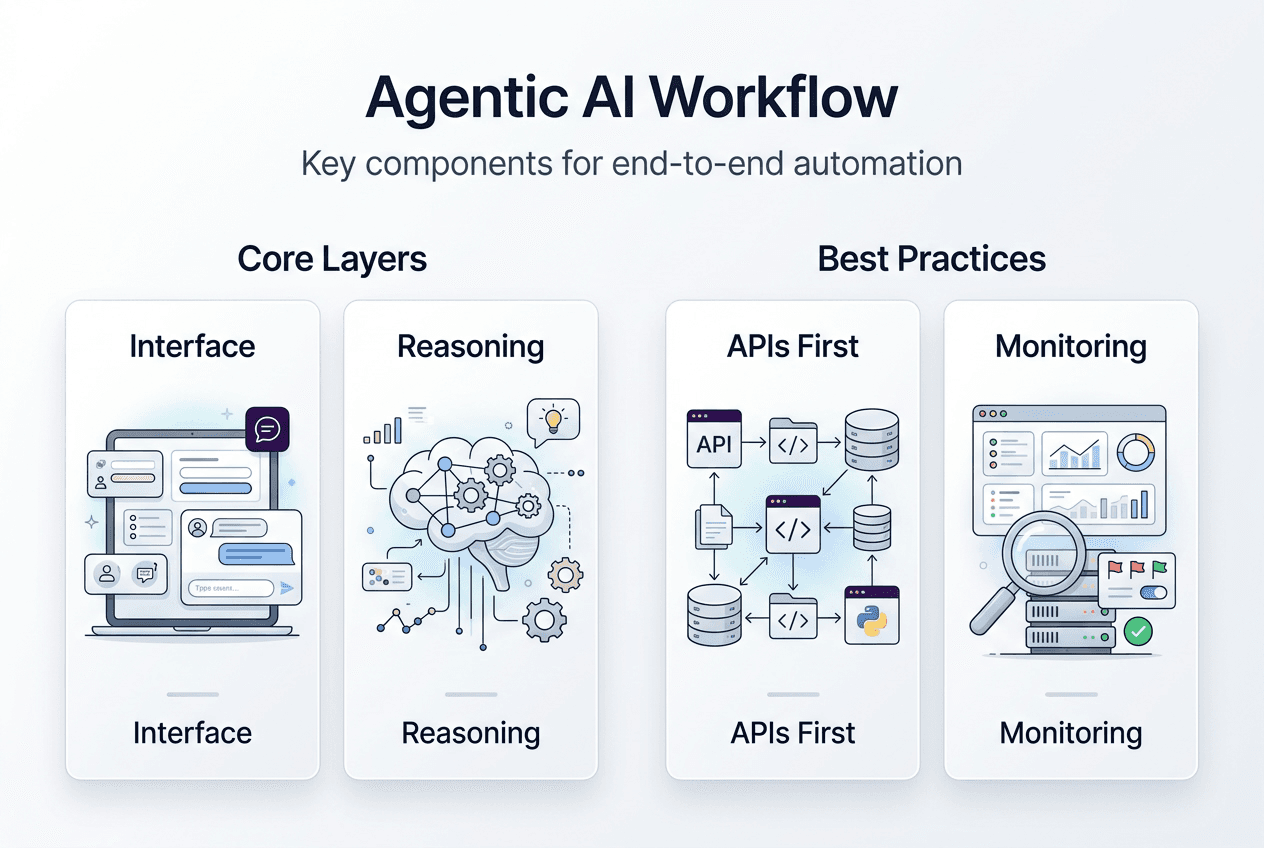
The architecture consists of five integrated layers working in concert. The conversational interface allows natural language interaction for initiating workflows, providing input, and receiving updates without learning specialized commands. The workflow engine orchestrates multi-step processes by coordinating between agents, managing state, and handling conditional logic based on real-time conditions. Context management maintains awareness of business rules, historical patterns, user preferences, and current system state throughout execution. Integration layers connect to existing business systems through APIs, webhooks, and data connectors while maintaining security protocols. The learning component improves performance over time by analyzing outcomes, identifying patterns, and refining decision logic without manual reprogramming.
Fuchsia embodies an agent-first automation architecture inspired by the LLM Operating System concept, demonstrating how these layers function together in production environments. This design enables capabilities impossible with traditional automation.
The operational benefits manifest in four key areas. Improved context handling means agents understand nuances like urgency levels, stakeholder relationships, and business priorities when making decisions. Adaptability allows workflows to adjust to changing conditions, unexpected inputs, and new scenarios without breaking or requiring manual intervention. Reduced human dependency frees teams from constant monitoring and exception handling while maintaining appropriate escalation for truly complex situations. Autonomous action enables agents to complete entire workflows from initiation through final documentation without human checkpoints at every stage.
Agentic AI directly addresses challenges that plague rule-based systems:
- Handles ambiguous inputs by interpreting intent rather than matching exact patterns
- Manages exceptions through reasoning rather than predefined conditional branches
- Maintains workflow continuity across system failures and temporary unavailability
- Scales complexity without exponential growth in configuration requirements
- Adapts to process changes through learning rather than manual reconfiguration
Pro Tip: Start your agentic AI implementation with high-volume, predictable tasks that have clear success criteria and measurable outcomes. Build confidence and demonstrate value before tackling more complex workflows. This approach reduces risk while establishing the monitoring and governance practices needed for broader AI automation deployment.
Engineering production-grade agentic AI workflows: best practices and pitfalls
Building reliable agentic AI systems requires disciplined engineering practices that differ significantly from traditional automation development. Nine core best practices for agentic AI workflows provide a framework for sustainable, robust implementations that deliver consistent business value.

The foundation starts with tool-first design, where you identify and integrate necessary APIs, databases, and services before building agent logic. Single-responsibility agents handle specific tasks rather than trying to create omniscient systems that do everything. Externalized prompts stored in version control enable rapid iteration and A/B testing without code changes. Structured outputs using JSON schemas ensure consistent data formats for downstream processing. Comprehensive logging captures decision points, reasoning chains, and execution paths for troubleshooting and optimization.
Additional practices ensure production readiness. Containerized deployment using Docker provides consistent environments across development, testing, and production. Environment-aware configuration adapts behavior based on deployment context without hardcoded values. Continuous monitoring tracks performance metrics, error rates, and business outcomes in real-time. Responsible AI considerations including bias detection, explainability, and human oversight maintain ethical standards and regulatory compliance.
| Aspect | Traditional Automation | Agentic AI Workflows |
|---|---|---|
| Error handling | Fail immediately on unexpected input | Reason through alternatives and adapt |
| Configuration | Hardcoded rules and decision trees | Dynamic prompts and learned patterns |
| Integration | Point-to-point connections | Orchestrated tool usage |
| Maintenance | Manual updates for new scenarios | Learning from outcomes |
| Debugging | Linear execution traces | Reasoning chain analysis |
Despite best practices, failure modes involving LLMs and agents can cause unexpected production issues that require specific mitigation strategies. Hallucination occurs when agents generate plausible but factually incorrect information, particularly dangerous in compliance or financial workflows. Interpretation collapse happens when agents misunderstand ambiguous instructions and confidently execute the wrong action. Long reasoning errors accumulate through multi-step processes where small mistakes compound into significant failures. Debugging complexity increases exponentially because you must trace both code execution and agent reasoning chains.
The KISS principle becomes even more critical with agentic systems. Simpler workflows with clear boundaries and well-defined responsibilities prove more reliable than complex architectures attempting to handle every edge case. Start with focused use cases, validate thoroughly, then expand scope incrementally based on proven performance.
Responsible AI considerations extend beyond technical implementation. Establish clear escalation paths for situations requiring human judgment. Implement bias detection to ensure fair treatment across different user groups and scenarios. Maintain explainability so stakeholders understand how decisions were reached. Document limitations transparently rather than overselling capabilities.
Pro Tip: Deploy agentic workflows in shadow mode initially, running parallel to existing processes without making actual changes. Compare agent decisions against human actions to identify gaps and build confidence before granting autonomous authority. This approach revealed critical edge cases in compliance automation tutorials that would have caused production issues.
Measuring ROI and demonstrating operational impact of agentic AI workflows
Quantifying the business value of AI automation requires rigorous methodology that goes beyond anecdotal success stories. Time sampling provides the baseline measurement needed to demonstrate concrete improvements and justify continued investment in agentic workflows.
The measurement process begins before automation deployment. Conduct time sampling studies where employees log hours spent on tasks targeted for automation over a representative period, typically two to four weeks. Capture not just execution time but also context switching, error correction, and coordination overhead. Document frequency for each task type to understand total weekly or monthly burden. Assess risk factors including compliance requirements, customer impact, and financial consequences of errors.
The ROI calculation formula provides a structured approach: Frequency × Minutes per occurrence × Risk factor. Frequency measures how often the task occurs weekly or monthly. Minutes per occurrence includes all time from initiation through completion and documentation. Risk factor weights tasks by their importance, using a scale where routine tasks rate 1.0, customer-facing tasks rate 1.5, and compliance-critical tasks rate 2.0 or higher.
Implementing AI workflows reduced 40 hours of weekly repetitive tasks in a partner agency case study, demonstrating the magnitude of impact possible with well-designed agentic systems. The following data illustrates typical improvements across different workflow categories.
| Workflow Category | Pre-Automation (hrs/week) | Post-Automation (hrs/week) | Time Saved | Error Rate Change |
|---|---|---|---|---|
| Document processing | 18 | 3 | 83% | Reduced 65% |
| Data entry and validation | 22 | 4 | 82% | Reduced 78% |
| Scheduling coordination | 12 | 2 | 83% | Reduced 45% |
| Report generation | 15 | 3 | 80% | Reduced 71% |
| Compliance documentation | 8 | 2 | 75% | Reduced 82% |
Aligning AI workflows with measurable business objectives ensures implementations deliver strategic value beyond simple time savings. Define success metrics before deployment including cycle time reduction, error rate improvement, customer satisfaction scores, and cost per transaction. Establish monitoring dashboards that track these metrics in real-time rather than waiting for quarterly reviews. Connect workflow performance to broader organizational KPIs so leadership sees direct impact on business outcomes.
Implementing and optimizing AI automation follows a sequential approach:
- Identify high-impact workflows through time sampling and stakeholder interviews to find the best initial candidates
- Design agent architecture using best practices for tool integration, prompt engineering, and error handling
- Deploy in shadow mode to validate decisions against human actions without risking production operations
- Measure baseline versus automated performance using the ROI formula and business metrics
- Iterate based on failure analysis, user feedback, and changing business requirements
- Scale successful workflows to additional use cases while maintaining governance and monitoring
The measurement discipline required for AI-driven office automation creates a virtuous cycle where data-driven insights continuously improve workflow design and deployment strategies. Organizations that treat automation as an ongoing optimization process rather than a one-time project achieve substantially better long-term results.
How Ailerons IT Consulting can accelerate your AI workflow automation journey
Ailerons brings specialized expertise in designing and deploying agentic AI workflows for mid-sized companies seeking to optimize operations without the trial-and-error costs of learning independently. Our team has implemented autonomous systems across front-office coordination, administrative processes, billing support, document management, and compliance workflows, documenting measurable results in detailed case studies that demonstrate time savings, error reduction, and improved operational consistency.
We provide end-to-end support from initial workflow assessment through production deployment and ongoing optimization. Our approach aligns agentic AI capabilities with your specific operational goals, existing systems, and compliance requirements. Rather than generic automation, we architect solutions that integrate seamlessly with your CRM, ERP, scheduling, accounting, and document platforms while maintaining security standards.
Explore how organizations similar to yours have transformed operations through intelligent automation, or connect with our team to discuss how agentic AI can address your specific workflow challenges and scale your business without proportional staff increases.
Frequently asked questions about agentic AI workflow automation
What is end-to-end workflow automation with agentic AI?
End-to-end workflow automation uses autonomous AI agents that manage complete business processes from initiation through final documentation without human intervention at each step. Unlike traditional automation that executes predefined scripts, agentic AI reasons through scenarios, adapts to changing conditions, and handles exceptions using contextual understanding. These systems coordinate across multiple platforms, maintain state throughout multi-step processes, and escalate only truly complex situations requiring human judgment. The approach enables organizations to automate sophisticated workflows that previously required constant oversight, delivering the operational efficiency gains that various AI automation types promise but traditional systems struggle to achieve.
How do agentic AI workflows differ from traditional RPA systems?
Agentic AI employs autonomous agents with contextual reasoning capabilities rather than the static, rule-based approach of robotic process automation. RPA mimics human clicks and keystrokes in exact sequences, breaking when interfaces change or unexpected conditions arise. Agentic systems understand goals and adapt their approach based on current circumstances, available tools, and business context. They orchestrate multi-step processes dynamically rather than following rigid scripts, handle ambiguous inputs through interpretation rather than pattern matching, and learn from outcomes to improve performance over time. This fundamental architectural difference enables agentic AI to manage complex workflows that RPA cannot reliably automate without constant human supervision and maintenance.
What are the biggest risks and failure modes when deploying AI workflows?
The primary risks include hallucinations where agents generate plausible but incorrect information, interpretation collapse when ambiguous instructions lead to wrong actions, long reasoning errors that compound through multi-step processes, and data quality issues that corrupt downstream decisions. Additional challenges involve debugging complexity because you must trace both code execution and agent reasoning chains, plus the risk of over-reliance on automation without appropriate human oversight for high-stakes decisions. Mitigation strategies include continuous monitoring with alerting on anomalies, starting with simple workflows before expanding complexity, implementing shadow mode deployments for validation, maintaining clear escalation paths, and following responsible AI principles including bias detection and explainability requirements.
How can I measure and prove the ROI of automating office workflows with AI?
Begin with baseline time sampling where employees log hours spent on tasks targeted for automation over two to four weeks, capturing execution time, context switching, error correction, and coordination overhead. Apply the ROI formula of Frequency × Minutes per occurrence × Risk factor to quantify total burden and potential savings. Deploy automation in shadow mode initially to validate performance without production risk, then measure actual time savings, error rate improvements, and cycle time reductions after full deployment. Track business metrics including cost per transaction, customer satisfaction scores, and compliance audit results to demonstrate strategic value beyond simple time savings. Establish dashboards that connect workflow performance to organizational KPIs so leadership sees direct impact on business outcomes rather than just technical metrics.
Recommended
- Improving Business Workflows with AI: Achieve Automation | Ailerons IT Consulting
- Process Automation Tutorial for Agentic AI in Compliance Workflows | Ailerons IT Consulting
- End-to-End Business Automation: Agentic AI Impact | Ailerons IT Consulting
- Agentic AI Workflow Automation in Modern Healthcare | Ailerons IT Consulting