

Legal firms using AI for contract review are reducing review time by 75%, yet many professionals remain uncertain how to implement these technologies effectively. This guide walks you through AI-driven digital collaboration strategies that enhance operational efficiency, explaining the specific technologies, governance requirements, and measurable outcomes that make AI integration successful in legal workflows during 2026.
Table of Contents
- The Evolving Role Of Digital Collaboration In Legal Firms
- Key Ai Technologies Powering Digital Collaboration In Legal Workflows
- Common Pitfalls And Essential Governance For Ai Integration In Legal Firms
- Measuring Success And Realizing Benefits Of Ai-Driven Digital Collaboration
- Enhance Your Legal Firm’s Efficiency With Ailerons Ai Consulting
- Frequently Asked Questions
Key takeaways
| Point | Details |
|---|---|
| Cost reduction potential | AI cuts contract review time by up to 75% when implemented with proper governance and human oversight. |
| Implementation requirements | Workflow mapping before AI adoption prevents costly errors and ensures technology aligns with actual operational needs. |
| Human oversight necessity | Lawyer supervision remains essential for quality control, ethical compliance, and managing AI limitations in legal contexts. |
| Executive sponsorship | C-suite buy-in significantly increases AI project success rates and enables meaningful organizational transformation. |
| Measurable ROI | Legal AI can reduce operational costs by 30-50% in document review while improving accuracy and consistency. |
The evolving role of digital collaboration in legal firms
Digital collaboration in 2026 legal firms means more than shared drives and video calls. It represents integrated AI systems that analyze contracts, triage documents, and coordinate workflows while lawyers maintain strategic oversight. The shift addresses a critical industry trend: 80% of Fortune 1000 legal leaders expect generative AI to reduce outside-counsel billing, creating pressure to adopt AI responsibly or risk competitive disadvantage.
Yet confusion persists about AI’s actual role in legal operations. Many professionals worry AI will replace lawyers, when the reality involves AI handling repetitive, text-heavy tasks while humans focus on judgment, strategy, and client relationships. The technology serves as an intelligent assistant that processes information faster than humanly possible, but lacks the contextual understanding and ethical reasoning required for legal decision making.
“AI in legal workflows isn’t about replacement. It’s about amplification of human expertise through intelligent task delegation and real-time collaboration tools.”
Effective digital collaboration requires three foundational elements:
- Integrated AI systems that connect with existing legal software and databases
- Clear governance frameworks defining when AI acts autonomously versus when it escalates to humans
- Continuous feedback loops where lawyers validate AI outputs and improve system performance
The statistics tell a compelling story. Legal teams implementing AI collaboration tools report faster turnaround times, more consistent document quality, and significant cost savings. However, success depends on thoughtful implementation rather than simply purchasing AI software. Understanding which AI trends in professional services 2026 apply to your firm’s specific needs creates the foundation for meaningful operational improvements.
Key AI technologies powering digital collaboration in legal workflows
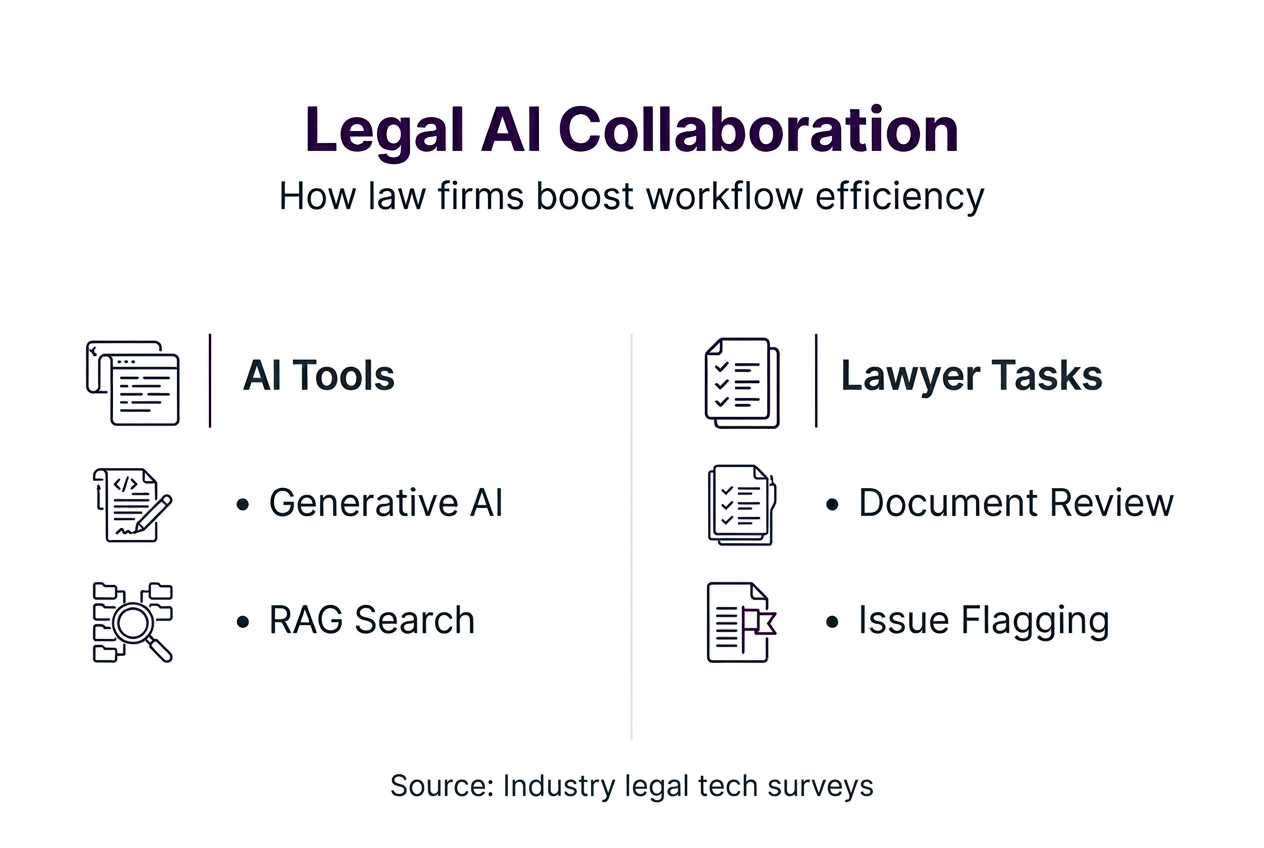
Two AI technologies dominate successful legal collaboration implementations: generative AI and retrieval-augmented generation. Generative AI creates content like contract clauses, memo drafts, and email responses based on patterns learned from training data. RAG enhances this by grounding AI output in source documents, dramatically reducing hallucinations where AI invents plausible-sounding but false information.
RAG works by searching relevant documents before generating responses, ensuring AI recommendations cite actual case law, contracts, or regulations rather than fabricated sources. For legal work where accuracy isn’t optional, this distinction matters enormously. A generative AI might confidently cite a nonexistent case, while RAG-enhanced systems reference actual documents your firm already possesses.

| Technology | Accuracy Level | Supervision Needs | Typical Use Cases |
|---|---|---|---|
| Generative AI alone | 70-85% | High (lawyer review required) | Draft generation, summarization, initial research |
| RAG-enhanced AI | 90-95% | Medium (spot-check validation) | Document analysis, contract comparison, compliance review |
| Traditional automation | 99%+ | Low (exception handling only) | Data entry, deadline tracking, billing calculations |
The lawyer-in-the-loop framework keeps humans central to AI workflows. AI performs initial analysis, flags potential issues, and suggests actions, but lawyers make final decisions. This approach captures efficiency gains while maintaining professional responsibility and quality standards. When BNY Mellon’s legal team deployed AI for contract review, they didn’t eliminate lawyer involvement. They eliminated repetitive reading, letting lawyers focus on negotiation strategy and risk assessment.
Pro Tip: Feed your AI systems complete, well-organized data from the start. AI trained on messy, incomplete document sets produces unreliable outputs regardless of how sophisticated the underlying technology might be. Clean data governance directly determines AI effectiveness.
Understanding these technologies helps you evaluate vendor claims realistically. Not all “AI-powered” legal tools use RAG or maintain appropriate supervision frameworks. The agentic AI process automation tutorial explains how to assess whether AI systems meet compliance requirements specific to legal operations.
Common pitfalls and essential governance for AI integration in legal firms
Most legal AI projects fail before delivering value. Research shows 77% of in-house legal teams experience failed technology implementations, with poor planning and inadequate governance as primary causes. The technology works, but organizational readiness often doesn’t.
The single biggest mistake involves deploying AI before mapping existing workflows. Firms purchase AI contract review tools without documenting how contracts currently move through review, approval, and execution stages. When AI enters unmapped processes, it amplifies existing inefficiencies or creates new bottlenecks. You must understand your current state before automating it.
Governance provides the framework ensuring AI operates within ethical and legal boundaries:
- Define clear policies on what data AI systems can access and how they use confidential information
- Establish approval workflows determining when AI acts autonomously versus escalating to humans
- Create audit trails documenting AI decisions for professional responsibility and malpractice defense
- Assign executive sponsors who champion AI adoption and resolve cross-department conflicts
“Governance serves as middleware between AI’s raw power and responsible deployment. Without it, even the most sophisticated AI creates more risks than benefits.”
Executive sponsorship particularly matters. Most successful AI implementations have C-suite sponsorship, providing budget authority, change management support, and political capital to overcome internal resistance. When partners or general counsel actively champion AI initiatives, success rates climb dramatically.
Before implementing AI, complete this checklist:
- Map current workflows documenting every step, decision point, and handoff
- Identify which tasks are repetitive, high-volume, and rule-based (prime AI candidates)
- Review confidentiality agreements and data handling policies for AI compatibility
- Secure executive sponsorship with clear success metrics and timeline expectations
- Pilot AI on low-risk tasks before expanding to mission-critical workflows
Avoid shadow IT where individual lawyers adopt consumer AI tools without firm approval. These tools may not meet data security standards, creating liability exposure and compliance violations. Centralized AI governance prevents well-meaning staff from accidentally compromising client confidentiality. Understanding secure AI compliance systems helps you build appropriate guardrails from the start.
Measuring success and realizing benefits of AI-driven digital collaboration
BNY Mellon’s legal team provides a concrete success example. They reduced contract review time by 75% using AI to analyze standard agreements, identify deviations from templates, and flag unusual clauses for lawyer attention. The AI didn’t replace lawyers. It eliminated the tedious clause-by-clause reading that consumed hours of professional time, letting lawyers focus on negotiation strategy and risk assessment.
Quantifying AI benefits requires tracking specific metrics before and after implementation. The comparison reveals where efficiency gains actually occur:
| Metric | Traditional Workflow | AI-Driven Workflow | Improvement |
|---|---|---|---|
| Contract review time | 4-6 hours per agreement | 60-90 minutes per agreement | 75% reduction |
| Cost per document review | $800-1,200 | $200-300 | 70% reduction |
| Error rate in clause identification | 8-12% (human fatigue) | 2-3% (with validation) | 75% improvement |
| Turnaround time for client requests | 3-5 business days | Same day to 24 hours | 80% improvement |
Research confirms these patterns hold broadly. AI integration can cut operational costs by 30-50% in document review, with accuracy improvements as AI systems learn from lawyer corrections over time.
To measure and optimize AI impact, follow these steps:
- Establish baseline metrics for tasks you plan to automate, tracking time, cost, accuracy, and client satisfaction.
- Run parallel workflows initially where both traditional and AI methods process the same work, comparing outputs.
- Calculate total cost of ownership including AI licensing, training time, and ongoing maintenance, not just software subscription fees.
- Monitor quality metrics continuously, as AI performance can drift when input data patterns change.
- Gather user feedback from lawyers actually using AI tools, as adoption resistance often signals usability problems rather than technology limitations.
- Expand gradually from pilot projects to broader deployment, incorporating lessons learned at each stage.
Pro Tip: Start with document-heavy, repeatable tasks like NDA review, lease abstraction, or regulatory compliance checks. These workflows generate quick wins that build organizational confidence before tackling more complex AI applications.
Human oversight remains essential even as efficiency grows. AI flags potential issues, but lawyers assess business context, client priorities, and strategic considerations that AI cannot evaluate. The goal isn’t removing humans from workflows. It’s removing humans from repetitive tasks that don’t require professional judgment, freeing capacity for work that demands expertise and relationship skills.
The AI integration checklist for business operations provides detailed implementation guidance, while AI tasks to automate in professional firms helps identify which specific workflows in your firm offer the highest ROI potential for AI-driven collaboration.
Enhance your legal firm’s efficiency with Ailerons AI consulting
Implementing AI-driven digital collaboration requires more than software licenses. It demands workflow analysis, governance design, system integration, and change management expertise that most legal firms don’t maintain in-house. Ailerons specializes in deploying agentic AI systems for legal operations, focusing on end-to-end workflow automation that maintains compliance while delivering measurable efficiency gains.
Our approach starts with understanding your firm’s specific operational challenges, then designing AI solutions that integrate with existing case management, document management, and billing systems. We emphasize lawyer-in-the-loop frameworks ensuring professional responsibility standards remain central while capturing the speed and cost benefits AI provides. From initial workflow mapping through pilot deployment and scaling, we provide the technical and strategic guidance making AI initiatives successful.
Explore our managed AI consulting services to learn how we’ve helped professional firms achieve 30-50% operational cost reductions while improving service quality. Review detailed AI consulting case studies showing specific implementations and ROI metrics from firms similar to yours. As legal operations evolve in 2026, partnering with experienced AI consultants accelerates your transformation while avoiding the costly missteps that derail 77% of legal technology projects.
Frequently asked questions
What is digital collaboration in legal firms?
Digital collaboration in legal firms means using integrated AI systems, cloud platforms, and workflow automation tools to coordinate work across teams more efficiently. Rather than emailing documents back and forth or managing tasks through spreadsheets, AI-powered systems route work automatically, flag issues requiring attention, and maintain audit trails for compliance. The technology handles repetitive coordination tasks, letting lawyers focus on substantive legal work while improving consistency and reducing turnaround times.
How does AI improve operational efficiency in legal workflows?
AI handles high-volume, text-heavy tasks like contract review, document analysis, and compliance checking with speed impossible for humans to match. It automates repetitive processes such as extracting key terms, comparing documents against templates, and flagging unusual clauses. This frees lawyers to focus on complex negotiations, strategy development, and client counseling where human judgment creates value. Real-time AI responses enable faster decision making while maintaining accuracy through retrieval-augmented generation that grounds outputs in verified source documents.
What are common challenges in adopting AI-driven digital collaboration in law firms?
Many AI pilots fail because firms deploy technology before mapping existing workflows, creating confusion about how AI integrates with current processes. Missing governance frameworks lead to data security risks and compliance violations when lawyers use unapproved AI tools. Without executive sponsorship, AI initiatives struggle to secure necessary budget and overcome resistance from staff comfortable with traditional methods. Perhaps most critically, insufficient human oversight allows AI errors to reach clients, damaging trust and creating liability exposure.
How can legal firms ensure successful AI integration in their workflows?
Map your existing workflows thoroughly before introducing AI, documenting every step, decision point, and handoff to identify where automation adds value. Obtain C-suite buy-in early, ensuring leadership understands both the investment required and the efficiency gains AI enables. Use lawyer-in-the-loop frameworks where AI performs initial analysis but lawyers make final decisions and validate outputs. Start with low-risk, repeatable tasks like NDA review or compliance checks to build organizational confidence before expanding to mission-critical workflows requiring more sophisticated AI capabilities.
Recommended
- AI Trends in Professional Services 2026: Beyond Automation | Ailerons IT Consulting
- Intelligent Automation Cuts Admin Overhead 72% in 2026 | Ailerons IT Consulting
- AI Trends in 2026: Transforming Office Operations | Ailerons IT Consulting
- Top Digital Transformation Tools for 2026: Expert Comparison | Ailerons IT Consulting