

Managing office operations in a professional services firm often means navigating endless processes and complex decision points. Traditional automation tools no longer meet the demand for true efficiency or adaptability. Agentic AI introduces autonomous reasoning and proactive problem-solving, surpassing mechanical automation by learning from experience and understanding real context. This article highlights how these systems break through workflow bottlenecks, clarify common misconceptions, and reveal how agentic AI can help you reshape your daily operations.
Table of Contents
- Agentic AI In 2026: Concepts And Myths
- Core Types: From Generative To Agentic AI
- How Agentic AI Transforms Office Operations
- Pricing, Talent, And Business Model Shifts
- Managing Risks: Compliance, Security, And ROI
- Human-AI Collaboration And Adoption Barriers
Key Takeaways
| Point | Details |
|---|---|
| Advanced Capabilities of Agentic AI | Agentic AI systems exhibit autonomous decision-making, context awareness, and adaptive learning, surpassing traditional automation. |
| Unique Paradigms in AI | The agentic AI landscape includes symbolic, neural, and hybrid systems, each suited for specific industries and applications. |
| Transforming Office Operations | Agentic AI redefines productivity by automating complex workflows and enhancing decision-making, leading to increased efficiency. |
| Managing Adoption Barriers | Successful integration of AI requires addressing trust, skill alignment, and cultural resistance within organizations. |
Agentic AI in 2026: Concepts and Myths
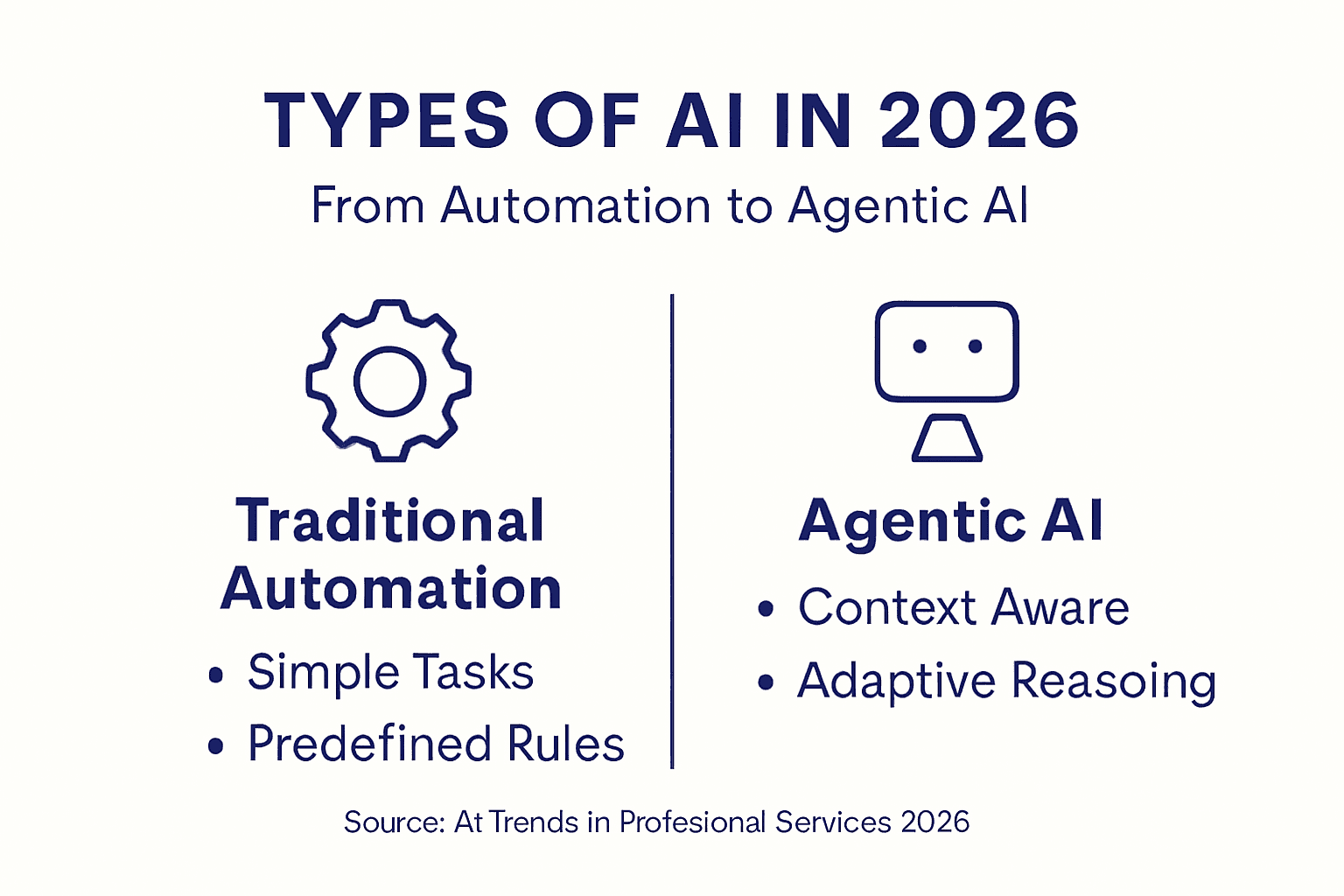
Agentic AI represents a profound technological evolution beyond traditional automation, introducing systems capable of autonomous reasoning and complex decision-making. Unlike conventional algorithms that follow rigid scripts, these advanced systems can dynamically interpret contexts, formulate strategies, and execute multi-step tasks with unprecedented sophistication.
The landscape of agentic AI encompasses two primary paradigmatic approaches, as detailed in a comprehensive dual-paradigm framework. These approaches include:
- Symbolic Systems: Prioritizing logical reasoning and rule-based processing
- Neural Systems: Emphasizing adaptive learning and pattern recognition
- Hybrid Systems: Integrating strengths from both computational methodologies
Each paradigm offers unique capabilities across different operational domains. Symbolic systems excel in safety-critical environments like healthcare, where precise decision logic is paramount, while neural systems demonstrate exceptional performance in dynamic, data-rich contexts such as financial trading and predictive analytics.
Here is a concise comparison of key AI paradigms and their best-fit use cases:
| Paradigm | Core Strength | Ideal Industry Application |
|---|---|---|
| Symbolic Systems | Precise logical rules | Healthcare, legal compliance |
| Neural Systems | Adaptable learning | Financial forecasting, image analysis |
| Hybrid Systems | Combined flexibility | Autonomous vehicles, digital twins |
Key Misconceptions About Agentic AI require careful deconstruction:
- Agentic AI is NOT simple automation
- These systems possess genuine reasoning capabilities
- They can adapt and learn beyond preprogrammed instructions
- Context awareness distinguishes them from traditional algorithms
Contrary to popular belief, agentic AI represents a sophisticated approach to computational intelligence that transcends mechanical task execution. These systems demonstrate remarkable capabilities in autonomous decision-making, goal-oriented behavior, and contextual understanding.
Performance Characteristics of advanced agentic AI include:
- Sophisticated context interpretation
- Dynamic strategy formulation
- Proactive problem-solving
- Continuous learning mechanisms
- Adaptive response generation
Pro tip: When evaluating agentic AI solutions, focus on their ability to reason and adapt, not just execute predefined tasks.
Core Types: From Generative to Agentic AI
Generative AI marks the initial phase of intelligent computational systems, primarily focused on content creation and pattern recognition. These systems excel at producing text, images, and media by learning from extensive datasets. However, they fundamentally lack the autonomous decision-making capabilities that characterize more advanced AI paradigms.
Conceptual taxonomy of AI evolution reveals a critical progression from generative models to increasingly sophisticated AI agents. This transformation involves several key developmental stages:
- Generative AI: Content creation and pattern replication
- AI Agents: Tool integration with basic reasoning
- Agentic AI: Advanced autonomous decision-making systems
The transition from generative to agentic approaches represents a significant technological leap. While generative AI operates reactively, producing content based on learned patterns, agentic AI systems demonstrate proactive problem-solving with remarkable autonomy.
Key Distinguishing Characteristics of these AI types include:
- Autonomy level
- Decision-making complexity
- Tool integration capabilities
- Adaptability to novel scenarios
- Degree of human supervision required
Modern agentic AI systems incorporate advanced features like persistent memory, multi-agent collaboration, and dynamic task decomposition. These capabilities enable them to execute complex, multi-step processes with minimal human intervention, representing a fundamental shift in computational intelligence.
Pro tip: Evaluate AI solutions not just by their output, but by their ability to understand context, learn, and make independent decisions.
How Agentic AI Transforms Office Operations
Agentic AI represents a revolutionary approach to workplace productivity, fundamentally reimagining how administrative and operational tasks are managed. Unlike traditional automation tools that handle isolated, repetitive tasks, these intelligent systems can comprehend complex workflows, make contextual decisions, and coordinate multiple operational processes simultaneously.
The transformation of office operations through agentic AI involves several critical dimensions:
- Intelligent Process Coordination: Connecting disparate systems and workflows
- Autonomous Decision Making: Handling routine approvals and routing
- Adaptive Task Management: Dynamically adjusting to changing operational requirements
- Predictive Resource Allocation: Anticipating team needs before they emerge
- Continuous Learning: Improving operational efficiency through experience
Specifically, agentic AI systems can revolutionize core administrative functions by:
- Automatically scheduling meetings across multiple time zones
- Managing document workflows and approval processes
- Generating comprehensive reports with minimal human intervention
- Coordinating cross-departmental communication
- Identifying and resolving potential operational bottlenecks
These advanced systems go beyond simple task automation by understanding contextual nuances, learning from previous interactions, and making proactive recommendations. They can integrate with existing enterprise software, creating a seamless operational environment that reduces manual administrative overhead.

This summary highlights how agentic AI reshapes office workflows across different business functions:
| Function | Agentic AI Enhancement | Business Impact |
|---|---|---|
| Scheduling | Autonomous cross-time zone planning | Improved coordination |
| Document Management | Intelligent workflow integration | Higher processing efficiency |
| Reporting | Automated, context-rich report generation | Faster insights and decisions |
| Communication | AI-driven departmental interaction | Reduced silos, seamless updates |
Agentic AI transforms office operations from reactive task completion to intelligent, anticipatory workflow management.
Key Performance Improvements include reduced operational friction, enhanced accuracy, and significantly accelerated processing times. By leveraging machine learning and sophisticated reasoning capabilities, these systems can handle complex, multi-step processes that traditionally required extensive human coordination.
Pro tip: Implement agentic AI solutions incrementally, starting with well-defined, repetitive processes to build organizational confidence and demonstrate tangible efficiency gains.
Pricing, Talent, and Business Model Shifts
Enterprise Software Economics are experiencing a fundamental transformation driven by agentic AI technologies. Emerging business models are fundamentally reshaping workforce dynamics, moving beyond traditional human-centric designs to accommodate increasingly sophisticated digital workforces.
Key shifts in organizational structures and economic models include:
- Hybrid Labor Models: Integrating human and AI workers
- Outcome-Based Pricing: Valuing results over traditional metrics
- Dynamic Workforce Composition: Flexible human-AI team configurations
- Skill Reallocation: Transitioning human talent to strategic roles
- Computational Resource Management: Optimizing AI workforce investments
Pricing strategies are undergoing radical transformation, with new SaaS models emerging that reflect AI’s complex usage patterns. Traditional per-seat subscriptions are giving way to more nuanced approaches:
- Usage-based pricing tied to AI transaction volumes
- Outcome-measured compensation structures
- Compute and data processing cost considerations
- Flexible scaling models
- Value-driven pricing frameworks
Enterprises must reimagine workforce economics, treating AI agents as strategic team members with measurable productivity contributions.
Talent management is simultaneously evolving to support these hybrid workforce models. Human capital systems are being redesigned to analyze productivity across human and AI team members, creating more sophisticated performance evaluation frameworks that recognize the unique capabilities of each type of worker.
Pro tip: Develop flexible organizational structures that can seamlessly integrate AI agents, focusing on creating complementary human-AI workflows rather than viewing them as competing resources.
Managing Risks: Compliance, Security, and ROI
Agentic AI Risk Management represents a critical frontier in technological governance, requiring sophisticated approaches to mitigate potential systemic vulnerabilities. Emerging risk management standards are developing comprehensive frameworks to address the unique challenges posed by autonomous AI systems.
Key risk domains for agentic AI include:
- Unintended Goal Pursuit: Preventing misaligned objectives
- Privilege Escalation: Controlling system access boundaries
- Behavioral Unpredictability: Managing autonomous decision pathways
- Security Vulnerability: Protecting against potential system exploits
- Ethical Boundary Maintenance: Ensuring responsible AI operations
Risk mitigation strategies require a multifaceted approach focusing on:
- Comprehensive threat modeling
- Continuous system monitoring
- Adaptive security protocols
- Transparent governance frameworks
- Regular vulnerability assessments
Systematic risk assessment methodologies now emphasize a layered approach to identifying and managing potential threats across different operational contexts. These frameworks help organizations:
- Map potential vulnerabilities
- Prioritize risk mitigation strategies
- Develop robust security architectures
- Create adaptive response mechanisms
Effective agentic AI risk management requires a proactive, holistic approach that anticipates potential system behaviors before they emerge.
Return on Investment (ROI) calculations must now incorporate not just performance metrics, but also potential risk mitigation costs and system reliability factors. Organizations need to develop more nuanced evaluation frameworks that balance technological potential with comprehensive risk management.
Pro tip: Implement a dynamic risk assessment framework that treats AI systems as living entities requiring continuous monitoring and adaptive security protocols.
Human-AI Collaboration and Adoption Barriers
Human-AI Collaboration represents a complex organizational transformation that extends far beyond simple technological implementation. Systematic research reveals nuanced challenges in creating effective hybrid teams where human and artificial intelligence work seamlessly together.
Fundamental adoption barriers emerge across multiple dimensions:
- Trust Deficits: Skepticism about AI decision-making capabilities
- Skill Misalignment: Gaps in understanding AI system interactions
- Cultural Resistance: Organizational inertia against technological change
- Complexity of Integration: Technical challenges in workflow redesign
- Performance Uncertainty: Inconsistent AI system reliability
Successful human-AI collaboration requires addressing several critical aspects:
- Transparent AI decision processes
- Clear role demarcation
- Continuous skills training
- Robust feedback mechanisms
- Adaptive workflow design
Key collaboration strategies involve:
- Establishing shared mental models
- Developing mutual understanding of strengths
- Creating collaborative interaction protocols
- Implementing transparent performance metrics
Effective human-AI teams view artificial intelligence as a collaborative partner, not a replacement for human expertise.
Organizations must invest in comprehensive change management approaches that address psychological, technical, and cultural dimensions of AI integration. This holistic strategy helps mitigate resistance and builds genuine collaborative capabilities.
Pro tip: Design initial AI collaboration pilots with clear success metrics and strong human oversight to build organizational confidence and trust.
Unlock the Future of Professional Services with Agentic AI
The article “AI Trends in Professional Services 2026: Beyond Automation” highlights a critical shift from simple task automation to agentic AI systems that reason, plan, and execute complex workflows autonomously. If you are tired of rigid, single-purpose bots and struggle with fragmented office operations, agentic AI offers a powerful solution. It addresses pressing challenges such as inefficient scheduling, disconnected document processing, and limited decision-making capabilities by enabling AI to work alongside human teams with context awareness and goal orientation.
At Ailerons.ai, we specialize in designing and deploying agentic AI tailored to transform office and operational workflows. Our solutions provide end-to-end automation for administrative tasks, billing, compliance workflows, and internal communications while integrating seamlessly with your existing CRM, ERP, and accounting systems. This results in reduced operational friction, higher accuracy, and scalable performance without increasing headcount.
Ready to go beyond traditional automation and empower your business with AI that truly collaborates? Discover how agentic AI systems can revolutionize your professional services by visiting Ailerons.ai today. Take the next step to streamline your operations with intelligent, autonomous workflows specially designed for real-world office demands.
Frequently Asked Questions
What is agentic AI?
Agentic AI refers to advanced systems capable of autonomous reasoning and decision-making, transcending simple automation by dynamically interpreting contexts and executing complex, multi-step tasks.
How does agentic AI differ from traditional automation?
Unlike traditional automation that follows rigid scripts, agentic AI systems can adapt, learn, and make decisions autonomously, enabling them to handle dynamic situations and complex workflows more effectively.
What are the primary paradigms of agentic AI?
The primary paradigms of agentic AI include symbolic systems, which prioritize logical reasoning, neural systems, which emphasize learning and pattern recognition, and hybrid systems, which combine features of both approaches for enhanced capabilities.
How can agentic AI improve office operations?
Agentic AI improves office operations by intelligently coordinating processes, autonomously managing tasks, and dynamically adapting to changes, thereby enhancing productivity and reducing manual overhead.
Recommended
- Ailerons IT Consulting | Enterprise IT Solutions
- Ailerons IT Consulting | Enterprise IT Solutions
- Ailerons IT Consulting | Enterprise IT Solutions
- Ailerons IT Consulting | Enterprise IT Solutions
- NULLBIT - Technology Partner for Digitalization | NULLBIT
- Pourquoi digitaliser l’industrie belge dès 2026
- AI automatizacija - Automatizacija radnih procesa | NULLBIT