

Most operations managers believe workflow automation is a solved problem. They deploy bots, watch them fail on anything unpredictable, and accept mediocrity. Meanwhile, agentic automation delivers 3 to 5 times higher productivity by enabling AI systems to reason through complex tasks autonomously. This guide explains why agentic AI represents the decisive shift from brittle scripts to adaptable digital collaborators in 2026.
Table of Contents
- What Is Agentic Automation And How Does It Differ From Traditional RPA?
- Capabilities And Limitations Of Agentic AI In Automating Office Workflows
- Business Benefits And Productivity Gains From Agentic Automation
- How To Implement Agentic Automation Successfully In Your Organization
- Elevate Your Operations With Ailerons IT Consulting
Key takeaways
| Point | Details |
|---|---|
| Superior flexibility | Agentic AI outperforms traditional RPA in handling unstructured data and complex decision making. |
| Massive productivity gains | Organizations report 3 to 5 times productivity improvements when deploying autonomous AI agents versus manual processes. |
| Autonomous reasoning | Agentic systems use continuous optimization loops to adapt and improve task execution without constant human intervention. |
| High usability rate | Approximately 90% of AI agent output requires minimal or no edits, making most work immediately production ready. |
What is agentic automation and how does it differ from traditional RPA?
Traditional Robotic Process Automation operates like a programmed robot following exact instructions. It clicks buttons, copies data, and moves information between systems with zero deviation. The moment something unexpected appears, RPA stops dead.
Agentic AI offers superior adaptability because it thinks through problems rather than following scripts. These systems employ large language models, reinforcement learning, and planning algorithms to make decisions in real time. When an invoice format changes or an approval workflow branches unexpectedly, agentic AI adjusts course autonomously.
RPA handles structured, predictable tasks brilliantly. Data entry between fixed fields, scheduled report generation, and standard email responses work flawlessly. But introduce unstructured emails, variable document formats, or judgment calls, and traditional bots fail immediately.
Agentic automation transforms this limitation into capability. AI agents parse messy documents, interpret context across communication channels, and execute multi-step workflows that require intermediate decisions. They function as digital team members who understand goals and figure out execution paths independently.
Key differences include:
- RPA executes predefined rules; agentic AI reasons through scenarios
- Traditional bots need structured data; AI agents handle unstructured information
- RPA breaks when workflows change; agentic systems adapt dynamically
- Bots require constant maintenance; agents learn and optimize continuously
- RPA is task focused; agentic AI is outcome oriented
The technology stack differs fundamentally. RPA relies on screen scraping, API calls, and workflow engines. Agentic systems integrate natural language processing, decision trees, and memory systems that build contextual understanding over time.
This architectural shift matters for operations managers facing increasingly complex workflows. Your office doesn’t run on perfectly structured data. Documents arrive in various formats, requests come through multiple channels, and exceptions demand judgment. End-to-end business automation requires systems that handle this reality, not simplified versions of it.
Pro Tip: Start by identifying workflows where humans spend time interpreting information and making small decisions repeatedly. These represent ideal candidates for agentic automation rather than traditional RPA.
Capabilities and limitations of agentic AI in automating office workflows
Agentic AI systems autonomously execute multi-step tasks through reasoning loops that plan, act, observe results, and adjust strategy. This capability transforms complex office workflows from manual orchestration to autonomous execution.
Consider invoice processing end to end. An AI agent receives the document, extracts data regardless of format, validates amounts against purchase orders, flags discrepancies, routes approvals to appropriate managers, updates accounting systems, and schedules payment. All without human intervention unless exceptions require escalation.

Current performance data reveals both promise and limitations. A 2025 study showed AI agents finished about 30 percent of complex multi-step tasks with perfect accuracy. That sounds disappointing until you examine the details.
The critical metric isn’t perfect completion rates. It’s usability of output. Research shows less than 5% needs major revision, with approximately 90% of agent output immediately usable after trivial edits. Most failures involve minor formatting issues or edge cases, not fundamental task breakdown.
Agentic AI excels at:
- Processing unstructured documents like contracts, emails, and reports
- Coordinating workflows across multiple systems and platforms
- Handling routine decision making based on established business rules
- Scaling operations without proportional staff increases
- Learning from patterns to optimize performance over time
Limitations remain predictable and manageable. AI agents struggle with:
- Tasks requiring nuanced human judgment on sensitive matters
- Workflows involving ambiguous or conflicting priorities
- Situations where context extends beyond available data
- Real-time collaboration requiring emotional intelligence
- Novel scenarios lacking historical patterns for reference
The key insight for operations managers is that failure modes are consistent and catchable. Unlike unpredictable human errors, AI agent failures follow patterns you can design quality control processes around. Build validation checkpoints, establish review triggers for specific scenarios, and create exception handling workflows.
This transforms the risk profile dramatically. You’re not gambling on AI working perfectly. You’re implementing systems with known boundaries, measurable accuracy, and structured fallback processes. That’s manageable operational risk with substantial upside.
AI-driven office automation works best when you architect workflows assuming 90% autonomous success and design elegant handling for the remaining 10%. Stop expecting perfection. Start building systems that capture massive efficiency gains while gracefully managing edge cases.
Pro Tip: Implement shadow mode deployment where AI agents process work in parallel with humans initially. This builds confidence, identifies failure patterns, and provides training data before full automation.
Business benefits and productivity gains from agentic automation
Organizations deploying autonomous AI agents achieved 3 to 5 times higher productivity compared to traditional operations. This isn’t marginal improvement. It’s operational transformation that fundamentally changes cost structures and capacity constraints.
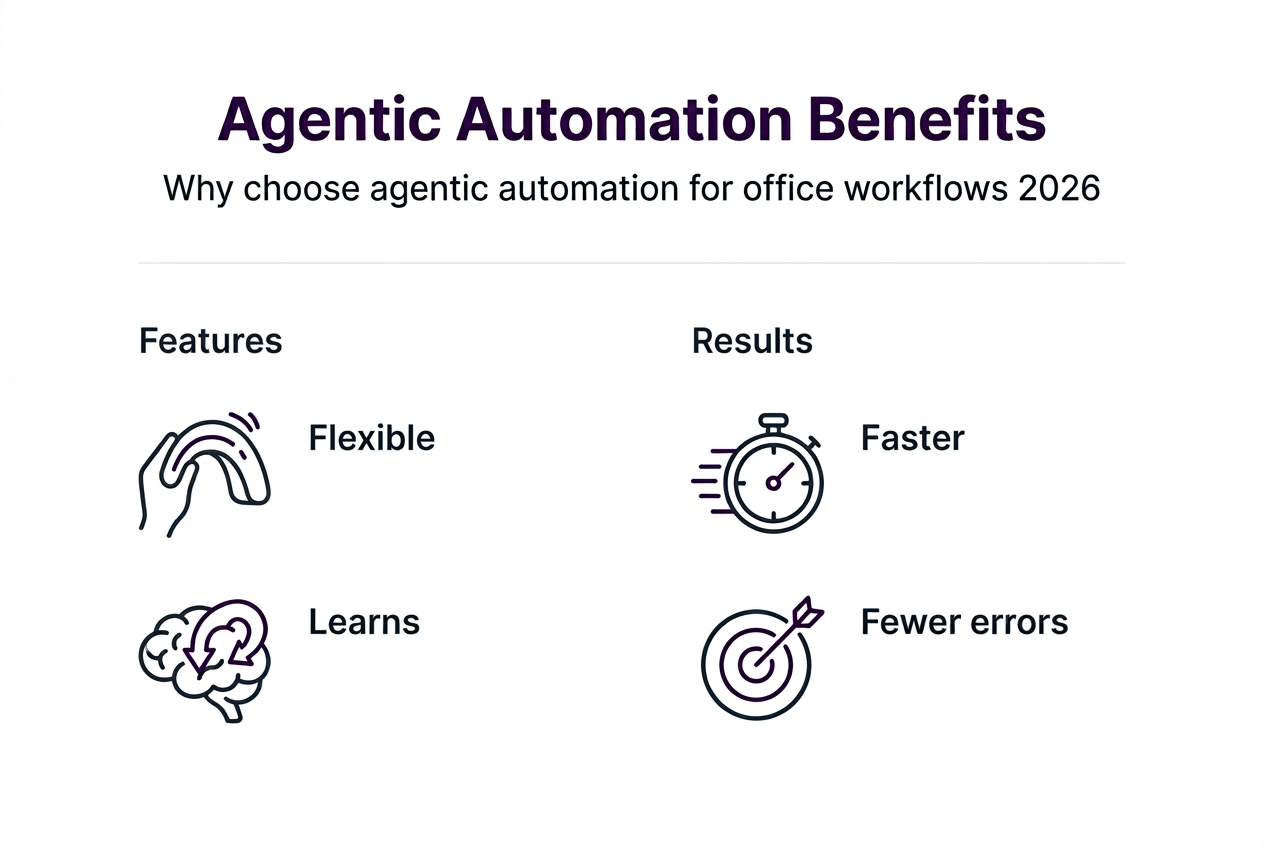
The Ninth Post provides concrete numbers. They saved approximately $50,000 annually by redesigning operations around AI agents. More importantly, they eliminated bottlenecks that previously required hiring additional staff to scale output.
Productivity gains manifest across multiple dimensions:
| Workflow Type | Traditional Time | With Agentic AI | Improvement |
|---|---|---|---|
| Invoice processing | 15 min per invoice | 3 min per invoice | 5x faster |
| Contract review | 45 min per contract | 12 min per contract | 3.75x faster |
| Customer inquiry response | 8 min per inquiry | 2 min per inquiry | 4x faster |
| Compliance documentation | 60 min per submission | 15 min per submission | 4x faster |
Cost savings extend beyond direct labor reduction. Agentic AI eliminates error correction costs, accelerates cycle times that unlock revenue faster, and removes capacity constraints that force expensive outsourcing.
Consider the compounding effect. When your finance team processes invoices 5x faster, they don’t just save time. They catch early payment discounts, improve cash flow forecasting accuracy, and redirect effort toward strategic financial analysis. When customer inquiries get resolved 4x faster, satisfaction increases, support costs decrease, and sales teams spend more time closing deals.
The strategic advantage comes from scalability without proportional cost increases. Traditional operations scale linearly. Double the workload, hire double the staff. Agentic AI scales exponentially. Add processing capacity, handle multiples of workload, maintain consistent quality.
Operations managers see this play out practically. Marketing campaigns that previously required careful volume management to avoid overwhelming support teams now scale freely. Seasonal peaks that demanded temporary staff hiring get absorbed by existing AI-augmented teams. Geographic expansion that meant replicating entire departments happens by deploying additional agent instances.
Financial impact breaks down clearly:
- Direct labor savings from automated task execution
- Error reduction savings from consistent AI performance
- Opportunity cost recovery from faster cycle times
- Scaling cost avoidance by handling growth without headcount
- Strategic value creation by redirecting human talent to high-impact work
The productivity multiplier effect matters most. When you automate routine execution, human team members focus on judgment, relationship building, and strategic thinking. This doesn’t just save money. It transforms your operational capability and competitive position.
Pro Tip: Measure baseline metrics for cycle time, error rates, and cost per transaction before implementing agentic AI. Document improvements quarterly to build ROI evidence and identify optimization opportunities.
How to implement agentic automation successfully in your organization
Agentic AI requires strategy that balances business benefits against implementation risks. Successful adoption follows structured phases rather than wholesale transformation attempts.
Start with workflow mapping. Document current processes in detail, identifying decision points, data sources, integration requirements, and exception handling needs. This groundwork reveals which workflows suit agentic automation and which require human judgment.
Risk assessment comes next. Evaluate failure impact for each workflow candidate. Invoice processing errors cost money but rarely create existential problems. Customer communication mistakes damage relationships more severely. Prioritize high-volume, lower-risk workflows for initial deployment.
Here’s the proven implementation sequence:
- Select pilot workflows with clear success metrics and contained risk profiles
- Deploy AI agents in shadow mode processing work parallel to existing operations
- Compare agent output against human work to identify accuracy gaps and failure patterns
- Refine agent instructions, add quality control checkpoints, and adjust business rules
- Transition to production with human review of flagged exceptions only
- Monitor performance continuously and expand to additional workflows incrementally
- Build internal expertise by training operations staff on agent management and optimization
Integration architecture matters critically. Agentic AI needs access to systems where work happens: CRM platforms, accounting software, document repositories, communication tools, and approval workflows. Plan authentication, data access, and audit logging before deployment.
Change management determines adoption success as much as technology does. Your team needs to understand that AI agents augment rather than replace them. Position automation as eliminating tedious work and enabling focus on valuable activities.
Establish clear governance:
- Define which workflows AI agents handle autonomously
- Specify escalation triggers requiring human intervention
- Create review processes for agent decisions on sensitive matters
- Document audit trails for compliance and quality assurance
- Build feedback loops where human corrections improve agent performance
The most successful implementations treat AI agents as team members requiring onboarding and continuous improvement. You wouldn’t hire an employee and expect perfect performance immediately. Apply the same patience and investment to agent development.
Improving business workflows happens iteratively. Start narrow, prove value, expand scope, and optimize continuously. Avoid the temptation to automate everything simultaneously.
Security and compliance deserve special attention. Ensure AI agents operate within data privacy regulations, maintain proper access controls, and log activities for audit purposes. Work with IT security teams to validate that agent actions meet organizational standards.
Finally, measure relentlessly. Track productivity improvements, error rates, cost savings, and user satisfaction. Use data to refine agent performance and justify expanded investment.
Elevate your operations with Ailerons IT Consulting
Transforming office workflows with agentic automation requires specialized expertise in AI architecture, system integration, and operational design. Ailerons IT Consulting partners with operations managers to implement autonomous AI systems that deliver measurable efficiency gains and sustainable competitive advantages.
Our approach combines technical depth with operational pragmatism. We assess your current workflows, identify high-impact automation opportunities, design agentic AI solutions tailored to your business systems, and deploy them with comprehensive training and support. Client case studies demonstrate how organizations achieve 3 to 5 times productivity improvements while maintaining quality and compliance standards.
Whether you’re exploring agentic automation for the first time or expanding existing implementations, Ailerons’ managed IT and AI consulting services provide the strategic guidance and technical execution that accelerates results. We don’t just implement technology. We transform operations.
FAQ
What types of office workflows benefit most from agentic automation?
Complex, multi-step workflows involving unstructured data deliver the highest returns from agentic AI. Finance operations like invoice processing and expense management, sales workflows including lead qualification and proposal generation, and compliance tasks such as documentation review and audit preparation all benefit significantly. Administrative coordination across scheduling, communications, and approvals also sees substantial efficiency gains.
How does agentic automation compare to traditional RPA in cost savings?
Traditional RPA implementations typically deliver 25 to 50% cost savings while reducing processing time by 30 to 80% for rule-based tasks. Agentic AI potentially delivers greater savings by automating more complex workflows that RPA cannot handle. Organizations report 3 to 5 times productivity improvements with agentic systems, translating to larger cost reductions when applied to knowledge work and decision-intensive processes.
What are the main challenges when adopting agentic AI?
Accuracy in multi-step tasks remains developmental, with current systems completing about 30% of complex workflows perfectly. However, approximately 90% of output requires minimal edits, making most work immediately usable. Understanding how agents fail enables building quality control systems that catch issues before production impact. Training teams to manage AI interaction, establish review processes, and handle exceptions effectively represents the primary organizational challenge beyond technology deployment.
How can my organization measure success after implementing agentic automation?
Track productivity improvements by comparing task completion times before and after deployment. Monitor error rate reductions and quality metrics to ensure AI maintains or improves accuracy standards. Calculate cost savings including direct labor, error correction expenses, and capacity expansion avoidance. Review AI agent outputs systematically and measure process cycle times across entire workflows, not just individual tasks. Establish baseline metrics before implementation to enable meaningful comparison and ROI documentation.
Recommended
- Step-by-Step Guide to AI-Driven Office Automation Success | Ailerons IT Consulting
- AI Trends in 2026: Transforming Office Operations | Ailerons IT Consulting
- Office Operations Automation Trends: Agentic AI Impact | Ailerons IT Consulting
- Improving Business Workflows with AI: Achieve Automation | Ailerons IT Consulting