

Managing technology can feel like a constant balancing act for business owners focused on growth rather than IT headaches. Outsourcing key systems through managed IT services lets companies sidestep expensive internal hires and still get professional monitoring, cybersecurity, and support. By turning to external experts who offer both advanced technology and hands-on oversight, organizations in the United States can improve reliability and keep teams productive while focusing energy on delivering better customer experiences.
Table of Contents
- Defining Managed IT Services For Businesses
- Key Features And Functions Explained
- Types Of Managed IT Services For SMBs
- Real-World Applications And AI Automation Roles
- Cost, Risk, And Compliance Considerations
- How Managed IT Compares To Other Models
Key Takeaways
| Point | Details |
|---|---|
| Importance of Managed IT Services | Outsourcing IT functions enhances operational efficiency and mitigates risks, allowing businesses to focus on core objectives. |
| Core Components of Services | Key features include network monitoring, cybersecurity, cloud management, and disaster recovery planning, all essential for managing technological infrastructure effectively. |
| AI’s Role in IT Management | Artificial intelligence and automation enhance efficiency and proactive response capabilities in IT services, transforming technology management. |
| Cost and Compliance Considerations | Evaluate financial implications, cybersecurity risks, and compliance requirements when outsourcing IT services to ensure strategic alignment with business needs. |
Defining Managed IT Services for Businesses
Managed IT services represent a comprehensive approach to technology management where external experts take responsibility for maintaining, monitoring, and optimizing a business’s entire technological infrastructure. These services go beyond traditional break-fix IT support, offering proactive and strategic technology management designed to enhance operational efficiency and reduce potential risks.
At its core, managed IT services involve outsourcing critical technology functions to specialized providers who bring advanced expertise and continuous monitoring capabilities. Comprehensive technology solutions enable businesses to leverage professional IT support without maintaining expensive in-house teams. This model allows organizations to focus on core business objectives while ensuring their technological systems remain secure, updated, and fully functional.
The key components of managed IT services typically include:
- Network infrastructure monitoring and maintenance
- Cybersecurity protection and threat detection
- Cloud computing and storage management
- Hardware and software maintenance
- Help desk and technical support services
- Data backup and disaster recovery planning
Businesses across various sectors benefit from managed IT services by gaining access to specialized technological expertise without the substantial overhead of building internal IT departments. These services provide scalable solutions that adapt to changing business needs, ensuring organizations can rapidly respond to technological challenges and opportunities.
Pro tip: When evaluating managed IT services, prioritize providers who offer transparent reporting, clear service level agreements, and demonstrated expertise in your specific industry.
Key Features and Functions Explained
Managed IT services encompass a wide range of sophisticated technological functions designed to provide comprehensive support for businesses of all sizes. Advanced technology integration enables organizations to leverage expert technological management without maintaining complex internal infrastructure. These services are strategically crafted to address multiple critical technological needs simultaneously.
The core functions of managed IT services typically include several key operational components:
- Continuous Remote Monitoring: Real-time tracking of network performance and potential vulnerabilities
- Cybersecurity Management: Proactive protection against digital threats and potential breaches
- Help Desk Support: Immediate technical assistance and problem resolution
- Cloud Solutions: Strategic management of cloud infrastructure and migration services
- Compliance Assistance: Ensuring technological operations meet industry-specific regulatory standards
- Disaster Recovery Planning: Comprehensive strategies for data protection and business continuity
Businesses benefit from these services by transforming their technological infrastructure from a potential liability into a strategic asset. The goal is not just maintaining systems but optimizing them to drive operational efficiency, reduce downtime, and create scalable technological frameworks that support business growth. By outsourcing complex IT management, companies can redirect internal resources towards core business objectives and innovation.
Pro tip: When selecting a managed IT services provider, request detailed service level agreements that clearly outline performance metrics, response times, and specific technological capabilities.
Types of Managed IT Services for SMBs
Small and medium-sized businesses have access to a diverse range of managed IT services designed to address their unique technological challenges and operational needs. Comprehensive service categories provide targeted solutions that help businesses optimize their technological infrastructure without requiring extensive internal IT expertise.
The primary types of managed IT services for SMBs include:
-
Network Management Services
- Continuous network performance monitoring
- Bandwidth optimization
- Network security configuration
- Infrastructure design and maintenance
-
Cybersecurity Services
- Threat detection and prevention
- Security vulnerability assessments
- Compliance management
- Data protection strategies
-
Cloud Computing Services
- Cloud infrastructure design
- Migration support
- Multi-cloud management
- Hybrid cloud integration
-
Data Backup and Recovery Services
- Automated backup solutions
- Disaster recovery planning
- Business continuity strategies
- Data restoration support
-
Help Desk and Technical Support
- Remote troubleshooting
- User support
- Software and hardware maintenance
- Technology training
By leveraging these specialized services, SMBs can transform their technological capabilities from potential limitations to strategic advantages. Each service type is designed to address specific operational challenges, enabling businesses to scale efficiently, maintain robust security, and focus on core business objectives without being bogged down by complex technological management.

Pro tip: Conduct a thorough assessment of your current IT infrastructure before selecting managed services to ensure you choose solutions that precisely match your business requirements.
Real-World Applications and AI Automation Roles
Artificial intelligence and automation are rapidly transforming managed IT services, offering small and medium-sized businesses unprecedented opportunities to streamline operations and enhance technological capabilities. AI-driven technological solutions are revolutionizing how businesses approach IT management, moving beyond traditional reactive support to proactive, intelligent system optimization.
The real-world applications of AI in managed IT services encompass several critical areas:
-
Network Monitoring and Predictive Maintenance
- Continuous 24/7 network performance tracking
- Automated anomaly detection
- Predictive failure prevention
- Intelligent resource allocation
-
Cybersecurity Enhancement
- Advanced threat detection algorithms
- Real-time security vulnerability scanning
- Automated incident response
- Machine learning-powered threat analysis
-
Help Desk and Technical Support
- AI-powered chatbots and initial problem triage
- Automated ticket routing and prioritization
- Intelligent self-service knowledge bases
- Predictive user support solutions
-
Operational Efficiency Optimization
- Automated workflow management
- Intelligent resource scheduling
- Performance analytics and insights
- Continuous process improvement algorithms
By integrating AI technologies, businesses can transform their IT infrastructure from a cost center into a strategic asset. These intelligent systems enable more responsive, efficient, and proactive technological management, allowing companies to allocate human resources toward more complex, value-added activities.
Pro tip: Implement AI automation gradually, starting with low-risk processes and continuously measuring performance to build organizational confidence and understand potential benefits.
Cost, Risk, and Compliance Considerations
Managed IT services introduce complex financial, security, and regulatory dimensions that small and medium-sized businesses must carefully evaluate. Comprehensive risk management requires a strategic approach to understanding the potential benefits and inherent challenges of outsourcing technological infrastructure.
Key cost and risk considerations include:
-
Financial Implications
- Predictable monthly service fees
- Reduced internal IT infrastructure costs
- Elimination of expensive hardware investments
- Scalable pricing models
-
Cybersecurity Risk Factors
- Third-party access to sensitive systems
- Potential increased attack surfaces
- Data privacy and protection protocols
- Vendor security assessment requirements
-
Compliance Framework Requirements
- Industry-specific regulatory standards
- HIPAA, PCI DSS, SOC 2 adherence
- Data handling and storage regulations
- Audit trail and documentation needs
-
Contractual Risk Management
- Service level agreement details
- Performance guarantee clauses
- Incident response protocols
- Exit strategy and data migration terms
Businesses must conduct thorough due diligence when selecting managed IT service providers, understanding that the lowest-cost option is not always the most secure or compliant. The goal is to find a partner that offers comprehensive protection, transparent pricing, and alignment with specific organizational requirements.
For quick reference, here are the main risks businesses should consider when outsourcing IT management:
| Risk Category | Common Examples | Impact on Business |
|---|---|---|
| Security Risks | Third-party access, data breaches | Loss of sensitive data |
| Compliance Risks | Failure to meet regulations | Legal or financial penalties |
| Financial Risks | Hidden costs, scaling fees | Budget overruns |
| Contractual Risks | Poor SLAs, unclear exit terms | Service disruption |
Pro tip: Request detailed security and compliance documentation from potential managed IT service providers, and conduct a comprehensive risk assessment before finalizing any agreements.
How Managed IT Compares to Other Models
Small and medium-sized businesses face critical decisions when selecting IT management strategies, with multiple approaches offering distinct advantages and challenges. Strategic IT support models provide businesses with varying levels of technological control, expertise, and financial commitment.
Key comparative models for IT management include:
-
In-House IT Department
- Full internal technological control
- Direct employee management
- Higher fixed operational costs
- Limited expertise breadth
- Significant recruitment and training expenses
-
Break-Fix IT Support
- Reactive problem-solving approach
- Pay-per-incident pricing
- No ongoing maintenance strategy
- Unpredictable cost structures
- Higher potential for extended downtime
-
Managed IT Services
- Proactive system monitoring
- Predictable monthly expenses
- Access to broad technological expertise
- Scalable support infrastructure
- Continuous system optimization
-
Cloud-Based IT Solutions
- Remote infrastructure management
- Flexible technological resources
- Lower initial investment
- Rapid deployment capabilities
- Reduced hardware maintenance
Each IT management model presents unique trade-offs between cost, control, expertise, and operational flexibility. Managed IT services distinguish themselves by offering comprehensive, strategic support that balances technological capability with financial predictability, making them increasingly attractive for businesses seeking efficient, scalable technological management.
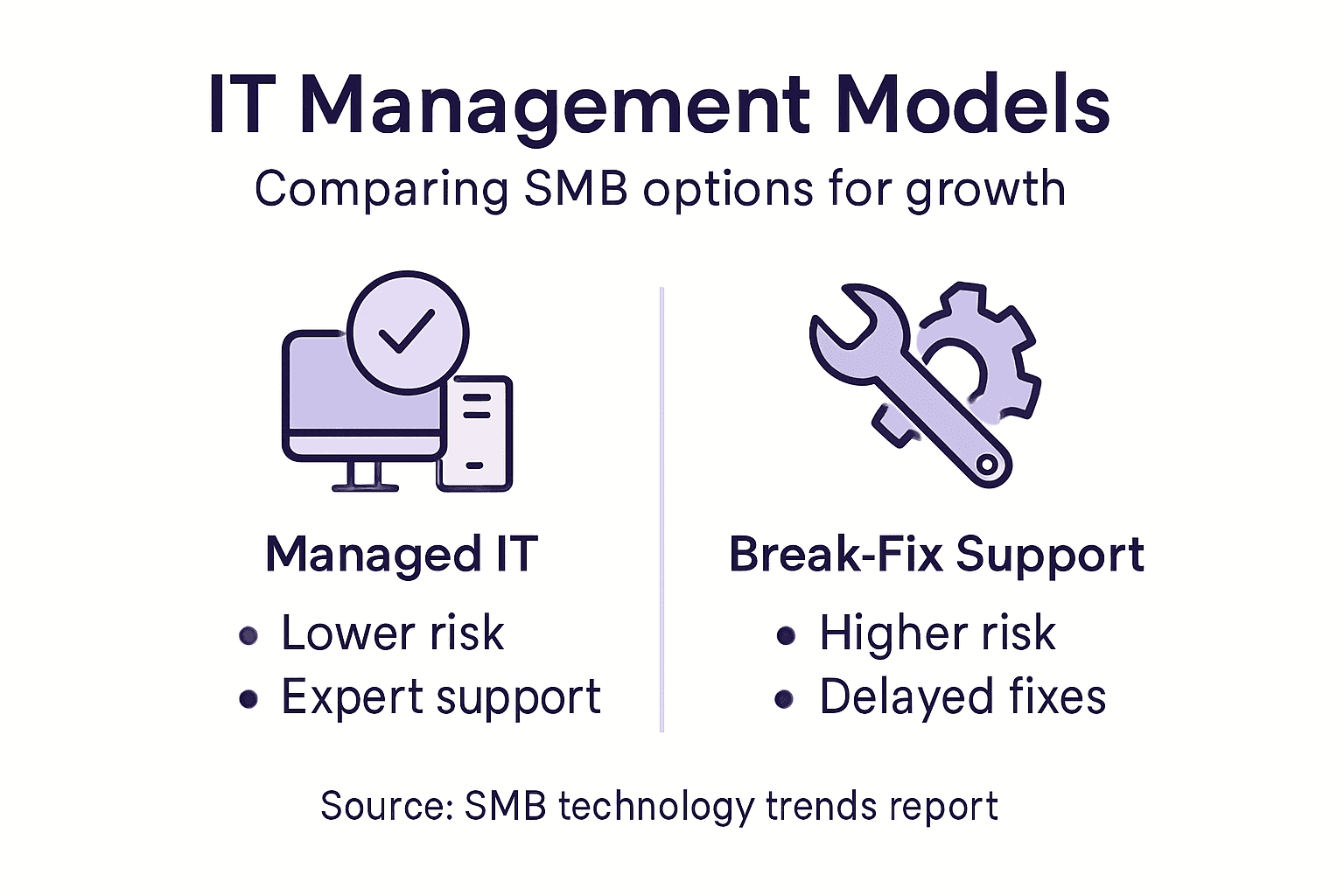
Here’s a comparison of key IT management models to help clarify their strengths and limitations:
| Model | Cost Structure | Level of Control | Depth of Expertise | Flexibility/Scalability |
|---|---|---|---|---|
| In-House IT | High fixed costs | Full internal control | Often limited, depends on staff | Low, requires hiring for growth |
| Break-Fix IT Support | Unpredictable, per incident | Very low | Narrow, limited to repairs | None, service only when needed |
| Managed IT Services | Predictable monthly fee | Shared with provider | Broad, specialized team | High, easily scales with needs |
| Cloud-Based IT Solutions | Lower initial investment | External cloud provider | High, vendor expertise | Very high, resources on demand |
Pro tip: Conduct a thorough cost-benefit analysis comparing your current IT model against managed services, considering not just immediate expenses but long-term strategic value and operational efficiency.
Unlock SMB Growth with Managed IT Services and AI-Powered Automation
Many small and medium-sized businesses face challenges managing complex IT infrastructure while trying to scale. This article highlights common pain points like high costs, unpredictable downtime, limited IT expertise, and the need for proactive technology management. At Ailerons IT Consulting, we understand that simply maintaining IT systems is not enough. You need reliable, agent-driven workflows that reduce manual work, improve response times, and create consistent outcomes across teams.
Our managed IT solutions integrate practical AI automation with your existing tools such as Microsoft 365, CRMs, and scheduling systems. This means your SMB can benefit from continuous system monitoring, streamlined help desk support, and AI-enhanced cybersecurity without the overhead of large internal teams. We specialize in building secure, scalable AI agents that execute multi-step tasks daily while maintaining human-in-the-loop controls to protect sensitive data and ensure compliance.
Experience technology as a true growth driver through intelligent automation tailored for SMBs. Visit Ailerons IT Solutions now to explore how agentic AI and managed IT services can transform your operational efficiency. Don’t wait to turn your technological challenges into strategic advantages. Start your path toward faster lead response, reduced downtime, and improved customer experience today.
Frequently Asked Questions
What are managed IT services?
Managed IT services are a comprehensive approach to technology management where external experts maintain, monitor, and optimize a business’s technological infrastructure. This model allows businesses to focus on core objectives while ensuring their systems are secure and functional.
How can managed IT services benefit small and medium-sized businesses (SMBs)?
Managed IT services benefit SMBs by providing access to specialized expertise, reducing operational risks, optimizing technology performance, and enabling scalability. This allows businesses to redirect resources towards innovation and growth.
What features are typically included in managed IT services?
Key features of managed IT services include network infrastructure monitoring, cybersecurity protection, cloud computing management, hardware/software maintenance, data backup, and help desk support. These services ensure comprehensive technology management.
How do managed IT services compare to traditional break-fix IT support?
Unlike break-fix support, which is reactive and incurs costs per incident, managed IT services provide proactive monitoring and a predictable monthly fee. This approach focuses on maintaining and optimizing systems rather than only fixing problems as they arise.