

You’ve invested in AI pilots, but only about 5% reach production with meaningful business impact. The problem isn’t your technology stack or budget. Most failures stem from poor context management, not weak AI models. Context-aware automation offers a disciplined approach that links workflows, preserves decision-making logic, and adapts to real-time signals across your systems. This guide explains what context-aware automation is, why traditional AI pilots fail without it, and how mid-sized companies implement it to save thousands of hours while improving accuracy and employee satisfaction.
Table of Contents
- What Is Context-Aware Automation?
- Why Do Most AI Automation Pilots Fail? The Role Of Context
- Proven Benefits: Context-Aware Automation In Real Businesses
- How To Implement Context-Aware Automation In Your Mid-Sized Company
- Explore Ailerons’ IT Consulting And AI Automation Services
- What Industries Benefit Most From Context-Aware Automation?
- How Does Context-Aware Automation Improve Employee Productivity?
- What Are Common Challenges When Implementing Context-Aware Automation?
- How Can Businesses Measure The Success Of Context-Aware Automation?
Key takeaways
| Point | Details |
|---|---|
| Context-aware automation integrates AI across workflows | It coordinates tasks by interpreting policies, urgency, and dependencies in real time. |
| Most AI failures stem from poor context management | Organizational learning gaps and context overload undermine AI reasoning more than model quality. |
| Successful companies save thousands of hours annually | Impact saved over 20,000 hours with Microsoft Copilot, while Morningstar achieved $600,000 in savings. |
| Implementation requires disciplined context curation | Treating context as a scarce resource and establishing feedback loops ensure reliability. |
| Strong AI orchestration empowers living processes | Automations collaborate seamlessly, continuously improving as workflows evolve. |
What is context-aware automation?
Context-aware automation uses AI to link and coordinate tasks across multiple systems, treating context as the crucial information that shapes automated decisions. Unlike static automation that follows rigid scripts, this approach adapts actions based on real-time contextual signals like user roles, approval hierarchies, document types, and urgency levels. AI acts as a decision layer that interprets policies, dependencies, and priorities to determine the right action at the right time.
Think of it as the difference between a traffic light that changes on a fixed timer versus one that adjusts based on actual traffic flow, time of day, and emergency vehicle presence. Context-aware automation generates what experts call a “living process graph” where individual automations don’t just execute tasks in isolation but collaborate based on shared understanding of the business environment.
The core involves mapping information and actions across systems, from trigger to resolution. When an invoice arrives, context-aware automation doesn’t just extract data. It understands vendor relationships, payment terms, approval requirements, budget availability, and exception handling rules. The system routes the invoice appropriately, escalates anomalies to humans, and updates related records across accounting, procurement, and vendor management platforms.
Key components include:
- Context sources: Systems, documents, user inputs, and historical data that provide decision-making signals
- AI reasoning layer: Interprets context to determine appropriate actions and workflows
- Integration fabric: Connects disparate systems to enable coordinated automation
- Feedback mechanisms: Capture outcomes to continuously refine context interpretation
Pro Tip: Start by documenting one complete workflow from trigger to completion, identifying every decision point where context influences the outcome. This mapping exercise reveals which context sources matter most and where automation can add immediate value.
The shift to context-aware automation represents moving from “doing tasks faster” to “orchestrating work intelligently.” Your business workflows with AI automation become adaptive rather than brittle, handling exceptions and variations without constant human intervention.
Why do most AI automation pilots fail? The role of context
The harsh reality is that only about 5% of enterprise AI pilots reach production with meaningful business impact. This failure rate surprises business leaders who assumed AI would simply work once deployed. The culprit isn’t the AI models themselves but how organizations manage context.
Most pilots fail because teams either provide too little context (context starvation) or overwhelm AI with irrelevant information (context stuffing). Both scenarios degrade AI reasoning and decision quality. When context is insufficient, AI makes decisions without understanding business rules, approval hierarchies, or exception handling protocols. When context is excessive, AI struggles to identify relevant signals amid noise, leading to slow processing and incorrect conclusions.
“Agent failures are rarely intelligence problems and almost always context management problems.” This insight challenges the common assumption that better AI models alone solve automation challenges.
Organizational learning gaps compound these technical issues. Companies often lack processes for curating context, validating AI decisions, and incorporating feedback. Without these disciplines, context quality degrades over time through what experts call “context rot,” where outdated information persists in AI systems, causing increasingly poor decisions.
Common failure patterns include:
- Isolated pilots: AI deployed in one department without cross-system context integration
- Missing feedback loops: No mechanism to validate AI decisions and refine context
- Undefined context boundaries: Teams don’t specify which information matters for each workflow
- Change management neglect: Staff lack training on working alongside AI systems
The shift to what practitioners call “Context Compaction” addresses these issues. This approach treats context as a scarce resource requiring rigorous curation. Instead of feeding AI everything available, teams identify the minimum context necessary for reliable decisions. Agentic workflows then use this compact context to reason through multi-step processes, escalating to humans only when encountering genuine ambiguity.
Your AI automation checklist for 2026 should prioritize context management from day one. Successful implementations establish clear context governance, defining what information feeds each automation, how frequently context updates, and who validates context accuracy. This discipline transforms AI from a fragile experiment into a reliable operational tool.
Proven benefits: context-aware automation in real businesses
The abstract promise of AI becomes concrete when you examine companies that implemented context-aware automation effectively. Impact, a technology services company, deployed Microsoft Copilot with disciplined context management and saved over 20,000 hours annually across 100 users. Their net ROI reached $1.72 million by automating document generation, meeting summaries, and cross-system data retrieval while maintaining decision quality through careful context curation.
Morningstar, the financial services firm, took a different approach by building custom AI workflows in Asana AI Studio. They achieved $600,000 in annual savings by automating content production pipelines and research workflows. The key wasn’t just automating tasks but ensuring AI understood project context, stakeholder requirements, and quality standards at each workflow stage.
These results span multiple operational areas:
- Administrative tasks: Scheduling, email triage, and document routing save 5 to 8 hours per employee weekly
- Financial processes: Invoice processing, expense approvals, and reconciliation reduce cycle times by 40 to 60%
- Content pipelines: Research, drafting, and review workflows accelerate by 30 to 50% while maintaining quality
- Customer service: Ticket routing, response drafting, and escalation improve resolution times by 35%
The following table shows typical time savings by workflow category:
| Workflow Category | Manual Time (hours/month) | Automated Time (hours/month) | Time Saved |
|---|---|---|---|
| Invoice Processing | 40 | 12 | 70% |
| Meeting Coordination | 30 | 8 | 73% |
| Document Review | 50 | 20 | 60% |
| Expense Approvals | 25 | 7 | 72% |
Beyond time savings, context-aware automation improves accuracy and consistency. When AI understands approval hierarchies, compliance requirements, and exception handling protocols, it routes work correctly the first time. This reduces rework, minimizes delays, and increases employee satisfaction by eliminating frustrating manual coordination.

Pro Tip: Calculate your potential ROI by identifying three high-volume workflows where context is well-defined. Estimate monthly hours spent, multiply by average hourly cost, and apply a conservative 50% automation rate to project first-year savings.
The benefits compound as AI coordinates multiple workflows simultaneously. Your end-to-end business automation becomes a network of intelligent agents that share context, collaborate on complex tasks, and continuously improve through feedback. Early adopters report that automation effectiveness increases 20 to 30% in the second year as context quality improves and teams develop better AI collaboration skills.
How to implement context-aware automation in your mid-sized company
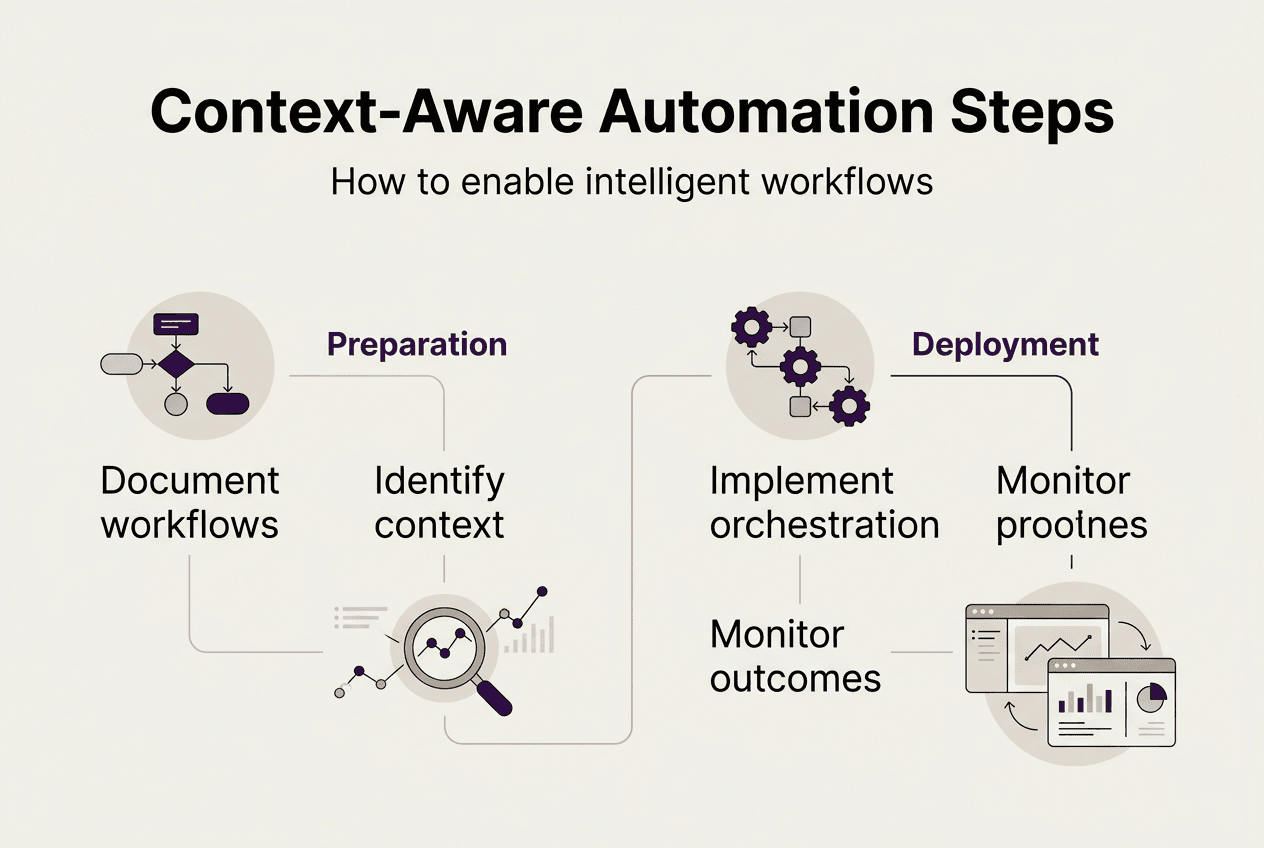
Successful implementation follows a disciplined framework that prioritizes context quality over automation speed. Start by mapping one complete workflow from trigger to completion, documenting every decision point, information source, and handoff. This exercise reveals where context influences outcomes and which automations deliver immediate value.
Follow these steps:
- Select pilot workflows: Choose processes where context is well-understood, volume justifies automation, and success metrics are clear
- Map context sources: Identify systems, documents, and human inputs that provide decision-making signals
- Define context boundaries: Specify exactly which information matters for each automation, avoiding both starvation and stuffing
- Establish validation protocols: Create feedback loops where humans review AI decisions and refine context as needed
- Build AI literacy: Train your team on working alongside AI systems, understanding when to trust automation and when to intervene
- Scale systematically: Expand to additional workflows only after validating context quality and decision reliability
The transition to agentic engineering requires treating context as a scarce resource and rigorous curation. This means regularly auditing context sources, removing outdated information, and updating decision logic as business processes evolve. Companies that skip this discipline experience context rot within months, undermining automation reliability.
The following table compares traditional automation with context-aware approaches:
| Aspect | Traditional Automation | Context-Aware Automation |
|---|---|---|
| Decision Logic | Fixed rules and scripts | Dynamic interpretation of context |
| Adaptability | Requires reprogramming for changes | Adjusts based on contextual signals |
| Exception Handling | Fails or requires human intervention | Escalates intelligently using context |
| Cross-System Coordination | Limited or manual | Seamless through shared context |
Common pitfalls include attempting too many workflows simultaneously, neglecting change management, and failing to establish clear success metrics. Start small, validate thoroughly, and expand based on demonstrated ROI. Your first pilot should take 60 to 90 days from mapping to production, with measurable time savings evident within the first month.
Pro Tip: Create a “context playbook” documenting which information sources feed each automation, how frequently context updates, and who validates accuracy. This living document becomes your operational guide as you scale automation across the organization.
Your guide to AI-driven office automation success emphasizes that technology is only one component. Organizational readiness, including AI literacy, change management, and continuous improvement processes, determines whether automation delivers lasting value or becomes another failed pilot.
Explore Ailerons’ IT consulting and AI automation services
Implementing context-aware automation requires both technical expertise and deep understanding of business operations. Ailerons specializes in designing and deploying agentic AI systems that go beyond traditional automation by enabling AI to reason, plan, and execute multi-step tasks across your office workflows. We help mid-sized companies map workflows, identify context sources, and establish the disciplined practices that ensure automation reliability.
Our approach includes workflow analysis, context mapping, AI orchestration design, and team training to build lasting AI literacy. We’ve guided companies through successful implementations documented in our case studies, demonstrating measurable time savings, cost reductions, and productivity improvements. Whether you’re exploring your first AI pilot or scaling existing automations, our managed IT and AI consulting services provide the expertise and support needed to achieve meaningful business impact.
What industries benefit most from context-aware automation?
Context-aware automation delivers the strongest results in knowledge work environments where workflows span multiple systems and require dynamic decision-making. Professional services firms, financial institutions, healthcare organizations, technology companies, and manufacturing operations with complex administrative processes see immediate value. These industries share common characteristics including high-volume document processing, multi-step approval workflows, cross-departmental coordination, and the need to maintain compliance while improving efficiency. The approach works particularly well when business rules are well-defined but require interpretation based on specific circumstances, such as invoice approvals that vary by amount, vendor relationship, and budget availability.
How does context-aware automation improve employee productivity?
By automating context-sensitive decisions, employees save 5 to 8 hours weekly on routine coordination, data entry, and status tracking tasks. They shift focus to higher-value work requiring judgment, creativity, and relationship building. The productivity gain comes not just from speed but from reducing cognitive load. When AI handles scheduling conflicts, routes approvals correctly, and maintains data consistency across systems, employees experience fewer interruptions and less frustration with manual coordination.
What are common challenges when implementing context-aware automation?
The main challenges include preserving accurate context as business processes evolve, ensuring data quality across source systems, and managing organizational change as employees adapt to working alongside AI. Technical integration complexity can slow initial deployment, particularly when connecting legacy systems with modern AI platforms. Many companies also struggle with defining clear success metrics and establishing feedback loops for continuous improvement. Overcoming these challenges requires disciplined project management, executive sponsorship, and investment in both technology and team training.
How can businesses measure the success of context-aware automation?
Track quantitative metrics including hours saved per workflow, process cycle time reductions, error rates, and cost savings from reduced manual effort. Complement these with qualitative measures like employee satisfaction scores, customer feedback on response times, and the percentage of processes running end-to-end without human intervention. Establish baseline measurements before automation, then monitor weekly or monthly to identify trends and areas for improvement. The most successful implementations review metrics quarterly, using insights to refine context curation and expand automation to additional workflows.
Recommended
- Step-by-Step Guide to AI-Driven Office Automation Success | Ailerons IT Consulting
- Master the Administrative Task Automation Process Today | Ailerons IT Consulting
- Step by Step Business Automation Guide for SMBs | Ailerons IT Consulting
- Office Operations Automation Trends: Agentic AI Impact | Ailerons IT Consulting