

Managing administrative workloads in healthcare often means facing a constant tug-of-war between efficiency and compliance. With rising demands and evolving regulations across regions from Canadian provinces to American states and European nations, mid-sized healthcare organizations are searching for ways to cut through time-consuming tasks. Intelligent automation and agentic AI open a path toward adaptive, autonomous solutions that handle complexity while ensuring compliance. This article explores how these advanced systems can transform critical office workflows, integrate with existing technology, and position your organization for scalable growth.
Table of Contents
- Defining Intelligent Automation And Agentic AI
- Key Agentic AI Features And Capabilities
- Use Cases In Healthcare Office Workflows
- Integration With Legacy Systems And Compliance
- Risks, Change Management, And Scalability Challenges
Key Takeaways
| Point | Details |
|---|---|
| Intelligent Automation Shift | Intelligent automation represents a shift to more autonomous systems that surpass traditional automation. |
| Agentic AI Capabilities | Agentic AI features proactive planning, adaptive learning, and autonomous decision-making. |
| Healthcare Applications | In healthcare, agentic AI can enhance administrative workflows and improve efficiency. |
| Integration and Compliance | Successful integration of intelligent automation requires adherence to regulatory standards and maintaining data privacy. |
Defining Intelligent Automation and Agentic AI
Intelligent automation represents a profound technological paradigm shift beyond traditional rule-based software systems. At its core, agentic AI emerges as a revolutionary approach to computational problem-solving, characterized by autonomous decision-making and adaptive behavior. Sophisticated autonomous systems are transforming how organizations approach complex operational challenges.
Agentic AI distinguishes itself through several key capabilities that set it apart from conventional automation technologies:
- Proactive planning with contextual understanding
- Dynamic goal-oriented behavior
- Ability to learn and adapt in real-time
- Sophisticated tool integration and manipulation
- Autonomous decision-making without constant human intervention
Large language models integrated with agent frameworks enable these systems to intelligently choose and combine actions for complex goal achievement. Unlike traditional software with rigid, predetermined pathways, agentic AI can reason, learn, and make nuanced decisions that approximate human-like problem-solving.
The fundamental architecture of agentic AI involves two primary system types: symbolic systems relying on algorithmic planning and neural generative systems leveraging stochastic generation. This dual-paradigm approach allows for remarkable flexibility in addressing multifaceted operational challenges across industries.
Pro Tip: When evaluating intelligent automation solutions, prioritize systems demonstrating adaptive learning and goal-oriented behavior rather than merely task-specific scripting.
Key Agentic AI Features and Capabilities
Agentic AI represents a sophisticated technological approach that transcends traditional computational methods by introducing dynamic, adaptive intelligence. Advanced software functionalities enable these systems to perform complex multi-step tasks with unprecedented autonomy and precision.
The core capabilities of agentic AI systems include:
- Proactive reasoning and strategic planning
- Contextual memory retention
- Autonomous multi-step decision-making
- Dynamic environmental adaptation
- Sophisticated tool integration and manipulation
- Iterative learning and performance optimization
Contextual memory and environmental adaptability distinguish agentic AI from traditional automation approaches. These systems function as collaborative partners, dynamically perceiving complex environments and executing goal-oriented actions with minimal human intervention.

Two primary architectural paradigms define agentic AI: symbolic/classical and neural/generative systems. Symbolic systems rely on algorithmic planning and persistent state management, while neural systems leverage stochastic generation and prompt-driven orchestration. This dual approach allows organizations to deploy intelligent automation solutions tailored to specific operational requirements and complexity levels.
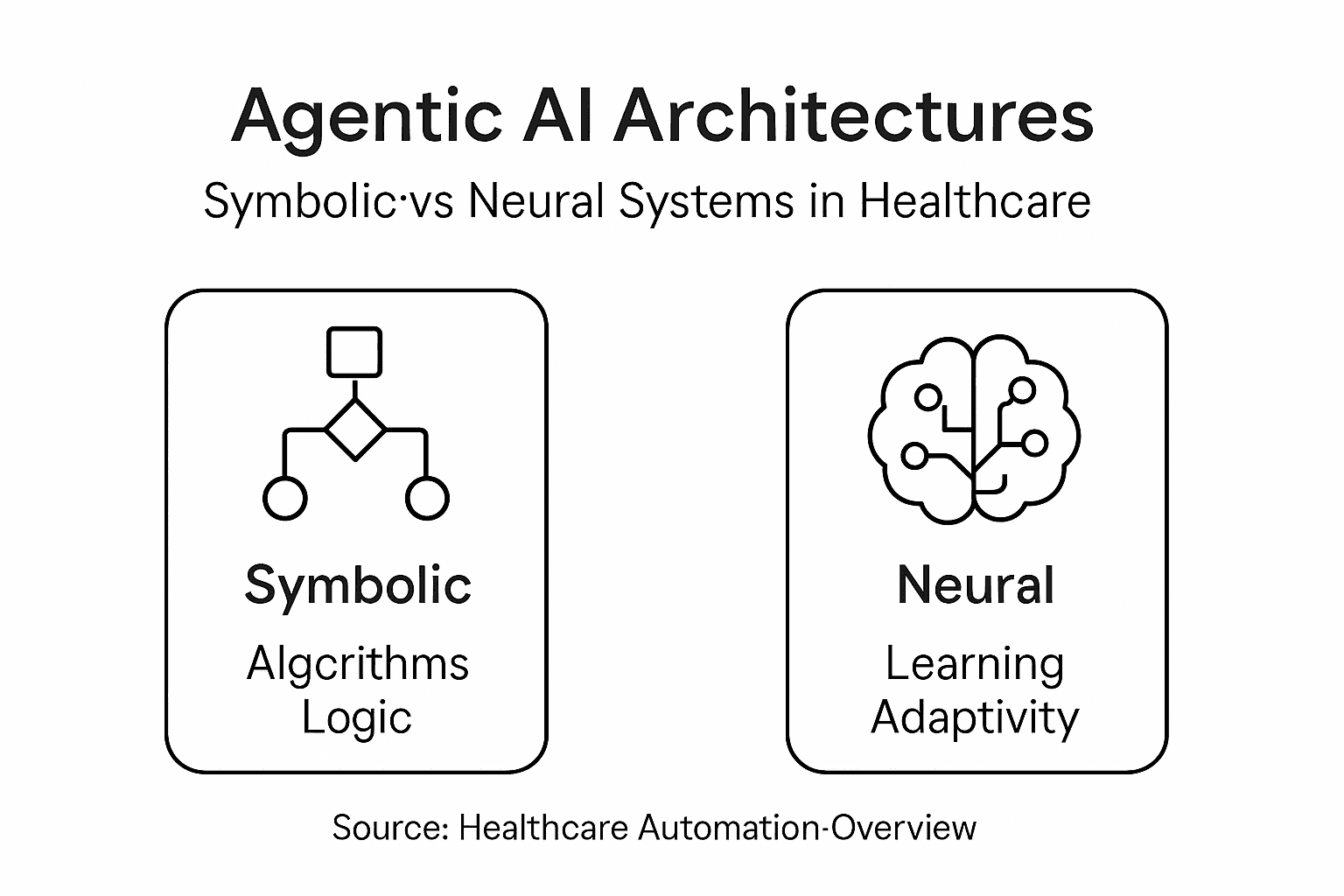
Here’s a summary of symbolic versus neural agentic AI architectures:
| System Type | Core Mechanism | Strengths | Use Case Fit |
|---|---|---|---|
| Symbolic (Classical) | Algorithmic planning | Precise control, transparency | Structured, rules-based tasks |
| Neural (Generative) | Stochastic generation | Adaptability, nuanced actions | Complex, dynamic scenarios |
Pro Tip: When implementing agentic AI, prioritize systems that demonstrate robust contextual understanding and the ability to learn and adapt across multiple operational scenarios.
Use Cases in Healthcare Office Workflows
Intelligent automation is revolutionizing healthcare administrative processes, addressing long-standing challenges in operational efficiency. Comprehensive workflow automation enables healthcare organizations to streamline complex administrative tasks while maintaining regulatory compliance and patient care quality.
Key healthcare office workflow applications for agentic AI include:
- Patient appointment scheduling and management
- Electronic health record (EHR) processing
- Claims and billing automation
- Provider credentialing verification
- Prior authorization management
- Real-time patient data monitoring
- Regulatory compliance tracking
HyperAutomation technologies integrate multiple intelligent systems to create comprehensive workflow solutions. These technologies combine robotic process automation (RPA), machine learning, and adaptive AI to reduce manual administrative burdens, minimize human error, and accelerate patient service delivery.
Healthcare organizations can strategically implement intelligent automation across various administrative domains, transforming time-consuming manual processes into efficient, accurate, and scalable digital workflows. By leveraging AI-driven solutions, medical offices can redirect valuable human resources toward direct patient care and strategic operational improvements.
Consider how intelligent automation addresses healthcare administrative challenges:
| Challenge | Automation Impact | Resulting Benefit |
|---|---|---|
| Manual data entry | Automates record processing | Fewer errors, saves time |
| Appointment scheduling | AI-driven coordination | Improved patient experience |
| Claims management | Predicts and processes claims | Faster reimbursement cycles |
| Compliance tracking | Monitors and reports changes | Reduces regulatory risk |
Pro Tip: Begin intelligent automation implementation by mapping existing workflows and identifying repetitive, rules-based processes that consume significant administrative time.
Integration with Legacy Systems and Compliance
Healthcare technology integration represents a complex challenge requiring sophisticated approaches to bridge existing infrastructure with intelligent automation solutions. Legacy system constraints demand nuanced strategies that preserve operational continuity while enabling technological advancement.
Successful integration strategies encompass multiple critical dimensions:
- Middleware and API-based connectivity
- Secure data migration protocols
- Comprehensive audit trail maintenance
- Regulatory compliance frameworks
- Patient privacy preservation mechanisms
- Incremental system upgrade approaches
- Interoperability standard adherence
Healthcare system integration techniques utilize advanced connectors like FHIR-based platforms to enable seamless data exchange. These approaches allow organizations to upgrade technological capabilities without complete system replacement, minimizing disruption and maintaining critical workflow continuity.
Compliance remains paramount when implementing intelligent automation. Healthcare organizations must meticulously design integration strategies that adhere to regulatory standards such as HIPAA and GDPR, ensuring robust data protection, transparent processing mechanisms, and comprehensive security protocols throughout the automation implementation process.
Pro Tip: Conduct a comprehensive system audit and create a phased integration roadmap that prioritizes secure, incremental technological upgrades.
Risks, Change Management, and Scalability Challenges
Intelligent automation introduces complex organizational dynamics that extend far beyond technological implementation. Healthcare AI adoption risks encompass technical, ethical, and human factors that demand comprehensive strategic planning.
Critical challenges in intelligent automation implementation include:
- Potential automation bias
- Clinical decision-making errors
- Staff resistance and cultural barriers
- Patient safety concerns
- Technical interoperability limitations
- Regulatory compliance complexity
- Workforce skills transformation requirements
Change management strategies play a crucial role in successful intelligent automation deployment. Structured approaches like Kotter’s 8-Step Process provide frameworks for addressing human factors, fostering organizational trust, and enabling smooth technological transitions.
Scalability challenges require holistic approaches that balance technological capabilities with organizational readiness. Healthcare leaders must develop comprehensive risk governance programs, implement continuous monitoring mechanisms, and create transparent communication channels to mitigate potential disruptions and maintain stakeholder confidence throughout the automation journey.
Pro Tip: Develop a cross-functional implementation team that includes clinical, technical, and administrative stakeholders to ensure comprehensive perspective and collaborative change management.
Transform Healthcare Operations with Agentic AI from Ailerons.ai
The article reveals the pressing challenges healthcare organizations face with manual administrative tasks and the need for intelligent automation that delivers adaptive, goal-oriented solutions. Issues like appointment scheduling, claims processing, and regulatory compliance demand systems that go beyond rigid scripting to learn, adapt, and autonomously manage complex workflows. This is where agentic AI becomes essential, offering proactive decision-making and real-time environmental understanding to drastically reduce errors and administrative burden.
At Ailerons.ai, we specialize in building agentic AI systems designed specifically for healthcare operations. Our solutions integrate seamlessly with your existing platforms including EHR, scheduling tools, and billing systems to automate entire workflows from start to finish. By deploying our AI-powered digital collaborators, your organization can focus on improving patient care while our technology handles multi-step tasks efficiently and securely. Explore how our end-to-end workflow automation can transform your office operations and how our secure, compliance-oriented AI frameworks align with healthcare’s strict regulatory demands.
Are you ready to overcome operational friction and scale with confidence? Discover the power of agentic AI and start your journey toward smarter healthcare automation today by visiting Ailerons.ai. Take the first step to redesign your workflows for lasting impact and efficiency.
Frequently Asked Questions
What is intelligent automation in healthcare?
Intelligent automation in healthcare refers to the integration of advanced technologies, such as agentic AI, to automate complex administrative processes, improve operational efficiency, and enhance patient care.
How does agentic AI differ from traditional automation?
Agentic AI differs from traditional automation by enabling autonomous decision-making, real-time learning, and adaptive behavior, allowing for more nuanced problem-solving rather than simply following predetermined scripts.
What are some use cases for intelligent automation in healthcare offices?
Key use cases for intelligent automation in healthcare include patient appointment scheduling, electronic health record processing, claims automation, and real-time monitoring of patient data.
What challenges are associated with implementing intelligent automation in healthcare?
Challenges include potential automation bias, clinical decision-making errors, staff resistance, regulatory compliance complexities, and the need for significant workforce skills transformation.