

Managing ever-growing administrative demands and strict compliance requirements can leave even experienced healthcare operations managers feeling stretched thin. The arrival of agentic AI systems offers a transformative way to tackle these challenges by automating nuanced decisions and adapting to shifting workflow needs with minimal oversight. For leaders aiming to reduce overhead while improving accuracy, this guide reveals how integrating agentic AI can reshape office work and compliance in the healthcare sector.
Table of Contents
- Agentic AI Systems Redefining Office Work
- Key Variations of Agentic AI in Operations
- Practical Workflow Applications for Enterprises
- Compliance, Security, and Risk Management
- Essential Implementation Challenges and Pitfalls
Key Takeaways
| Point | Details |
|---|---|
| Agentic AI Systems are Transformational | These systems autonomously pursue complex goals and adapt without constant human supervision, marking a significant shift in office workflows. |
| Integration into Workforce is Essential | Organizations need comprehensive strategies to incorporate AI as collaborative partners rather than mere tools, enhancing human-AI interactions. |
| Regulatory Compliance and Governance are Critical | Effective governance frameworks and accountability measures must be established to manage ethical, compliance, and risk considerations of AI systems. |
| Implementation Requires a Holistic Approach | Successful deployment of agentic AI involves addressing technical complexity, skill gaps, and cultural resistance within organizations. |
Agentic AI Systems Redefining Office Work
The emergence of agentic AI systems is fundamentally transforming how organizations approach office work and workforce management. Unlike traditional automation tools, these intelligent systems can autonomously pursue complex goals, make nuanced decisions, and adapt without constant human supervision. Agentic AI is evolving into digital teammates capable of executing intricate tasks across multiple operational domains.
At its core, agentic AI represents a paradigm shift in workplace technology. These advanced systems go beyond reactive task completion by demonstrating several key capabilities:
- Autonomous goal pursuit and decision-making
- Contextual understanding of complex workflows
- Adaptive learning and self-optimization
- Cross-platform task coordination
- Proactive problem resolution
Workforce integration is becoming increasingly sophisticated. Organizations can no longer view AI as mere tools but must develop comprehensive strategies for incorporating these digital agents into hybrid team structures. Experts highlight the need for new management frameworks that support seamless human-AI collaboration.
Healthcare operations stand to benefit dramatically from these technological advancements. Imagine AI systems that can simultaneously manage patient scheduling, process insurance claims, update electronic health records, and flag potential compliance issues—all with minimal human intervention. The potential for reducing administrative overhead while maintaining high accuracy is remarkable.
Agentic AI transforms digital workers from passive tools into active, intelligent collaborators within organizational ecosystems.
Pro tip: Develop clear accountability frameworks and performance metrics for AI agents before full-scale deployment to ensure responsible and transparent operations.
Key Variations of Agentic AI in Operations
Agentic AI is not a monolithic technology but a diverse landscape of intelligent systems with varying capabilities and architectural approaches. Agentic AI systems fall into distinct paradigmatic categories that fundamentally differ in their design, reasoning mechanisms, and operational strategies.
The primary variations of agentic AI can be categorized into several key architectural paradigms:
- Symbolic Systems: Rule-based architectures using algorithmic planning
- Neural Systems: Generative models leveraging stochastic processing
- Hybrid Systems: Combining symbolic logic with neural network adaptability
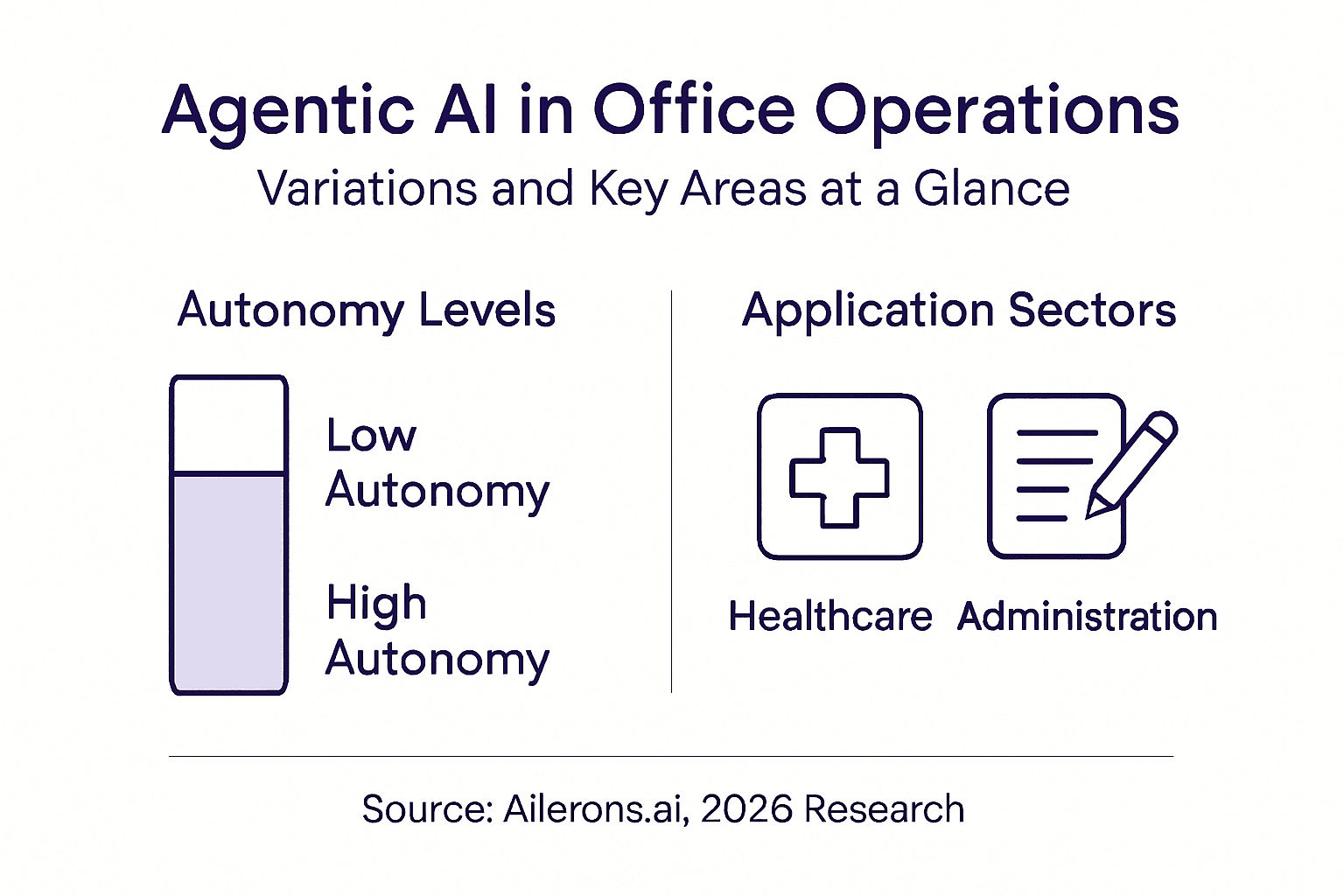
Autonomy levels represent another critical dimension of variation. Experiments demonstrate diverse implementation models ranging from narrow task automation to comprehensive workforce replication. These variations are profoundly influenced by specific operational contexts, technological constraints, and organizational requirements.
Healthcare and administrative operations particularly benefit from nuanced AI variations. For instance, a medical records management system might require a highly deterministic symbolic approach, while customer interaction platforms could leverage more adaptive neural architectures. The key is matching the AI system’s architectural complexity to the specific workflow demands.

Here is a summary comparing the primary paradigms of agentic AI systems and their ideal organizational applications:
| AI Paradigm | Typical Use Case | Strengths | Limitations |
|---|---|---|---|
| Symbolic Systems | Policy enforcement | Highly predictable actions | Limited adaptability |
| Neural Systems | Customer interaction | Flexible learning | Harder to audit decisions |
| Hybrid Systems | Healthcare automation | Balanced adaptability and control | Increased integration complexity |
Different agentic AI variations are not competing technologies, but complementary tools designed to address unique organizational challenges.
Pro tip: Conduct thorough workflow analysis to determine the most appropriate agentic AI architectural approach for your specific operational needs.
Practical Workflow Applications for Enterprises
Agentic AI is revolutionizing enterprise workflow management by transforming how organizations approach complex administrative and operational tasks. These intelligent systems enable businesses to reimagine traditional processes, creating more efficient, adaptive, and intelligent work environments across multiple functional domains.
Enterprise workflow applications for agentic AI span several critical operational areas:
- Human Resources: Automating recruitment screening, candidate matching, and onboarding processes
- Finance: Managing complex financial reporting, expense analysis, and compliance tracking
- Customer Service: Handling multi-channel customer interactions with contextual understanding
- Legal Compliance: Monitoring regulatory changes and automatically updating internal protocols
- Supply Chain: Predicting inventory needs and optimizing procurement strategies
Healthcare and administrative sectors stand to gain substantial efficiency improvements. Intelligent workflow management means AI systems can now coordinate intricate processes that previously required extensive human intervention. For instance, an agentic AI could simultaneously schedule patient appointments, verify insurance eligibility, update medical records, and flag potential compliance issues—all without continuous human oversight.
Agentic AI transforms enterprise workflows from reactive task completion to proactive, intelligent process orchestration.
Pro tip: Start with pilot projects in low-risk departments to build organizational confidence and demonstrate tangible AI workflow benefits.
Compliance, Security, and Risk Management
Agentic AI introduces complex governance challenges that require sophisticated approaches to compliance, security, and risk management. Responsible AI frameworks are critical for managing autonomous systems as organizations navigate the intricate landscape of emerging technological capabilities.
Key compliance and security considerations for agentic AI include:
- Ethical Guidelines: Establishing clear boundaries for AI decision-making
- Transparency Requirements: Ensuring algorithmic decision processes can be audited
- Data Privacy Protocols: Protecting sensitive information across AI interactions
- Bias Detection Mechanisms: Identifying and mitigating potential discriminatory patterns
- Accountability Frameworks: Defining clear responsibility for AI-generated outcomes
Enterprise risk management strategies must evolve to address the unique challenges posed by autonomous AI systems. Healthcare and financial sectors particularly require robust governance frameworks that balance technological innovation with regulatory compliance, ensuring that AI systems operate within strict ethical and legal boundaries.
The complexity of agentic AI governance demands a multifaceted approach. Organizations must develop comprehensive monitoring systems, implement continuous learning protocols, and create adaptive control mechanisms that can respond to emerging technological and regulatory landscapes.
Effective agentic AI governance requires a proactive, holistic approach that anticipates potential risks while enabling technological innovation.
Pro tip: Develop a cross-functional AI governance team that includes legal, technical, and ethical experts to create comprehensive risk management strategies.
Essential Implementation Challenges and Pitfalls
Agentic AI implementation represents a complex organizational transformation that extends far beyond simple technological deployment. Organizations often encounter significant knowledge gaps during the integration process, requiring comprehensive strategies to navigate the intricate landscape of autonomous AI systems.
Key implementation challenges include:
- Technical Complexity: Integrating AI systems with existing technological infrastructure
- Skill Gap: Training personnel to effectively manage and collaborate with agentic AI
- Cultural Resistance: Overcoming organizational skepticism about AI-driven workflows
- Performance Uncertainty: Establishing reliable performance metrics for autonomous systems
- Scalability Limitations: Designing flexible AI architectures that can adapt to evolving business needs
Healthcare and administrative sectors face unique obstacles when implementing agentic AI. These organizations must balance technological innovation with strict regulatory requirements, ensuring that autonomous systems maintain high standards of accuracy, privacy, and ethical decision-making. The transition requires not just technological investment, but a fundamental reimagining of workflow design and human-AI collaboration.
Successful implementation demands a holistic approach that addresses both technological and human factors. Organizations must develop robust training programs, create clear governance frameworks, and foster a culture of continuous learning and adaptation to effectively integrate agentic AI into their operational ecosystems.
Below is a comparison of critical challenges versus recommended solutions for effective agentic AI implementation:
| Key Challenge | Impact Area | Recommended Solution |
|---|---|---|
| Technical Complexity | Integration speed | Create modular, scalable systems |
| Skill Gap | Team productivity | Invest in AI upskilling programs |
| Cultural Resistance | User adoption | Foster open communication and pilot trials |
| Performance Uncertainty | System reliability | Define robust evaluation metrics |
Effective agentic AI implementation is less about technology replacement and more about creating intelligent, collaborative workflows.
Pro tip: Conduct thorough organizational readiness assessments and pilot small-scale implementations to build institutional confidence and identify potential challenges.
Embrace the Agentic Shift in Office Operations with Ailerons.ai
The article highlights a critical challenge many organizations face today managing complex workflows and autonomous decision making in office environments. You need AI systems that do more than just automate simple tasks. You require solutions capable of contextual understanding, goal-oriented execution, and adaptive decision logic to truly transform your operations. Agentic AI is changing the game by evolving digital workers into intelligent collaborators that seamlessly handle scheduling, compliance, document processing, and more with minimal oversight.
At Ailerons.ai, we specialize in designing agentic AI systems that align perfectly with these challenges. Our platform empowers your business to shift from task-based automation to end-to-end workflow orchestration. We integrate deeply with your existing CRM, ERP, and document systems to reduce operational friction, increase accuracy, and scale your workforce intelligently without simply adding headcount. If your goal is to confidently deploy AI that reasons, plans, and adapts in complex office scenarios, explore how our agentic AI architecture and deployment solutions can make the difference.
Are you ready to lead the agentic AI transformation and unlock new levels of operational efficiency and compliance? Visit Ailerons.ai now to learn more and start building autonomous digital collaborators designed for your unique workflows.
Frequently Asked Questions
What are agentic AI systems?
Agentic AI systems are advanced digital technologies that autonomously pursue complex goals and make nuanced decisions without constant human supervision, transforming workplace operations.
How can agentic AI improve workforce management?
Agentic AI can enhance workforce management by automating tasks, improving decision-making, and facilitating seamless collaboration between humans and AI, ultimately increasing efficiency and reducing administrative overhead.
What are the main types of agentic AI systems?
The main types of agentic AI systems include symbolic systems, neural systems, and hybrid systems, each with distinct capabilities suited for different organizational needs and workflows.
What challenges might organizations face when implementing agentic AI?
Organizations may face several challenges when implementing agentic AI, including technical complexity, skill gaps, cultural resistance, performance uncertainty, and scalability limitations.