

TL;DR:
- Mid-sized enterprises often mistake AI record management as a deployment issue rather than a governance challenge. Agentic AI actively classifies, retrieves, and manages records with decision logic and compliance awareness, requiring proper understanding and oversight. Human review remains critical to ensure accuracy, legal compliance, and risk mitigation in AI-enhanced records processes.
Mid-sized enterprises using AI for record management often make the same mistake: they treat it as a deployment problem instead of a governance problem. Install the tool, point it at your file server, and let it sort everything. In practice, fragmented records spread across legacy systems, departmental drives, and cloud platforms resist that kind of passive fix. Agentic AI changes the equation. These systems classify, retrieve, and manage records actively, with decision logic and compliance awareness built in. But getting real value requires understanding what the technology can and cannot do before you commit resources to it.
Table of Contents
- Understanding AI for record management: capabilities and challenges
- Navigating record retention and compliance with AI
- Implementing AI-powered automation in records workflows
- Best practices for integrating agentic AI in record management systems
- Comparing AI record management solutions: features and fit for mid-sized enterprises
- Why agentic AI must complement, not replace, human-led record management
- Explore Ailerons AI consulting services to optimize your record management
- Frequently asked questions
Key Takeaways
| Point | Details |
|---|---|
| Agentic AI capabilities | Agentic AI automates record classification and lifecycle tasks but requires human governance for accuracy. |
| Retention compliance | AI-created content must be exported and retained according to legal schedules to ensure compliance. |
| Automation benefits | AI-driven retrieval, creation, and redaction speed workflows and reduce administrative overhead. |
| Integration best practices | Pilot testing, user training, and aligned governance are critical for successful AI adoption. |
| Human oversight | Human review prevents AI errors and safeguards record integrity and accountability. |
Understanding AI for record management: capabilities and challenges
Agentic AI is not a search tool with better filters. It reasons across record types, applies retention logic, triggers approval workflows, and flags exceptions without waiting for a human to prompt it at each step. That distinction matters when you are managing thousands of documents across departments with different compliance obligations.
Core capabilities you should expect from a mature AI document management solution include:
- Full-text OCR that extracts content from scanned files, handwritten forms, and PDFs for indexing and retrieval
- Metadata tagging that classifies records by type, date, author, department, and retention category automatically
- Version control that tracks document history and prevents overwriting of records with legal value
- Audit trails that log every access, edit, and deletion event for compliance reporting
- Natural language search that lets staff query records using plain English instead of folder paths or file naming conventions
The efficiency gains are real. Centralized AI-driven systems like Foxit DMS reduce overhead by 30% through unified repositories with advanced metadata and compliance logging. That number reflects what happens when classification and retrieval stop consuming manual labor.
“The biggest mistake organizations make is assuming AI classifies records correctly by default. Without training data aligned to your specific record taxonomy, misclassification is the norm, not the exception.”
Challenges are equally concrete. AI-generated content, including chat outputs, summaries, and auto-drafted correspondence, can be ephemeral by default, disappearing before anyone considers their retention value. Hallucinations, where the AI confidently returns wrong information or fabricates document details, represent a real compliance risk in regulated industries. Human oversight is not optional. Understanding AI in business process management gives you a broader frame for where records management fits within a larger automation strategy.
Navigating record retention and compliance with AI
The technology side of AI record management is complex. The legal side is unforgiving. If your organization operates in a regulated sector or under public records laws, the rules governing what you keep and for how long apply equally to AI-generated content.
Here is the sequence that matters for compliance:
- Identify which AI-generated content qualifies as a record. Prompts, responses, and summaries tied to business decisions or transactions typically qualify.
- Establish export protocols. Many AI platforms auto-delete content on short cycles. For example, UW GenAI content is deleted after 30 days, requiring active export for longer retention.
- Map AI outputs to your existing retention schedule. Do not create a separate track for AI content. Apply the same categories your retention policy uses for conventional records.
- Build approval workflows into AI-assisted record creation. Any document generated or modified by AI before final submission should pass through a human review step.
- Monitor for scope creep. AI systems that touch HR, finance, or legal records often expand their footprint quietly. Regular audits of what the AI is touching keep your inventory accurate.
- Align decommissioning plans with governance frameworks. When an AI tool is retired, the records it produced need safe archival or deletion per documented policy.
The Virginia Public Records Act makes this explicit: AI-generated records must follow full lifecycle retention requirements, the same as any other official record. That is not a Virginia-specific concern. It reflects a broader regulatory direction that operations managers should anticipate across jurisdictions.
Pro Tip: Use the NIST AI Risk Management Framework as a baseline when building your AI records governance program. It provides a structured approach to inventory, risk assessment, and decommissioning that regulators recognize and auditors respect. Pair it with your AI integration checklist to close gaps before deployment.
Implementing AI-powered automation in records workflows
With compliance foundations in place, the next step is applying AI automation where it generates the most operational value. Three use cases deliver consistent results for mid-sized enterprises.

Natural language retrieval and record creation. Staff should not need to know a file’s exact name or location to find it. Oracle HCM AI assistants use natural language queries, role-based access, and automated approval workflows to make document retrieval fast and access-controlled. A manager asking “show me all signed NDAs from the past 18 months for vendors in the Midwest region” gets results in seconds rather than filing tickets with IT.
Role-based access and approval workflows. Automated record storage alone does not protect sensitive documents. Access controls tied to job roles, combined with approval gates for record modification or deletion, prevent both accidental and intentional breaches. These controls also create the paper trail that auditors need.
AI-powered PII redaction. Removing personally identifiable information from records before sharing or archiving is time-consuming when done manually. AI redaction tools detect PII candidates rapidly, but effective programs keep humans in the loop for review before finalizing redactions. The audit trail generated by these tools is what makes the output defensible in a legal context.
| Feature | Traditional redaction | AI-assisted redaction |
|---|---|---|
| Time per document | 20 to 45 minutes | 2 to 5 minutes |
| PII detection accuracy | Dependent on reviewer | Consistent pattern detection |
| Audit trail | Manual log required | Automated and timestamped |
| Human review step | All redactions | Flagged exceptions only |
| Scalability | Limited by staff capacity | Scales with document volume |
Pro Tip: Do not use AI redaction as a final step without review. Use it as a first pass that surfaces candidates, then have a trained reviewer confirm or override. This workflow captures the speed benefit while maintaining the human accountability that courts and regulators expect. For a fuller picture of how this connects to regulatory requirements, see how agentic AI compliance automation works end to end.
Best practices for integrating agentic AI in record management systems
Buying the right tool is not the same as deploying it effectively. Most implementations that underperform do so because of governance gaps, not technology gaps.
- Pilot on a controlled dataset first. Select a single department or record category with well-defined permissions and retention rules. Run the AI against it, then compare outputs to manual classification. RAG systems require permission-aware indexing and pilot testing before scaling, and the same principle applies to any agentic AI tool.
- Train users on what the AI can and cannot do. Staff who understand the tool’s limitations are more likely to catch errors. Staff who trust it blindly are the ones who let misclassified records slip through.
- Align AI behavior with your governance policy. If your policy says financial records are retained for seven years, the AI’s retention logic needs to match that rule explicitly, not approximate it.
- Schedule regular output reviews. Set monthly audits of AI classification decisions, particularly in the first year. Early errors are fixable. Errors discovered during a regulatory audit are not.
- Measure what changes. Track retrieval time, classification accuracy, and administrative hours before and after deployment. These numbers tell you whether the investment is working and where to adjust.
- Document the decommissioning plan before you go live. When the tool changes or is replaced, you need a clear process for migrating or archiving the records it managed.
Operationally, this connects directly to improving business workflows across your organization. Record management does not exist in isolation from the rest of your operations.
Comparing AI record management solutions: features and fit for mid-sized enterprises
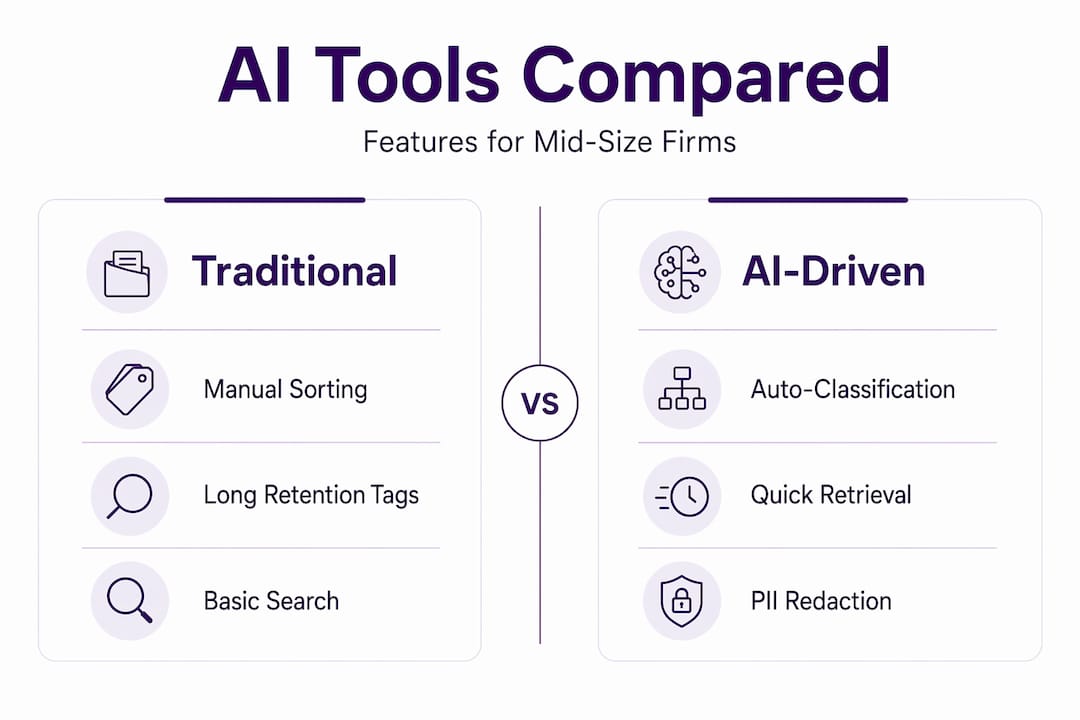
Choosing a platform requires matching features to your specific regulatory environment, workflow complexity, and existing infrastructure. The table below summarizes how three platforms differ on the criteria that matter most for mid-sized enterprise deployments.
| Criteria | Foxit DMS | Oracle HCM AI assistant | SafeRedact |
|---|---|---|---|
| Primary focus | Document lifecycle management | HR document records management | PII detection and redaction |
| OCR and metadata | Full OCR with metadata tagging | LLM-driven natural language indexing | Focused on sensitive data fields |
| Compliance logging | Built-in audit trails and compliance logs | Role-based access and approvals | Automated redaction audit trail |
| Human oversight | Configurable review workflows | Approval workflows built in | Human review for flagged PII |
| Best fit | General records management | HR and employee document records | Legal, HR, and healthcare records |
| Integration complexity | Moderate | High (Oracle ecosystem dependent) | Low to moderate |
A few decision criteria worth prioritizing:
- Regulatory environment. Healthcare and financial services organizations face stricter PII and retention requirements. Tools with built-in compliance logging and human review workflows reduce audit exposure.
- Workflow complexity. Organizations with multi-step approval chains need platforms that can model those processes, not just search and retrieve.
- Integration requirements. AI-powered data management tools that cannot connect to your ERP, CRM, or existing document platforms add friction rather than removing it.
- Support for machine learning for records. Platforms that learn from corrections over time become more accurate as your record taxonomy evolves.
Understanding the types of AI automation available helps you categorize what each platform actually does versus what the vendor claims it does.
Why agentic AI must complement, not replace, human-led record management
The premise that AI eventually handles records without human involvement is attractive and wrong. Not because the technology lacks capability, but because record management carries legal and fiscal accountability that cannot be delegated to software.
Human review is critical to prevent AI hallucinations and maintain record integrity. When an AI system misclassifies a contract as an internal memo and applies a shorter retention period, the error is not visible until the record is gone and someone needs it for litigation. At that point, the organization is exposed regardless of which tool made the decision.
Effective governance treats AI as a capable assistant operating within a defined boundary. The AI handles volume: classification, tagging, retrieval, initial redaction. Humans handle judgment: validating edge cases, approving deletions, confirming that AI-generated summaries accurately represent source documents. This is not a reluctant compromise. It is a model that produces better outcomes than either pure manual processing or pure automation.
The organizations that get the most from AI-driven operations are the ones that build accountability into the AI workflow from day one, not as an afterthought added after something goes wrong.
The uncomfortable truth is that deploying AI without a clear governance model does not reduce risk. It relocates it and makes it harder to see.
Explore Ailerons AI consulting services to optimize your record management
The gap between a well-configured AI record management system and a compliance liability is usually a governance design problem, not a technology problem. Ailerons helps operations and IT leaders at mid-sized enterprises close that gap by designing agentic AI workflows that match your regulatory environment, existing systems, and operational scale. Our approach covers strategy, governance alignment, system integration, and ongoing monitoring so AI becomes an asset rather than an audit risk. If you want to see how this works in practice, the Ailerons case studies show concrete outcomes from real implementations. Contact us to discuss where agentic AI fits in your record management program.
Frequently asked questions
What exactly is agentic AI in record management?
Agentic AI actively manages record processes like classification, retrieval, and lifecycle tasks by automating and augmenting manual workflows under human governance. The Oracle HCM Document Records Management Assistant, for example, uses large language models to handle natural language queries and automated approval workflows.
How does AI affect legal retention requirements for records?
AI-generated content and prompts are considered records if related to business activities and must adhere to established retention schedules. The Virginia Public Records Act requires AI-generated records to follow full lifecycle retention, and failure to export or retain them properly risks compliance violations.
Can AI fully automate PII redaction in records?
AI can quickly detect PII candidates, but effective redaction requires human review and audit trails to ensure accuracy and defensible compliance. SafeRedact automates PII detection but includes human review with full audit trails specifically to maintain defensibility.
What steps should organizations take before deploying AI for records?
Organizations should pilot AI on limited datasets, train users, establish governance policies, and continuously monitor AI outputs for accuracy and compliance. RAG systems require pilot tests and permission-aware indexing for accuracy before scaling, which applies broadly to agentic AI deployments.
Why is human oversight essential when using AI in record management?
Humans prevent AI errors such as hallucinations, ensure proper record classification, and maintain accountability to protect the legal and operational integrity of records. The Library of Virginia explicitly warns that AI integrations must include records management oversight to avoid fiscal and legal risks.