

TL;DR:
- AI in healthcare functions as an augmentation layer that supports clinical judgment and reduces administrative burdens, rather than replacing clinicians. Its successful integration relies on usability, explainability, staff training, and comprehensive governance, with organizational redesign necessary for sustainable impact. Effective AI deployment enhances workflows when combined with strategic planning, stakeholder alignment, and continuous bias and compliance monitoring.
Many healthcare administrators carry a persistent concern: that deploying AI means gradually removing clinicians from the decisions that matter most. That assumption is not only incorrect but has slowed adoption in organizations that stand to benefit significantly. AI in healthcare workflows functions as an augmentation layer, supporting clinical judgment and reducing the administrative burden that consumes a disproportionate share of clinician time. This article examines how AI integrates into healthcare operations, what governance and compliance structures are required, how to measure actual impact, and what organizations must redesign to see lasting results.
Table of Contents
- The evolving role of AI in healthcare workflows
- Integrating AI: Usability, explainability, and the human factor
- Orchestrating and governing AI workflows: Human-in-the-loop and compliance
- Measuring impact: Accuracy, efficiency, and the paradoxes of AI orchestration
- Bias, risk, and workflow redesign for sustainable AI transformation
- A new mindset: Why strategic workflow redesign, not just AI, drives real healthcare value
- Unlock workflow transformation with expert AI integration
- Frequently asked questions
Key Takeaways
| Point | Details |
|---|---|
| AI augments, not replaces | Artificial intelligence in healthcare workflows enhances human roles through support and orchestration, rather than removing clinicians from decision-making. |
| Integration needs more than tech | Successful AI adoption hinges on usability, clinician training, and fit with existing workflows, not just model accuracy. |
| Oversight and compliance are vital | Human-in-the-loop orchestration and regulatory strategies ensure safety, accountability, and ongoing trust in AI-enabled automation. |
| Measure holistically | Both system efficiency and clinical accuracy must be assessed to evaluate AI workflow success in practice. |
| Redesign for real impact | Sustainable transformation requires rethinking processes, governance, and equity—not just adding more automation. |
The evolving role of AI in healthcare workflows
With the stage set, let’s clarify what AI actually does within healthcare workflows today versus popular assumptions.
The dominant narrative around AI in healthcare often centers on automation replacing human roles. The operational reality is far more precise. AI in healthcare workflows is typically used as an augment-and-orchestrate layer that supports both clinical decision-making and operational and administrative processes, rather than fully replacing clinicians. This distinction matters enormously for how administrators plan deployments, set expectations, and structure accountability.
AI performs best when it handles specific, well-defined “task primitives” within a broader workflow. These include structured data retrieval, image classification scoring, automated documentation flagging, and deterministic computations such as drug interaction checks. Human clinicians remain responsible for interpreting outputs, making consequential decisions, and managing exceptions. Agentic AI workflow automation extends this further by enabling AI to coordinate across multiple steps, systems, and data sources in sequence.
Radiology offers one of the clearest examples. AI tools now pre-screen imaging studies, flag potential abnormalities, and prioritize worklists so radiologists review the most urgent cases first. The radiologist still reads every image and signs off on every report. The AI reduces the cognitive load of triage and improves throughput without removing the clinician from any consequential step.
| Workflow model | Human involvement | AI role | Example |
|---|---|---|---|
| Human-only | Full | None | Manual prior authorization review |
| AI-supported | High, oversight required | Augmentation and flagging | AI-assisted diagnostic imaging triage |
| Fully automated | Low, exception-based | Execution and orchestration | Automated appointment reminders and confirmations |
Key patterns for effective AI deployment in healthcare workflows include:
- Data retrieval and summarization: Pulling relevant patient history before a visit or procedure
- Scoring and risk stratification: Flagging patients by readmission risk or deterioration indicators
- Document processing: Extracting structured data from referral letters, lab reports, or insurance forms
- Task routing: Assigning follow-up actions to the appropriate staff member or system based on outcome
- Exception escalation: Surfacing cases that fall outside normal parameters for human review
“AI’s role in clinical workflows is not to make decisions on behalf of clinicians but to reduce the steps between raw data and informed judgment.”
Integrating AI: Usability, explainability, and the human factor
Now that we understand AI’s role, it’s crucial to explore what really drives adoption and trust among the humans at the center of these workflows.
A technically accurate AI model that clinicians don’t trust or can’t easily use is, for practical purposes, worthless. This is one of the most consistently underestimated realities in healthcare AI implementation. Adoption depends heavily on human factors including explainability, interpretability, usability, workflow integration, and training, well beyond raw algorithmic accuracy. An AI system that produces a recommendation without any visible reasoning trail will face significant resistance, particularly in high-stakes clinical settings where accountability is non-negotiable.
Explainability refers to how clearly an AI system communicates why it produced a particular output. In clinical decision support, this means showing which data inputs contributed to a risk score or recommendation. Clinicians are more likely to act on AI outputs when they can evaluate the logic, flag errors, and override recommendations with confidence. Without that transparency, the tool becomes a black box that most experienced clinicians will simply ignore.
Usability covers how smoothly the AI integrates into existing systems and daily practice. If a nurse must log into a separate platform, re-enter patient data, and then manually transfer the AI output back into the electronic health record, the workflow is broken regardless of the AI’s accuracy. Improving business workflows with AI requires designing AI touchpoints into existing systems rather than alongside them.

Training is the third underinvested factor. Staff need to understand not just how to use an AI tool but what its limitations are, when to override it, and how to document disagreements. Organizations that launch AI tools with a single orientation session and minimal follow-up documentation consistently see lower adoption rates and higher rates of workarounds.
Common pitfalls in AI workflow integration:
- Deploying AI that does not align with how clinicians actually perform tasks in their specific setting
- Offering no mechanism for clinicians to provide feedback on AI outputs
- Underinvesting in change management and ongoing training
- Assuming that accuracy benchmarks from research settings will transfer directly to operational environments
Pro Tip: Before deploying any AI tool, conduct structured workflow observations with the staff who will use it. Map exactly where the AI output will appear in their current process and identify every additional step it creates. Every extra click is a friction point that compounds into real adoption failure at scale.
Orchestrating and governing AI workflows: Human-in-the-loop and compliance
As usability and trust anchor adoption, organizations also need robust approaches for governance, oversight, and compliance with evolving regulatory expectations.
Human-in-the-loop design is not a limitation on AI capability. It is the appropriate architecture for consequential healthcare tasks. Stanford Health Care describes an organizational shift toward agentic AI that works alongside humans to change where people spend time, not to remove people from the process. The goal is to reallocate human attention toward the tasks that genuinely require clinical expertise.
Workflow orchestration becomes critical in high-volume environments. Rather than a single AI model performing one task, orchestrated systems coordinate multiple agents, each handling a defined step, passing results forward, and escalating to human reviewers when confidence thresholds are not met. This architecture is far more reliable than single-model pipelines under realistic operational conditions.
Regulatory compliance adds a layer of complexity that administrators often underestimate until they face an update cycle. FDA’s Predetermined Change Control Plans provide a structured approach for managing iterative AI model modifications while maintaining assurance of safety and effectiveness. Every planned change to an AI-enabled medical device must be documented, validated, and assessed for impact before deployment.
| Governance element | Why it matters | Practical requirement |
|---|---|---|
| Human-in-the-loop checkpoints | Maintains accountability for consequential outputs | Define which task outputs require clinician sign-off |
| Audit logging | Supports regulatory review and incident investigation | Log all AI recommendations and user responses |
| Version control | Tracks model changes over time | Document every model update with validation evidence |
| Bias monitoring | Detects performance drift across patient subgroups | Run subgroup performance analysis at regular intervals |
Steps for building a compliant AI governance structure:
- Define accountability at each AI-assisted decision point before deployment
- Establish a change management protocol aligned with FDA PCCP requirements
- Assign a clinical informatics or AI governance lead responsible for ongoing monitoring
- Create clear escalation paths for cases where AI outputs are flagged or overridden
- Schedule quarterly audits of model performance across key patient subgroups
AI compliance and security standards require deliberate design from the outset. Retrofitting compliance onto an already deployed AI system is significantly more costly and disruptive than building it in from the start. Organizations that treat governance as a post-deployment concern consistently face regulatory exposure and operational disruption.
Pro Tip: Involve your legal and compliance teams in AI procurement conversations, not just technical implementation. Contract terms around model versioning, retraining schedules, and vendor notification of changes directly affect your compliance posture under evolving FDA guidance. Reviewing those terms after signing creates avoidable risk. For additional guidance on reducing risk in AI automation, structured frameworks are available.
Measuring impact: Accuracy, efficiency, and the paradoxes of AI orchestration
Having covered governance and integration, the next logical focus is on how to measure whether these AI workflow deployments are achieving the intended impact in practice.
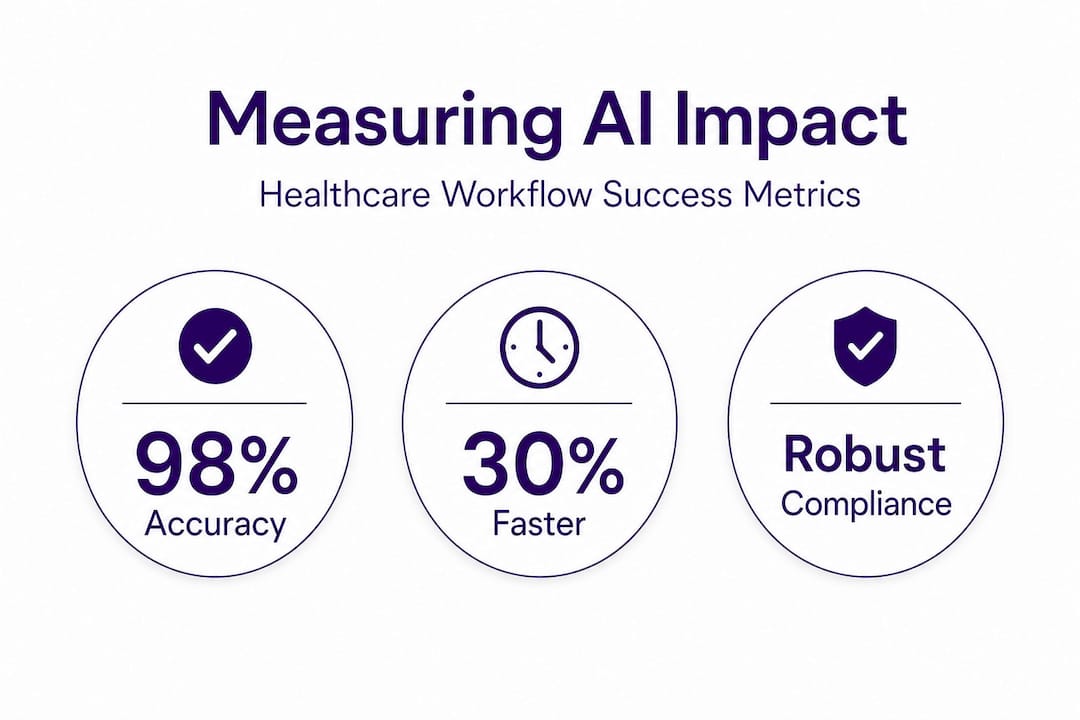
Measuring AI impact in healthcare requires looking at both clinical accuracy and operational performance. A system that improves diagnostic accuracy by 10% but increases total processing time by 20% has not delivered a net gain. Both dimensions must be tracked simultaneously and evaluated against the baseline workflow, not against an idealized benchmark.
Multi-agent orchestration has shown meaningful results under realistic workloads. At five concurrent tasks, multi-agent systems maintained approximately 90.6% accuracy. At 80 concurrent tasks, accuracy held at 65.3%. By contrast, single-agent systems collapsed from 73.1% accuracy at low load to 16.6% at high load. Those numbers illustrate why orchestration architecture matters operationally, not just theoretically.
| Orchestration design | Accuracy at low load | Accuracy at high load | Best use case |
|---|---|---|---|
| Single-agent | 73.1% | 16.6% | Simple, low-volume tasks |
| Multi-agent orchestrated | 90.6% | 65.3% | High-volume, complex workflows |
That said, a documented paradox exists in multi-agent design. More agents and more complex orchestration do not automatically produce better diagnostic accuracy. In some system designs, process complexity can introduce coordination errors or latency that cancel out the individual agent performance gains. System architecture choices directly affect outcomes, and those choices require validation in the specific operational environment, not just in laboratory conditions.
“Accuracy metrics from controlled studies rarely survive first contact with real-world patient volume and data variability without careful re-validation.”
Practical metrics for evaluating AI workflow success:
- Task completion rate: Percentage of cases handled without manual override or escalation
- Time-to-decision: Reduction in elapsed time from data availability to clinician action
- Override rate: Frequency with which clinicians reject or modify AI outputs (a proxy for trust and calibration)
- Subgroup performance variance: Accuracy differences across patient demographics, which signals potential bias
- Staff satisfaction scores: Clinician and staff perception of workflow improvement post-implementation
- Documentation compliance rate: How consistently AI-assisted workflows produce complete, audit-ready records
Empowering healthcare operations with intelligent automation requires establishing these baselines before deployment so that post-implementation comparisons are credible and actionable rather than anecdotal.
Bias, risk, and workflow redesign for sustainable AI transformation
Evaluating results isn’t enough. Understanding the pitfalls and redesigning processes holistically is essential for sustainable, equitable AI-enabled transformation.
Bias in healthcare AI is not a hypothetical risk. It is a documented operational problem that affects patient outcomes. Bias mitigation methods require careful tailoring because correcting one form of bias in training data or model outputs can inadvertently worsen performance for other subgroups. A model retrained to improve accuracy for one demographic may degrade its performance for another if the underlying data distribution is not thoroughly analyzed before retraining.
This is not a reason to avoid AI. It is a reason to approach implementation with structured rigor. Every AI tool deployed in a clinical or administrative workflow should have a documented bias assessment plan, a defined set of subgroups to monitor, and a response protocol for when disparities are detected.
Organizational redesign across access, care delivery, operations, infrastructure, and governance is required for AI to deliver durable results. Deploying an AI model into a broken workflow produces faster broken results. The model does not fix the underlying process gaps; it accelerates them.
“Technology layered onto a flawed process produces a faster version of the same problem. Redesigning the process first creates something AI can meaningfully improve.”
Critical steps for bias-aware, sustainable AI implementation:
- Conduct a representative data audit before model training or vendor evaluation
- Define protected subgroups and establish performance parity thresholds before go-live
- Build bias monitoring into the standard operational reporting cadence, not as a one-time pre-launch check
- Require vendors to disclose training data demographics and known performance limitations
- Engage frontline clinical staff in identifying workflow constraints that technology cannot solve
- Document all governance decisions, escalation protocols, and model change approvals
Scaling automation in healthcare without first resolving interoperability gaps, data governance issues, and stakeholder alignment creates compounding technical debt that becomes increasingly expensive to unwind.
Pro Tip: Run a “pre-mortem” exercise with clinical, operational, and compliance stakeholders before any AI deployment. Ask the team to imagine the deployment has failed spectacularly and work backward to identify what caused it. This exercise surfaces organizational and process risks that technical due diligence routinely misses.
A new mindset: Why strategic workflow redesign, not just AI, drives real healthcare value
The honest lesson from organizations that have advanced past initial AI pilots is that the technology was rarely the limiting factor. The limiting factor was organizational readiness. Workflows built around paper-based or siloed digital processes do not automatically become efficient when AI is inserted into them. They become more complex and harder to troubleshoot.
The organizations seeing durable results started by mapping desired outcomes first. They identified specific inefficiencies with measurable costs, whether that was prior authorization turnaround time, scheduling bottlenecks, or documentation burden per clinician per shift. Then they asked which of those problems AI was actually positioned to address, given their existing data infrastructure and staff capacity. That sequence matters. Tool-first thinking consistently produces implementations that solve the wrong problem efficiently.
Leadership alignment is equally non-negotiable. When administrators and clinical leaders are not operating from a shared understanding of what AI is supposed to accomplish and for whom, implementation decisions fracture along departmental lines. IT pursues technical integration. Clinical informatics pursues accuracy. Finance pursues cost reduction. Without a unified outcome framework, these goals produce conflicting requirements and stalled deployments.
The most practical advice for decision-makers considering AI workflow transformation is straightforward: start with outcome mapping, build your governance structure before you select a vendor, and treat explainability as a clinical requirement rather than a preference. Review your AI automation checklist for 2026 to validate that your organization has covered the foundational requirements before expanding AI-assisted workflows across departments.
AI does not transform healthcare organizations. Thoughtful leaders who use AI strategically do.
Unlock workflow transformation with expert AI integration
For organizations ready to take the next steps, trusted guidance is available. Ailerons.ai works with healthcare organizations to design and deploy AI workflow integration solutions that address the real operational constraints administrators face, including compliance requirements, EHR integration, staff adoption, and bias monitoring. Our approach is grounded in the evidence-based strategies outlined in this article, with a focus on governance-first, human-centered implementation. Whether your organization is evaluating its first AI deployment or scaling across departments, the right architecture and oversight structure makes the difference between a pilot and a program. Start with our integration checklist to assess your current readiness and identify your highest-priority next steps.
Frequently asked questions
Does AI replace clinicians in healthcare workflows?
No, AI acts as an augmenting layer to support clinicians and streamline processes while keeping humans in decision-making roles. Clinicians retain responsibility for consequential decisions at every stage.
What’s required for successful AI integration into clinical workflows?
Successful integration depends on workflow fit, explainability, usability, and adequate clinician training, not just the algorithm’s accuracy. Adoption determinants consistently point to human factors as the primary success variable.
How is regulatory compliance maintained as AI healthcare tools improve?
Protocols like FDA’s PCCP help manage iterative AI tool modifications while ensuring ongoing safety and effectiveness through documented validation requirements.
What are the main risks when automating healthcare workflows with AI?
The top risks are amplifying data bias, limiting generalizability, and failing to adapt workflows, which can increase disparities or reduce effectiveness across patient subgroups.
Is AI alone enough to fix workflow inefficiencies in healthcare?
No. Organizational redesign across governance, process, and stakeholder alignment is essential because technology alone cannot resolve systemic workflow constraints.
Recommended
- Agentic AI Workflow Automation in Modern Healthcare | Ailerons IT Consulting
- Intelligent Automation: Empowering Healthcare Operations | Ailerons IT Consulting
- Top 5 AI solutions for healthcare administrative tasks 2026 | Ailerons IT Consulting
- 6 Steps to an Effective AI Integration Checklist for Business Operations | Ailerons IT Consulting