

Managing complex administrative workflows can feel overwhelming when every process demands constant oversight and manual intervention. For North American healthcare organizations, the push toward greater efficiency often clashes with growing compliance burdens and limited resources. Agentic AI workflow automation offers a breakthrough, empowering intelligent systems to independently plan, adapt, and optimize tasks with minimal human input. This article explores how agentic AI is redefining operational support, making daily tasks smarter and more responsive for healthcare operations managers.
Table of Contents
- Defining Agentic AI Workflow Automation
- Types and Capabilities of Agentic AI Systems
- Integrating Agentic AI Into Healthcare Processes
- Regulatory Compliance and Security Essentials
- Risks, Obstacles, and Successful Adoption Strategies
Key Takeaways
| Point | Details |
|---|---|
| Advancement of Agentic AI | Agentic AI enables intelligent systems to manage complex tasks autonomously, surpassing traditional automation methods. |
| Key Capabilities | These systems feature autonomous decision-making, adaptive learning, and real-time optimization of workflows. |
| Healthcare Integration | Agentic AI transforms healthcare by enhancing clinical decision-making and optimizing administrative processes through intelligent support. |
| Regulatory Compliance Importance | Robust governance frameworks and continuous monitoring are essential to ensure ethical AI deployment and patient privacy. |
Defining Agentic AI Workflow Automation
Agentic AI workflow automation represents a significant leap beyond traditional automation technologies, enabling intelligent systems to independently manage complex operational tasks with unprecedented autonomy. Unlike conventional rule-based automation, these advanced systems can dynamically plan, reason, and execute multi-step workflows with minimal human intervention.
At its core, agentic AI is distinguished by several key capabilities that set it apart from traditional automation approaches. Advanced AI systems demonstrate remarkable capacities for autonomous decision-making and adaptive problem-solving. These systems are characterized by their ability to:
- Independently analyze contextual information
- Generate sophisticated multi-step action plans
- Learn and adapt from previous workflow experiences
- Make dynamic adjustments without constant human supervision
- Reflect on outcomes and optimize future performance
The fundamental difference between traditional automation and agentic AI lies in reasoning and autonomy. Traditional systems operate through predefined scripts and rigid workflows, whereas agentic AI can interpret complex scenarios, understand nuanced requirements, and develop creative solutions in real-time. This means healthcare operations can now have intelligent digital assistants that comprehend context, anticipate potential challenges, and proactively manage intricate administrative processes.
Here’s a summary of how agentic AI differs from traditional automation:
| Aspect | Traditional Automation | Agentic AI |
|---|---|---|
| Decision-Making | Follows strict rules | Adapts decisions in real time |
| Response to Change | Requires manual edits | Self-adjusts to new scenarios |
| Task Complexity | Handles simple, repetitive steps | Manages complex, multi-step workflows |
| Human Supervision | Needs frequent oversight | Operates mostly autonomously |
| Solution Creativity | Limited by scripts | Can create new solutions |
Modern agentic AI workflow systems go beyond simple task execution by incorporating advanced cognitive capabilities. They can synthesize information from multiple sources, evaluate potential strategies, and select optimal approaches based on predefined organizational objectives. This represents a transformative shift from reactive task completion to proactive, intelligent workflow management.

Pro tip: When implementing agentic AI workflow automation, start with clearly defined objectives and gradually expand the system’s autonomy by establishing robust governance frameworks and continuous monitoring mechanisms.
Types and Capabilities of Agentic AI Systems
Agentic AI systems represent a sophisticated spectrum of intelligent technologies, each designed to address specific operational challenges with remarkable autonomy and cognitive flexibility. Evolving from monolithic architectures, these systems now encompass diverse types with specialized capabilities that transform how organizations manage complex workflows.
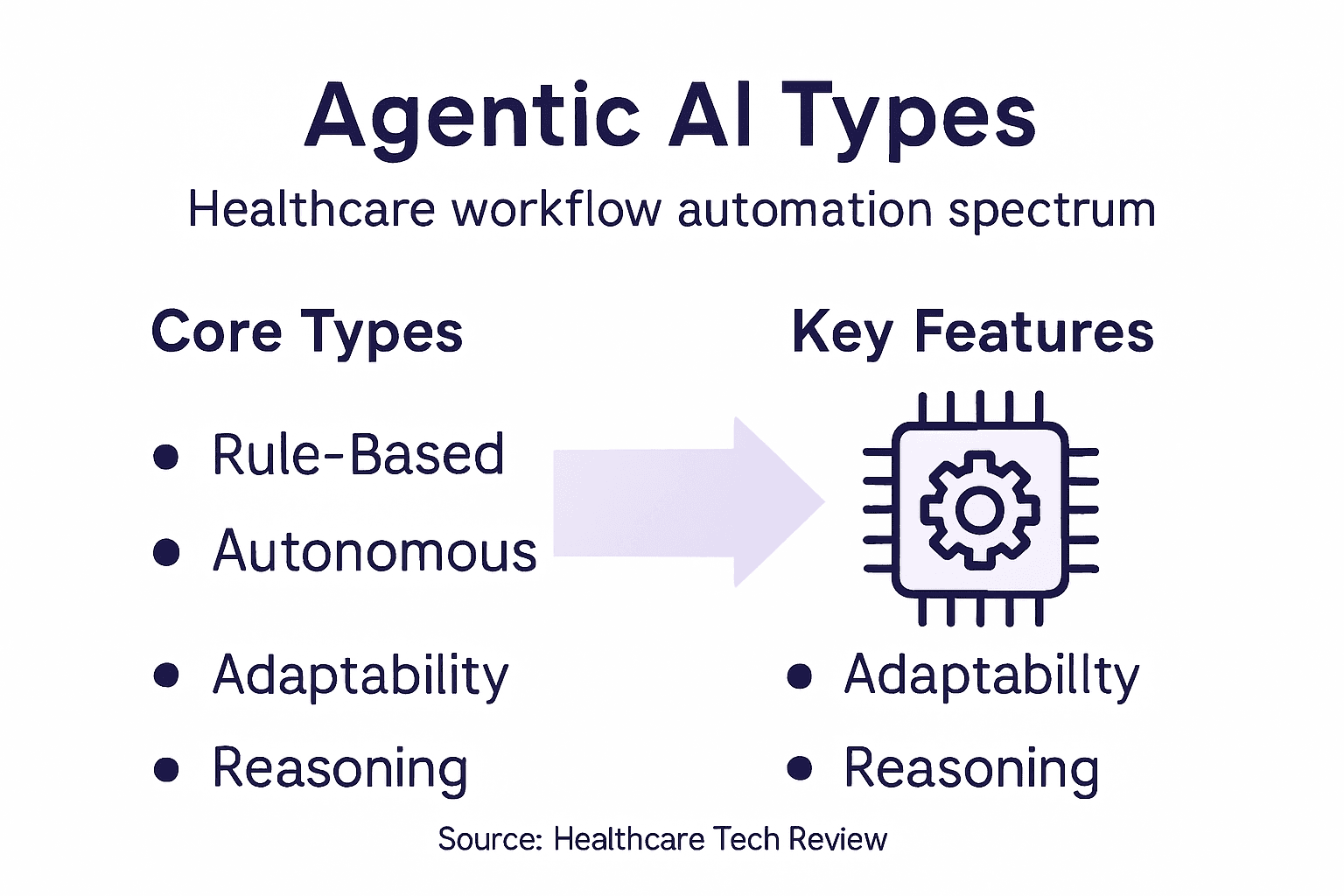
The primary categories of agentic AI systems include:
Below is a comparison of agentic AI system types and their primary industry use cases:
| AI System Type | Primary Skills | Example Use Case |
|---|---|---|
| Reasoning Agent | Logical analysis | Complex claim approvals |
| Planning Agent | Strategic workflow design | Hospital resource scheduling |
| Collaborative Agent | Seamless human-AI teamwork | Multidisciplinary case reviews |
| Learning Agent | Continuous self-improvement | Diagnostic image interpretation |
| Tool-Use Agent | Integrating digital tools | Automated medical reporting |
- Reasoning Agents: Capable of complex logical problem-solving and strategic decision-making
- Planning Agents: Develop comprehensive multi-step action strategies with predictive capabilities
- Collaborative Agents: Designed for seamless human-AI interaction and workflow coordination
- Learning Agents: Continuously adapt and improve performance through experience
- Tool-Use Agents: Dynamically integrate and utilize multiple software and technological resources
Memory architecture represents another critical dimension of agentic AI capabilities. Modern systems incorporate sophisticated memory types that enable more nuanced and contextually aware performance. These memory frameworks include:
- Episodic memory (storing specific experiences)
- Semantic memory (holding conceptual knowledge)
- Procedural memory (managing learned processes and skills)
Agentic AI systems are not just executing tasks—they are dynamically interpreting, learning, and optimizing workflows with unprecedented intelligence.
Large language model-powered systems demonstrate particularly impressive capabilities in specialized domains like healthcare, where they can autonomously monitor complex processes, analyze intricate datasets, and make sophisticated recommendations with minimal human oversight.
Pro tip: When evaluating agentic AI systems, prioritize solutions with transparent decision-making processes and robust governance frameworks to ensure predictable and reliable performance.
Integrating Agentic AI Into Healthcare Processes
Agentic reasoning AI represents a transformative approach to reimagining healthcare operations, offering intelligent support that goes far beyond traditional technological interventions. By functioning as an active clinical co-pilot, these advanced systems can dramatically reshape how medical professionals approach complex clinical and administrative challenges.
Successful integration of agentic AI into healthcare processes requires a strategic framework that addresses multiple operational dimensions:
- Clinical Decision Support: Enhancing diagnostic accuracy and treatment planning
- Administrative Workflow Optimization: Streamlining complex bureaucratic processes
- Patient Engagement: Personalizing communication and care management
- Resource Allocation: Intelligent scheduling and capacity planning
- Continuous Learning: Adapting insights from real-time medical data
Technological integration involves carefully designed implementation strategies that prioritize patient safety, data privacy, and clinical effectiveness. Healthcare organizations must develop robust governance models that enable AI systems to operate with transparency, accountability, and alignment with existing medical protocols.
Agentic AI is not about replacing human expertise, but augmenting and supporting medical professionals with intelligent, context-aware insights.
Strategic AI frameworks emphasize cross-domain collaboration, ensuring that AI technologies work seamlessly with existing healthcare infrastructure. This approach supports responsible innovation by creating adaptable systems that can evolve alongside emerging medical technologies and changing patient needs.
Pro tip: Develop a phased implementation strategy that begins with low-risk administrative functions, gradually expanding AI capabilities while maintaining rigorous performance monitoring and human oversight.
Regulatory Compliance and Security Essentials
World Health Organization guidelines underscore the critical importance of establishing comprehensive regulatory frameworks for artificial intelligence in healthcare. As agentic AI systems become increasingly sophisticated, healthcare organizations must develop robust mechanisms to ensure patient privacy, data security, and ethical technological deployment.
Key regulatory compliance requirements for agentic AI in healthcare include:
- Data Privacy Protection: Implementing advanced encryption and access controls
- Consent Management: Developing transparent patient information sharing protocols
- Algorithmic Transparency: Ensuring explainable AI decision-making processes
- Continuous Monitoring: Establishing real-time audit and compliance tracking systems
- Ethical AI Governance: Creating multi-stakeholder oversight committees
Security architecture plays a fundamental role in maintaining regulatory compliance. Healthcare organizations must implement comprehensive security strategies that address potential vulnerabilities while maintaining the adaptive capabilities of agentic AI systems.
Regulatory compliance is not a one-time achievement, but an ongoing commitment to protecting patient rights and maintaining technological integrity.
HIPAA-compliant AI frameworks demonstrate sophisticated approaches to managing sensitive healthcare data, incorporating advanced techniques like attribute-based access control and immutable audit trails. These systems provide granular protection mechanisms that safeguard patient information while enabling intelligent workflow automation.
Pro tip: Develop a comprehensive AI governance framework that includes regular external audits, continuous staff training on data privacy, and transparent reporting mechanisms for potential algorithmic biases.
Risks, Obstacles, and Successful Adoption Strategies
Key obstacles to agentic AI adoption encompass complex technological, organizational, and strategic challenges that healthcare leaders must systematically address. Successful implementation requires a nuanced understanding of potential risks and proactive mitigation strategies.
Critical obstacles in agentic AI adoption include:
- Infrastructure Limitations: Insufficient computational and data management capabilities
- Trust Deficits: Organizational skepticism about AI reliability and performance
- Data Quality Challenges: Inconsistent, fragmented, or inadequate data ecosystems
- Skill Gap: Limited organizational expertise in advanced AI technologies
- Regulatory Uncertainty: Complex compliance and governance requirements
Risk management demands a comprehensive approach that balances technological potential with organizational readiness. Healthcare organizations must develop robust frameworks that address potential vulnerabilities while maintaining the transformative potential of agentic AI systems.
Successful AI adoption is not about technology implementation, but about creating a culture of innovation, learning, and strategic transformation.
Agentic AI project implementation requires careful strategic planning, including transparent business cases, proactive change management, and continuous performance monitoring. Organizations must invest in foundational infrastructure, develop clear value propositions, and create adaptive governance mechanisms.
Pro tip: Develop a phased adoption strategy that starts with low-risk pilot projects, builds organizational confidence through measurable outcomes, and progressively expands AI capabilities with transparent performance metrics.
Elevate Healthcare Operations with Agentic AI Workflow Solutions
The article highlights the complex challenges healthcare providers face when moving beyond traditional automation to intelligent systems that reason, plan, and adapt autonomously. Pain points such as managing multi-step workflows, ensuring regulatory compliance, and bridging trust deficits with transparent AI decision-making all call for advanced digital collaborators rather than rigid scripted bots. Healthcare leaders need tools that seamlessly integrate with clinical and administrative processes, optimize resource allocation, and reduce operational friction while maintaining privacy and security.
At Ailerons.ai, we specialize in agentic AI systems designed exactly for these challenges. Our solutions go beyond simple task automation by enabling AI to independently coordinate, execute, and adjust complex office workflows across platforms such as CRM, ERP, and scheduling systems. With a focus on compliance-driven processes and transparent AI governance, we empower healthcare organizations to unlock scalability and improve accuracy without increasing staff burden. Discover how our agentic AI architecture can transform your healthcare operations with secure, end-to-end automation crafted for real-world complexity.
Ready to turn your healthcare workflows into intelligent, autonomous operations That means less manual oversight and more consistent outcomes. Visit Ailerons.ai to explore how agentic AI can enhance your office and clinical processes today. Learn about our end-to-end workflow automation and achieve smarter healthcare management. Don’t let outdated automation hold you back Start evolving your operations now.
Frequently Asked Questions
What is agentic AI workflow automation in healthcare?
Agentic AI workflow automation refers to advanced systems that autonomously manage complex operational tasks in healthcare, enabling intelligent decision-making and adaptive problem-solving with minimal human intervention.
How does agentic AI differ from traditional automation?
Unlike traditional automation, which relies on fixed rules and scripts, agentic AI has the ability to adapt decisions in real time, manage complex workflows, and operate with a high degree of autonomy without continuous human oversight.
What are the key capabilities of agentic AI systems?
Agentic AI systems can independently analyze information, create multi-step action plans, learn from experiences, adjust dynamically to new scenarios, and optimize their performance based on outcomes.
Why is regulatory compliance important for agentic AI in healthcare?
Regulatory compliance ensures patient privacy, data security, and ethical deployment of AI systems. It establishes guidelines for transparency, consent management, and ongoing monitoring to protect patient rights and maintain integrity in healthcare technology.
Recommended
- Ailerons IT Consulting | Enterprise IT Solutions
- Ailerons IT Consulting | Enterprise IT Solutions
- Ailerons IT Consulting | Enterprise IT Solutions
- Ailerons IT Consulting | Enterprise IT Solutions
- What is Automated Scheduling? Understanding Its Impact - WhenNOT Blog
- How Enterprise Content Teams Are Adopting AI Tools in 2025 - 40Q