

Managing administrative tasks across departments can quickly drain resources in a busy healthcare organization. Rising volumes of manual work often hide bottlenecks and inefficiencies, making it tough to deliver timely patient care. For operations managers, adopting systematic workflow evaluation methods and agentic AI solutions offers a way to reclaim control, reduce overhead, and build a foundation for lasting productivity and collaboration.
Table of Contents
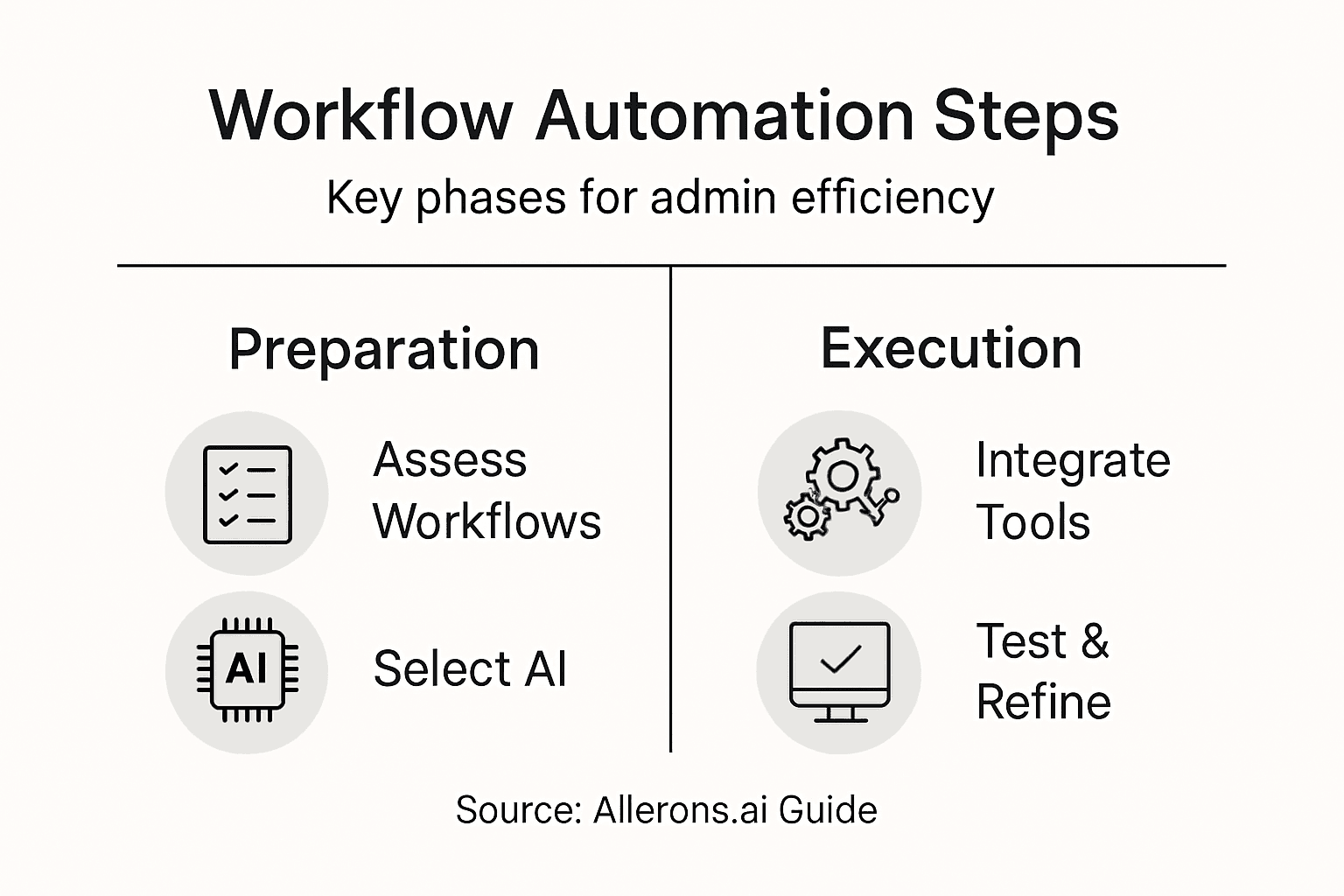
- Step 1: Assess Current Administrative Workflows
- Step 2: Select And Configure Agentic AI Solutions
- Step 3: Integrate Automation With Business Platforms
- Step 4: Orchestrate And Test Automated Workflows
- Step 5: Monitor Performance And Optimize Results
Quick Summary
| Key Insight | Explanation |
|---|---|
| 1. Thoroughly Document Current Workflows | Clearly map existing workflows to identify inefficiencies and improvement opportunities. |
| 2. Choose Compatible AI Solutions | Select agentic AI tools that integrate seamlessly with your infrastructure and processes. |
| 3. Ensure Seamless System Integration | Focus on connecting automation tools with existing business platforms for comprehensive efficiency. |
| 4. Test Automated Workflows Rigorously | Conduct extensive testing to validate workflows under various scenarios and operational pressures. |
| 5. Continuous Performance Monitoring | Establish ongoing assessments to optimize workflows based on real-time data and team feedback. |
Step 1: Assess current administrative workflows
To optimize your organization’s administrative processes, you need a systematic approach to understanding and evaluating existing workflows. This critical first step helps you identify inefficiencies, bottlenecks, and opportunities for improvement across your administrative operations.
Start by mapping out your current workflows using comprehensive documentation techniques. Systematic workflow evaluation methods can help you pinpoint exactly where your administrative processes might be breaking down. Here are key strategies for a thorough assessment:
- Conduct comprehensive workflow documentation
- Interview staff involved in each administrative process
- Track time spent on routine tasks
- Identify manual, repetitive steps that could be automated
- Review current technology and software integration
The goal is to create a clear, visual representation of how work actually moves through your organization. Pay special attention to cross-departmental interactions and communication handoffs, as these areas often contain hidden inefficiencies.
A precise workflow assessment reveals more than just bottlenecks—it uncovers opportunities for strategic transformation.
Additionally, gather quantitative data by tracking metrics like task completion times, error rates, and resource utilization. Efficiency measurement techniques can provide objective insights into your current administrative performance.

Here’s a summary of critical workflow assessment metrics and their value:
| Metric | What It Reveals | Business Benefit |
|---|---|---|
| Task completion time | Speed of processes | Identifies where delays occur |
| Error rate | Process accuracy | Highlights quality and training needs |
| Resource utilization | Efficiency of staff and tools | Pinpoints underused or overloaded assets |
| Communication handoffs | Smoothness of collaboration | Uncovers cross-department bottlenecks |
Pro tip: Create a baseline workflow map before making any changes to establish a clear starting point for measuring future improvements.
Step 2: Select and configure agentic AI solutions
In this critical phase, you’ll strategically choose and customize agentic AI solutions that align precisely with your organization’s unique administrative needs. The right AI solution can transform your workflow from manual processes to intelligent, automated systems.
Systematic AI tool selection approaches require careful evaluation of several key factors. Consider these essential criteria when selecting your agentic AI solutions:
- Compatibility with existing infrastructure
- Scalability of the AI platform
- Integration capabilities with current systems
- Machine learning and reasoning capabilities
- Security and compliance features
- Cost-effectiveness and ROI potential
When configuring your chosen AI solution, focus on precise workflow mapping and iterative implementation. SCRUM-based automation strategies can help you develop a flexible, adaptive approach to AI deployment.
Successful AI configuration is not about replacing humans, but empowering them with intelligent automation tools.
Begin with pilot programs in specific departments, allowing you to test, learn, and refine the AI’s performance before full-scale implementation. This approach minimizes risks and enables continuous improvement.
Pro tip: Always involve key stakeholders from different departments during AI solution selection to ensure comprehensive buy-in and smooth integration.
Step 3: Integrate automation with business platforms
Successfully connecting your agentic AI solutions with existing business platforms requires a strategic and methodical approach. This step transforms isolated automation tools into a comprehensive, interconnected system that enhances organizational efficiency.
Digital technology integration strategies highlight the critical importance of seamless connectivity between automated workflows and core business systems. When integrating automation, focus on these key considerations:
- Ensure API compatibility
- Validate data transfer protocols
- Maintain data integrity across platforms
- Implement robust security measures
- Create standardized data mapping
- Design flexible integration architecture
The goal is to create a unified digital ecosystem where information flows smoothly between different systems. Enterprise resource planning integration requires careful planning to minimize disruptions and maximize operational effectiveness.
Successful platform integration is about creating a symphony of technologies, not just connecting individual instruments.
Begin by mapping out all current systems and identifying potential integration points. Work closely with your IT team to develop a phased implementation strategy that allows for incremental testing and refinement.
Pro tip: Create detailed documentation of your integration process to facilitate future system updates and onboarding of new team members.
Step 4: Orchestrate and test automated workflows
Now you’ll transform your carefully designed automation strategy into a robust, reliable system by meticulously orchestrating and thoroughly testing your workflows. This critical phase ensures your agentic AI solutions perform exactly as intended across various scenarios and operational conditions.
Decentralized workflow management approaches provide a structured framework for comprehensive testing and validation. When orchestrating your automated workflows, consider these essential strategies:
- Create detailed workflow scenarios
- Simulate complex operational conditions
- Define clear success and failure criteria
- Implement incremental testing phases
- Establish performance benchmarks
- Design fallback and recovery mechanisms
Focus on developing comprehensive testing protocols that evaluate your workflow’s performance under different stress conditions. This means challenging your automation with edge cases, unexpected inputs, and varying workload intensities.
Effective workflow orchestration transforms potential vulnerabilities into opportunities for systemic resilience.
Begin by mapping out each workflow step, identifying potential points of failure, and creating targeted test scenarios that validate your system’s adaptability and reliability. Collaborate closely with your technical team to develop nuanced, scenario-driven verification processes.
Pro tip: Document every test case and its outcomes to build an institutional knowledge base that supports continuous improvement of your automated workflows.
Step 5: Monitor performance and optimize results
In this crucial phase, you’ll transition from implementation to continuous improvement by establishing a robust performance monitoring system that enables data-driven optimization of your automated workflows. Your goal is to create a dynamic feedback loop that continuously refines and enhances administrative automation.
Systematic administrative performance assessment requires a comprehensive approach to tracking key performance indicators. Consider implementing these critical monitoring strategies:
- Establish baseline performance metrics
- Track real-time workflow efficiency
- Measure error reduction rates
- Monitor resource utilization
- Analyze process completion times
- Evaluate cost savings and productivity gains
Develop comprehensive performance dashboards that provide instant visibility into your automated workflows. Benchmark performance monitoring techniques can help you compare your results against industry standards and identify improvement opportunities.
Continuous optimization is not about perfection, but about persistent incremental improvements.
Prioritize a data-driven approach that balances quantitative metrics with qualitative feedback from team members. Create regular review cycles where you analyze performance data, gather insights, and make strategic adjustments to your automated workflows.
Compare the impact of automation at different integration stages:
| Integration Stage | Key Focus | Potential Challenges | Measurable Benefits |
|---|---|---|---|
| Initial Pilots | Department-specific rollout | Limited scope, technology learning | Early feedback, risk reduction |
| Full Integration | Cross-platform connectivity | Data mapping, system compatibility | Unified workflows, cost savings |
| Continuous Monitoring | Ongoing performance checks | Adapting to change, data overload | Sustained optimization, agility |
Pro tip: Schedule monthly performance review meetings that include both technical and operational stakeholders to ensure comprehensive insights and collaborative optimization efforts.
Transform Your Administrative Processes with Agentic AI Today
If you are overwhelmed by manual workflows and hidden inefficiencies in your administrative tasks you are not alone. This article highlights critical challenges like workflow bottlenecks, error rates, and the need for seamless integration that many organizations face when trying to optimize administrative automation. Key goals such as precise workflow mapping, iterative AI configuration, and continuous performance monitoring require intelligent solutions that go beyond traditional automation.
At Ailerons.ai, we specialize in agentic AI systems that bring context awareness, decision logic, and multi-step task execution to your office operations. Our approach enables you to replace repetitive manual processes with autonomous digital collaborators that handle scheduling, document processing, approvals, and cross-platform updates securely and seamlessly. By leveraging our expertise in agentic AI architecture and deployment, you gain an advanced, scalable solution designed to reduce operational friction while improving accuracy and consistency.
Ready to master your administrative task automation? Discover how intelligent orchestration can empower your team and transform workflows by visiting Ailerons.ai now. Take the first step toward a future where AI truly works alongside humans to manage complex office processes efficiently and reliably.
Frequently Asked Questions
How can I assess my current administrative workflows before automating tasks?
To assess your current administrative workflows, start by mapping out the processes and documenting them thoroughly. You can interview staff, track time spent on tasks, and identify any manual steps that could be automated. Aim to complete this assessment within 30 days to ensure a clear understanding of inefficiencies.
What criteria should I consider when selecting an agentic AI solution for my organization?
When selecting an agentic AI solution, focus on compatibility with your existing infrastructure, scalability, and integration capabilities with current systems. Evaluate security features and cost-effectiveness as well. Create a checklist of these criteria to systematically compare potential solutions during your selection process.
How do I integrate automation tools with my current business platforms?
To integrate automation tools with your current business platforms, ensure that you check for API compatibility and validate data transfer protocols. Work closely with your IT team to design an integration architecture that maintains data integrity and security. Plan to develop a phased implementation approach within four to six weeks for a smooth transition.
What steps should I take to test my automated workflows effectively?
To test your automated workflows, create detailed scenarios to simulate different operational conditions. Define clear success and failure criteria, and implement incremental testing phases. Begin by identifying potential failure points in your workflows to ensure comprehensive testing.
How can I monitor the performance of my automated workflows for continuous improvement?
To monitor the performance of your automated workflows, establish baseline performance metrics and track real-time workflow efficiency. Create comprehensive performance dashboards to visualize key indicators and conduct regular review cycles. Schedule monthly performance reviews to adapt and refine your automated processes based on feedback and data insights.
What are some key performance indicators I should track for automated workflows?
Key performance indicators (KPIs) to track include task completion times, error rates, and resource utilization. Monitoring these KPIs will help you identify bottlenecks and opportunities for improvement. Set a goal to analyze these metrics at least quarterly to guide your optimization efforts.