

TL;DR:
- Secure AI deployment involves layered controls that monitor behavior, enforce permissions, and ensure compliance during AI operations. Implementing runtime governance and phased deployment strategies is essential to manage the unique risks of autonomous agentic AI, especially in business workflows. Building operational readiness with continuous monitoring, incident response plans, and tool access audits is critical for trustworthy and secure AI systems.
Most business leaders assume securing AI means choosing a safe model and adding a privacy policy. That assumption is costly. Secure AI deployment is a layered discipline covering how AI systems behave at runtime, what actions they are authorized to take, how data flows through automated workflows, and how your organization responds when something goes wrong. For agentic AI, which reasons, plans, and executes multi-step tasks without constant human direction, the stakes are higher and the security requirements are fundamentally different from anything traditional IT controls were designed to handle.
Table of Contents
- Understanding secure AI deployment and its unique challenges
- Frameworks and best practices for securing agentic AI deployment
- Key technical controls and operational strategies for secure AI in business workflows
- Runtime governance and continuous monitoring: Controlling AI actions at scale
- Implementing secure AI deployment: Practical steps for business leaders
- Why runtime governance is the real game changer in secure AI deployment
- Explore secure AI solutions tailored to your business needs
- Frequently asked questions
Key Takeaways
| Point | Details |
|---|---|
| Secure AI is multifaceted | Protecting AI requires controls across development, deployment, runtime, and governance, not just model safety. |
| Runtime governance is essential | Real-time authorization for each AI action prevents unsafe or unauthorized autonomous behaviors. |
| Start with foundational controls | Identity-based access, input validation, sandboxing, and monitoring form the security base for AI. |
| Shadow mode reduces risk | Observing AI agents without execution helps identify issues before granting full autonomy. |
| Continuous monitoring maintains trust | Automated scanning and incident response protect AI investments and ensure compliance over time. |
Understanding secure AI deployment and its unique challenges
Secure AI deployment is the practice of building, releasing, and operating AI systems in a way that protects data, enforces authorized behavior, and maintains compliance throughout the entire lifecycle of the system. For agentic AI specifically, that definition carries real weight. These systems do not just respond to queries. They take actions: they update records, send communications, process approvals, and move data between platforms, often in seconds and without a human reviewing each step.
Traditional IT security was built to protect access points and data at rest. It was not designed to evaluate whether an AI agent’s decision to send an invoice, modify a contract record, or escalate an exception aligns with your organization’s actual business intent. As CSA notes, securing AI cannot be reduced to model safety, governance policies, or perimeter controls alone. It requires monitoring AI behavior and business intent alignment throughout deployment.
This gap creates a new category of business risk that most mid-sized companies are not yet prepared for. Common exposures include:
- Unauthorized actions: An agent executes a task it was not explicitly cleared to perform in a given context
- Data leakage: Sensitive information passes through AI workflows and exits through unsecured tool calls or API responses
- Compliance breaches: An agent completes a process that violates a regulatory requirement because no runtime check stopped it
- Misuse and prompt manipulation: External inputs manipulate agent behavior in ways that bypass your intended controls
- Auditability gaps: Actions occur at machine speed with no record available for review or investigation
Understanding these risks is the first step toward secure compliant agentic AI design that your business can actually trust.
Frameworks and best practices for securing agentic AI deployment
With a clear picture of the risks, you can apply structured frameworks designed for exactly this challenge. Three frameworks stand out for mid-sized enterprises deploying agentic AI.
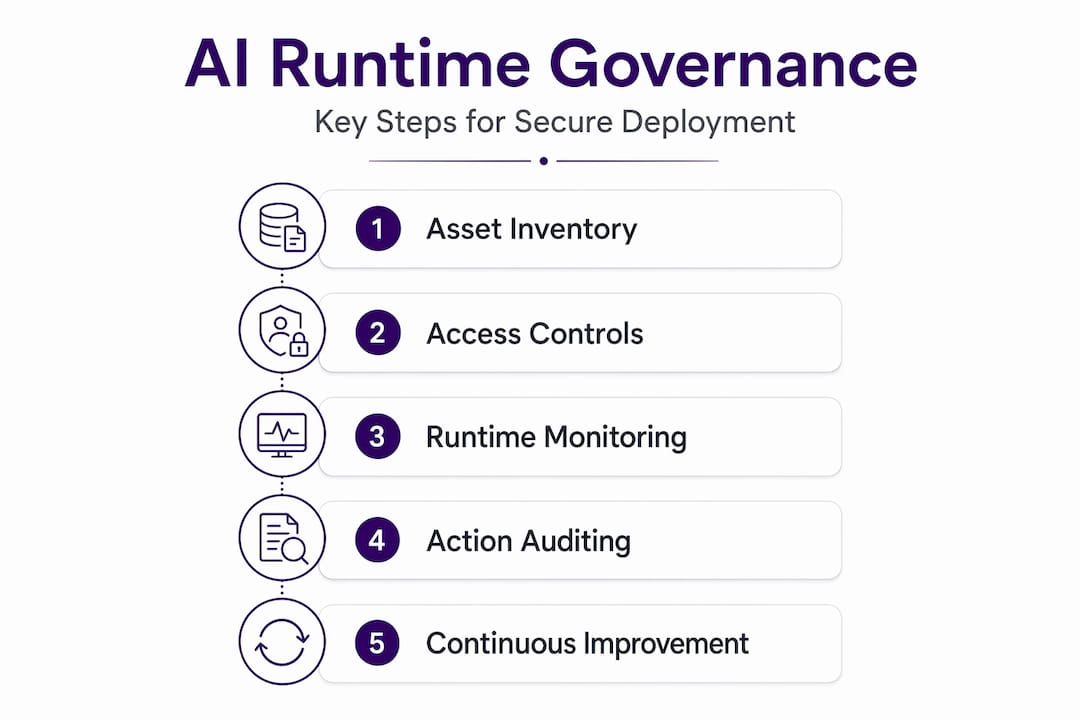
Microsoft Azure recommends creating a complete AI asset inventory, securing communication channels, protecting AI data and artifacts, and implementing automated monitoring and incident response as the core pillars of AI security. The asset inventory piece is often skipped by organizations moving fast, but you cannot secure what you have not cataloged.
NIST AI RMF structures risk management across four functions: Govern, Map, Measure, and Manage. It emphasizes continuous monitoring and managing risks according to your organization’s actual risk tolerance, not a generic benchmark. This lifecycle approach is well suited to agentic AI because it treats security as an ongoing operational function, not a pre-launch checklist.
The Cloud Security Alliance AI framework categorizes AI risks into five areas: misuse defense, monitoring agents at runtime, protecting development environments, securing the AI supply chain, and strengthening oversight readiness. That last category matters more than most leaders expect. Oversight readiness means your team can actually respond to an AI security incident when it happens.
| Framework | Primary focus | Key strength for agentic AI |
|---|---|---|
| Microsoft Azure AI security | Asset inventory and channel security | Automated monitoring and incident response |
| NIST AI RMF | Lifecycle risk management | Continuous governance across all phases |
| CSA AI framework | Five risk category coverage | Runtime agent monitoring and oversight readiness |
Core best practices for secure AI implementation:
- Build a complete inventory of all AI models, agents, tools, and data sources in use
- Apply role-based access controls to all data the AI can reach
- Implement data loss prevention measures on AI output channels
- Define incident response plans specific to AI security events before deployment
- Require secure AI compliance systems to govern how AI decision logic in workflows is authorized and audited
Pro Tip: Treat your AI agent’s tool access list the same way you treat administrator privileges. Every tool connection is a potential attack surface. Audit it before go-live and review it on a defined schedule.
Key technical controls and operational strategies for secure AI in business workflows
Frameworks give you a structure. Technical controls give you enforcement. For mid-sized companies running agentic AI across office workflows, here are the controls that matter most.
-
Just-in-time permissions: Most agent compromises exploit over-permissioned access. Grant the AI access only at task start and revoke it when the task is complete. This single control eliminates a large category of risk.
-
Identity-based access control: Every AI agent should have its own identity with defined access boundaries. Agents should not share credentials or inherit permissions from human user accounts.
-
Input validation: Validate all inputs reaching your AI agent, especially those coming from external sources like emails, web forms, or third-party APIs. Unvalidated inputs are the primary vector for prompt injection attacks, where malicious instructions are embedded in seemingly normal data.
-
Tool sandboxing: Isolate the environment in which your AI executes tool calls. If an agent is compromised or behaves unexpectedly, sandboxing limits the damage to a contained scope rather than allowing it to propagate across connected systems.
-
Source-tiered retrieval: When your AI retrieves data to complete a task, enforce a hierarchy of trusted sources. Documents from your verified internal repositories should be weighted and processed differently from unverified external content.
-
Behavioral monitoring: Log and analyze what your AI agent actually does during execution, not just whether the final output looks correct. Pattern deviations in behavior are often the first indicator of a security issue.
Foundational controls including identity-based access, input validation, tool sandboxing, source-tiered retrieval, and behavioral monitoring should be in place before any scaling begins. Organizations that skip ahead to scale without these foundations create compounding risk that becomes very difficult to untangle.
These controls directly support decision logic automation in agentic AI by ensuring the logic operates within trusted, bounded conditions at every step.

Pro Tip: Before deploying any AI agent into a live workflow, map every tool call it can make. For each one, ask: what is the worst-case outcome if this call is triggered incorrectly? If the answer is “significant business or compliance harm,” add an approval gate before that specific action.
Runtime governance and continuous monitoring: Controlling AI actions at scale
Static controls established at deployment time are necessary but not sufficient for agentic AI. The missing layer is runtime governance, and it changes everything about how you control AI at scale.
Traditional AI governance asks: “Is this model safe?” Runtime governance asks: “Is this specific action, taken by this agent, at this moment, authorized?” That is a fundamentally different question, and it requires a different kind of infrastructure.
“Agentic AI operates at machine speed with little human oversight, requiring centralized AI gateways for runtime visibility to avoid blind spots.”
An Agent Runtime Controller enforces policy, identity, budget, and tool authorization at the moment of execution. It evaluates each action against active rules and issues an ALLOW or DENY decision before the action completes. Runtime governance evaluates each AI action in real-time against policies, identities, budgets, and approvals, enabling decisions like ALLOW or DENY per action. This means your governance policies are not aspirational documents. They are enforced contracts.
Key capabilities runtime governance provides:
- Real-time authorization: Each agent action is evaluated against current policy before execution, not after
- State capture: The system records what the agent knew, what it decided, and what it did at each step
- Budget enforcement: Agents cannot exceed defined resource or transaction limits without triggering escalation
- Centralized visibility: An AI gateway aggregates activity across multiple agents and workflows into a single monitoring surface
Tools like SentinelX runtime monitoring offer this kind of centralized control for cloud-native agentic deployments. This operational layer also generates the audit evidence you need for compliance reviews and incident investigation.
The future of operational AI runs through runtime governance. Organizations that build this capability now will have a significant advantage as AI autonomy increases.
Implementing secure AI deployment: Practical steps for business leaders
Knowing the frameworks and controls is one thing. Knowing how to sequence implementation is what separates successful deployments from costly ones. Here is how to deploy AI securely from day one.
-
Start in shadow mode: Deploy your AI agent in an observation-only configuration. It monitors workflows and produces recommendations, but takes no live actions. This gives you real behavioral data without real risk. Shadow mode first, then enable reversible low-risk actions with approval before scaling to full autonomy.
-
Enable reversible low-risk actions first: Once shadow mode confirms the agent behaves as expected, allow it to take a narrow set of low-consequence, easily reversible actions. Think read operations, draft generation, or internal notifications rather than external communications or financial transactions.
-
Add human-in-the-loop reviews for escalations: Define specific conditions under which the agent must pause and request human review before proceeding. This is not a limitation. It is a control mechanism that builds trust and catches edge cases your initial design did not anticipate.
-
Treat permission grants as change-controlled events: Any expansion of what your AI agent can access or do should go through the same approval process as a production code change. Undocumented permission creep is one of the most common causes of systemic AI security failures.
-
Scale in phases with governance checkpoints: Each phase of expansion should require a formal review of monitoring data, incident logs, and behavioral patterns before the next phase begins.
Pro Tip: Run a tabletop exercise with your operations and IT team before full deployment. Walk through three scenarios: an agent behaving unexpectedly, a data exposure event, and a compliance audit request. If your team cannot answer confidently, your governance plan is not ready.
Training your team to recognize AI-specific security events is equally important. Human awareness remains a critical layer in secure AI deployment workflows that no technical control fully replaces.
Why runtime governance is the real game changer in secure AI deployment
Most organizations approach AI governance the same way they approached early data governance: with policies, documentation, and periodic audits. That approach worked reasonably well when AI systems produced outputs that humans then acted on. It does not work when the AI itself is the one taking action.
The shift from model-centric to action-centric governance is not incremental. It is architectural. Model-centric governance programs are increasingly insufficient; ensuring safe autonomous AI actions requires a runtime mediation layer enforcing authorization and compliance dynamically. What this means practically is that your governance posture needs to be wired into the execution path, not reviewed after the fact.
Think about what happens in a typical agentic workflow. An agent receives a goal, breaks it into sub-tasks, selects tools, retrieves data, makes decisions, and executes actions, all within seconds. A quarterly audit of that process tells you almost nothing useful in real time. Runtime governance converts your policies into enforced contracts at every decision point, every time.
This also changes what your AI decision logic in workflows needs to look like. Logic that operates under a runtime governance envelope is not just executing instructions. It is operating within a structure that verifies each step against a defined set of rules before the next step begins.
The organizations that will deploy agentic AI with genuine confidence are not the ones with the most detailed policy documents. They are the ones that have built operational readiness into the system itself. That means continuous monitoring, automated enforcement, and a team that knows how to respond when the monitoring surfaces something unexpected.
Explore secure AI solutions tailored to your business needs
Understanding what secure AI deployment requires is the first step. Implementing it correctly, in a way that fits your existing systems and scales with your operations, is where expert guidance makes a measurable difference. Ailerons.ai has designed and deployed agentic AI systems for mid-sized companies across office operations, compliance-driven workflows, billing processes, and document management, with security and governance built in from the start. Review real-world case studies showing how businesses like yours have achieved operational efficiency without compromising security. Then explore our approach to secure compliant agentic AI design to see how runtime governance, identity controls, and phased deployment come together in practice.
Frequently asked questions
What does secure AI deployment mean for mid-sized businesses?
Secure AI deployment means implementing controls that protect AI systems, data, and actions throughout their lifecycle, reducing business risk and ensuring compliance. It goes beyond model selection to cover AI behavior and governance across every workflow the AI touches.
Why is runtime governance critical for agentic AI?
Agentic AI acts autonomously at machine speed, so pre-deployment controls alone cannot catch every risk. Runtime governance evaluates each action in real-time against active policies, enforcing authorization before the action completes rather than reviewing it afterward.
How can businesses start implementing secure AI deployments safely?
Begin by running AI agents in shadow mode to observe behavior without live execution, then enable reversible low-risk actions with human approval before expanding to full autonomy. Phased deployment reduces exposure and builds trust incrementally.
What are common risks involved in deploying agentic AI?
The five categories of AI risk include misuse, insufficient runtime monitoring, development environment vulnerabilities, supply chain exposure, and weak oversight readiness. For agentic systems, uncontrolled autonomous behavior is the most operationally dangerous.
Recommended
- Secure AI Deployment for Real Estate Workflows | Ailerons
- Secure, Compliant AI Design: Building Trustworthy Agentic Systems | Ailerons IT Consulting
- AI-driven operations guide: boost efficiency 72% in 2026 | Ailerons IT Consulting
- 6 Steps to an Effective AI Integration Checklist for Business Operations | Ailerons IT Consulting