

Juggling business growth with security demands can quickly become overwhelming for any IT manager. Understanding the core definition and structure of IT infrastructure is key for American organizations aiming to stay productive and secure amid constant technological change. This overview breaks down the fundamental components and types of IT infrastructure, highlighting how a robust framework supports digital transformation and protects critical operations.
Table of Contents
- Core Definition of IT Infrastructure Today
- Types of IT Infrastructure: Physical, Cloud, Hybrid
- How IT Infrastructure Supports Business Operations
- Key Cost Drivers and Budget Considerations
- Security, Compliance, and Risk Management
- Common IT Infrastructure Mistakes to Avoid
Key Takeaways
| Point | Details |
|---|---|
| Importance of IT Infrastructure | IT infrastructure is crucial for modern businesses, providing the foundation for digital capabilities and operational efficiency. |
| Infrastructure Types | Organizations can choose between physical, cloud, and hybrid infrastructures, each with unique advantages and challenges. |
| Cost Management | Effective budget planning for IT infrastructure should encompass hardware, software, and personnel costs to ensure long-term sustainability. |
| Security and Risk Management | Proactive cybersecurity measures and comprehensive risk management strategies are essential to protect IT assets from evolving threats. |
Core Definition of IT Infrastructure Today
IT infrastructure represents the technological backbone that enables modern business operations, serving as the critical foundation for organizational digital capabilities. At its core, IT infrastructure encompasses the essential technological components that organizations rely on to deliver computing services, support business processes, and maintain technological performance.
The fundamental components of IT infrastructure include several interconnected technological layers: hardware systems like servers, computers, and networking equipment; software environments such as operating systems and enterprise applications; network technologies that facilitate device communication; and data storage solutions like physical and cloud-based data centers. These integrated systems work together to create a comprehensive technological ecosystem that supports business productivity, information management, and strategic digital transformation.
Modern IT infrastructure goes beyond simple technological assemblage, functioning as a dynamic framework that enables rapid adaptation and service delivery. Organizations depend on robust IT infrastructure to support critical functions such as customer relationship management, resource planning, cybersecurity, and seamless digital communication. The infrastructure must remain flexible, scalable, and responsive to emerging technological trends and business requirements.
Pro tip: Regularly audit and assess your IT infrastructure components to identify potential performance bottlenecks, security vulnerabilities, and opportunities for strategic technological upgrades.
Types of IT Infrastructure: Physical, Cloud, Hybrid
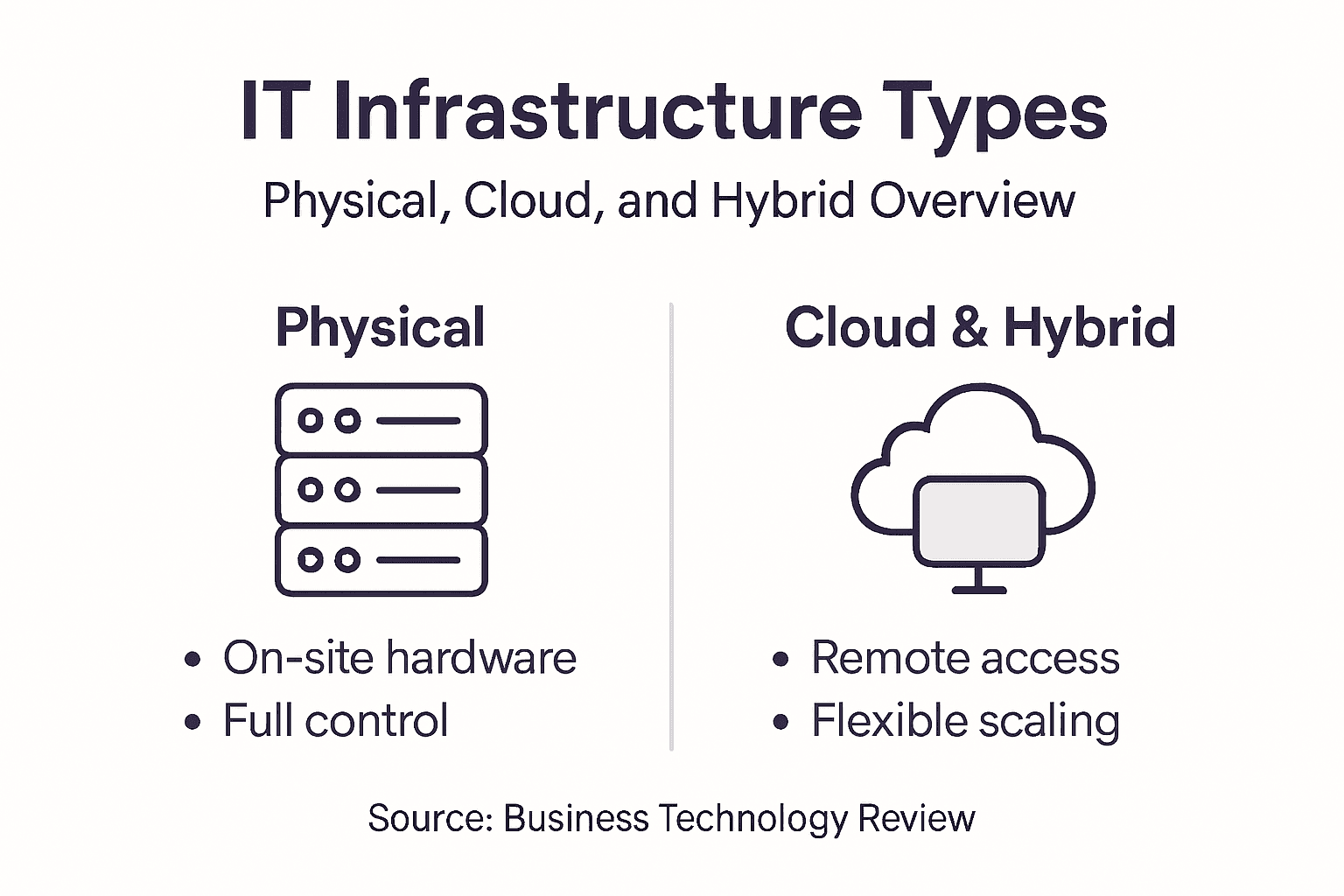
IT infrastructure has evolved significantly, presenting organizations with three primary architectural approaches: physical infrastructure, cloud infrastructure, and hybrid infrastructure. Traditional physical infrastructure remains a critical foundation for many businesses, involving on-site hardware and software systems that provide direct control and immediate access to technological resources.
Physical infrastructure involves maintaining dedicated hardware and servers within an organization’s premises, offering maximum security and complete technological control. Cloud infrastructure, in contrast, represents a more flexible model where computing resources are accessed via internet-based services, enabling businesses to scale rapidly without significant upfront hardware investments. Hybrid cloud infrastructure combines these approaches, allowing organizations to strategically distribute workloads between on-premises systems and cloud environments based on specific security, performance, and cost requirements.

Each infrastructure type presents unique advantages and challenges. Physical infrastructure provides complete control and potentially lower long-term costs for stable workloads. Cloud infrastructure offers unprecedented scalability, global accessibility, and reduced maintenance overhead. Hybrid infrastructure emerges as a sophisticated solution, enabling businesses to leverage the strengths of both physical and cloud environments, maintaining sensitive data on secure on-premises systems while utilizing cloud resources for variable computational needs.
Here’s a quick comparison of the main IT infrastructure types and their strategic fit:
| Infrastructure Type | Best For | Key Benefit | Main Challenge |
|---|---|---|---|
| Physical | Stable workloads, high security | Complete control over assets | High upfront/maintenance costs |
| Cloud | Rapid scaling, remote access | Flexible and easily scalable | Data sovereignty, recurring costs |
| Hybrid | Mixed needs, regulatory compliance | Balances control and flexibility | Complex integration, management |
Pro tip: Conduct a comprehensive workload assessment to determine the most suitable infrastructure model, considering factors like data sensitivity, computational requirements, budget constraints, and future scalability.
How IT Infrastructure Supports Business Operations
IT infrastructure functions as the critical nervous system of modern organizations, enabling seamless communication, data management, and operational efficiency across all business functions. The Information Technology sector plays a central role in supporting economic activities, connecting hardware, software, and communication systems that power organizational productivity and innovation.
At its core, IT infrastructure supports business operations through several key mechanisms. It provides the technological foundation for data storage, processing, and transmission, allowing businesses to collect, analyze, and leverage information instantaneously. Communication platforms enabled by robust IT infrastructure facilitate real-time collaboration among team members, regardless of geographical location. Critical business applications such as customer relationship management systems, enterprise resource planning tools, and financial tracking software depend entirely on a well-designed IT infrastructure to function effectively and securely.
U.S. infrastructure investments demonstrate the strategic importance of technological frameworks in driving economic growth and organizational performance. By enabling digital services, enhancing communication capabilities, and supporting rapid scalability, IT infrastructure allows businesses to adapt quickly to market changes, implement innovative technologies, and maintain competitive advantages. The interconnected nature of modern IT systems means that infrastructure is no longer just a support function but a fundamental driver of business strategy and operational excellence.
Pro tip: Regularly conduct comprehensive IT infrastructure audits to identify potential performance bottlenecks, security vulnerabilities, and opportunities for technological optimization.
Key Cost Drivers and Budget Considerations
IT infrastructure investments represent a complex financial landscape where strategic planning meets technological necessity. Infrastructure spending involves multiple interconnected cost factors that extend far beyond simple hardware purchases, requiring comprehensive budget considerations for organizations of all sizes.
The primary cost drivers for IT infrastructure include hardware acquisition, software licensing, data center facilities, power consumption, network infrastructure, and ongoing personnel costs. Hardware investments encompass servers, networking equipment, storage systems, and end-user devices, which require substantial upfront capital and periodic replacement. Software costs involve operating system licenses, enterprise applications, cybersecurity tools, and cloud service subscriptions that contribute to recurring monthly or annual expenses. Procurement practices significantly influence overall infrastructure spending, with market competition and efficient management strategies playing crucial roles in controlling expenditures.
Below is a summary of cost factors and their influence on IT infrastructure planning:
| Cost Driver | Typical Frequency | Budgeting Impact |
|---|---|---|
| Hardware acquisition | Every 3-5 years | Major upfront expenditure |
| Software licensing | Annual or monthly | Ongoing operational costs |
| Data center facilities | Varies | Significant fixed investment |
| Network infrastructure | As needed | Affects scalability and speed |
| Personnel costs | Ongoing | Influences support and security |
Successful budget management requires a holistic approach that balances performance requirements with financial constraints. Organizations must develop multi-year infrastructure investment strategies that account for technological obsolescence, scalability needs, and emerging market technologies. This involves creating flexible budgeting models that can adapt to rapid technological changes while maintaining fiscal responsibility. Strategic considerations should include total cost of ownership, potential return on investment, and the long-term impact of infrastructure decisions on organizational productivity and competitiveness.
Pro tip: Implement a comprehensive technology lifecycle management strategy that maps infrastructure investments against business objectives, allowing for predictive budgeting and strategic technology upgrades.
Security, Compliance, and Risk Management
Cybersecurity represents a critical cornerstone of modern IT infrastructure, demanding comprehensive strategies that protect organizational assets from evolving digital threats. Organizations must implement robust security controls that go beyond traditional defensive mechanisms, creating multi-layered approaches to risk mitigation and digital resilience.
Effective security and compliance frameworks require holistic risk management strategies that integrate technological solutions, organizational policies, and human awareness. This involves developing comprehensive governance models that identify potential vulnerabilities, implement protective controls, and establish continuous monitoring processes. Key components include network security protocols, data encryption standards, access management systems, threat detection mechanisms, and regular security assessments that proactively address potential risks before they can compromise organizational systems. IT risk management demands systematic approaches to evaluating and mitigating potential technological vulnerabilities, ensuring that security measures align with broader business objectives and regulatory requirements.
Modern organizations must adopt dynamic risk management approaches that recognize the constantly shifting technological landscape. This requires creating adaptive security frameworks that can quickly respond to emerging threats, integrate new technologies, and maintain compliance with industry-specific regulations. Successful strategies involve regular staff training, implementing zero-trust security models, conducting frequent vulnerability assessments, and maintaining flexible incident response protocols that can address complex and evolving cybersecurity challenges.
Pro tip: Develop a comprehensive incident response plan that includes clear communication protocols, designated team responsibilities, and predefined escalation procedures to ensure rapid and coordinated action during potential security breaches.
Common IT Infrastructure Mistakes to Avoid
Infrastructure management requires strategic foresight and proactive planning to avoid critical errors that can compromise organizational technological capabilities. Organizations frequently underestimate the complexity of critical systems, leading to cascading failures and significant operational disruptions.
One of the most prevalent mistakes involves inadequate investment in infrastructure maintenance and upgrade processes. Many organizations fall into the trap of viewing IT infrastructure as a static asset rather than a dynamic ecosystem requiring continuous adaptation. This mindset leads to technological stagnation, increased security vulnerabilities, and reduced operational efficiency. Compliance and qualification requirements demand structured risk management that goes beyond simple hardware and software updates, necessitating comprehensive approaches that integrate emerging technologies, regulatory standards, and organizational objectives.
Technological resilience demands a holistic perspective that anticipates potential vulnerabilities and proactively addresses systemic risks. Common pitfalls include neglecting interdependencies between different technological components, failing to implement robust backup and disaster recovery strategies, and overlooking the human factors that contribute to infrastructure performance. Successful organizations develop adaptive frameworks that balance technological innovation with systematic risk mitigation, recognizing that infrastructure management is an ongoing process of continuous assessment, improvement, and strategic alignment.
Pro tip: Conduct quarterly comprehensive infrastructure audits that evaluate technological performance, identify potential vulnerabilities, and develop actionable strategies for continuous improvement and risk mitigation.
Elevate Your IT Infrastructure with Expert Support
Understanding what IT infrastructure is and why it matters reveals key challenges businesses face every day: managing physical assets, ensuring security compliance, controlling costs, and adapting rapidly to changing technology demands. If you find yourself struggling with infrastructure complexity or want to avoid costly maintenance mistakes, you are not alone. The concepts of physical, cloud, and hybrid infrastructures show there is no one-size-fits-all solution, but a tailored approach guided by expert insight is essential for lasting success.
At Ailerons IT, we specialize in helping small to medium-sized businesses build resilient, scalable IT infrastructures that meet their unique needs. Whether you seek to improve cybersecurity protocols, streamline infrastructure budget planning, or plan a smooth migration to hybrid systems we provide personalized consulting to help you make confident decisions. Visit our blog to explore valuable resources, or reach out now for a consultation and discover how a strategic, well-managed IT infrastructure can become your company’s greatest asset.
Frequently Asked Questions
What is IT infrastructure?
IT infrastructure refers to the collection of hardware, software, networking components, and data storage solutions that form the technological backbone of an organization, enabling business processes and supporting digital operations.
Why does IT infrastructure matter for businesses?
IT infrastructure is essential for businesses as it facilitates efficient communication, data management, and operational efficiency. It acts as the backbone for critical applications and services, enabling organizations to adapt quickly to market changes and sustain competitive advantages.
What are the main types of IT infrastructure?
The main types of IT infrastructure include physical infrastructure (on-site hardware), cloud infrastructure (internet-based services), and hybrid infrastructure (a combination of both). Each type has its unique benefits and challenges, allowing organizations to choose based on their specific needs.
How can organizations ensure their IT infrastructure is secure?
Organizations can enhance the security of their IT infrastructure by implementing robust governance models, regular security assessments, multi-layered cybersecurity measures, and ongoing staff training. Additionally, creating a comprehensive incident response plan is crucial for addressing potential security breaches promptly.