

TL;DR:
- Goal-oriented automation enables systems to autonomously pursue business objectives, unlike fixed rule-based methods.
- Agentic AI significantly improves efficiency and accuracy in variable, unstructured workflows, delivering high ROI.
- Successful implementation relies on workflow audits, clear governance, and process redesign rather than technology choice alone.
Most automation tools still operate on fixed rules: if this happens, do that. That model works for simple, repetitive tasks, but it breaks down fast when business processes involve judgment, variation, or multiple systems. Agentic AI is redefining what automation can actually achieve, moving from static scripts to systems that pursue real business objectives. This article breaks down what goal-oriented automation is, how it differs from legacy robotic process automation (RPA), what the benchmarks show, and how mid-market operations leaders can put it to work without falling into common traps.
Table of Contents
- Defining goal-oriented automation and agentic AI
- How goal-oriented automation transforms business workflows
- Goal-oriented AI vs. traditional RPA: Key differences and benchmarks
- Risks, edge cases, and real-world adoption lessons
- Best practices for implementing goal-oriented automation
- Why most ‘AI agents’ fail, and where the real value lies
- Transform your workflows with proven goal-oriented automation
- Frequently asked questions
Key Takeaways
| Point | Details |
|---|---|
| Beyond rules-based automation | Goal-oriented AI enables businesses to automate complex, unstructured workflows with self-adaptive agents. |
| Massive efficiency gains possible | Case studies show up to 73% time savings, 3x ROI, and dramatic cost reductions using agentic automation. |
| Governance and design are critical | Effective adoption relies on strong business process framing and ongoing oversight, not just advanced technology. |
| Hybrid strategies excel | Combining RPA and agentic AI covers more use cases and delivers higher ROI than using either alone. |
Defining goal-oriented automation and agentic AI
Traditional automation follows a script. You define every step, every condition, every exception in advance. If something unexpected happens, the process either fails or gets stuck in a queue for a human to resolve. That rigidity is the core limitation.
Goal-oriented automation works differently. Instead of following a fixed path, the system is given an objective and figures out how to achieve it. Agentic AI systems autonomously pursue objectives by planning actions, executing tasks, monitoring progress, and adapting based on feedback. The system reasons about what needs to happen, selects the right tools or integrations, and adjusts when conditions change.
Here is what that workflow looks like in practice:
- Goal setting: A business objective is defined, such as processing all new vendor invoices within 24 hours.
- Action planning: The agent maps out the steps needed, including pulling data, checking against records, and routing for approval.
- Execution: The agent carries out each step across connected systems, such as your ERP, email, and document platform.
- Progress monitoring: The system tracks completion and flags exceptions in real time.
- Feedback loop: Results are evaluated, and the agent refines its approach for future runs.
This is fundamentally different from prompt-based tools or chatbots, which respond to individual inputs without maintaining context or pursuing a broader goal across sessions.
“The shift from rule-following to goal-pursuing is not a minor upgrade. It is a different category of software entirely, one that can handle the messy, variable reality of actual business operations.”
For operations managers focused on improving business workflows, this distinction matters. Agentic AI does not just speed up existing processes. It can manage processes end to end, including the judgment calls that previously required human intervention.
How goal-oriented automation transforms business workflows
Now that you have a clear understanding of what goal-oriented automation is, let’s see the practical impact these systems have on real-world business operations.

Consider three common mid-market pain points: synthesizing research across multiple sources, triaging incoming service or compliance incidents, and generating periodic reports from scattered data. Each of these involves variable inputs, multiple tools, and decisions that change depending on context. Rule-based automation handles none of them well.
Agentic AI handles all three. Mid-market companies using agentic AI have cut admin burdens by up to 72%, with broader studies showing 73% time savings, efficiency gains of 40 to 75% in SMB environments, and ROI figures as high as 3,107% in documented deployments. These are not projections. They are measured outcomes from real implementations.
Here is how an agent might orchestrate a multi-system reporting process:
- The agent receives a trigger, such as end-of-month date or a manual request.
- It pulls data from the CRM, ERP, and project management platform simultaneously.
- It cross-references figures, identifies discrepancies, and flags them for review.
- It generates a formatted report and routes it to the appropriate stakeholders.
- It logs the completed task and updates the relevant records automatically.
No manual handoffs. No waiting for someone to compile spreadsheets. The office workflows automation guide covers how context-aware systems manage these kinds of multi-step processes reliably.
The same logic applies to compliance-driven tasks. Agents can monitor for regulatory triggers, gather required documentation, and route approvals, as detailed in resources on AI in compliance automation.
Pro Tip: Before selecting any automation tool, run a workflow audit. Map every admin process by volume, error rate, and time cost. The highest-burden workflows are your best starting points for agentic AI deployment.
Goal-oriented AI vs. traditional RPA: Key differences and benchmarks
Understanding business applications, it’s crucial to evaluate how goal-oriented automation measures up against the older generation of RPA tools.
RPA is not obsolete. For high-volume, structured, repetitive tasks, such as data entry from a fixed-format form or scheduled file transfers, RPA remains fast, reliable, and cost-effective. The problem is that most real business workflows are not that clean.
Goal-oriented AI handles variable, unstructured tasks with 95%+ accuracy, delivers roughly 3x ROI compared to RPA, and requires approximately 90% less ongoing maintenance. That last point is significant. RPA bots break when interfaces change. Agentic systems adapt.
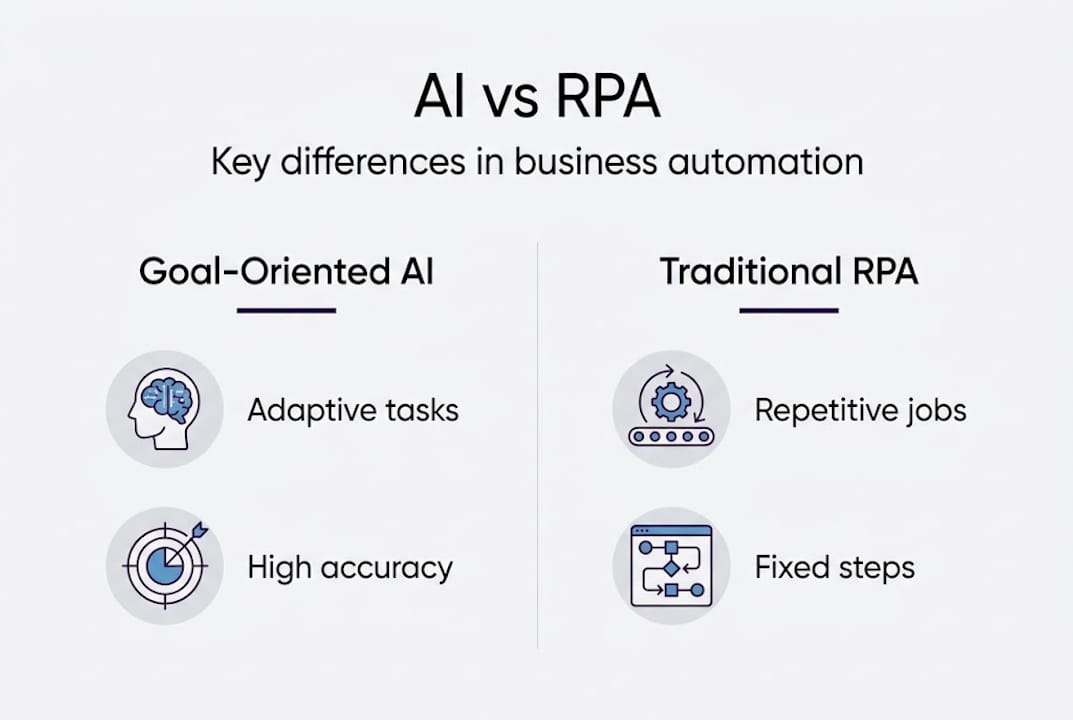
| Factor | Goal-oriented AI | Traditional RPA |
|---|---|---|
| Task type | Unstructured, variable | Structured, repetitive |
| Accuracy | 95%+ on complex tasks | High on fixed inputs |
| ROI | Up to 3x vs. RPA | Moderate, task-dependent |
| Maintenance | Low (adaptive) | High (brittle to change) |
| Setup cost | Higher upfront | Lower upfront |
| Total cost of ownership | Lower long-term | Higher with scale |
When deciding which approach fits your situation, consider the following:
- Use RPA for structured data extraction, scheduled transfers, and fixed-format document processing.
- Use agentic AI for multi-step workflows, exception handling, research tasks, and processes involving judgment.
- Use both when you have a mix of structured back-end tasks and variable front-end coordination.
Exploring the types of automation available helps clarify which layer of your operations benefits from each approach. For broader process design, business process management with AI provides a solid framework.
Pro Tip: Hybrid RPA and agentic AI strategies consistently outperform either approach alone. Use RPA for the predictable steps and agentic AI for the variable ones within the same workflow.
Risks, edge cases, and real-world adoption lessons
With differences clear, it’s essential to see where even powerful systems can go wrong, and how experienced adopters avoid pitfalls.
Agentic AI is not a plug-and-play solution. Even advanced AI agents face edge-case failures including hallucinations, prompt injection vulnerabilities, and context loss on long-horizon tasks. Real adoption requires human-in-the-loop oversight, governance structures, and careful workflow design from the start.
The major risks to plan for include:
- Hallucinations: The agent produces plausible but incorrect outputs, particularly in document generation or data synthesis tasks.
- Context loss: On long, multi-step tasks, the agent loses track of earlier decisions or constraints.
- Over-permissiveness: Agents granted excessive system access can make unintended changes across platforms.
- Prompt injection: Malicious inputs embedded in documents or emails can redirect agent behavior.
| Risk factor | Frequency in early deployments | Mitigation approach |
|---|---|---|
| Hallucinations | Common without grounding | Retrieval-augmented generation, output review |
| Context loss | Moderate on 10+ step tasks | Task segmentation, memory management |
| Over-permissiveness | Common without governance | Least-privilege access design |
| Prompt injection | Low but high impact | Input sanitization, sandboxed execution |
The organizations that see consistent results treat governance as a design requirement, not an afterthought. Human oversight checkpoints, minimum necessary permissions, and clear escalation paths are non-negotiable. The AI-driven automation success guide covers how to structure these safeguards in practice.
Best practices for implementing goal-oriented automation
Having examined the risks, let’s move to a step-by-step playbook for successful adoption and optimization.
The organizations that achieve strong ROI from agentic AI do not start with technology selection. They start with process clarity. Experts consistently advise beginning with audits, piloting hybrid RPA and agent strategies, and embedding governance early to avoid the high failure rates seen in rushed deployments.
Here is a practical adoption sequence:
- Audit your workflows. Identify processes by volume, error rate, and manual time cost. Prioritize unstructured, high-burden admin tasks.
- Select pilot targets. Choose two or three workflows where agentic AI can show measurable impact within 60 to 90 days.
- Design for governance first. Define human oversight checkpoints, access permissions, and escalation rules before writing a single integration.
- Run a controlled pilot. Measure accuracy, time savings, and exception rates against your baseline.
- Iterate and expand. Use pilot data to refine the agent’s workflow framing, then scale to adjacent processes.
The SMB automation adoption guide walks through this sequence in detail. For teams focused on overhead reduction, the data on cutting admin overhead provides concrete benchmarks to set internal targets.
Pro Tip: The biggest lever in agentic AI implementation is not the software you choose. It is how well you frame the workflow domain. Agents perform best when given clear boundaries, defined objectives, and structured feedback. Invest time in workflow design before you invest in deployment.
Why most ‘AI agents’ fail, and where the real value lies
The market is crowded with tools labeled as AI agents. Most of them are not. The vast majority of so-called AI agents are sophisticated chatbots without true autonomy, making workflow-centric design and governance far more important than software selection alone.
The failure pattern is consistent: a company buys an AI agent platform, connects it to a few systems, and expects results. When the agent underperforms, the instinct is to blame the technology. The actual problem is almost always the absence of clear workflow framing, governance, and process redesign.
“Layering AI software onto a broken or poorly defined process does not fix the process. It accelerates the dysfunction.”
The real value of goal-oriented automation comes from rethinking how work gets done, not just automating the existing steps. Operations leaders who treat agentic AI as a process redesign initiative, rather than a software purchase, consistently outperform those who do not. Resources on how to boost operations efficiency with AI reinforce this point with practical frameworks for mid-market teams.
Transform your workflows with proven goal-oriented automation
Goal-oriented automation delivers measurable results when it is designed, governed, and deployed with precision. At Ailerons.ai, we specialize in agentic AI systems built for real office and operational workflows, from document management and billing support to compliance coordination and front-office automation. Our implementations are outcome-focused, integrating with your existing CRM, ERP, and scheduling platforms without disrupting current operations. Explore real-world case studies showing quantifiable efficiency gains and cost reductions. If you are ready to identify where goal-oriented automation fits your operations, contact us to schedule a consultation and get a clear picture of what is achievable.
Frequently asked questions
How is goal-oriented automation different from traditional RPA?
Goal-oriented automation uses adaptive agents to pursue objectives across variable, unstructured workflows, while RPA follows strict rules for repetitive tasks and breaks when inputs change.
What ROI can mid-market firms expect from adopting agentic AI?
Documented outcomes include up to 3,107% ROI, 73% time savings, and significant yearly cost reductions depending on the workflows targeted and the quality of implementation.
What are the main risks with goal-oriented automation?
The primary risks are hallucinations, context loss on long tasks, over-permissive access, and prompt injection, all of which require governance and human oversight built into the deployment from day one.
What first steps should leaders take to implement agentic automation?
Start with a workflow audit and pilot targeting unstructured admin processes, combine agentic AI with RPA where appropriate, and establish governance structures before scaling.
Recommended
- Improving Business Workflows with AI: Achieve Automation | Ailerons IT Consulting
- Step-by-Step Guide to AI-Driven Office Automation Success | Ailerons IT Consulting
- Context-aware automation: efficient office workflows guide | Ailerons IT Consulting
- Step by Step Business Automation Guide for SMBs | Ailerons IT Consulting
- Role Of AI In Trading: Revolutionizing Forex Automation