

Over half of American small and medium-sized businesses face unexpected hurdles when shifting operations to the cloud. For IT managers, navigating cloud migration means managing risks, updating systems, and controlling costs while maintaining security. This guide breaks down what cloud migration really involves, exposes common misconceptions, and highlights practical strategies that help American companies modernize without overspending or compromising critical data.
Table of Contents
- Cloud Migration Defined And Common Misconceptions
- Different Types Of Cloud Migration Approaches
- How Cloud Migration Works For SMB Operations
- Benefits And Challenges Of Cloud Migration
- Cost, Security, And Compliance Considerations
Key Takeaways
| Point | Details |
|---|---|
| Understanding Cloud Migration | Cloud migration is a strategic and comprehensive process, not just simple data transfer, requiring thorough planning and execution. |
| Approaches to Migration | Different migration strategies such as Rehosting, Replatforming, and Refactoring should be chosen based on specific organizational needs and goals. |
| Benefits and Challenges | While cloud migration offers benefits like reduced costs and improved scalability, organizations must address challenges like data security and compliance issues. |
| Critical Security and Compliance | For effective cloud migration, develop a robust strategy focusing on data protection, regulatory adherence, and ongoing security assessments. |
Cloud Migration Defined and Common Misconceptions
Cloud migration is a strategic process that involves transferring an organization’s digital infrastructure, data, and applications from traditional on-premises systems to cloud-based environments. Unlike simple data transfers, cloud migration represents a comprehensive technological transformation that requires meticulous planning and execution.
At its core, cloud migration is about reimagining how businesses store, access, and manage their technological resources. This isn’t just moving files from one location to another - it’s a sophisticated process of restructuring computational capabilities through scalable network resources. Organizations typically choose from three primary cloud deployment models: public cloud, private cloud, and hybrid cloud environments, each offering distinct advantages for different business needs.
Common misconceptions about cloud migration can lead IT managers to underestimate its complexity. Many believe it’s a straightforward technical task, when in reality, it involves:
- Comprehensive infrastructure assessment
- Detailed migration strategy development
- Application compatibility evaluation
- Security and compliance considerations
- Performance optimization planning
Successful cloud migration requires a holistic approach that goes beyond simple data transfer. It demands strategic thinking, technical expertise, and a clear understanding of how cloud technologies can transform business operations.
Pro Tip: Always conduct a thorough infrastructure and application readiness assessment before initiating any cloud migration project to identify potential challenges and minimize disruption.
Different Types of Cloud Migration Approaches
Cloud migration is not a one-size-fits-all strategy, but rather a nuanced process with multiple approaches tailored to specific organizational needs. Cloud migration strategies encompass several distinct methodologies that enable businesses to transition their digital infrastructure strategically and efficiently.
The primary cloud migration approaches include:
- Rehosting (Lift and Shift)
- Minimal application modifications
- Fastest migration method
- Low initial complexity
- Ideal for organizations with legacy systems
- Replatforming
- Moderate application modifications
- Optimize for cloud environment
- Partial cloud-native feature utilization
- Balance between speed and modernization
- Refactoring
- Comprehensive application redesign
- Maximum cloud-native feature leverage
- Highest transformation potential
- Significant time and resource investment
- Repurchasing
- Replace existing applications with cloud-based solutions
- Adopt software-as-a-service (SaaS) alternatives
- Eliminate complex migration processes
- Potential licensing and data migration challenges
- Retiring
- Eliminate obsolete or redundant applications
- Streamline IT infrastructure
- Reduce unnecessary operational costs
- Improve overall system efficiency
Data migration strategies require comprehensive risk management that addresses security, privacy, and operational continuity. Each approach demands careful evaluation of an organization’s technological landscape, existing infrastructure, and future scalability requirements.
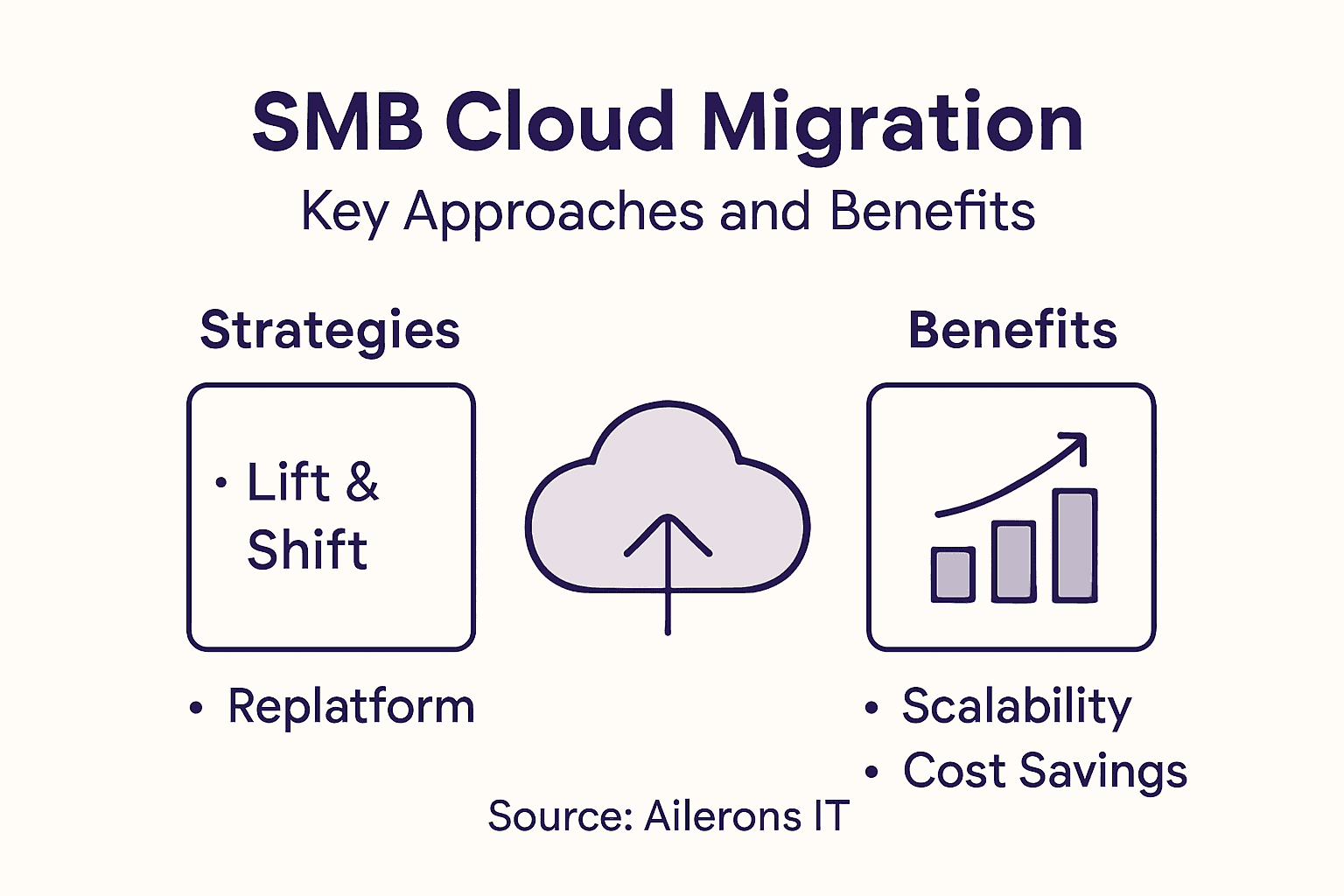
Here’s how the main cloud migration approaches differ in their business transformation potential:
| Approach | Modernization Level | Cost Impact | Business Transformation Potential |
|---|---|---|---|
| Rehosting | Minimal changes | Lower upfront | Preserves legacy systems |
| Replatforming | Partial optimization | Moderate | Improves operations |
| Refactoring | Full redesign | Higher investment | Enables advanced capabilities |
| Repurchasing | New SaaS adoption | Variable | Streamlines and modernizes |
| Retiring | Removal of redundancies | Cost saving | Boosts efficiency |
Pro Tip: Conduct a thorough application portfolio assessment before selecting a migration strategy to ensure alignment with your business objectives and technological capabilities.
How Cloud Migration Works for SMB Operations
Cloud migration transforms small and medium-sized businesses by providing a flexible pathway to modernize technological infrastructure without massive upfront investments. Unlike traditional IT approaches, cloud migration enables SMBs to access enterprise-grade technological capabilities through scalable, on-demand resources that can dynamically adjust to changing business requirements.
The cloud migration process for SMBs typically involves several critical stages:
- Infrastructure Assessment
- Evaluate current IT systems
- Identify migration-ready applications
- Determine cloud compatibility
- Map interdependencies between systems
- Cloud Strategy Development
- Select appropriate migration approach
- Choose cloud service model (IaaS, PaaS, SaaS)
- Define performance and security requirements
- Establish budget and timeline
- Migration Execution
- Migrate data and applications
- Configure cloud environment
- Implement security protocols
- Test system functionality
- Post-Migration Optimization
- Monitor system performance
- Fine-tune cloud resources
- Train staff on new systems
- Continuously improve cloud infrastructure
SMB cloud migration enhances operational efficiency by providing unprecedented flexibility in managing technological resources. Small businesses can now access sophisticated computing capabilities previously available only to large enterprises, leveling the technological playing field and enabling more competitive business strategies.

Pro Tip: Start with a pilot migration of non-critical systems to gain practical experience and minimize potential disruptions to core business operations.
Benefits and Challenges of Cloud Migration
Cloud migration presents a complex landscape of transformative opportunities and potential organizational risks for businesses seeking technological modernization. While the potential advantages are significant, successful implementation requires a strategic approach that carefully balances potential benefits against inherent challenges.
Key Benefits of Cloud Migration:
- Reduced infrastructure costs
- Improved scalability and flexibility
- Enhanced disaster recovery capabilities
- Global accessibility of resources
- Advanced technological capabilities
- Simplified IT management
Potential Challenges to Address:
- Data security vulnerabilities
- Compliance and regulatory concerns
- Potential performance inconsistencies
- Complex migration processes
- Need for specialized technical skills
- Potential hidden implementation costs
Cloud computing challenges require comprehensive risk management strategies that go beyond simple technological implementation. Organizations must develop robust security protocols, clearly define responsibilities between cloud providers and internal teams, and maintain continuous monitoring to mitigate potential operational risks.
Successful cloud migration demands a nuanced understanding of both technological capabilities and organizational constraints. By carefully evaluating individual business needs, conducting thorough risk assessments, and implementing strategic migration approaches, companies can effectively leverage cloud technologies while minimizing potential disruptions.
Pro Tip: Develop a comprehensive risk assessment matrix that maps potential cloud migration challenges against your specific organizational capabilities and requirements.
Cost, Security, and Compliance Considerations
Cloud migration security demands comprehensive strategic planning that goes far beyond basic technological implementation. Small and medium-sized businesses must carefully navigate the complex landscape of protecting sensitive data, managing infrastructure vulnerabilities, and ensuring regulatory compliance while maintaining cost-effectiveness.
Cost Considerations:
- Initial migration expenses
- Ongoing cloud service subscriptions
- Potential training and transition costs
- Infrastructure reduction savings
- Scalable resource allocation
- Avoiding unnecessary technology investments
Security Priorities:
- Robust data encryption protocols
- Multi-factor authentication
- Comprehensive access controls
- Regular security vulnerability assessments
- Network traffic monitoring
- Incident response planning
Compliance Framework Requirements:
- Industry-specific regulatory adherence
- Data sovereignty regulations
- Privacy protection standards
- Transparent data handling practices
- Documentation of security measures
- Regular compliance audits
Strategic planning optimizes cloud migration costs while maintaining rigorous security standards. Organizations must develop a holistic approach that balances technological innovation, financial prudence, and comprehensive risk management. This requires ongoing evaluation, continuous improvement, and adaptive strategies that align with evolving business needs and technological landscapes.
The following table summarizes the cost, security, and compliance priorities in cloud migration for SMBs:
| Factor | Critical Focus | Risk if Ignored | Strategic Approach |
|---|---|---|---|
| Cost | Budget management | Overspending, outages | Analyze needs, monitor expenses |
| Security | Data protection | Breaches, data loss | Use encryption, regular audits |
| Compliance | Regulatory alignment | Fines, legal issues | Document processes, conduct audits |
Pro Tip: Conduct a quarterly comprehensive review of your cloud security and compliance strategy to proactively identify and address potential vulnerabilities and cost optimization opportunities.
Unlock the Full Potential of Cloud Migration for Your SMB
Navigating the complexities of cloud migration can be overwhelming for small and medium-sized businesses. From choosing the right migration approach to managing security and compliance, the process requires expert guidance to avoid disruptions and hidden costs. If you are concerned about data protection, application compatibility, or achieving true business transformation through cloud technology, you are not alone. Many SMBs face these exact challenges highlighted in the article, such as selecting between rehosting, replatforming, or refactoring, while balancing cost and operational efficiency.
Ailerons IT specializes in helping businesses like yours make cloud migration seamless and strategically sound. Our tailored IT consulting services ensure you conduct thorough infrastructure assessments and develop a migration strategy that aligns with your unique goals. Discover how you can optimize security, control costs, and leverage scalable cloud solutions without compromising performance by exploring our expert insights on our blog. Start your journey with confidence by booking a personalized consultation today and transform your IT infrastructure with trusted guidance. Visit us now at Ailerons IT to learn more and take the next step.
Frequently Asked Questions
What is cloud migration?
Cloud migration is the process of transferring an organization’s digital infrastructure, data, and applications from traditional on-premises systems to cloud-based environments. It involves comprehensive planning and execution for a successful transition.
What are the main types of cloud migration approaches?
The primary cloud migration approaches include rehosting (lift and shift), replatforming, refactoring, repurchasing, and retiring. Each approach offers different levels of modernization and impacts on business transformation.
How does cloud migration benefit small and medium-sized businesses (SMBs)?
Cloud migration provides SMBs with flexible pathways to modernize their technology, which includes improved scalability, reduced infrastructure costs, enhanced disaster recovery capabilities, and access to advanced technological resources previously limited to larger enterprises.
What are some common challenges faced during cloud migration?
Common challenges during cloud migration include data security vulnerabilities, compliance and regulatory concerns, potential performance inconsistencies, complex migration processes, and the need for specialized technical skills.