

TL;DR:
- Autonomous AI perceives its environment, makes decisions, and executes tasks independently without ongoing human input.
- It differs from generative AI, which creates content on prompts, and agentic AI, which manages multiple agents over extended tasks.
Autonomous AI is defined as artificial intelligence that perceives its environment, makes decisions, and executes multi-step tasks independently, without continuous human input. Unlike a chatbot that waits for prompts or a script that runs on a fixed schedule, a true autonomous AI system pursues standing goals, selects its own tools, and adapts when conditions change. The industry term most commonly used alongside this concept is “agentic AI,” and understanding the difference between the two is where most professionals get tripped up. This guide covers the definition of autonomous AI, how it works under the hood, where it delivers real value, and what governance it demands before you deploy it.
What is autonomous AI and how does it differ from related AI types?
Autonomous AI is an AI system that pursues goals and acts using tools without needing ongoing human approval at each step. The system perceives inputs from its environment, reasons about the best path forward, and executes actions. That three-part loop, perceive, decide, act, is what separates autonomous AI from simpler automation.

The confusion starts when people use “autonomous AI,” “agentic AI,” and “generative AI” interchangeably. They are not the same thing.
| Type | Primary function | Human involvement |
|---|---|---|
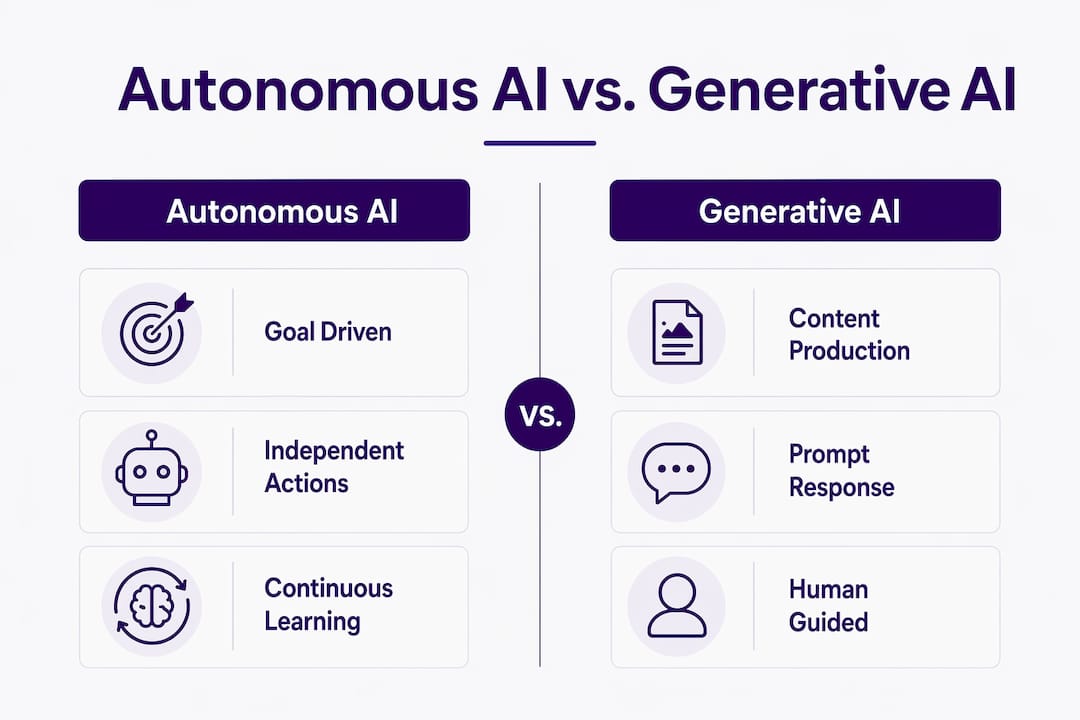
| Generative AI | Produces content (text, images, code) on request | High: human prompts each output |
| Autonomous AI | Pursues goals, makes decisions, takes actions | Low: human sets goal, system executes |
| Agentic AI | Coordinates multiple agents across extended tasks | Minimal: operates in open environments over time |
Generative AI tools like GPT-4 or Claude generate outputs when prompted. They do not act on the world unless connected to tools and given authority to use them. Autonomous AI has that authority baked in. Agentic AI takes it further still: it manages task decomposition across multiple coordinated agents, sustaining operations over longer periods in less predictable environments. Think of agentic AI as the organizational layer above a single autonomous agent.
Pro Tip: If a vendor calls their product an “autonomous AI agent” but it only responds to user messages and runs scheduled scripts, it is a chatbot with a cron job. True autonomy requires state management, error recovery, and goal-directed decision logic.
How does autonomous AI work in practice?
Real autonomous AI is an engineering challenge, not just a model capability. The system must handle a continuous loop of perception, planning, execution, and verification. Here is what that looks like at each layer:
- Perception: The agent reads inputs from connected systems, databases, APIs, file systems, or sensors. It builds a working model of the current state of its environment.
- Planning: The agent breaks a high-level goal into sub-tasks, sequences them, and selects the tools needed for each step. This is where large language models like those from Anthropic or OpenAI provide the reasoning backbone.
- Execution: The agent calls tools, writes to systems, sends communications, or triggers downstream processes. It does not wait for a human to confirm each action.
- Verification: A well-built system includes self-verification and audit trails to confirm actions completed correctly and flag exceptions for human review.
Most systems marketed as autonomous fall short on the last two layers. Robust autonomous AI requires reliable state management, error handling, and scheduling loops that maintain continuous independent operation. Without those, the system breaks silently and nobody notices until a downstream process fails.
Security is a structural concern, not an afterthought. NVIDIA’s OpenShell runtime provides secure sandboxing with policy enforcement to isolate autonomous agents, limiting the attack surface and preventing unauthorized data access. The key architectural principle is separating the control plane from the data plane: constraints live at the environment level, not inside the model itself. That distinction matters because a model cannot reliably police its own behavior under adversarial conditions.
Levels of autonomy exist on a spectrum. Semi-autonomous systems pause at defined approval gates before taking high-stakes actions. Fully autonomous systems operate end-to-end within pre-authorized boundaries. Most enterprise deployments today sit somewhere in the middle, which is the right place to start.
What are the benefits and challenges of autonomous AI in enterprise?
The benefits of autonomous AI are concrete and measurable when the system is properly scoped. Organizations that deploy these systems correctly report gains in three specific areas:
- End-to-end task completion: Autonomous agents handle entire workflows, from data ingestion through processing to output delivery, without hand-offs that introduce delay or error.
- Consistent execution: Unlike human workers, autonomous agents apply the same logic every time. Billing runs, compliance checks, and document routing happen on schedule without variation.
- Scalable capacity: Adding workload does not require adding headcount. The same agent architecture that handles 100 invoices handles 10,000 with the same configuration.
The challenges are equally real. Autonomous AI agents lack inherent human constraints, which means every boundary must be explicitly defined. An agent authorized to send emails can send the wrong email to the wrong person if its authorization scope is not tightly written. This is not a hypothetical risk. It is the default outcome when governance is treated as optional.
Governance frameworks like ACAP (Agent Capability and Authorization Profile) explicitly define what actions an autonomous agent is permitted to perform. ACAP bridges technical capability with enforceable organizational authorization, documenting delegated power and oversight requirements. Organizations deploying autonomous AI without something equivalent to ACAP are operating on trust rather than policy.
Security requires the same rigor. NVIDIA OpenShell and NemoClaw provide open-source platforms for policy-driven autonomous agents capable of long-running tasks with integrated access controls. The principle is consistent: constrain the environment, not just the model. You can read more about the technical side of this in Ailerons’ guide on secure agentic AI design.
Pro Tip: Treat autonomous AI like a new employee with broad system access. You would not give a new hire unrestricted access to every platform on day one. Define authorization boundaries before deployment, not after the first incident.
Autonomous AI examples across industries and workflows
Autonomous AI is moving from pilot programs to operational systems across multiple sectors. The following examples illustrate how the technology performs in practice:
- Front-office coordination: Ailerons deploys agents named Mona and Luna that manage scheduling, document routing, and approval workflows across business operations. These agents coordinate with existing CRM and ERP systems without requiring manual hand-offs between departments.
- Customer service operations: Autonomous agents handle tier-one support queries, escalate exceptions to human agents, and update customer records in real time. The agent does not wait for a human to close a ticket before moving to the next task.
- Billing and accounting support: Agents process invoices, flag discrepancies, and route approvals through accounting platforms. The same logic that handles a standard invoice also catches an anomaly and holds it for review, applying AI decision logic consistently across every transaction.
- Compliance-driven document management: In regulated industries, autonomous agents apply retention policies, redact sensitive fields, and generate audit logs without human involvement in each step. This is particularly relevant for law firms and healthcare organizations where precision is non-negotiable.
- Multi-agent business process management: Complex operations use coordinated agent networks where one agent handles data extraction, another handles validation, and a third handles output delivery. This mirrors how AI in business process management enables organizations to handle end-to-end workflows at scale.
The emerging trend is not single-agent automation but multi-agent collaboration, where specialized agents hand off tasks to each other based on context and capability. This architecture mirrors how human teams divide work, except the coordination happens in milliseconds and does not require meetings.
Key takeaways
Autonomous AI systems deliver real operational value only when goal-directed decision logic is paired with explicit governance, security constraints, and defined authorization boundaries.
| Point | Details |
|---|---|
| Core definition | Autonomous AI perceives, decides, and acts independently to pursue standing goals without continuous human approval. |
| Distinct from generative AI | Generative AI produces content on request; autonomous AI takes actions in connected systems with delegated authority. |
| Engineering requirements | True autonomy demands state management, error handling, and audit trails. Scheduled scripts do not qualify. |
| Governance is non-negotiable | Frameworks like ACAP define authorized actions explicitly, because autonomous agents have no built-in human constraints. |
| Security by architecture | Sandboxed runtime environments like NVIDIA OpenShell isolate agents at the environment level, not just the model level. |
Why the gap between hype and reality still matters in 2026
I have reviewed enough autonomous AI deployments to say this plainly: the majority of systems labeled “autonomous” are not. They are well-dressed automation pipelines that break when an edge case appears and have no mechanism to recover. The organizations that discover this learn it the hard way, usually when a workflow silently fails for three days before anyone notices.
What I find genuinely useful about the current moment is that the engineering standards for real autonomy are now well-defined. The ACAP framework, sandboxed runtime environments, and multi-agent coordination patterns are not experimental concepts. They are production-ready approaches that organizations can adopt today. The gap is not technical. It is organizational. Most teams have not yet built the governance culture that autonomous AI requires.
The framing I use with every client is this: autonomous AI is empowered delegation, not magic automation. You are giving a system authority to act on your behalf within defined limits. That requires the same rigor you would apply to hiring, onboarding, and supervising a person with significant system access. Organizations that approach it that way consistently get better outcomes than those chasing the marketing promise of “set it and forget it.” The future of autonomous AI technologies belongs to teams that build trust through governance, not teams that skip it in pursuit of speed.
— Sam
How Ailerons can help you deploy autonomous AI with confidence
Ailerons specializes in designing and deploying agentic AI systems for office and operational workflows, including front-office coordination, billing support, document management, and compliance-driven processes. Every deployment is built on secure, compliant architecture aligned with modern identity and cloud standards. If you are evaluating autonomous AI for your organization, the Ailerons case studies show exactly how these systems perform in real operational environments, with measurable outcomes. For organizations ready to move from evaluation to implementation, the managed AI consulting services at Ailerons cover architecture, integration, governance, and ongoing supervision. Contact Ailerons to book a consultation and define the right scope for your first autonomous AI deployment.
FAQ
What is the definition of autonomous AI?
Autonomous AI is defined as an artificial intelligence system that perceives its environment, makes decisions, and executes actions independently to achieve standing goals without requiring continuous human approval. It is most commonly implemented through AI agents or agentic AI architectures.
How does autonomous AI differ from generative AI?
Generative AI produces content such as text, images, or code in response to prompts. Autonomous AI takes actions in connected systems, manages multi-step workflows, and operates with delegated authority to complete tasks end-to-end.
Is autonomous AI safe to deploy in enterprise environments?
Autonomous AI is safe when deployed with explicit governance frameworks, sandboxed runtime environments, and defined authorization boundaries. Tools like NVIDIA OpenShell provide policy-driven isolation, and frameworks like ACAP document what actions agents are authorized to perform.
What are the most common autonomous AI examples in business today?
Common examples include agents that manage scheduling and document routing, process invoices, handle tier-one customer service, apply compliance policies to documents, and coordinate multi-step approval workflows across CRM and ERP platforms.
What is the difference between AI and autonomous AI?
Standard AI systems respond to inputs and produce outputs when prompted. Autonomous AI pursues goals proactively, selects its own tools, manages multi-step task sequences, and operates continuously without a human initiating each action.