

TL;DR:
- AI enhances legal workflows by integrating intelligent automation into research, drafting, and compliance processes with governance and accountability. Lawyers shift from manual tasks to validator roles, ensuring outputs are verified within auditable, context-aware systems that prioritize legal authority and ethical standards. Responsible AI adoption requires clear policies, ongoing supervision, and process design to maintain reliability, confidentiality, and professional integrity.
The role of AI in legal workflows is defined as the integration of intelligent automation directly into legal research, drafting, document review, and compliance processes. In 2026, 58% of attorneys use legal-specific AI tools for research, while 49% use them for document drafting and 47% for summarization. These numbers reflect a profession that has moved past experimentation. Platforms like LexisNexis Protégé and practice management software like MyCase now embed AI directly into attorney workflows, making artificial intelligence in law a daily operational reality rather than a future aspiration.
How is AI changing the structure of legal workflows?
The shift happening in legal practice is not simply about adding AI tools. It is about replacing isolated, single-purpose applications with connected workflow layers that govern how legal work gets done from start to finish.
A standalone AI tool handles one task in isolation. A lawyer pastes text into a general-purpose model, gets a draft, and manually carries it into the next step. An embedded workflow layer operates differently. LexisNexis Protégé Workflows connects research, drafting, analysis, and client advice within a single governed environment, anchored to authoritative legal content and traceable at every step. That distinction matters because it changes what lawyers are responsible for reviewing, and how.
Three pillars define well-designed AI workflow integration:
- Governance: Clear rules about which AI tools are approved, what data they can access, and who holds accountability for outputs.
- Auditability: The ability to trace every AI-assisted output back to its source, model version, and the prompt that generated it.
- Source authority: AI outputs grounded in verified legal databases rather than general web content, reducing the risk of fabricated citations.
When these pillars are in place, the lawyer’s role shifts. Instead of performing every research and drafting task manually, attorneys become validators and controllers. They review AI outputs, apply judgment, and take professional responsibility for the final work product. This is not a reduction in the lawyer’s role. It is a redefinition of where legal expertise adds the most value.
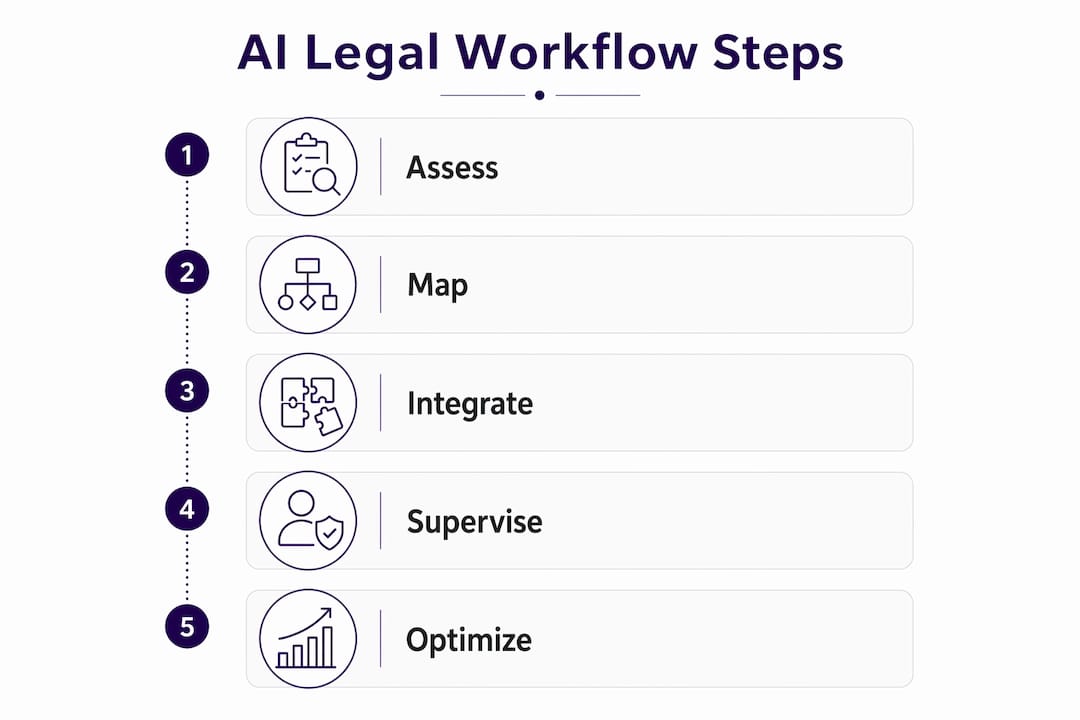
Pro Tip: Before adopting any AI tool firm-wide, map your existing workflow steps first. AI integration works best when it slots into a defined process rather than replacing an undefined one.
What ethical responsibilities apply when using AI in legal practice?
The American Bar Association’s ABA Formal Opinion 512 establishes six professional duties that apply directly to lawyers using generative AI. Understanding these duties is not optional. They define the floor of acceptable conduct when AI touches legal work.
The six duties are:
- Competence: Lawyers must understand how the AI tools they use function, including their limitations and failure modes.
- Confidentiality: Client data fed into AI systems must be protected, with clear policies on what information can enter which platforms.
- Communication: Clients have a right to know when AI is used in their matters, and informed consent may be required.
- Candor: Lawyers cannot submit AI-generated content to courts without verifying its accuracy, including every citation.
- Supervision: Supervising attorneys are responsible for the AI-assisted work of junior lawyers and staff, not just their own.
- Reasonable fees: Billing for AI-assisted work must reflect actual time and value, not inflated hours for tasks AI completed in seconds.
The consequences of ignoring these duties are concrete. A High Court judge admonished Pinsent Masons after a junior lawyer used AI to draft letters containing fabricated references, without disclosing the AI use to supervisors or verifying the citations. The court’s criticism focused on two failures: no verification checkpoint existed, and no disclosure protocol was in place. Both are now standard requirements under Opinion 512.
“AI serves as an assistive tool rather than a replacement for human judgment. Human judges must retain responsibility for decision-making.” — Master of the Rolls, on AI and the judiciary
Operationalizing these ethics means treating human review as a workflow control, not a final formality. Firms that embed review checkpoints before any AI output is filed or sent to a client are meeting the standard. Firms that treat review as optional are not. Training, written policies, and audit trails are the mechanisms that make compliance real rather than theoretical.
How does AI improve document management, case coordination, and compliance?
Practical AI applications in legal operations deliver measurable gains across three core areas: document handling, matter coordination, and regulatory compliance tracking.

| Workflow Area | AI Application | Operational Benefit |
|---|---|---|
| Document review | Automated summarization and issue spotting | Reduces manual review time on large document sets |
| Legal research | AI-assisted case law and statute retrieval | Faster research with source-linked citations |
| Drafting | AI-generated first drafts of contracts and briefs | Attorneys focus time on revision and judgment |
| Compliance tracking | Automated monitoring of regulatory changes | Reduces risk of missed filing deadlines or rule updates |
| Matter coordination | AI-linked task management across case stages | Fewer dropped handoffs between practice areas |
The legal AI stack now embeds AI directly into Microsoft Word, Outlook, document management systems, and research platforms. This means attorneys do not need to switch tools to access AI assistance. The AI operates inside the software they already use, which is a significant reason why 52% of firms that adopted legal AI did so because the functionality was built into software they already had. Adoption follows integration, not the other way around.
For compliance-driven work, AI tools that monitor regulatory databases and flag relevant changes give firms a real advantage. A compliance team tracking changes across multiple jurisdictions manually will always lag behind one using AI to surface updates in real time. The examples of AI in legal operations that produce the strongest results share one trait: they connect AI outputs to human decision points rather than letting AI operate as a black box.
Pro Tip: When evaluating AI tools for document management, ask vendors specifically how their system handles audit trails. If they cannot show you a log of what the AI generated, from which source, and under which model version, the tool is not ready for professional legal use.
What are the best practices for governing AI adoption in law firms?
Responsible AI adoption in legal practice requires governance frameworks that address both technology and human behavior. The following practices define what effective governance looks like in 2026.
-
Define approved tools explicitly. Maintain a firm-approved list of AI platforms, with clear documentation of why each was selected, what data it can access, and what tasks it is authorized to perform. Unapproved tools should be prohibited by policy, not just discouraged.
-
Implement client consent protocols. Before using AI on a client matter, document that the client has been informed and has consented where required. This is both an ethical obligation under Opinion 512 and a risk management measure.
-
Train for technological competence. Every attorney and staff member using AI tools must understand how those tools work, where they fail, and what verification steps are required. Competence is not assumed. It is built through structured training.
-
Maintain granular audit trails. AI workflow governance requires records of the prompt used, the matter data involved, user permissions at the time, and the model version that generated the output. NetDocuments and similar platforms are building this capability directly into their document management systems.
-
Supervise AI outputs continuously. Supervision is not a one-time review at the end of a project. It is an ongoing responsibility that applies each time AI generates content that will be used in legal work. Firms should assign clear supervisory responsibility for AI-assisted work products.
-
Evaluate technology on integration and transparency. When selecting AI tools, prioritize platforms that integrate with existing systems, provide source attribution for outputs, and allow supervising lawyers to inspect the reasoning behind AI-generated content. Raw capability matters less than defensibility.
Firms that treat these practices as a checklist will meet minimum standards. Firms that embed them into daily workflows will build a genuine competitive advantage in quality, consistency, and client trust. For a deeper look at how to align AI tools with professional responsibility standards, the AI compliance tips published by Ailerons provide a practical starting point.
Key takeaways
AI in legal workflows delivers real efficiency gains only when embedded within governed, auditable systems that keep human judgment at the center of every consequential decision.
| Point | Details |
|---|---|
| Embedded AI outperforms standalone tools | Integrated platforms like LexisNexis Protégé connect research, drafting, and advice within a single governed layer. |
| ABA Opinion 512 sets the ethical floor | Six duties apply to all AI use: competence, confidentiality, communication, candor, supervision, and reasonable fees. |
| Citation verification is non-negotiable | AI-generated references must be verified by a supervising attorney before any filing or client submission. |
| Audit trails define governance quality | Records of prompts, data subsets, permissions, and model versions are required for defensible AI-assisted work. |
| Adoption follows integration | 52% of firms adopted legal AI because it was built into software they already use, not because of standalone capability. |
Where I think most firms are getting AI adoption wrong
From my perspective, the firms struggling most with AI are not the ones that adopted too slowly. They are the ones that adopted quickly without defining what “good output” looks like before they started.
The Pinsent Masons case is the clearest example of what happens when speed outpaces process. A junior lawyer used AI, produced letters with fabricated citations, and no verification step existed to catch it. The failure was not the AI. The failure was the absence of a defined standard for what a reviewed AI output looks like before it leaves the firm.
I have seen firms invest in capable AI platforms and then leave the governance design to individual attorneys. That approach produces inconsistent results at best and professional liability at worst. The technology is not the hard part. The hard part is deciding, as a firm, what human review actually means in practice and then building that into the workflow so it cannot be skipped.
The firms getting this right are starting small, on lower-stakes document types, and using those early deployments to define their review standards before scaling. They are also treating AI governance as a living document, not a policy written once and filed away. As AI capabilities change, and they are changing fast, the governance framework has to keep pace.
The opportunity here is real. AI can reduce the time attorneys spend on routine research and drafting significantly. But that time savings only translates into firm value if the work that comes out is reliable. That reliability comes from process, not from the AI itself.
— Sam
How Ailerons supports legal firms adopting AI
Ailerons designs and deploys agentic AI systems built for the operational realities of legal practice. That means AI that integrates with your existing document management, practice management, and communication platforms rather than sitting alongside them as a separate tool. Ailerons focuses on secure, compliant AI design aligned with professional responsibility standards, including the audit trail and governance requirements that ABA Opinion 512 demands. If your firm is evaluating how to move from isolated AI experiments to a governed, firm-wide workflow, the Ailerons case studies show how that transition works in practice. Contact Ailerons to discuss where AI fits in your current workflows and what a governed deployment looks like for your firm.
FAQ
What is the role of AI in legal workflows?
The role of AI in legal workflows is to automate and support research, drafting, document review, summarization, and compliance tracking within governed systems. AI functions as an assistive layer that increases attorney efficiency while keeping human judgment responsible for all final outputs.
What does ABA Formal Opinion 512 require of lawyers using AI?
ABA Formal Opinion 512 requires lawyers to maintain competence, confidentiality, communication, candor, supervision, and reasonable fees when using generative AI. It mandates human review of all AI outputs, including verification of citations and analysis, before any submission to courts or clients.
What are the risks of using AI without proper supervision in legal work?
Unsupervised AI use in legal work creates risks including fabricated citations, misleading client communications, and professional liability. The Pinsent Masons case demonstrates that courts will hold firms accountable when AI outputs are used without verification or disclosure.
How do law firms build effective AI governance?
Effective AI governance requires approved tool lists, client consent protocols, structured attorney training, granular audit trails, and continuous supervisory review of AI-generated work products. Governance frameworks should be treated as living documents that evolve as AI capabilities change.
Why do legal-specific AI tools outperform general AI tools in law firms?
Legal-specific AI tools are grounded in authoritative legal databases, integrated into existing legal software, and designed with source attribution and traceability built in. General AI tools lack these features, increasing the risk of unreliable outputs and making supervision harder to operationalize.