

TL;DR:
- Manual bottlenecks cost mid-sized companies time, money, and morale.
- Agentic AI handles complex workflows with autonomous decision-making, unlike rule-based tools.
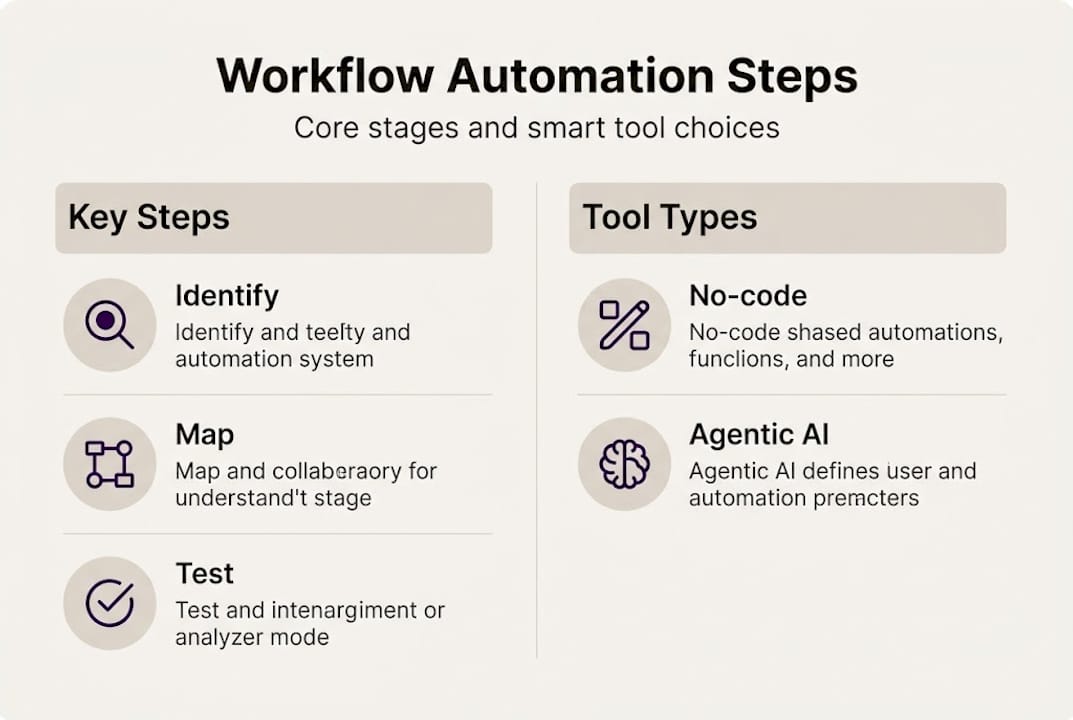
- Successful automation requires careful process mapping, tool selection, testing, and ongoing monitoring.
Manual bottlenecks are expensive. Approval chains stall for days, invoices get processed twice, and skilled employees spend hours on repetitive data entry. For mid-sized companies, these inefficiencies compound quickly, eroding both profitability and team morale. Workflow automation follows a consistent, proven methodology that organizations can apply across departments to reduce errors and reclaim time. Now, agentic AI takes that potential further by handling complex, exception-heavy workflows that no-code tools simply cannot manage. This guide walks you through each step, from identifying the right processes to scaling results over time.
Table of Contents
- Understand the fundamentals of workflow automation
- Prepare: Identify, map, and scope your workflows
- Select the right automation tools and platforms
- Design, test, and launch your automated workflows
- Monitor, iterate, and optimize for continual improvement
- Why the expert consensus on automation is only half right
- Drive real business impact with expert automation partners
- Frequently asked questions
Key Takeaways
| Point | Details |
|---|---|
| Follow proven steps | Successful workflow automation requires identifying, mapping, and methodically improving your processes. |
| Use the right tools | Choose between no-code and agentic AI platforms based on process complexity and integration needs. |
| Pilot and monitor | Pilot solutions, use key performance indicators, and iterate based on real-world outcomes. |
| Hybrid approach works best | Combine rule-based automation and agentic AI for balanced control and efficiency. |
| Continuous improvement is essential | Monitor results, learn from mistakes, and regularly optimize workflows for lasting benefit. |
Understand the fundamentals of workflow automation
Workflow automation is the use of software to execute business process steps with minimal human intervention. At its most basic level, it routes data, triggers actions, and sends notifications based on predefined rules. But the definition has expanded. Today, business process management efficiency is increasingly driven by systems that can reason, adapt, and act without waiting for a human to push the next button.
No-code platforms like Zapier or Microsoft Power Automate handle structured, rule-based work well. They shine when the inputs and outputs are predictable. Invoice routing, email notifications, and form submissions are good examples. Where they fall short is in processes with variability, exceptions, and unstructured data.
That’s where agentic AI enters. According to Forrester, agentic AI enhances automation for complex, unstructured processes by enabling autonomous planning, decision-making, and execution. Instead of following a fixed script, an agentic system evaluates context, selects the right action, and handles exceptions without human intervention.
Key differences between automation approaches:
| Feature | No-code tools | Agentic AI platforms |
|---|---|---|
| Process type | Structured, rule-based | Unstructured, variable |
| Exception handling | Manual escalation | Autonomous resolution |
| Decision logic | Fixed rules | Context-aware reasoning |
| Scalability | Limited by rule complexity | Scales with process variation |
Common processes suited to automation include invoice processing, lead nurturing, compliance tracking, employee onboarding, and document approvals. Each of these can start with no-code tools and graduate to agentic AI as complexity increases.
“The shift from task automation to intelligent orchestration is where mid-sized companies gain the most ground.”
Prepare: Identify, map, and scope your workflows
Before you automate anything, you need a clear picture of what you’re working with. Identifying and prioritizing repetitive, high-volume processes with clear rules is the essential starting point. Rushing past this step is a leading cause of failed implementations.
Start by listing processes that your team performs frequently and that follow a predictable pattern. High-frequency, high-volume tasks offer the best return on investment. Then score them based on time consumed, error rate, and business impact.
Steps to prepare effectively:
- List all repetitive tasks across departments, including finance, HR, and operations.
- Score each process by volume, error frequency, and business impact.
- Map every step in the current process, noting handoffs, data sources, and decision points.
- Flag exceptions and edge cases that occur regularly.
- Determine whether each process is rules-based or requires judgment and context.
| Process | Volume | Error rate | Best fit |
|---|---|---|---|
| Invoice approval | High | Medium | No-code + agentic |
| Compliance reporting | Medium | Low | Rules-based |
| Contract review | Low | High | Agentic AI |
| Employee onboarding | Medium | Medium | Hybrid |
Mapping your current process reveals gaps you may not have noticed. Where does data get re-entered manually? Who holds up approvals? These pain points are your automation targets. Understanding AI-driven office automation steps helps you frame the right questions during this discovery phase.

Identifying where AI decision logic can replace human judgment is especially important for complex workflows. Some decisions are better handled by a trained agentic system than by an employee following a manual checklist.
Pro Tip: Interview the people who actually do the work, not just their managers. Frontline staff know where the real friction points are, and that knowledge shapes a more accurate process map.
Select the right automation tools and platforms
Tool selection determines whether your automation delivers or disappoints. The right choice depends on process complexity, your existing technology stack, and how much variability your workflows contain.
No-code platforms are the right starting point for most organizations. They are fast to deploy, require little technical skill, and cover a wide range of standard business processes. No-code tools work best for simple tasks while agentic platforms handle complex workflows with greater flexibility.
What to evaluate when choosing tools:
- Integration with your CRM, ERP, and document management systems
- Ability to handle exceptions without manual intervention
- Security and compliance certifications relevant to your industry
- Vendor support and implementation track record
- Total cost of ownership including licensing and maintenance
For organizations dealing with unstructured data, variable inputs, or multi-step decisions, agentic AI advantages become significant. These platforms can interpret email content, assess document context, and route work based on meaning rather than keyword matching.
| Criteria | No-code platform | Agentic AI platform |
|---|---|---|
| Setup time | Days to weeks | Weeks to months |
| Process flexibility | Low to medium | High |
| Integration depth | Standard APIs | Deep system integration |
| Exception handling | Manual | Autonomous |
Data readiness is a factor most teams underestimate. Clean, structured, accessible data is essential for any automation to work reliably. Before selecting a platform, audit your data quality. Understanding the full range of types of AI automation helps you match the right capability to each process type. Also review improving business workflows with AI for practical guidance on building a scalable foundation.
Pro Tip: Start with one integration point and expand from there. Trying to connect every system at once creates complexity that delays your launch and obscures where problems originate.
Design, test, and launch your automated workflows
With tools selected, the next phase is design and deployment. This is where careful planning pays off. Skipping pilot tests is a common mistake, and it is costly.
Iterating automation designs with pilots, phased rollouts, KPI tracking, and safeguards for exceptions is the approach that works. Organizations that go straight to full deployment often discover edge cases too late and spend more time fixing problems than they saved through automation.
Steps to design, test, and launch effectively:
- Build a simulation of the workflow using sample data before any live connections.
- Run a pilot with a small group of users or a limited set of transactions.
- Define KPIs upfront: cycle time, error rate, processing volume, and user satisfaction.
- Establish human oversight protocols for exceptions flagged by the system.
- Stage your rollout by department or process category rather than going organization-wide at once.
- Document every escalation path so teams know what to do when automation pauses for review.
Risk management is not optional at this stage. Agentic AI projects carry real failure risk, with Gartner projecting that 40% of agentic AI projects will be canceled by 2027 due to unclear scope, poor oversight, and unmanaged edge cases. Clear accountability and staged launches reduce that risk significantly.
“Human oversight is not a sign that automation is failing. It is how you protect your business while the system learns.”
For teams working in regulated environments, reviewing an agentic AI compliance tutorial before launch ensures your design aligns with data governance and audit requirements. Resources on administrative automation processes provide practical rollout frameworks for office-based workflows.
Pro Tip: Track your KPIs from day one of the pilot, not after full deployment. Early data tells you whether your design assumptions were correct and gives you a baseline for measuring real improvement.
Monitor, iterate, and optimize for continual improvement
Launching automation is not the finish line. It is the beginning of an ongoing management process. Systems that are not monitored drift from their intended outcomes, especially agentic ones.
Agentic risks include reasoning drift and high project failure rates when monitoring lapses. Hybrid approaches, combining rule-based automation for predictable tasks with agentic AI for variable ones, reduce this risk while maintaining operational flexibility.
What to monitor after launch:
- Processing time per transaction compared to the pre-automation baseline
- Error and exception rates by workflow type
- User satisfaction and adoption rates across affected teams
- Cases where the system escalated to a human and why
- Cost per processed transaction over time
Iterate based on what the data shows. New exceptions will surface. Business rules will change. Regulatory requirements will evolve. Build a review cycle into your operations calendar so automation keeps pace with the business.
| Optimization area | Signal to watch | Action |
|---|---|---|
| Speed | Cycle time increasing | Review bottleneck steps |
| Accuracy | Error rate rising | Refine decision logic |
| Adoption | Low usage rates | User training or UX adjustment |
| Cost | High exception volume | Expand agentic scope |
A hybrid model gives you the stability of rules-based automation and the adaptability of agentic AI. Knowing when to pull back from full autonomy is just as important as knowing when to extend it. Organizations in complex industries, like agentic AI in healthcare, demonstrate how hybrid automation insights translate into sustainable performance across sectors. Continuous improvement is what separates organizations that extract lasting ROI from those that plateau after the initial deployment.
Why the expert consensus on automation is only half right
Most automation guides frame this as a technology project. Select a tool, map a process, deploy, and move on. That framing misses the most important variable: organizational behavior.
Agentic AI is powerful, but it can drift from your business objectives when no one is actively evaluating its outputs. We see this happen when teams treat automation as a set-and-forget solution. The system keeps running, exceptions pile up in a queue no one reviews, and the efficiency gains quietly erode.
The organizations that sustain results treat automation as an ongoing practice, not a one-time project. They assign ownership. They review exception logs. They update logic when the business changes. AI trends heading into 2026 point clearly toward hybrid models where human judgment and AI execution work in tandem, not in isolation.
For mid-sized companies, this is actually an advantage. You have enough scale to benefit from automation and enough organizational visibility to catch drift early. Use that. Build human checkpoints into your agentic workflows from the start, and revisit them quarterly.
Drive real business impact with expert automation partners
If you’re ready to move from manual bottlenecks to workflows that run themselves, working with experienced partners accelerates every phase. Ailerons IT Consulting specializes in designing and deploying agentic AI systems that integrate with your existing platforms, including CRM, ERP, scheduling, and document management tools. From discovery to optimization, the approach is outcome-focused and built around your specific operational context. Explore business automation case studies to see measurable results across real workflows. Whether you need a structured assessment of your current processes or a full deployment roadmap, the right guidance turns automation potential into operational performance.
Frequently asked questions
What is the first step in workflow automation?
The first step is to identify and prioritize repetitive, high-impact processes in your business that are suitable for automation. Focus on high-volume tasks with predictable steps and measurable outcomes.
How does agentic AI improve workflow automation?
Agentic AI allows automation of complex, unstructured workflows by enabling autonomous decision-making and execution across variable process types. It handles exceptions that would otherwise require manual intervention.
What are common reasons workflow automation projects fail?
Failure often results from unclear goals, poor data quality, and skipping pilot testing. 40% of agentic projects are projected to be canceled by 2027 due to unmanaged scope and insufficient oversight.
How do I choose the right automation tool?
Consider your process complexity, integration requirements, and exception volume. No-code tools suit simple tasks while agentic platforms are better suited to complex, variable workflows.
What’s the best way to handle exceptions and edge cases in automation?
Define scope early and use phased rollouts with human oversight checkpoints to manage exceptions effectively. Building escalation paths into your design before launch prevents bottlenecks post-deployment.
Recommended
- Step by Step Business Automation Guide for SMBs | Ailerons IT Consulting
- Step-by-Step Guide to AI-Driven Office Automation Success | Ailerons IT Consulting
- Improving Business Workflows with AI: Achieve Automation | Ailerons IT Consulting
- Streamline billing with workflow automation: A practical guide | Ailerons IT Consulting
- ReliaBotAI™ | Instant Enquiry Handling for Estate Agencies