

TL;DR:
- Secure-by-design integrates security from the initial development of agentic AI systems to prevent vulnerabilities.
- Lifecycle frameworks like NIST AI RMF and SAIL guide continuous governance and risk management.
- Practical mitigation includes threat modeling, least privilege access, audit logs, and ongoing compliance checks.
Most enterprises treat security as a final checkpoint before deployment. You build the system, then you lock it down. With traditional software, that approach carries risk. With agentic AI, it can be a serious liability. Agentic AI systems reason, plan, and execute multi-step tasks autonomously across business operations. They interact with live data, connected tools, and sensitive workflows in ways that static software never did. That creates an entirely new category of exposure. This article lays out a practical framework for building secure, compliant agentic AI from the ground up, covering lifecycle governance, key frameworks, real threat categories, and actionable steps your teams can apply today.
Table of Contents
- Understanding secure-by-design for agentic AI
- Mapping compliance and security frameworks for AI
- Agentic AI risks: Threats and mitigation strategies
- Integrating security and compliance into agentic AI workflows
- Our perspective: Secure AI isn’t just technical—it’s operationally strategic
- Ready to deploy secure, compliant agentic AI? Explore practical solutions
- Frequently asked questions
Key Takeaways
| Point | Details |
|---|---|
| Start with secure-by-design | Integrate security and compliance at every phase, not just after deployment. |
| Lifecycle frameworks matter | Use SAIL, NIST, OWASP, and ISO to map risks and proactively address agentic AI threats. |
| Mitigation is continuous | Threat modeling and least privilege controls should evolve with your AI workflows. |
| Compliance boosts trust | Embedding compliance not only prevents penalties, but also builds stakeholder confidence. |
Understanding secure-by-design for agentic AI
Secure-by-design is not a product feature or a compliance checkbox. It is a development philosophy that integrates security requirements from the very first design decision, rather than applying controls after the system is built. For agentic AI, this matters more than it does for conventional software.
Traditional cybersecurity focuses on the CIA triad: confidentiality, integrity, and availability. That model works well for systems with predictable inputs and outputs. Agentic AI does not behave that way. It reasons across context, calls external tools, interprets natural language instructions, and makes decisions with limited human oversight. The CIA triad alone is insufficient for these probabilistic, adaptive systems. You need MLSecOps and DevSecOps extensions that account for adversarial machine learning, model drift, and emergent behavior.
Two new threat categories stand out for agentic systems. Prompt injection occurs when malicious input manipulates an AI agent’s instructions, causing it to take unintended actions. Goal hijacking happens when an agent’s objective is redirected mid-task, either by corrupted data or a compromised tool call. Both are difficult to detect using conventional monitoring.
The answer is lifecycle security governance, which integrates security from inception using frameworks like NIST AI RMF and SAIL, prioritizing ongoing oversight over bolt-on measures. Understanding AI compliance risks specific to agentic systems is the starting point for any deployment plan.
Here are the core principles of secure-by-design for agentic AI:
- Threat model early. Identify attack surfaces before writing a single line of code.
- Least privilege by default. Agents should only access what they need for each specific task.
- Immutable audit logs. Every agent action must be traceable and tamper-proof.
- Human-in-the-loop checkpoints. High-risk decisions require human confirmation before execution.
- Supply chain validation. Third-party models and tools must be vetted and monitored continuously.
Secure-by-design is not about adding more controls. It is about building systems where security is structurally impossible to skip.
Your AI integration checklist should reflect these principles before any agentic system touches production data.
Mapping compliance and security frameworks for AI
With secure-by-design defined, it is important to understand how established frameworks structure compliance and security across the AI lifecycle. Four frameworks are most relevant for enterprise agentic AI deployments in 2026.
NIST AI RMF provides a voluntary but widely adopted risk management structure. It organizes AI risk into four functions: Govern, Map, Measure, and Manage. It is framework-agnostic, meaning it works alongside sector-specific regulations.
SAIL (Secure AI Lifecycle) is more granular. It maps 70+ risks across seven lifecycle phases, complementing NIST, OWASP, and ISO 42001 with specific security tasks tied to each phase. This makes it especially practical for teams building agentic systems.
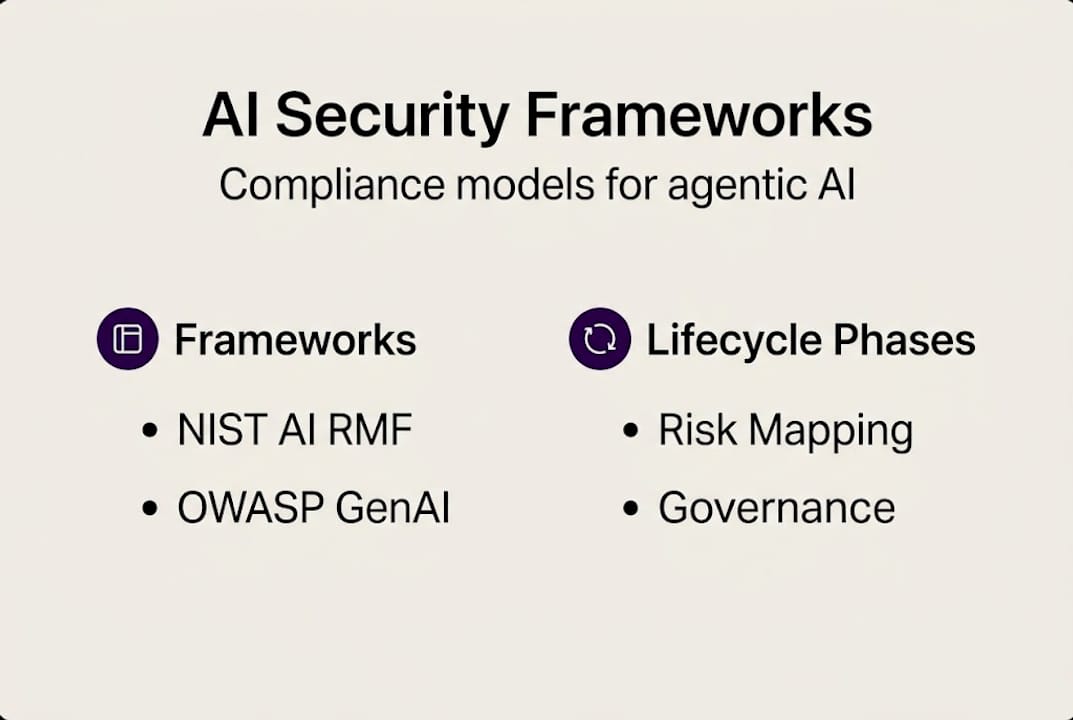
OWASP GenAI publishes the Top 10 AI risks for large language models and generative AI, including a new Agentic AI Top 10 list. It is the most accessible starting point for development teams.
ISO 42001 is the international standard for AI management systems. It provides certification-grade governance requirements, useful for enterprises with global regulatory obligations.
| Framework | Primary focus | Best for | Agentic AI coverage |
|---|---|---|---|
| NIST AI RMF | Risk governance | Enterprise-wide AI programs | Strong |
| SAIL | Lifecycle security tasks | Development and ops teams | Very strong |
| OWASP GenAI | Application-level threats | Dev and security teams | Strong |
| ISO 42001 | Management system certification | Regulated industries | Moderate |
Here is how these frameworks map to lifecycle phases:
- Requirements and design. Apply NIST AI RMF Govern function; document threat model using SAIL Phase 1.
- Data preparation. Use SAIL Phase 2 and 3 for data provenance and poisoning controls.
- Model development. Apply OWASP Top 10 LLM controls; validate against ISO 42001 requirements.
- Integration and testing. Run adversarial testing per SAIL Phase 5; validate supply chain components.
- Deployment. Apply NIST Manage function; configure monitoring per SAIL Phase 6.
- Operations and monitoring. Continuous compliance per ISO 42001; incident response per NIST.
Reviewing AI security standards across regulated industries gives you a clear picture of where these frameworks overlap and where gaps remain. Your automation checklist should map directly to these phases before any system goes live.
Agentic AI risks: Threats and mitigation strategies
Frameworks are useful, but real-world agentic AI risks demand practical mitigation. The threat landscape for agentic systems is meaningfully different from conventional software vulnerabilities.

The OWASP Agentic AI Top 10 identifies risks including prompt injection, supply chain vulnerabilities, excessive agency, goal hijacking, and tool misuse as the most critical categories for enterprise deployments. Each deserves a specific design response.
Key agentic AI threat categories:
- Prompt injection. Malicious content in data or user input redirects agent behavior. Mitigation: input sanitization, instruction isolation, and output validation.
- Tool misuse. An agent calls an integrated tool in an unintended way, causing data leakage or unauthorized actions. Mitigation: strict tool permission scoping and call logging.
- Excessive agency. An agent takes actions beyond its intended scope because permissions were set too broadly. Mitigation: least privilege access and task-scoped authorization.
- Goal hijacking. An agent’s objective is manipulated mid-execution through corrupted context or adversarial input. Mitigation: goal state validation checkpoints and anomaly detection.
- Supply chain vulnerabilities. Third-party models, plugins, or APIs introduce unvetted risk. Mitigation: vendor assessment, software bill of materials (SBOM), and continuous monitoring.
Organizations deploying agentic AI in compliance-sensitive workflows face compounded risk because agents often have access to sensitive records, approval queues, and external communications simultaneously.
Pro Tip: Run a dedicated threat modeling session for every agentic workflow before deployment. Map each tool call, data source, and decision point as a potential attack surface. This single step catches more design-level vulnerabilities than post-deployment audits.
For teams building process automation with agentic AI, the goal is not to eliminate all risk. It is to design systems where risk is visible, bounded, and actively managed. That requires threat modeling to be a recurring practice, not a one-time exercise.
Integrating security and compliance into agentic AI workflows
Mitigation strategies are best put into practice through lifecycle integration with real office workflows. The four-phase model of Secure Design, Development, Deployment, and Operation provides a practical structure for this.
Lifecycle security methodology integrates threat modeling, least privilege, and supply chain security from the outset, rather than treating them as post-build additions. For office workflows specifically, this means mapping security controls to each stage where the agent touches business data or executes actions.
| Workflow stage | Security controls | Compliance actions |
|---|---|---|
| Design | Threat modeling, data flow mapping | Risk register, regulatory mapping |
| Development | Secure coding, dependency scanning | OWASP controls, SAIL phase tasks |
| Testing | Adversarial testing, access review | Audit trail validation |
| Deployment | Least privilege config, secrets management | Change management sign-off |
| Operations | Continuous monitoring, anomaly alerts | Periodic compliance review |
Here are the practical steps for operationalizing compliance in agentic systems:
- Define agent scope explicitly. Document every tool, data source, and action the agent is permitted to take before build begins.
- Apply role-based access at the agent level. Treat each agent as a distinct identity with its own permissions, not a shared service account.
- Build audit logging into the architecture. Log every agent decision, tool call, and data access event from day one.
- Establish escalation paths. Define which decisions require human review and build those checkpoints into the workflow logic.
- Schedule compliance reviews. Set recurring intervals to reassess agent behavior against current regulatory requirements.
For teams managing AI-driven office automation, these steps translate directly into deployment checklists and change management procedures. Improving business workflows with AI is most effective when security and compliance are built into the workflow design, not added to it afterward.
Pro Tip: Assign each agentic workflow a designated data owner and a security reviewer before it reaches production. Clear ownership prevents the accountability gaps that lead to compliance failures.
Our perspective: Secure AI isn’t just technical—it’s operationally strategic
The industry tends to frame AI security as a technical problem. Patch the vulnerabilities, run the audits, check the boxes. That framing is too narrow, and it leads to a predictable failure mode: organizations pass their initial compliance review and then let governance drift as the system evolves.
What we see in practice is that the enterprises with the most resilient agentic AI programs treat security and compliance as ongoing operational disciplines, not project milestones. They build governance into their change management processes. They review agent behavior as part of regular operations reviews, not just security audits. They treat compliance as a continuous signal, not a periodic certification.
This shift matters because agentic AI systems change over time. Models update, integrations expand, data flows shift. A system that was compliant at launch may not be compliant six months later without active oversight. The organizations that understand this are building operational AI programs that scale securely. The ones that treat security as a one-time technical task are accumulating invisible risk.
Lifecycle governance is not overhead. It is the mechanism that keeps agentic AI trustworthy as your business evolves.
Ready to deploy secure, compliant agentic AI? Explore practical solutions
Building trustworthy agentic AI requires more than good intentions. It requires structured design, the right frameworks, and implementation experience across real enterprise environments. At Ailerons.ai, we specialize in designing and deploying agentic AI systems that are secure, compliant, and built for operational scale. You can review secure AI case studies to see how these principles translate into working systems across office and operational workflows. If you are ready to move from planning to deployment, our team can help you map the right framework to your specific environment and compliance requirements.
Frequently asked questions
What are agentic AI risks and how can enterprises mitigate them?
Agentic AI risks include prompt injection, tool misuse, excessive agency, and supply chain vulnerabilities. Mitigation starts with lifecycle security design, proactive threat modeling, and controls like least privilege access from the outset.
Why is secure-by-design essential for compliant enterprise AI?
Secure-by-design ensures security and compliance are integrated from the start, not added after deployment. This aligns with NIST AI RMF and SAIL standards, which prioritize lifecycle governance for trustworthy AI systems.
How do lifecycle frameworks like SAIL and NIST AI RMF help secure agentic AI?
Lifecycle frameworks break down security tasks by phase, with SAIL mapping 70+ risks across seven phases so teams can address compliance requirements at design, development, and operation stages.
What practical steps should IT leaders take for secure agentic AI in office workflows?
Start with threat modeling, apply least privilege at the agent identity level, and map security controls to each workflow stage. Use compliance checklists tied to lifecycle phases for ongoing assurance.
Recommended
- Compliance in AI Automation: Reducing Risk and Ensuring Trust | Ailerons IT Consulting
- Secure AI Systems for Compliance: Minimizing Regulatory Risks | Ailerons IT Consulting
- Process Automation Tutorial for Agentic AI in Compliance Workflows | Ailerons IT Consulting
- Future of Operational AI 2026: Agentic Systems Transforming Work | Ailerons IT Consulting