

TL;DR:
- Most organizations wrongly assume AI security only involves protecting the model, but the entire AI infrastructure must be secured. Effective AI security requires embedding controls from the start, limiting tool permissions, maintaining asset inventories, and fostering cross-team governance. Focusing solely on models overlooks deeper risks like privileged access exploits, data exfiltration, and shadow AI, which necessitate a comprehensive, layered security approach.
Most business leaders assume AI integration security means protecting the model itself. Lock down the API, add a content filter, and you’re covered. That assumption is wrong, and it’s costing organizations dearly. Secure AI integration explained properly covers a much wider surface: the infrastructure your AI touches, the tools it can execute, the data it processes, and the governance structures that hold everything together. This guide breaks down that full picture in practical terms, so you can make informed decisions about how your organization builds and deploys AI.
Table of Contents
- Key takeaways
- Secure AI integration explained: the real threat landscape
- Architectural principles that make AI integration secure
- Visibility, governance, and continuous testing
- Balancing efficiency and security in your AI workflows
- What most leaders miss about AI integration security
- How Ailerons supports secure AI integration
- FAQ
Key takeaways
| Point | Details |
|---|---|
| Model security is not enough | AI agents interact with real systems and data, creating attack surfaces far beyond the model layer. |
| Embed security from day one | Retrofitting security after deployment expands compliance scope and significantly increases data exposure risk. |
| Apply least privilege to AI tools | Restrict what AI agents can access and execute to limit the blast radius of any compromise. |
| Maintain a living AI asset inventory | Unmanaged AI endpoints are the fastest-growing source of shadow risk in enterprise environments. |
| Governance requires cross-functional alignment | Legal, security, and product teams must share ownership of AI risk to make controls stick. |
Secure AI integration explained: the real threat landscape
AI integration security is not an abstract concern. It’s a category of concrete, documented vulnerabilities that expand every time your organization connects an AI system to another business tool.
The most discussed risk is prompt injection. This is when malicious content in user input or external data manipulates an AI model into ignoring its instructions or performing unintended actions. But prompt injection is only the entry point. The more serious risk sits one layer deeper.
AI agent frameworks granting file system and shell access create privileged execution environments. When an AI agent can read files, write to databases, call APIs, or execute shell commands, it becomes a high-value target. A successful attack does not just extract a conversation. It can execute arbitrary code, move laterally across systems, or exfiltrate customer records at scale.
“Prompt security alone cannot prevent arbitrary code execution when AI agents have privileged system access. Architectural boundaries must be strictly enforced.”
The CVE record for major AI frameworks tells the same story repeatedly. Command injection vulnerabilities in widely used agent frameworks have demonstrated what security researchers call trust boundary collapse. The AI layer is trusted to act on behalf of the organization, and attackers exploit that trust.
The business impact of insecure AI integration extends across three dimensions:
- Data exposure: Customer records, financial data, and proprietary information flow through AI systems. Without proper controls, that data can be exfiltrated through model outputs, tool calls, or misconfigured integrations.
- Compliance liability: Replicating and storing customer data in AI systems significantly increases compliance requirements under SOC 2, HIPAA, and GDPR. Many organizations discover this only after a breach or audit.
- Operational disruption: A compromised AI agent embedded in billing, scheduling, or document workflows can corrupt data integrity across connected systems, often silently.
Understanding these risks of AI integration at the architecture level is the starting point for building defenses that actually hold.
Architectural principles that make AI integration secure
Security built into the design of an AI integration holds. Security bolted on after deployment rarely does. This is the single most important principle for any business leader to carry into conversations with their technical teams.
Here is what sound architectural practice looks like in practical terms:
- Minimize stored sensitive data. Every copy of sensitive data you allow an AI system to retain is a liability. Design integrations to pass data in real-time rather than store it in AI memory or logs. Use tokenization and masking where retention is unavoidable.
- Deploy AI firewalls and gateways. AI firewalls and inline gateways provide real-time inspection to block prompt injection and prevent unauthorized data exfiltration. These tools give your security team visibility into sensitive data usage that was previously invisible.
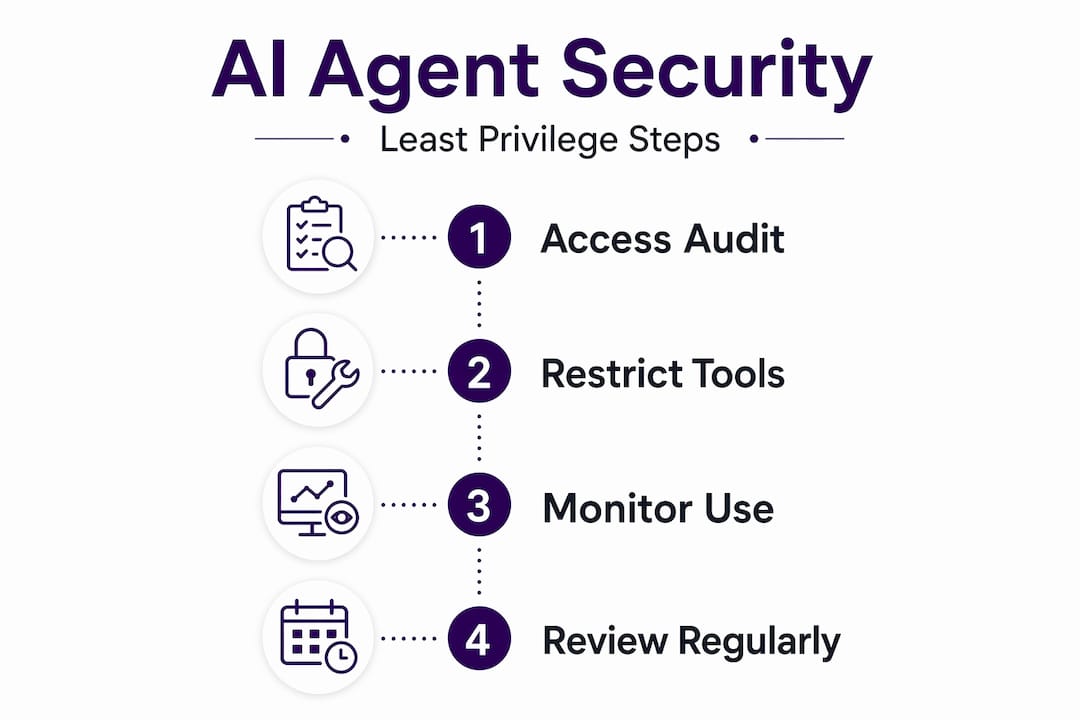
- Enforce least privilege for every tool permission. An AI agent that manages calendar scheduling does not need access to the payroll database. Map the minimum permissions required for each task and enforce them at the system level, not the prompt level.
- Build layered guardrails. Effective guardrails combine redaction, policy enforcement, and tool authorization to enforce least privilege and prevent unauthorized actions. Apply controls at input (what the AI receives), at output (what the AI returns), and at runtime (what the AI is permitted to execute).
- Use content-free audit trails. Logging synthetic, masked, or hashed metadata allows you to evidence security controls according to NIST AI RMF and ISO 42001 frameworks without exposing sensitive prompts or data in your audit records.
Pro Tip: When evaluating any AI integration vendor, ask specifically how they implement tool authorization at runtime. If the answer is “we rely on the model’s instructions,” that is a gap worth addressing before deployment.
These principles support what security professionals call secure-by-default architecture. The system is configured to fail safely, not permissively. For more on how these principles apply across compliance frameworks, the Ailerons team has detailed guidance on secure AI system design.
Visibility, governance, and continuous testing
You cannot secure what you cannot see. This is where many organizations with good intentions still fall short.
The first practical step is building and maintaining an AI asset inventory. That means knowing every AI endpoint, integration, and model your organization uses, including tools that individual departments have adopted without formal approval. Tools like Azure Resource Graph and Microsoft Defender for Cloud enable automated discovery of unmanaged AI components, which is the only realistic way to keep up with the pace of adoption.

Shadow AI is a specific and growing problem. When employees use unsanctioned AI tools to process work data, those tools fall outside your security controls entirely. The data those tools handle, sometimes including customer records or confidential financials, is governed by the vendor’s policies, not yours.
The table below summarizes the core elements of an effective AI security governance program:
| Governance element | Purpose | How to implement |
|---|---|---|
| AI asset inventory | Identify all AI touchpoints | Automated discovery tools with regular audits |
| Continuous red teaming | Test for prompt injection and model abuse | Scheduled adversarial simulation by internal or external teams |
| Anomaly detection | Catch unusual AI behavior in production | Monitor tool call patterns, output volumes, and access logs |
| Incident response plan | Minimize damage when something goes wrong | Define AI-specific runbooks and escalation paths |
| Cross-functional risk register | Align legal, security, and product on risk ownership | Shared documentation reviewed quarterly |
Cross-functional collaboration among legal, security, and product is not optional for effective AI risk governance. Shared risk registers improve accountability and ensure that security controls are actually enforced rather than documented and forgotten.
Secure-by-default architectures, automated review gates, and red teaming improve the resilience of AI integrations over time. Red teaming in the AI context means deliberately trying to manipulate your own AI systems through adversarial prompts and edge-case inputs, before an attacker does it for you.
Balancing efficiency and security in your AI workflows
The goal is not to make AI integration so restricted it becomes useless. It’s to enable the operational benefits of AI while keeping exposure within acceptable bounds. These two objectives are compatible when you approach integration with a clear methodology.
Practical secure integration strategies for business leaders include:
- Risk-based prioritization. Not every AI workflow carries equal risk. A scheduling assistant has a different exposure profile than an AI agent with access to your ERP system. Prioritize security investment where the data sensitivity and system access are highest.
- Zero Trust for AI APIs. Security must be a priority from the start during integration projects. Apply Zero Trust principles: every AI request is authenticated, every tool call is authorized, and no implicit trust exists between connected systems.
- Employee training on shadow AI. Most employees adopt unsanctioned tools out of convenience, not malice. A brief, practical training program that explains the risks and offers approved alternatives reduces shadow AI adoption significantly.
- Software supply chain hygiene. The AI frameworks and libraries you use carry their own vulnerabilities. Maintain a current inventory of AI-related dependencies, apply patches promptly, and vet new frameworks before they reach production.
- Use monitoring data to improve. Audit logs and anomaly alerts are not just for incident response. Review them regularly to identify integration patterns that create unnecessary risk and adjust configurations accordingly.
Pro Tip: Before deploying any AI agent with tool-calling capabilities, conduct a permissions audit. List every system the agent can reach and every action it can take. Remove any permission that is not required for the defined workflow.
For organizations working through an AI integration project, the AI integration checklist from Ailerons covers the stepwise considerations that prevent the most common security gaps from being missed. You can also explore enterprise IT security approaches for broader context on where AI security fits within enterprise IT strategy.
What most leaders miss about AI integration security
I’ve worked through enough AI integration projects to recognize a pattern. Organizations focus heavily on model selection and capability. They spend weeks evaluating which AI vendor to use, what the model can do, and how to fine-tune outputs. Then they spend a fraction of that time on how the model connects to everything else.
That imbalance is the core problem. The model is often the safest part of the stack. The integration layer, the APIs, the tool permissions, the data pipelines, the identity controls, is where the real exposure lives.
What I’ve seen repeatedly is that AI agent components are treated like any other business application, but they operate with a fundamentally different risk profile. A traditional application does what its code says. An AI agent reasons and plans, which means it can take paths its designers did not anticipate. That unpredictability, combined with privileged system access, demands the same security rigor you’d apply to critical infrastructure.
My practical advice: treat your AI agent layer the way you’d treat your identity provider or your core network. Not as a tool. As infrastructure. The organizations that get this right early spend less time on incident response later.
The governance piece matters just as much. I’ve watched security controls get documented thoroughly and then bypassed within months because no one owned the ongoing enforcement. Assign clear ownership. Review it regularly. AI security is not a project with an end date.
— Sam
How Ailerons supports secure AI integration
Ailerons works with business leaders to design and deploy agentic AI systems with security built into the architecture from the start. That means assessing your current AI integrations for exposure, defining least-privilege access models for AI tool permissions, and implementing the governance structures that keep security controls active over time.
Explore real-world deployment examples to see how organizations across industries have implemented secure AI workflows that improve operational efficiency without increasing risk. When you’re ready to discuss what secure AI integration looks like for your specific environment, the Ailerons consulting team is available to walk through your current setup and identify the highest-priority gaps.
FAQ
What does secure AI integration mean?
Secure AI integration means designing AI systems so that every component, including the model, the APIs, the tools the AI can call, and the data it processes, operates within defined security boundaries with monitored access and enforced permissions.
What are the biggest risks of AI integration?
The biggest risks include prompt injection attacks, unauthorized tool execution, data exfiltration through model outputs, and shadow AI use that bypasses security controls entirely.
How does least privilege apply to AI agents?
Least privilege for AI agents means restricting each agent to only the system access and tool permissions required for its specific workflow, reducing the potential damage if the agent is compromised or manipulated.
What is an AI asset inventory and why does it matter?
An AI asset inventory is a catalog of every AI system, model, integration, and endpoint your organization uses. Maintaining it with automated discovery tools reduces shadow AI risk and gives security teams the visibility needed to enforce controls.
How do content-free audit logs support AI compliance?
Content-free audit logs record metadata and cryptographic hashes of AI interactions rather than the raw data itself, allowing organizations to demonstrate compliance with frameworks like NIST AI RMF and ISO 42001 without exposing sensitive information in audit records.
Recommended
- What is secure AI deployment: A guide for business leaders | Ailerons
- 6 Steps to an Effective AI Integration Checklist for Business Operations | Ailerons IT Consulting
- Secure AI Systems for Compliance: Minimizing Regulatory Risks | Ailerons IT Consulting
- Secure, Compliant AI Design: Building Trustworthy Agentic Systems | Ailerons IT Consulting