

TL;DR:
- Deploying AI in real estate requires a disciplined governance approach due to sensitive data and decision-making risks. Organizations must implement both technical and governance controls, maintain thorough documentation, and continuously monitor AI workflows to ensure compliance. Relying solely on vendor certifications is insufficient; proactive internal oversight and regular audits are essential for regulatory accountability.
Most real estate and property management teams assume that deploying AI for workflow automation is a straightforward technology upgrade. Pick a reputable vendor, enable some integrations, and watch the efficiency gains roll in. The reality is far more demanding. Real estate data is among the most sensitive in any industry, agentic AI introduces decision-making risks that traditional software never did, and regulators are actively developing frameworks that hold organizations accountable for every automated action their systems take. Getting this right requires a structured, disciplined approach from the start.
Table of Contents
- Why secure AI deployment matters in real estate
- Key security and governance frameworks for real estate AI
- Building and maintaining secure AI workflows and document management
- Common pitfalls and how to avoid them
- A fresh perspective: What most real estate teams miss about secure AI deployment
- Next steps: Partner with experts in secure AI deployment
- Frequently asked questions
Key Takeaways
| Point | Details |
|---|---|
| Control every AI agent | Extend guardrails and privilege controls to every AI component to avoid unauthorized actions. |
| Prove compliance readiness | Maintain documentation, audit logs, and inventories to satisfy regulators on demand. |
| Go beyond vendor checks | Implement your own documented controls—certifications alone are never sufficient. |
| Test and adapt workflows | Regularly audit and update your AI-driven processes for secure, ongoing operations. |
Why secure AI deployment matters in real estate
Real estate transactions involve dense concentrations of sensitive personal and financial data. Buyer credit profiles, title records, loan origination details, lease agreements, and property ownership histories all flow through your systems daily. This makes your organization a high-value target, and it means a single misconfigured automation can expose far more than a typical data breach would.
Agentic AI compounds that risk. Unlike a simple form-processing bot, an agentic system reasons through tasks, makes decisions, and takes actions across multiple platforms. It might update a CRM record, generate a compliance document, trigger a payment approval, and email a counterparty, all in a single orchestrated sequence. Each of those steps carries its own risk surface. Secure AI systems compliance requires thinking about the entire chain of decisions, not just the data the agent touches.
Traditional application security was designed to protect systems from unauthorized human access. It was not built to control what an autonomous software agent is allowed to decide or do. This gap is significant. Forrester’s AEGIS framework addresses it directly, requiring that enterprise guardrails extend Zero Trust principles beyond human users to govern agent access, decision scope, and operational containment through identity lifecycle governance and privilege controls.
Regulators are not waiting for the industry to self-regulate. Fannie Mae’s AI/ML governance framework requires mortgage and servicing organizations to maintain a documented governance program with ongoing monitoring, controls, and audits. The expectation is not that you deployed a compliant tool. The expectation is that you actively govern how that tool operates.
Workflow automation also increases your exposure to audit scrutiny. Every automated step is a potential finding in a compliance review. If your AI workflow lacks clear documentation, access logs, and decision records, you cannot demonstrate what happened or why. Compliance in AI automation operates on the same principle across regulated industries: evidence of control matters as much as the control itself.
Key risks introduced by agentic AI in real estate automation include:
- Decision authority without human review. Agents can approve, reject, or escalate items without a human in the loop unless explicit constraints are configured.
- Cross-platform data exposure. An agent with broad integration access can inadvertently expose data to systems where it does not belong.
- Unlogged actions. Without telemetry at every step, you cannot reconstruct what an agent did or why.
- Vendor dependency without internal oversight. Relying on a vendor’s security posture without your own controls leaves you unable to prove compliance independently.
Key security and governance frameworks for real estate AI
Understanding the risk is the first step. The second is knowing which frameworks give you a reliable structure to act on. Two categories of control matter here: technical controls and governance controls. They are not interchangeable, and you need both.
Forrester’s AEGIS framework is the most directly applicable technical reference for agentic AI. It calls for least-agency enforcement, meaning AI agents should only be granted the minimum access and decision rights needed to complete their assigned tasks. Practically, this means API gateways and access brokers that enforce what an agent can call, and Identity and Access Management (IAM) components that handle agent lifecycle governance, including provisioning, deprovisioning, and ongoing audit trails.
The following table compares technical and governance requirements side by side, which helps operational teams understand where their gaps are most likely to appear:
| Control category | Examples | Primary purpose |
|---|---|---|
| Technical controls | Role-based access, API gateways, encryption, audit logging | Limit what the agent can access and record what it does |
| Governance controls | Documented roles, policy documentation, change management records | Prove accountability and enable regulator review |
| Monitoring and telemetry | Real-time alerts, activity logs, anomaly detection | Detect and respond to unexpected agent behavior |
| Vendor oversight | Periodic vendor audits, contractual obligations, review cycles | Ensure third-party tools meet your internal standards |
GSE AI governance rules reinforce this split explicitly. Technical controls like access controls, audit trails, and encryption are necessary but not sufficient. Governance controls, including documented roles, explicit accountability assignments, and auditability requirements, must accompany them. Vendor assurances alone do not satisfy regulator expectations.
AI compliance in business across regulated contexts follows a consistent pattern. Organizations that pass audits are not those with the most advanced technology. They are the ones with the clearest paper trail showing who approved what, when, and under what authority.
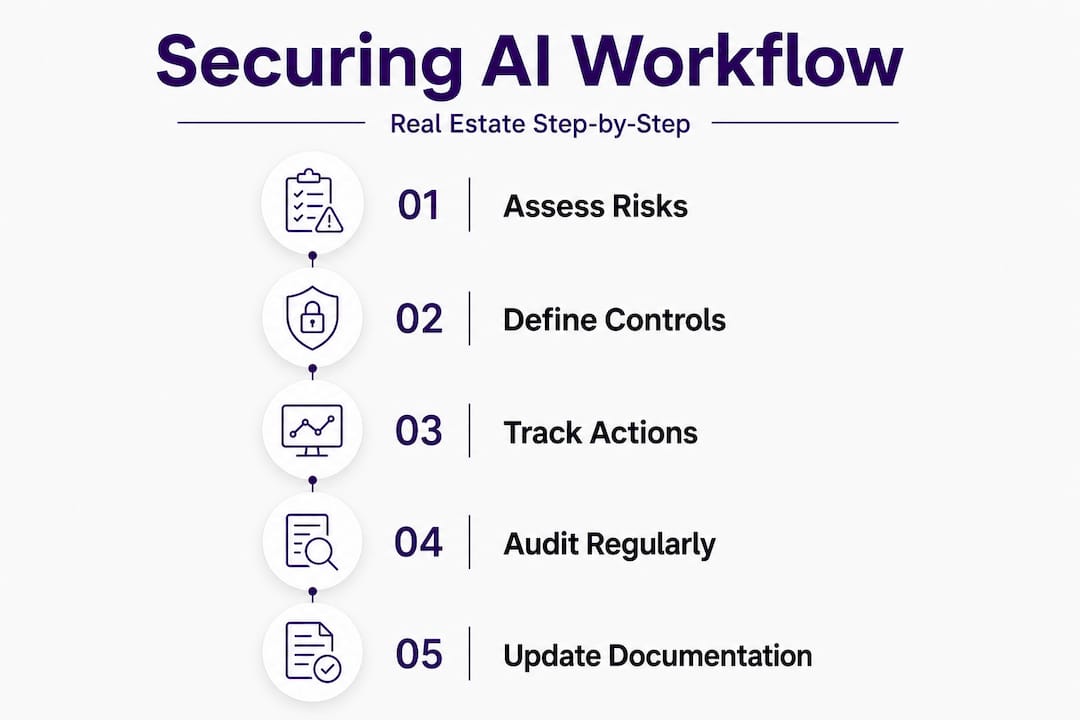
To structure your governance program, follow these steps in order:
- Inventory every AI tool in use. Include purpose, data access scope, and integration points. This is your baseline.
- Assign documented ownership. Every AI system needs a named internal owner who is accountable for its behavior and controls.
- Define decision boundaries. Document what each AI agent is permitted to decide on its own versus what requires human approval.
- Implement IAM at the agent level. Provision each agent with its own identity, apply least-privilege access, and set up deprovisioning processes.
- Build audit trail requirements into every integration. Every data exchange and decision action should produce a timestamped, retrievable log.
- Schedule ongoing review cycles. Governance is not a one-time exercise. Set quarterly reviews at minimum.
Pro Tip: If your governance documentation cannot answer the question “what did this agent do on a specific date, and who authorized it to have that capability?”, you are not ready for a regulatory audit.
Building and maintaining secure AI workflows and document management
With a governance structure in place, the next challenge is applying it to real workflows. Document management is the most common AI automation use case in real estate, and it is also one of the highest-risk areas because documents often contain personally identifiable information, financial data, and legally binding terms.
Fannie Mae’s AI/ML governance requirements make clear that mortgage and servicing organizations must back every automated process with documented controls, ongoing monitoring, and regular audits. The same logic applies to property management operations automating lease processing, maintenance records, or tenant communications.

The following table shows typical compliance controls mapped to workflow stages in a document-heavy real estate process:
| Workflow stage | AI action | Required control |
|---|---|---|
| Identity verification | Agent validates a counterparty record | IAM verification, access log entry |
| Document intake | Agent classifies and routes incoming documents | Data classification policy, intake log |
| Data extraction | Agent reads and pulls key fields from a lease or mortgage | Encryption in transit, field-level audit trail |
| Approval routing | Agent sends document to appropriate reviewer | Role-based routing rules, decision log |
| Record update | Agent updates CRM or property management system | Change log, reconciliation check |
| Archiving | Agent stores final document | Retention policy enforcement, access restriction |
Designing these controls into your workflow from the beginning is far less costly than retrofitting them after deployment. The types of AI automation that work best in real estate share one common trait: they are built with constraint logic at every decision point, not just at the input and output stages.
Steps for secure AI-driven document management:
- Classify documents at intake. Every document that enters an AI workflow should be labeled by sensitivity level before any agent processes it.
- Apply field-level encryption. Sensitive fields such as Social Security numbers, financial account details, and signature data should be encrypted individually, not just at the file level.
- Restrict agent write access. Agents should be able to read and extract data from documents without having default write access to underlying records systems.
- Log every extraction and update. Each time an agent reads or modifies a document or record, a timestamped log entry should be created and stored separately from the operational system.
- Require human review for high-stakes outputs. Any document that triggers a financial transaction, legal commitment, or regulatory submission should require a human sign-off before the agent proceeds.
- Test your controls before go-live. Run your automated workflow in a sandbox environment with simulated compliance scenarios before deploying it against real data.
Pro Tip: Regularly testing controls through internal audits and red-team exercises, where someone actively tries to find gaps in your agent’s decision boundaries, reveals vulnerabilities that documentation reviews miss. Schedule these at least twice a year and document the results.
AI compliance tips for regulated professional services translate directly to real estate: the moment you automate a decision that was previously made by a licensed professional or governed by regulation, you inherit accountability for proving that automation was sound.
Common pitfalls and how to avoid them
Even organizations that understand the frameworks well tend to stumble on implementation. These are the most frequent errors that real estate teams make when deploying AI for workflow automation, along with concrete strategies for avoiding them.
The most common mistake is treating security as a vendor-selection problem. Freddie Mac’s Selling Guide now mandates AI policies explicitly because regulators recognize that organizations routinely assume SOC 2 or ISO certification from a vendor substitutes for internal governance. It does not. You are accountable for what your AI systems do, regardless of who built the underlying technology.
GSE AI governance rules are explicit on this point. Both technical and governance controls must be internally owned and documented. Vendor assurances are a starting point, not a compliance strategy.
The most actionable steps to avoid common pitfalls:
- Audit your vendor relationships. Review vendor contracts to confirm what data they can access, how they log agent activity, and what they will provide in a regulator audit scenario.
- Restrict agentic decision rights explicitly. Use decision logic automation principles to define exactly which decisions an agent can make autonomously and which require human escalation. Put this in writing.
- Build a centralized AI tool inventory. Maintain a living document that lists every AI system in use, its data scope, its owner, and its current control status. Update it whenever a new tool is adopted or an existing one is modified.
- Validate audit trails with spot checks. Do not assume your logging is working. Periodically pull logs from your AI systems and verify they contain what they should. Missing logs are a compliance finding waiting to happen.
- Treat ongoing monitoring as a core operational function. Compliance monitoring for AI is not an annual checkbox. Set up automated alerts for unusual agent activity and assign someone responsible for reviewing them regularly.
- Document your exceptions. When an agent escalates to a human or fails a constraint check, that event should be logged and reviewed. These records demonstrate that your controls are actually functioning.
Pro Tip: Maintain a documented inventory of every AI tool in use, including its access permissions, the date it was last reviewed, and any open control gaps. This single document can dramatically accelerate your response during a regulator inquiry.
A fresh perspective: What most real estate teams miss about secure AI deployment
Most teams approach secure AI deployment as a project with a clear finish line. Deploy the tool, configure the integrations, pass the initial compliance check, and move on. The real challenge is that regulators and institutional counterparties increasingly expect to see evidence of continuous oversight, not just a clean launch.
The future of operational AI in real estate belongs to organizations that treat their AI governance program the same way they treat their financial controls. No one finishes setting up accounting controls and then stops monitoring them. The same operational discipline applies to AI.
The biggest threat to secure AI deployment in real estate is not a technical vulnerability. It is the absence of operational accountability. Organizations that deploy capable AI tools but fail to assign clear internal ownership, document their control decisions, and maintain audit-ready records are exposed, even if the underlying technology is excellent. When a regulator asks you to demonstrate what your AI system decided, when it decided it, and who was responsible for its authority to do so, your governance program is the only thing that can answer those questions. The technology cannot answer them for you. That distinction is where most teams underinvest, and it is the most important area to get right before scaling your AI automation program.
Next steps: Partner with experts in secure AI deployment
Implementing secure AI workflows in real estate requires more than selecting the right software. It demands a governance-first approach backed by practical experience in regulated environments. The teams that succeed are those who build their security and compliance structure before scaling automation, not after discovering gaps in an audit.
Ailerons.ai works with real estate and property management organizations to design and deploy agentic AI systems that are built for compliance from the ground up. From identity governance and audit trail architecture to end-to-end workflow automation, the work is grounded in the same standards regulators expect. Explore real-world case studies to see how these systems perform in practice, or visit the IT and AI consulting services page to connect with a team that understands the specific demands of regulated real estate operations. The right foundation makes scaling faster, safer, and far less costly in the long run.
Frequently asked questions
What are the most important security controls for AI in real estate automation?
The most critical controls include access management, audit trails, documented governance, and role-based privileges for both systems and AI agents. GSE AI governance rules confirm that both technical and governance controls are required, not just one category.
How can we prove our AI workflows are compliant if regulators audit our processes?
Maintain current control documentation, complete activity logs for all AI actions, and a living inventory of AI tools to demonstrate active oversight. Fannie Mae’s governance framework requires documented programs with ongoing monitoring and audits as the standard of evidence.
Is choosing a SOC 2/ISO certified vendor enough to ensure secure AI deployment?
No. Freddie Mac’s mandated AI policies make clear that organizations must implement and document their own ongoing internal controls, and vendor certifications are not a substitute for that accountability.
How often should audit trails and compliance controls for AI be reviewed or updated?
Audit trails and controls should be reviewed at minimum on a quarterly basis, and immediately whenever changes are made to your AI systems, integrations, or data access configurations. Waiting for an annual review cycle creates gaps that are difficult to close under audit pressure.
Recommended
- Secure, Compliant AI Design: Building Trustworthy Agentic Systems | Ailerons IT Consulting
- Top 4 Property management ai solutions 2026 | Ailerons IT Consulting
- Improving Business Workflows with AI: Achieve Automation | Ailerons IT Consulting
- 6 Steps to an Effective AI Integration Checklist for Business Operations | Ailerons IT Consulting