

TL;DR:
- Agentic AI transforms administrative workflows by managing entire processes with decision-making and cross-system coordination. Most firms prefer augmentation over full automation to balance efficiency gains with human oversight, ensuring reliability and skill retention. Successful deployment requires thorough workflow redesign, human-in-the-loop oversight, and careful change management to unlock scalable, trustworthy AI-enabled operations.
Most business leaders still think of AI as a faster way to complete individual tasks. Send an email, fill a form, extract data from a document. That view is outdated, and it’s costing organizations real efficiency. Agentic AI doesn’t just speed up isolated steps; it restructures entire administrative workflows from start to finish, making decisions, routing exceptions, and coordinating across systems with minimal human involvement. This guide walks through how agentic AI works, how to prepare your workflows for it, and how to manage adoption in a way that actually scales.
Table of Contents
- How agentic AI transforms administrative workflows
- Mapping and redesigning workflows for AI deployment
- Managing edge cases and risks: Human-in-the-loop and oversight
- Adoption trends and governance: Why most firms choose augmentation over full automation
- From pilot to scale: Steps to drive agentic AI success
- Why agentic AI adoption is about people as much as technology
- Unlock transformative workflow efficiency with agentic AI solutions
- Frequently asked questions
Key Takeaways
| Point | Details |
|---|---|
| Agentic AI enables end-to-end transformation | It restructures entire administrative processes, not just individual tasks, boosting efficiency. |
| Workflow mapping is your foundation | Careful workflow redesign maximizes AI’s impact and reduces integration risks. |
| Human oversight remains crucial | Edge cases and complex scenarios still need well-planned human validation. |
| Full automation is rare | Less than 15% of firms fully automate with agentic AI due to ROI and governance concerns. |
| Adoption succeeds with a people-first mindset | Blending AI advances with staff involvement ensures scalable, sustainable transformation. |
How agentic AI transforms administrative workflows
Traditional automation tools operate on fixed rules. If condition A is true, perform action B. That works well for repetitive, predictable tasks, but it breaks down the moment something unexpected happens. Agentic AI is fundamentally different.
Agentic AI workflows involve multi-agent systems that decompose human workflows into reasoning steps, decision points, and actions assigned to specialized agents. Each agent handles a specific part of the process, such as data validation, approval routing, or compliance checking, while a coordinating layer manages sequencing and exception handling. The result is an end-to-end system that doesn’t just automate tasks but manages entire processes.
To understand the practical difference, consider an invoice processing workflow. A traditional automation tool extracts invoice data and routes it to a queue. An agentic system extracts the data, verifies it against purchase orders, checks vendor payment terms, flags discrepancies for review, routes approvals based on dollar thresholds, and updates the accounting system once approved. All of that happens without a human manually moving the process forward.
The contrast in outcomes is significant:
| Capability | Traditional automation | Agentic AI |
|---|---|---|
| Task handling | Single-step, rule-based | Multi-step, decision-based |
| Exception management | Fails or requires manual fix | Routes to appropriate agent or human |
| System integration | Point-to-point | Cross-platform coordination |
| Adaptability | Static rules | Context-aware adjustment |
| Learning over time | No | Yes, with proper design |
Early adopters of agentic AI in administrative functions report measurable improvements in processing accuracy, faster cycle times for approvals and document handling, and significantly reduced manual handoffs between teams. AI agents for business operations are increasingly purpose-built for exactly these kinds of cross-system coordination challenges.
For a deeper look at how these systems fit into broader operations, the AI workflow automation guide covers the practical mechanics in detail.
“Agentic AI doesn’t eliminate the need for thoughtful process design. It amplifies whatever structure exists, so organizations that invest in mapping their workflows first get far more out of deployment.”
Mapping and redesigning workflows for AI deployment
Before any AI agent touches a workflow, leaders need a clear picture of what that workflow actually looks like. Not what the process diagram says it should look like, but how work actually moves through the organization.
AI reshapes entire workflows rather than individual tasks, which requires mapping task sequences and eliminating the human “glue” connecting systems. That human glue, the emails, the spreadsheet updates, the verbal confirmations, represents the most fragile part of any administrative process. It’s also where most errors originate.
Here’s a practical step-by-step approach to workflow mapping and redesign before AI deployment:
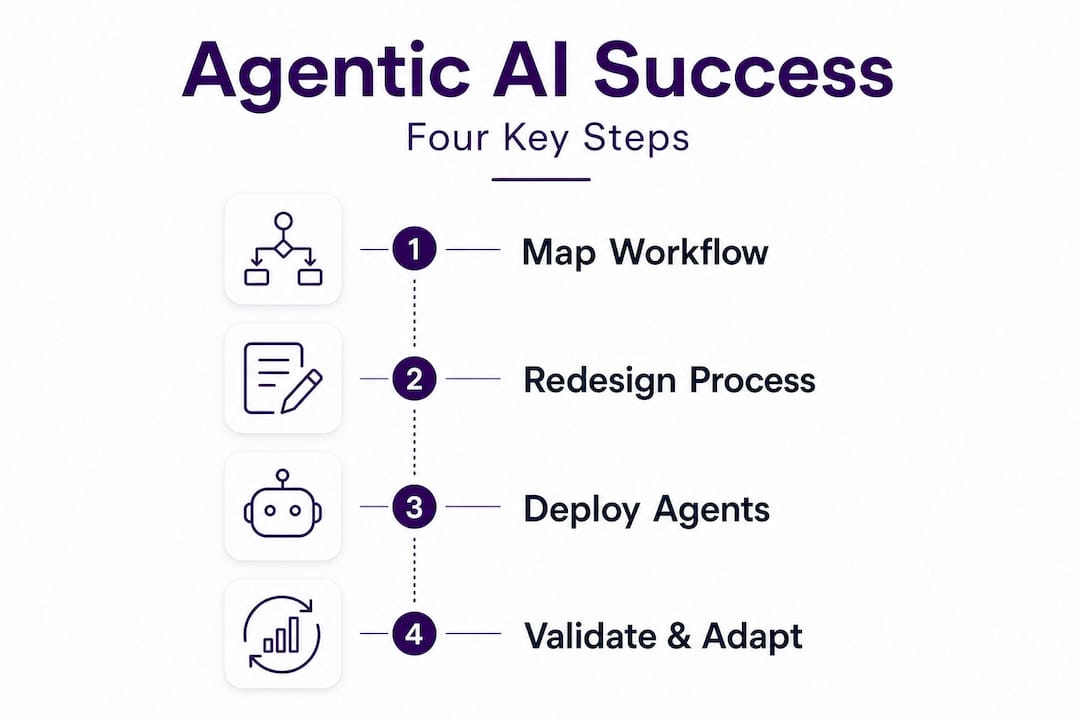
- Document current state. Map every step in the process as it actually happens, including informal workarounds, manual checks, and handoffs between people or systems.
- Identify bottlenecks and weak links. Look for steps with high error rates, long wait times, or heavy manual involvement. These are your highest-value targets for redesign.
- Define decision points. Clarify what decisions are made at each step, who makes them, and what information they need. This is critical for assigning agent roles later.
- Redesign before automating. Fix broken or redundant steps before handing them to AI. Automating a flawed process only produces flawed results faster.
- Assign AI roles. Determine which steps an agent can handle independently, which need human review, and which require real-time escalation.
- Build integration checkpoints. Specify where the AI system needs to read from or write to existing platforms like CRM, ERP, or document management systems.
Legacy vs. agentic AI workflow design:
| Dimension | Legacy approach | Agentic AI approach |
|---|---|---|
| Starting point | Existing process, automate in place | Full redesign with AI roles built in |
| Error handling | Manual review queue | Automated exception routing |
| Human involvement | Constant throughout | Targeted at high-judgment steps |
| Cross-system coordination | Manual or scripted | Agent-managed, dynamic |
| Scalability | Limited by headcount | Scales with workload |
Resources like AI business process management and the business automation guide offer structured frameworks for working through each phase of this redesign process.
For organizations looking at AI deployment in enterprise-grade test environments, contextual AI for enterprise design illustrates how the same principles of workflow decomposition and intelligent agent assignment apply across functional areas.

Pro Tip: Build validation layers into every major handoff point in your redesigned workflow. These checkpoints confirm data quality before the next agent takes over, preventing errors from cascading through the process. A 30-second validation step can save hours of remediation downstream.
Managing edge cases and risks: Human-in-the-loop and oversight
No matter how well a workflow is designed, edge cases will occur. An unusual vendor dispute. A compliance question that requires legal review. A document with formatting the AI hasn’t encountered before. How your agentic AI system handles these situations determines whether it builds or erodes trust within the organization.
AI fails in high-ambiguity tasks, amplifying errors in front-end processes and requiring human oversight for emotion, compliance, and unstructured data. This isn’t a flaw in agentic AI specifically; it’s a structural characteristic of any AI system. The solution is design, not avoidance.
Key areas where human oversight is non-negotiable:
- Regulatory compliance decisions. Any action with legal, financial, or regulatory consequences should include a human review step before execution.
- Emotionally sensitive communications. Responses involving disputes, complaints, or employee-facing HR processes require human judgment.
- Unstructured or ambiguous data. Documents with inconsistent formatting, missing fields, or conflicting information should be flagged for review rather than processed automatically.
- High-value transactions. Financial approvals above defined thresholds should always route to a human approver, regardless of how routine the pattern appears.
- Novel situations. When an agent encounters a scenario outside its training distribution, escalation is the right default behavior.
The concept of “human in the loop” describes a design pattern where humans are embedded at specific checkpoints in an otherwise automated process. This is different from full manual oversight and different from full automation. It’s a deliberate, structured approach to keeping humans accountable for the decisions that matter most.
“The goal isn’t to remove humans from the process. It’s to remove humans from the parts of the process that don’t require human judgment, so their attention is focused where it creates the most value.”
For compliance-driven workflows specifically, the design of these oversight layers is especially critical. The AI in compliance workflows guide covers how to build exception routing and audit trails that satisfy regulatory requirements without slowing down the process.
Pro Tip: Establish a quarterly audit cycle for AI-driven decisions. Review a sample of completed cases, including both routine ones and exceptions, to identify drift, new edge cases, and areas where agent logic may need updating as regulations or business policies change.
Adoption trends and governance: Why most firms choose augmentation over full automation
The data on AI adoption tells a clear story. Less than 15% of firms adopt full agentic AI by 2026, with ROI uncertainty and governance challenges cited as the primary barriers. Full automation, where AI handles a process end-to-end without any human involvement, also carries real risks beyond governance. It can lead to skill atrophy in teams that once understood those processes deeply, and to overreliance on systems whose failure modes may not be well understood.
Key stat: Fewer than 1 in 7 mid-market organizations have deployed fully autonomous agentic AI systems as of 2026. The majority are pursuing a hybrid model.
Augmentation, the approach where AI handles high-volume, routine steps while humans retain decision authority on exceptions and judgment calls, avoids most of these risks while still delivering substantial efficiency gains. It also tends to generate faster organizational buy-in because employees can see the AI as a tool that supports their work rather than replaces it.
Here’s a practical sequence for moving from augmentation to broader adoption:
- Define the scope of human authority. Before deploying any AI agent, document which decisions remain human-only, which are AI-recommended with human approval, and which are fully delegated to the agent.
- Establish governance checkpoints. Create a review cadence where AI performance, error rates, and edge case patterns are evaluated against defined benchmarks.
- Track ROI at the process level. Measure time saved, error rates, cycle times, and cost per transaction for each automated workflow separately, not just in aggregate.
- Expand scope incrementally. As confidence in agent performance builds, extend the scope of autonomous action based on evidence, not assumptions.
| Adoption model | Human involvement | Governance complexity | Speed to value |
|---|---|---|---|
| Full manual | High | Low | Slow |
| Task automation | Medium | Low | Medium |
| Augmentation | Targeted | Medium | Fast |
| Full agentic AI | Minimal | High | Fastest (when ready) |
The AI decision logic framework provides useful guidance on how to structure the boundaries between what AI handles and what humans retain. Understanding contextual AI in enterprise testing also offers perspective on how this boundary-setting applies in technical enterprise environments.
From pilot to scale: Steps to drive agentic AI success
The organizations that scale agentic AI successfully share a common pattern. They start narrow, prove value, build organizational confidence, and expand methodically. They don’t attempt to transform everything at once.
Here’s a structured approach to piloting and scaling agentic AI in administrative operations:
- Select a pilot process with clear ROI. Choose a workflow that is high-volume, well-documented, and measurable. Accounts payable, scheduling coordination, and document intake processing are common starting points.
- Map and redesign the process first. Apply the workflow mapping steps from Section 3 before deploying any AI. The pilot should test a redesigned process, not an automated version of a broken one.
- Deploy with validation layers in place. Build in checkpoints that log agent decisions, flag exceptions, and route edge cases to humans before the pilot goes live.
- Run a parallel period. For the first four to six weeks, run the AI-assisted process alongside the existing manual process. Compare outcomes, identify gaps, and refine agent logic.
- Gather cross-functional feedback. Talk to the people who interact with the process, including staff who hand off to the AI and those who receive its outputs. Their observations often surface issues that metrics miss.
- Document lessons learned before scaling. Capture what worked, what required human intervention most often, and what would need to change for the process to work at higher volume.
- Scale with governance in place. As you expand to additional workflows, apply the same oversight structure established during the pilot rather than building it fresh each time.
Additional workflows suited to early-stage agentic AI deployment include:
- Employee onboarding document collection and routing
- Client intake and CRM record creation
- Internal approval workflows for procurement or travel
- Billing exception detection and follow-up
- Compliance document tracking and renewal reminders
For a broader view of how these steps fit into a complete organizational transformation, end-to-end business automation and the AI office automation guide are practical references. Discovering the range of available AI app integrations can also help teams identify tools that connect with existing systems during deployment.
Pro Tip: Engage finance, operations, and IT stakeholders in the pilot design phase, not just after results come in. Early cross-functional involvement dramatically reduces resistance during the scaling phase and surfaces integration requirements that would otherwise delay rollout.
Why agentic AI adoption is about people as much as technology
Here’s the perspective most technology vendors won’t give you: the organizations that struggle most with agentic AI adoption are rarely limited by the technology itself. They’re limited by how they manage the human side of the change.
Teams that feel threatened by AI agents become passive resistors. They escalate edge cases unnecessarily, introduce unofficial workarounds, and undermine adoption metrics without any visible opposition. This isn’t malicious. It’s a predictable organizational response to change that wasn’t communicated clearly or implemented with their involvement.
The most effective implementations we observe share one consistent characteristic. Leaders invest in explaining what the AI is doing and why, and they create formal channels for staff to flag problems and suggest improvements. That feedback loop isn’t just good change management. It’s a core mechanism for keeping AI logic aligned with real business conditions over time.
There’s also a skill dimension that organizations consistently underestimate. When AI agents absorb routine process steps, the humans who used to perform those steps need new skills. They need to know how to review AI decisions critically, how to identify when agent logic has drifted, and how to escalate effectively. Without deliberate re-skilling, teams become dependent on systems they don’t understand, which creates fragility rather than resilience.
The AI automation types overview is useful for helping teams understand what kinds of tasks AI handles well versus where human expertise remains essential. That clarity is foundational to building the kind of shared understanding that makes adoption sustainable.
Lasting efficiency through agentic AI comes from iterative collaboration between your people and your agents, not from deploying technology and stepping back. The technology creates the capacity. Your people determine whether that capacity becomes a genuine organizational asset.
Unlock transformative workflow efficiency with agentic AI solutions
If you’re ready to move beyond task-level automation and start redesigning administrative workflows for real scale, Ailerons.ai can help you get there. Our team specializes in designing and deploying agentic AI systems that integrate with your existing CRM, ERP, document management, and accounting platforms. We focus on measurable outcomes, not just implementation. Explore our agentic AI case studies to see how mid-market organizations have reduced manual workload, improved processing accuracy, and scaled operations without proportional headcount growth. When you’re ready to discuss your specific workflows, our team is available for a focused consultation tailored to your operational priorities.
Frequently asked questions
What is agentic AI in administrative workflows?
Agentic AI workflows use multiple specialized agents to coordinate entire administrative processes, handling decision points, routing, and exception management rather than just automating isolated tasks. Each agent is assigned a specific role within a larger, orchestrated sequence.
How can mid-market firms prepare for agentic AI adoption?
Prioritize workflow mapping and redesign before deploying any AI agents, then implement validation layers and human oversight checkpoints for edge cases to ensure the system scales reliably from day one.
What types of administrative tasks should not be fully automated with AI?
AI amplifies errors in high-ambiguity tasks, so any work requiring emotional intelligence, compliance judgment, or interpretation of unstructured data should retain meaningful human involvement rather than being fully delegated to an agent.
Why do most companies choose AI augmentation over full automation?
Full automation risks skill loss and overreliance, which is why fewer than 15% of firms have adopted fully autonomous agentic AI as of 2026. Augmentation keeps humans accountable for high-stakes decisions while still delivering substantial efficiency gains across routine operations.
Recommended
- Master the Administrative Task Automation Process Today | Ailerons IT Consulting
- Process Automation Tutorial for Agentic AI in Compliance Workflows | Ailerons IT Consulting
- Improving Business Workflows with AI: Achieve Automation | Ailerons IT Consulting
- AI-driven operations guide: boost efficiency 72% in 2026 | Ailerons IT Consulting