

Managing day-to-day operations often means juggling complex IT needs while racing to meet customer expectations. As small and mid-sized businesses in American service sectors pursue greater efficiency, the rise of Managed Service Providers offers relief from resource-heavy technology demands. This guide breaks down the role of MSPs, explores service models, and spotlights how agentic AI workflows and careful risk management drive smoother processes and stronger customer experiences.
Table of Contents
- Defining Managed Service Providers Today
- Categories and Service Models Explained
- Agentic AI Integration and Workflow Automation
- Key Security, Compliance, and Human Roles
- Cost Implications and Common Pitfalls
Key Takeaways
| Point | Details |
|---|---|
| MSPs Provide Comprehensive Support | Managed Service Providers offer a range of IT services including cybersecurity, cloud management, and data recovery, enabling businesses to focus on their core operations. |
| Careful Vendor Management is Essential | Organizations must maintain oversight and establish clear communication to manage cybersecurity risks effectively when partnering with MSPs. |
| Choosing the Right MSP Model is Crucial | The appropriate MSP model should align with the organization’s size, budget, and specific technological needs to ensure optimal support. |
| Cost Transparency is Key for Success | Businesses should evaluate all financial implications of MSP partnerships to avoid unexpected costs and ensure effective resource allocation. |
Defining Managed Service Providers Today
Managed Service Providers (MSPs) represent a critical evolution in modern business technology support, offering comprehensive remote IT management solutions for organizations across various industries. These third-party vendors provide strategic technological support by managing complex IT infrastructures on behalf of businesses seeking efficient and scalable technology solutions.
At their core, MSPs function as external technology partners that handle multiple dimensions of an organization’s technological ecosystem. Their service offerings typically encompass:
- Remote system monitoring and maintenance
- Cybersecurity protection and threat management
- Cloud infrastructure management
- Network configuration and optimization
- Help desk and technical support services
- Data backup and disaster recovery planning
- Software and hardware lifecycle management
The evolution of MSPs has been driven by increasing technological complexity and the need for specialized expertise that many organizations cannot develop internally. Technological agility has become a paramount concern for businesses, and MSPs provide the flexibility to adapt quickly to changing technological landscapes without substantial internal investment.
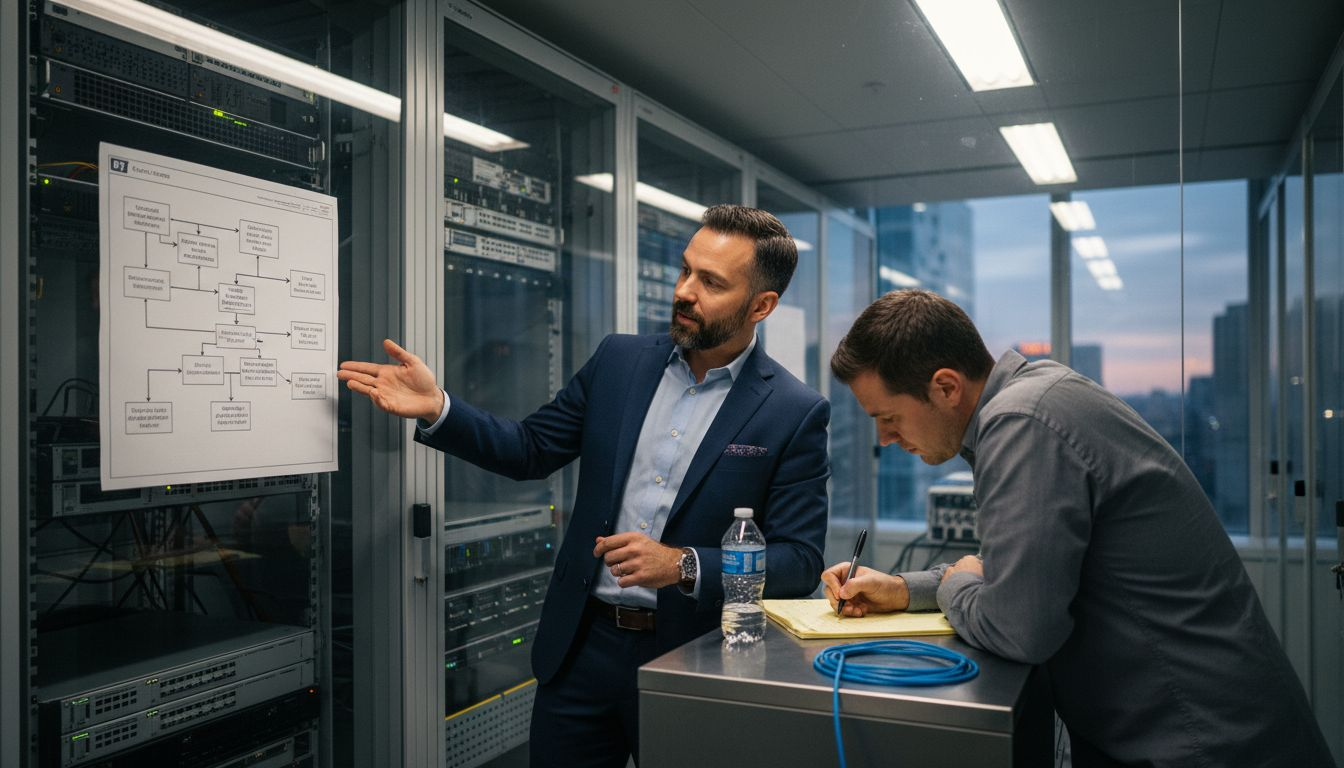
However, partnering with MSPs is not without considerations. Organizations must carefully manage third-party cybersecurity risks when outsourcing critical technological functions. This requires establishing clear communication protocols, defining precise service level agreements, and maintaining robust governance frameworks that ensure accountability and security.
Pro tip: Before selecting an MSP, conduct comprehensive due diligence by requesting detailed security audits, examining their incident response capabilities, and verifying their compliance with industry-specific regulatory standards.
Categories and Service Models Explained
Managed Service Providers (MSPs) operate through diverse service models that cater to the unique technological needs of different organizations. Managed care entities exhibit multiple strategic approaches to delivering technological support, each with distinct characteristics and operational frameworks.
The primary categories of MSP service models include:
- Full-Service MSP: Comprehensive technology management covering entire IT infrastructure
- Specialized MSP: Focused on specific technological domains like cybersecurity or cloud services
- Co-Managed MSP: Collaborative model working alongside internal IT departments
- Remote Monitoring MSP: Providing offsite technology monitoring and support
- On-Demand MSP: Offering flexible, project-based technological assistance
Each service model represents a unique approach to technological management. Risk-based service delivery models allow organizations to select providers that align precisely with their operational requirements, budget constraints, and strategic technological objectives. Technological flexibility becomes a critical advantage, enabling businesses to scale their support infrastructure dynamically.
The selection of an appropriate MSP model depends on multiple factors, including organizational size, technological complexity, budget limitations, and specific industry requirements. Companies must carefully evaluate their internal capabilities, growth projections, and technological dependencies to identify the most suitable service model that provides optimal support and strategic alignment.
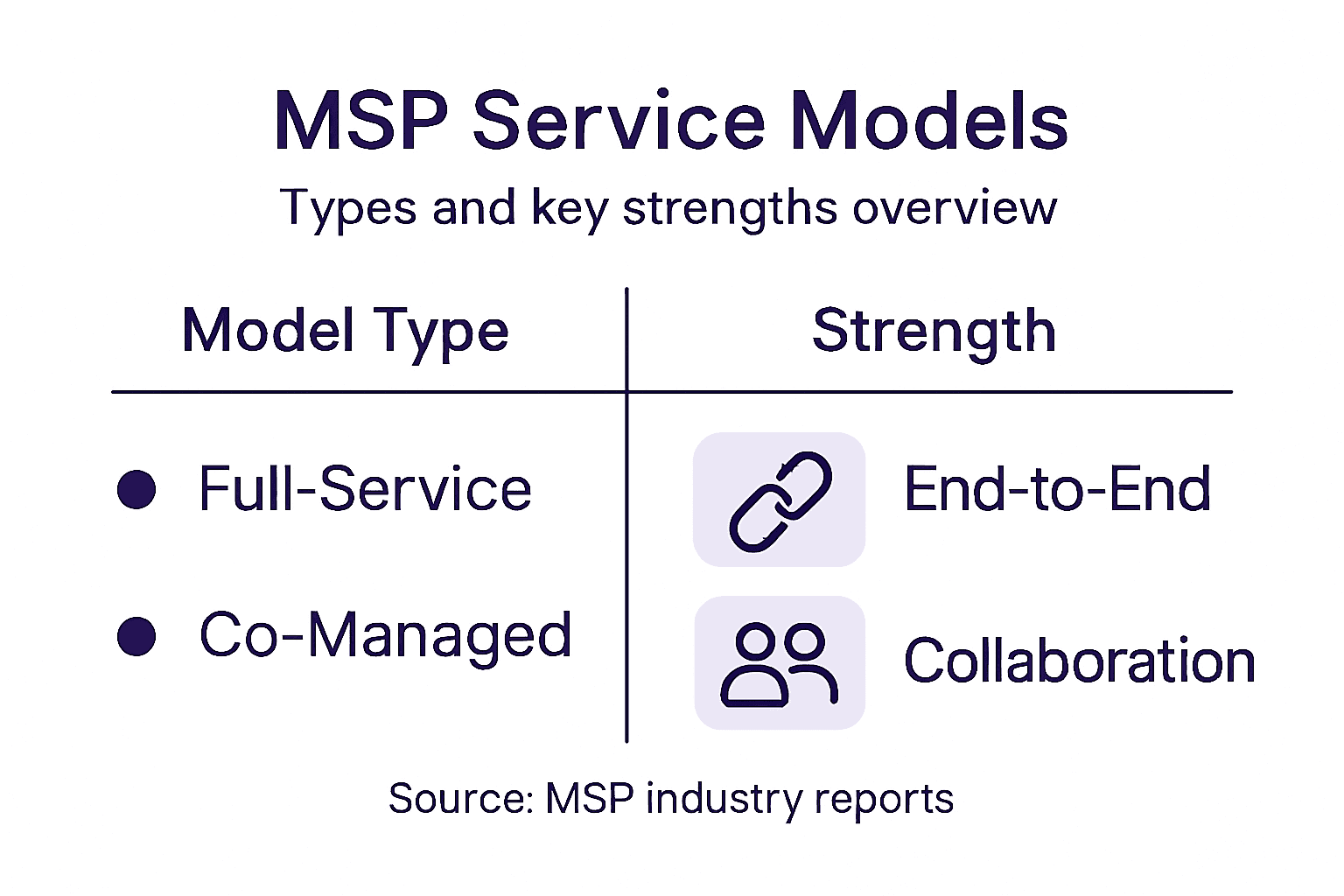
Here’s a side-by-side comparison of common MSP service models and when each is most effective:
| MSP Model Type | Ideal For | Key Strength |
|---|---|---|
| Full-Service MSP | Small firms without IT staff | Complete technology coverage |
| Specialized MSP | Businesses needing niche expertise | Deep domain knowledge |
| Co-Managed MSP | Growing firms with IT departments | Flexible task sharing |
| Remote Monitoring | Companies with uptime focus | Proactive issue detection |
| On-Demand MSP | Project-based or seasonal needs | Cost-effective flexibility |
Pro tip: Conduct a comprehensive internal technology audit before selecting an MSP service model to ensure precise alignment with your organization’s unique operational needs and future growth strategies.
Agentic AI Integration and Workflow Automation
Agentic AI represents a transformative approach to operational automation, enabling businesses to create intelligent systems that can autonomously plan, execute, and optimize complex workflows. Advanced AI systems autonomously manage multi-step tasks by leveraging sophisticated reasoning and learning capabilities that go beyond traditional rule-based automation.
The key components of agentic AI workflow integration include:
- Autonomous Task Planning: AI systems that can break down complex processes into executable steps
- Dynamic Decision Making: Intelligent agents that adapt and respond to changing operational conditions
- Cross-Platform Orchestration: Ability to interact and coordinate across multiple technological systems
- Continuous Learning: Mechanisms for self-improvement and performance optimization
- Contextual Understanding: Deep comprehension of task requirements and organizational constraints
AI agents facilitate evidence-based decision making by processing real-time data streams and generating intelligent recommendations. Operational intelligence becomes a critical advantage, allowing organizations to transform repetitive manual processes into streamlined, self-managing workflows that significantly reduce human intervention and minimize potential errors.
Successful agentic AI integration requires a strategic approach that balances technological capabilities with organizational readiness. Businesses must develop robust governance frameworks, establish clear performance metrics, and create comprehensive validation processes to ensure AI systems operate within defined ethical and operational boundaries.
Pro tip: Begin your agentic AI implementation with pilot projects in well-defined, low-risk operational domains to build organizational confidence and refine integration strategies.
Key Security, Compliance, and Human Roles
Collaborative risk management strategies are fundamental to maintaining robust cybersecurity in modern technological ecosystems. Organizations must recognize that outsourcing technological services does not absolve them of ultimate responsibility for security and compliance, requiring a holistic approach to vendor management and risk mitigation.
Critical human roles in security and compliance include:
- Leadership: Setting strategic cybersecurity priorities and establishing governance frameworks
- Procurement: Conducting comprehensive vendor due diligence and contract management
- Technical Teams: Monitoring system integrations, responding to security incidents
- Compliance Officers: Ensuring regulatory adherence and risk assessment
- Security Architects: Designing robust integration protocols and access controls
Organizational accountability remains paramount in managing technological partnerships. This requires developing comprehensive oversight mechanisms that enable continuous monitoring, rapid incident response, and clear delineation of responsibilities between internal teams and external service providers.
Consider these key elements when managing security and compliance roles in MSP partnerships:
| Human Role | Main Responsibility | Strategic Impact |
|---|---|---|
| Leadership | Sets security vision | Drives governance and alignment |
| Procurement | Assesses and selects vendors | Reduces third-party risk |
| Technical Teams | Integrates and monitors systems | Responds to technical threats |
| Compliance Officers | Validates regulatory adherence | Minimizes legal exposure |
| Security Architects | Designs security frameworks | Strengthens infrastructure |
Successful security integration demands a multi-layered approach that balances technological safeguards with human expertise. Organizations must implement rigorous validation processes, establish clear communication channels, and create adaptive frameworks that allow for continuous security assessment and improvement.
Pro tip: Develop a detailed vendor security assessment matrix that evaluates potential MSPs across multiple dimensions including technical capabilities, compliance history, incident response protocols, and cultural alignment with your organization’s security standards.
Cost Implications and Common Pitfalls
Managed service provider cost considerations require a sophisticated approach that balances potential operational efficiencies against hidden financial risks. Organizations must conduct comprehensive financial assessments that extend beyond surface-level pricing models to understand the complete economic implications of technological partnerships.
Common financial pitfalls in MSP relationships include:
- Unexpected Incident Remediation Costs: Unforeseen security breaches or system failures
- Contract Complexity: Hidden fees, unclear service level agreements
- Inefficient Resource Allocation: Overprovisioning or underutilizing technological services
- Compliance Violation Penalties: Regulatory non-compliance resulting in financial sanctions
- Scalability Challenges: Inflexible pricing structures that cannot adapt to organizational growth
Managed environments introduce complex spending dynamics that require rigorous financial oversight. Cost transparency becomes crucial, demanding organizations develop sophisticated evaluation frameworks that continuously monitor service performance, validate expenditures, and ensure alignment between technological investments and strategic business objectives.
Successful cost management in MSP relationships requires a proactive, holistic approach. Organizations must develop comprehensive vendor assessment strategies, implement robust financial monitoring mechanisms, and maintain flexibility to adjust service agreements as technological and business needs evolve.
Pro tip: Create a detailed financial scoring matrix that evaluates MSP costs across direct expenses, potential risk mitigation expenses, and long-term strategic value to make more informed vendor selection decisions.
Unlock Seamless Operation Automation with Expert Agentic AI Support
Managed Service Providers play a vital role in automating complex workflows and improving operational efficiency through intelligent technology. Yet many organizations face challenges such as balancing security risks, ensuring compliance, and integrating AI agents that can autonomously plan and execute multi-step tasks across systems. These pain points can stall progress and increase costs despite the promise of smarter automation.
Ailerons IT Consulting specializes in addressing these exact challenges by designing secure agent-first AI workflows tailored for small and mid-sized businesses. We help you overcome common obstacles like inefficient process handoffs and manual bottlenecks with AI agents that integrate your existing CRM, scheduling, support, and accounting systems to deliver consistent, scalable results. With robust governance and role-based controls, your team gains operational agility without sacrificing security or compliance.
Discover how our proven approach to agentic AI and workflow automation can transform your operations today. Explore tailored solutions at Ailerons IT Solutions and learn how to move beyond traditional IT support toward intelligent automation that truly scales. Don’t let complexity or risk slow you down take the next step now to secure streamlined, smart workflows built for real-world success.
Frequently Asked Questions
What are Managed Service Providers (MSPs)?
Managed Service Providers (MSPs) are third-party vendors that offer comprehensive remote IT management solutions, handling various aspects of an organization’s technological ecosystem, including system monitoring, cybersecurity, cloud management, and technical support.
How do MSPs help in automating operations?
MSPs help automate operations by implementing systems that manage IT infrastructures, streamline workflows, enhance cybersecurity, and enable businesses to scale their technological capabilities without significant internal investment.
What are the different service models offered by MSPs?
MSPs offer various service models, including Full-Service MSP, Specialized MSP, Co-Managed MSP, Remote Monitoring MSP, and On-Demand MSP, each catering to different operational needs and levels of technological management.
What should organizations consider before choosing an MSP?
Organizations should assess their internal capabilities, budget constraints, and specific technological requirements. Conducting due diligence on security audits, incident response capabilities, and compliance with industry standards is essential before selecting an MSP.