

TL;DR:
- Compliance bottlenecks manifest as missed deadlines, failed audits, and costly remediation efforts that damage operations. Building an auditable, risk-based workflow with proper governance and phased automation enhances compliance effectiveness and defensibility. Continuous measurement and structured improvement ensure workflows remain resilient amid regulatory changes and organizational growth.
Compliance bottlenecks do not announce themselves politely. They appear as missed deadlines, failed audits, and costly remediation projects that drain your operations team’s time and credibility. A sequential, auditable workflow chain that maps obligations, selects controls, and defines escalation paths is no longer optional for mid-sized organizations navigating complex regulatory environments. This guide walks through every stage of compliance workflow optimization, from the prerequisites you need before writing a single process document, to the governance structures that make agentic AI deployment defensible and effective.
Table of Contents
- What you need before you start
- Step-by-step workflow optimization
- Agentic AI in compliance workflows: integration and governance
- How to measure success and optimize continuously
- Our perspective: why “efficiency” alone misses the real value
- Ready to optimize your compliance workflows?
- Frequently asked questions
Key Takeaways
| Point | Details |
|---|---|
| Start with baseline mapping | Begin by thoroughly mapping obligations, risks, and controls before automating compliance workflows. |
| Phase your workflow redesign | Prioritize high-risk or high-volume processes and implement automation in phases for control and review. |
| Embed governance in AI | Agentic AI solutions only work when identity, permissions, and auditability are built into your workflows. |
| Measure auditable metrics | Track compliance-impact metrics like speed, risk visibility, and event response rate—not just automation coverage. |
| Prioritize defensibility | Successful compliance workflows are designed for robust audits and clear accountability, not just efficiency. |
What you need before you start
Building a better compliance workflow starts with preparation, not software. Many organizations rush to automate before they have documented what they are actually automating. That shortcut creates fragile systems that fail under audit scrutiny.
Gather your baseline documentation first. You need three foundational inputs before any redesign work begins: a documented inventory of regulatory obligations, a current risk map that rates those obligations by likelihood and impact, and a list of existing controls with honest notes on their effectiveness. Without these, you are optimizing guesswork.
Here is a quick-reference checklist of what to assemble before starting:
- Regulatory obligation inventory (federal, state, and industry-specific requirements)
- Current risk register with probability and impact ratings
- Control inventory with owner, frequency, and current pass/fail rate
- Data source catalog: where compliance evidence lives and who owns it
- IT integration map: which systems feed compliance data and which need to be connected
- List of high-risk or high-volume processes flagged for priority attention
- Escalation and audit requirement documentation
- Executive sponsorship confirmation and governance committee structure
The last two items matter more than most teams acknowledge. Compliance redesign without executive sponsorship stalls when it hits cross-functional resistance. And governance structure must be defined before automation begins, not after.
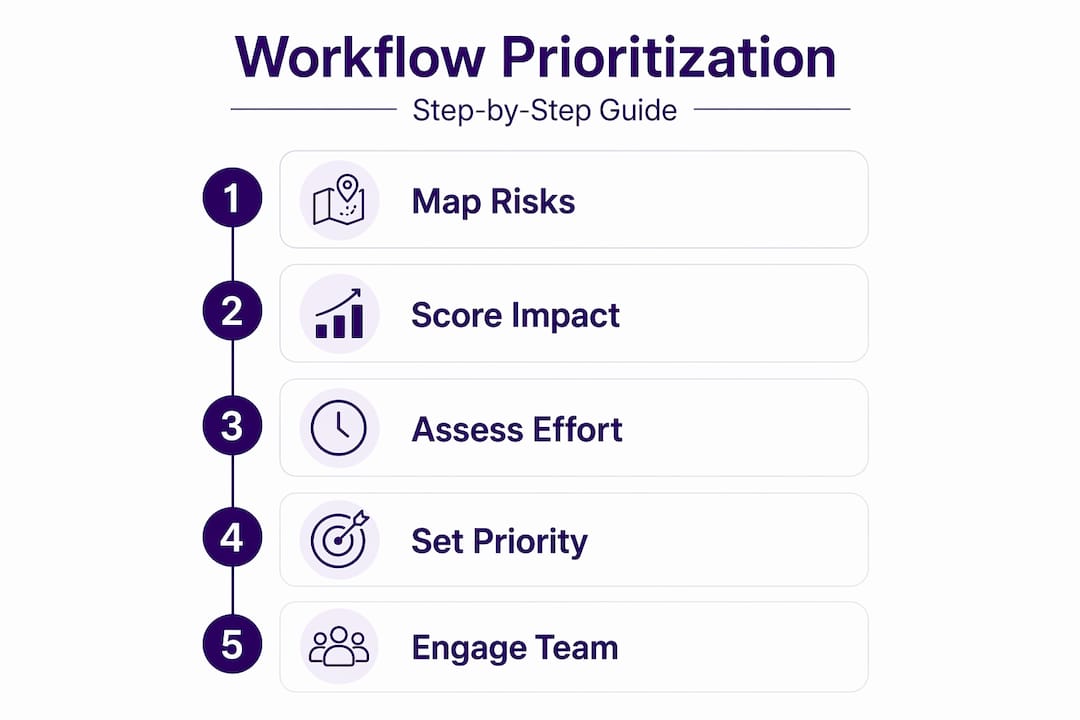
Prioritize strategically. As a starting principle, automation work should begin by mapping and prioritizing high-risk or high-volume processes, then implement in phases with integration and ongoing review to prevent automation logic from degrading over time. This phased approach protects you from the common mistake of automating low-stakes tasks while critical risk areas remain manual and error-prone.
A practical way to prioritize is to score each process by two factors: the severity of a compliance failure in that area, and the current volume of manual work it requires. Processes that score high on both dimensions become your Phase 1 targets. Examples include vendor contract review, employee training certification tracking, and regulatory filing preparation.
Pro Tip: Run a 30-minute stakeholder interview with the compliance officer, IT lead, and operations manager before drafting any process maps. Misaligned assumptions about who owns a control are one of the top reasons workflow redesign projects fail before they launch.
Before you proceed to workflow redesign, make sure your process automation tutorial and your secure AI systems requirements are already on your team’s radar. These foundations shape every design decision downstream.
| Prerequisite item | Owner | Status check |
|---|---|---|
| Obligation inventory | Compliance officer | Complete before Phase 1 |
| Risk map | Risk manager | Updated within 6 months |
| Control inventory | Operations lead | Includes pass/fail data |
| IT integration map | IT/Systems lead | Confirms data sources |
| Executive sponsorship | C-suite | Written commitment |
Step-by-step workflow optimization
With your prerequisites confirmed, you can begin rearchitecting the workflow itself. The sequence below is designed to be auditable at every stage, so regulators and internal auditors can trace decisions back to documented design choices.
-
Map all compliance obligations to specific controls. Start with your obligation inventory and assign at least one control to each obligation. Document the evidence that control produces, who collects it, and how often. This mapping becomes the backbone of your audit trail.
-
Define evidence collection requirements for each control. Each control needs a defined output: a log entry, a signed document, a system timestamp, or a completed checklist. Vague controls are unauditable controls. Be specific about format, frequency, and storage location.
-
Design monitoring cadences. Decide whether each control needs real-time monitoring, daily review, weekly reporting, or quarterly assessment. Not all controls require the same attention frequency. High-risk areas typically need continuous monitoring; low-risk areas may warrant monthly spot checks.
-
Build escalation and reporting protocols into every phase. Define the trigger conditions that move an issue from frontline staff to a compliance manager, and from the compliance manager to the governance committee. Document who is notified, within what time frame, and by which channel.
-
Introduce agentic AI only after controls are defined. AI tools should execute a process you have already designed and validated manually. As workflow redesign best practice confirms, the sequence runs: map obligations, select frameworks and controls, design controls and evidence collection, establish monitoring cadences, then define escalation and reporting to governance bodies. AI enters after that structure exists.
-
Phase your automation rollout. Begin with high-risk, high-volume processes identified in your prerequisites stage. Automate those fully before moving to medium-risk processes. Review automation logic at each phase boundary to catch logic drift before it compounds across the workflow.
-
Schedule ongoing logic reviews. Automation logic degrades when regulations change, organizational structures shift, or data sources are modified. Build a quarterly review into your compliance calendar that specifically checks whether automated decisions still reflect current rules.
Pro Tip: Build a “shadow period” into every automated workflow. Run the automated process in parallel with the existing manual process for two to four weeks before switching over completely. Any discrepancies that appear during shadow mode are far less costly to fix than failures discovered during an audit.
Comparing manual versus automated compliance workflow performance:
| Workflow element | Manual approach | Agentic AI approach |
|---|---|---|
| Obligation tracking | Spreadsheet updates, prone to gaps | Automated mapping with change alerts |
| Evidence collection | Manual document gathering | System-triggered collection at defined intervals |
| Escalation | Email-dependent, variable timing | Rule-based triggers with documented timestamps |
| Audit trail | Manually assembled, inconsistent | Continuous, structured, and retrievable |
| Logic review | Ad hoc, often skipped | Scheduled, version-controlled |
Using decision logic in automation correctly is what separates compliance automation that holds up under scrutiny from automation that creates new liability. And every system you build should be validated against trustworthy agentic AI systems standards before it touches regulated processes.

Agentic AI in compliance workflows: integration and governance
Once your process structure is validated, the question becomes how to integrate agentic AI without introducing new governance gaps. This is where many organizations create more risk than they solve.
Gartner warns against treating AI as a bolt-on enhancement layer, noting that agentic AI requires governance that clarifies accountability and control over identity, permissions, policy enforcement, system-of-record access, and auditability. Bolting an AI agent onto a legacy compliance system without re-engineering the governance layer is a structural mistake.
Here is what proper AI governance for compliance workflows requires:
- Identity and permissions architecture: Each AI agent must operate under a defined identity with role-based access controls. It should only touch the data and systems its role explicitly permits.
- Audit log requirements: Every automated action, decision, and exception must be logged with a timestamp, the triggering condition, and the outcome. These logs must be retrievable and tamper-evident.
- Override and shutdown mechanisms: Human operators must be able to pause or reverse any automated decision at any stage. The override path must be documented and tested regularly.
- Test protocols before go-live: Run the agent through controlled scenarios that include edge cases before deploying in a live compliance environment.
- Authority and liability documentation: Every automated decision must have a documented owner. Who is accountable when the agent makes an incorrect determination? That answer must exist in writing before deployment.
“Key edge cases in agentic compliance deployments include privacy and data management, vendor and supply-chain changes, oversight testing for discriminatory outcomes, ensuring authenticated and authorized actions with effective override and shutdown, and identity, authority, and attribution for agent actions.” Agentic AI is Here: Legal Compliance and Governance
The edge cases listed above deserve serious attention. Privacy risks arise when agents access personal data across systems to compile compliance evidence. Vendor risks emerge when a third-party integration changes its API or data structure without notice, causing the agent to process stale or corrupted information. Discriminatory outcomes can occur when historical data used to train decision logic reflects past biases in enforcement or documentation practices.
Tools like datatool.dev for AI data validation can help verify that the data flowing into your compliance agents meets quality and consistency standards before automated decisions are made based on it. Data quality is a governance issue, not just a technical one.
For teams working in regulated industries, reviewing AI automation in compliance case studies and AI compliance tips specific to professional services environments provides practical grounding for governance design decisions.
How to measure success and optimize continuously
Implementation is not the finish line. The compliance workflow you deploy on day one will need to evolve as regulations change, your organization grows, and new risk patterns emerge. Measurement is what tells you when to act.
Anchor your metrics in compliance outcomes, not automation coverage. A common mistake is measuring success by the percentage of tasks that are now automated. That metric tells you nothing about compliance quality. Instead, track metrics that directly reflect regulatory performance.
According to PwC’s 2025 global compliance study, organizations report the top benefits of compliance optimization as improved visibility of risks (cited by 64% of respondents) and faster identification and response to compliance issues (cited by 53%). These are the benchmarks that matter to boards and regulators.
Recommended compliance workflow performance metrics:
| Metric | What it measures | Target direction |
|---|---|---|
| Mean time to detect a compliance issue | Speed of risk identification | Decrease over time |
| Exception rate per workflow | Frequency of edge cases hitting the system | Track trends, investigate spikes |
| Audit finding rate | Issues discovered by external auditors | Decrease over time |
| Control evidence completeness | Percentage of controls with documented evidence | Increase toward 100% |
| Escalation response time | Time from trigger to governance notification | Decrease over time |
A continuous improvement cycle for compliance workflows:
- Run the workflow for a defined period (30 to 90 days per phase).
- Review all flagged exceptions and categorize their root causes.
- Identify whether exceptions reflect rule gaps, data quality problems, or logic errors.
- Update automation logic, control definitions, or escalation triggers accordingly.
- Document all changes with version control and regulatory rationale.
- Repeat the cycle when new regulations take effect or organizational changes occur.
Research on algorithmic optimization for compliance supervision shows that structured, algorithm-driven approaches to workflow optimization produce measurable improvements in model performance and supervision effectiveness compared to non-optimized baselines. The key word is “structured.” Ad hoc tweaks to automation logic without a defined review process produce inconsistent outcomes and create audit risk.
For a deeper look at how these improvement cycles function across operational contexts, the AI operations efficiency guide provides practical frameworks applicable directly to compliance program management.
Our perspective: why “efficiency” alone misses the real value
Most compliance optimization conversations start and end with speed. How fast can we process a vendor agreement? How quickly can we close an audit finding? Those are fair questions, but they are the wrong primary objectives.
The real value of a well-designed compliance workflow is defensibility. When a regulator or external auditor examines your process, can you demonstrate who made each decision, on what authority, with what evidence, and through what escalation path? That is what protects your organization. Speed without traceability is liability with better branding.
We see this consistently: teams invest heavily in automation and then discover their audit trail is incomplete because the governance layer was designed as an afterthought. Agentic AI amplifies whatever governance structure is already in place. If that structure is weak, the AI scales the weakness. If it is sound, the AI scales the protection.
The practical implication is that compliance workflow redesign should be evaluated first by the question “can we defend every automated decision under audit?” before asking “how much faster are we?” Override paths, identity controls, and documented authority are not bureaucratic extras. They are the foundation that makes everything else legally and operationally credible.
Organizations that build secure AI systems for compliance with governance-first architecture consistently report fewer audit findings and stronger board confidence than those that treat governance as a phase-two concern. Phase two rarely arrives on schedule.
Ready to optimize your compliance workflows?
Ailerons.ai works with operations and compliance teams at mid-sized organizations to design and deploy agentic AI systems that are built around governance from the ground up. Our implementations start with your specific regulatory obligations, risk profile, and existing systems before a single automation is designed. You can review real-world case studies showing how organizations have used agentic AI to transform compliance operations without compromising auditability or control. If you are ready to move from frameworks to action, Ailerons AI solutions offers the architecture, integration expertise, and compliance-aligned design your program needs to scale with confidence.
Frequently asked questions
What is a compliance workflow and why does optimization matter?
A compliance workflow is a structured, repeatable sequence for meeting regulatory obligations, collecting evidence, and reporting to governance bodies. Optimization matters because a sequential, auditable workflow chain reduces the risk of missed controls, speeds up audit preparation, and makes regulatory obligations manageable at scale.
How should agentic AI be governed within compliance workflows?
Agentic AI must operate under clearly defined identity, role-based permissions, audit logging, and attribution rules. As Gartner notes, governance must cover accountability and control over policy enforcement, system-of-record access, and auditability to ensure every automated action is defensible.
What metrics show compliance workflow optimization is succeeding?
The most meaningful indicators are speed of compliance issue detection, risk visibility, and accuracy of control evidence. According to PwC’s compliance research, benchmarking should focus on compliance-impact metrics rather than automation coverage alone.
Which compliance workflow steps should be automated first?
Prioritize automation for high-risk or high-volume processes where manual errors or bottlenecks most directly threaten your compliance posture, then expand to lower-risk areas in subsequent phases.
How does agentic AI improve compliance workflow outcomes?
Agentic AI can increase supervision effectiveness and evidence quality, but only when deployed within a defined governance structure. Algorithmic optimization research shows measurable improvements in compliance performance metrics when structured approaches replace ad hoc manual processes.
Recommended
- Process Automation Tutorial for Agentic AI in Compliance Workflows | Ailerons IT Consulting
- Step-by-step workflow automation guide for business leaders | Ailerons IT Consulting
- 6 Steps for an Effective AI Automation Checklist 2026 | Ailerons IT Consulting
- Secure AI Systems for Compliance: Minimizing Regulatory Risks | Ailerons IT Consulting