

TL;DR:
- Operational orchestration connects multiple tasks into unified, goal-driven workflows for better efficiency.
- Effective orchestration involves triggers, dependencies, state tracking, error handling, and real-time monitoring.
- Proper design reduces failures and bottlenecks, enabling scalable, AI-enhanced business operations.
Most operations managers assume that adding more automation tools will make their teams more efficient. In practice, the opposite often happens. Each new tool solves one problem but creates another: disconnected data, duplicated steps, and processes that stall because no single system knows what the other is doing. The result is a patchwork of automations that still requires constant human intervention to hold together. Operational orchestration changes that equation. Rather than automating tasks in isolation, orchestration connects them into unified, goal-driven workflows. This article explains what orchestration is, how it works, where it breaks down, and how AI is making it more powerful for mid-sized operations teams.
Table of Contents
- Defining operational orchestration: more than automation
- Core components: how orchestration actually works
- Common orchestration challenges and pitfalls
- Real-world applications: operational orchestration in action
- Why orchestration—not just automation—drives lasting efficiency
- Take the next step with expert-led orchestration
- Frequently asked questions
Key Takeaways
| Point | Details |
|---|---|
| Orchestration centralizes workflows | Unlike traditional automation, orchestration coordinates multiple tasks and systems for true efficiency. |
| Design for failure | Building explicit error handling and retries into workflows makes orchestration more resilient. |
| AI enhances accuracy | Adding semantic metadata and using AI tools can dramatically boost the reliability of orchestrated operations. |
| Real-world impact | Companies see faster onboarding, fewer manual tasks, and streamlined processes when orchestration is implemented well. |
Defining operational orchestration: more than automation
Many teams use the terms automation and orchestration interchangeably. They are not the same thing. Automation handles a specific, repeatable task, such as sending a confirmation email or updating a record. Orchestration does something broader. Per the definition of orchestration, it is the coordinated management of multiple tasks, processes, systems, and dependencies to execute complex workflows efficiently.
Think of automation as individual musicians. Orchestration is the conductor who ensures every musician plays the right note at the right time. Without that coordination layer, even the best individual automations can conflict, duplicate work, or leave gaps.
The key distinction is that automation operates at the task level while orchestration operates at the workflow level. Orchestration is preferred when you need control across multiple systems, though it does add some latency and overhead compared to simple task automation.
Here is a side-by-side comparison to make this concrete:
| Feature | Automation | Orchestration |
|---|---|---|
| Scope | Single task | Multi-step workflow |
| System awareness | Limited | Cross-system |
| Error handling | Task-specific | Workflow-wide |
| Human oversight needed | Moderate | Reduced |
| Scalability | Low to medium | High |
Four core elements define how orchestration works in practice:
- Triggers: Events that start a workflow, such as a form submission or a system alert
- State tracking: Monitoring where a workflow stands at any given moment
- Conditional branching: Routing tasks differently based on data or outcomes
- Dependencies: Ensuring step B only runs after step A is confirmed complete
For operations teams, these elements translate into real gains. Less time is spent chasing down incomplete tasks. Errors get caught at the workflow level rather than discovered downstream. And infrastructure management across departments becomes far more consistent. The automated coordination of tasks and dependencies is what separates orchestration from a simple sequence of automated steps.

Core components: how orchestration actually works
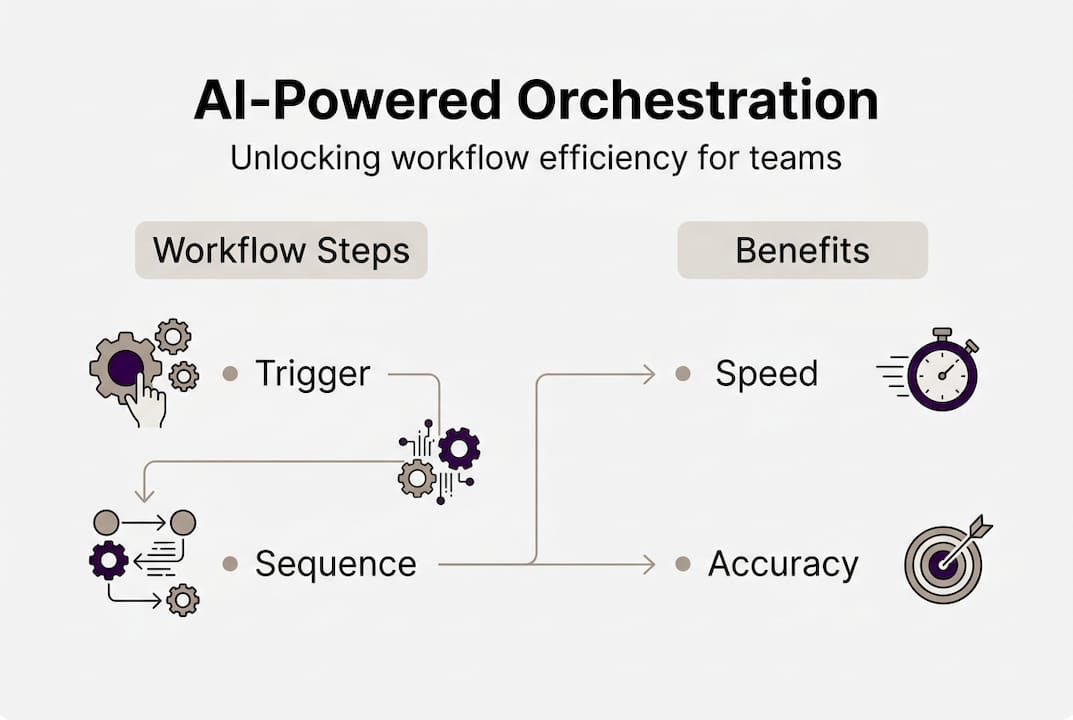
With the concept clear, it helps to understand the actual mechanics. Workflow orchestration involves defining sequences, dependencies, triggers, conditions, state management, retries, error handling, and real-time monitoring. Each of these plays a specific role.
Here is how those components map to real workflow behavior:
| Component | Function | Example |
|---|---|---|
| Trigger | Starts the workflow | New employee record created |
| Sequence | Orders the steps | IT setup before access granted |
| Dependency | Links steps logically | Benefits enrollment after HR approval |
| State management | Tracks progress | Step 3 of 7 complete |
| Retry logic | Handles failures | Reattempts failed API call |
| Monitoring | Flags issues in real time | Alert if step exceeds time limit |
A practical example makes this easier to follow. Consider employee onboarding. Without orchestration, HR sends an email, IT waits for a ticket, payroll sets up accounts manually, and someone eventually remembers to order equipment. With orchestration, a single trigger (a signed offer letter) kicks off a coordinated sequence across HR, IT, payroll, and facilities, each step dependent on the previous one completing successfully.
The numbered steps of a well-designed orchestration flow look like this:
- Trigger fires when a condition is met
- First task executes and reports its status
- Dependent tasks wait for confirmation before proceeding
- Conditional logic routes the workflow based on outcomes
- Errors trigger retries or escalations automatically
- Monitoring captures the full audit trail
Understanding the AI automation types available to your team helps you decide which tasks belong in an orchestrated flow versus which can stay as standalone automations. A solid guide to AI-driven operations can also clarify where orchestration fits within a broader operational strategy.
Pro Tip: Start with a workflow that already has clear steps and handoffs, like client provisioning or invoice approval. These are easier to orchestrate and deliver visible results quickly, which builds internal confidence for larger rollouts.
Common orchestration challenges and pitfalls
Orchestration is not a plug-and-play solution. Real-world deployments run into problems that can slow down or break workflows if not anticipated. Edge cases include downstream service failures, resource exhaustion, silent failures, deadlocks in dependencies, human-in-loop delays, and accuracy drops in complex AI-driven orchestration.
Here are the most common pitfalls operations teams encounter:
- Service failures: A third-party API goes down mid-workflow, and without retry logic, the process stalls silently
- Deadlocks: Two steps each wait for the other to complete, creating a loop that never resolves
- Silent failures: A task appears to complete but produces incorrect output, and no alert fires
- Human-in-the-loop delays: Workflows that require manual approvals can bottleneck at those steps, especially during peak periods
- AI accuracy degradation: As the number of API endpoints in a workflow grows, AI planning accuracy drops significantly
That last point deserves attention. When AI is used to plan or coordinate complex orchestration flows, accuracy drops to 30 to 49% at 300 to 600 endpoints. That is a serious reliability issue for any team depending on consistent output.
The good news is that these risks are manageable with deliberate design. Building in explicit retry logic, compensation steps, and timeout rules reduces the chance of silent failures. Reviewing the future of operational AI helps teams anticipate where AI-driven orchestration is heading and how to design for it now. Staying current on AI trends in office automation also helps managers avoid over-engineering workflows before the technology is ready to support them.
Pro Tip: Map every human approval step in your workflow before you build. If those steps are unavoidable, design time-based escalations so a delayed approval does not freeze the entire process.
Real-world applications: operational orchestration in action
With the challenges in mind, it is worth looking at where orchestration is delivering concrete results for operations teams right now. The use cases are broader than most managers expect.
Here are four high-impact applications for mid-sized companies:
- Invoice processing: Orchestration connects intake, validation, approval routing, and payment scheduling into a single flow, reducing manual touchpoints and payment delays
- Customer onboarding: New client data triggers account setup, welcome communications, system access provisioning, and kickoff scheduling without manual coordination
- Hybrid IT management: Orchestration coordinates tasks across on-premise and cloud environments, keeping both in sync during updates or provisioning events
- Supply chain coordination: Purchase orders, inventory updates, vendor notifications, and shipping confirmations are linked so each step triggers the next automatically
AI adds a layer of adaptability that static orchestration cannot match. When workflow data changes, an AI-driven orchestration system can adjust routing, reprioritize tasks, or flag anomalies without human input. The accuracy improvement is significant: planning accuracy rises from 30 to 49% to 73 to 142% when declarative queries and semantic metadata are used. Semantic metadata means labeling each workflow component with structured, machine-readable descriptions so the AI understands context, not just sequence.
For operations managers, the business value is direct. Fewer bottlenecks mean faster cycle times. Lower admin loads mean your team focuses on decisions rather than data entry. Reviewing AI trends for office operations shows how quickly these capabilities are becoming standard. Exploring end-to-end automation frameworks and working through an AI integration checklist before deployment helps ensure your orchestration investment delivers measurable results.
Why orchestration—not just automation—drives lasting efficiency
Here is what most operations leaders miss: the efficiency ceiling for automation is low. You can automate every individual task in a process and still end up with a fragmented, brittle operation. The real gains come from orchestrating how those tasks connect, depend on each other, and recover from failure.
Many businesses over-invest in point solutions, each solving one problem well, but nobody owns the space between them. That gap is where delays, errors, and admin overhead live. Orchestration fills that gap.
Two details that rarely get enough attention are semantic metadata and failure design. As noted in expert guidance on workflow design, using directed acyclic graphs (DAGs) for dependencies, building explicit retries and compensations, and applying semantic metadata are what separate reliable orchestration from fragile automation chains. These are not advanced features. They are foundational.
Orchestration also prepares your operation for growth. A well-designed AI-driven operations framework scales without requiring proportional increases in headcount or oversight. That is the kind of efficiency that compounds over time, not just a one-time productivity bump.
Take the next step with expert-led orchestration
If your team is running multiple automation tools but still dealing with manual handoffs, approval delays, or inconsistent outputs, the issue is likely a lack of orchestration rather than a lack of automation. Ailerons.ai helps mid-sized operations teams design and deploy agentic AI systems that coordinate workflows end to end. From invoice processing to client onboarding, we build orchestration that connects your existing systems and reduces administrative friction. Explore our AI consulting services to see how we approach workflow design, or see our case studies for real examples of orchestration improving operational efficiency in companies like yours.
Frequently asked questions
How is operational orchestration different from process automation?
Operational orchestration synchronizes whole workflows across systems, while process automation typically focuses on automating individual tasks. Orchestration adds control, dependency management, and cross-system visibility that task-level automation cannot provide.
What are the biggest risks of poorly designed orchestration systems?
The main risks are service failures, silent errors, bottlenecks from human-in-the-loop steps, and decreased accuracy with complex integrations. Designing explicit retry logic and escalation paths mitigates most of these risks before they affect operations.
How can AI improve operational orchestration in companies?
AI makes orchestration more adaptive by learning from workflow data and adjusting task coordination dynamically. AI-driven orchestration can reprioritize steps, flag anomalies, and improve planning accuracy significantly when paired with semantic metadata.
What are some real-life use cases for operational orchestration?
Common use cases include employee onboarding, IT provisioning, invoice processing, and hybrid cloud management. Orchestration coordinates these multi-step processes across departments and systems, reducing manual effort and improving consistency.
Recommended
- Improving Business Workflows with AI: Achieve Automation | Ailerons IT Consulting
- AI-driven operations guide: boost efficiency 72% in 2026 | Ailerons IT Consulting
- Future of Operational AI 2026: Agentic Systems Transforming Work | Ailerons IT Consulting
- 7 Essential Types of AI Automation for Modern Operations | Ailerons IT Consulting