

Most enterprises believe that scaling AI automation simply means deploying more bots across departments. This misconception leads to fragmented workflows, spiraling costs, and stalled pilots. True scalability requires agentic AI systems that reason, plan, and execute multi-step tasks with context awareness and decision logic. Unlike traditional robotic process automation, agentic AI operates with goal orientation and adapts to exceptions in real time. This guide explains how to implement scalable agentic AI automation that delivers measurable efficiency gains, compares leading frameworks, and provides actionable deployment strategies for business leaders and operations managers.
Table of Contents
- Key takeaways
- Understanding scalable agentic AI for enterprise workflows
- Comparing AI agent frameworks and design approaches
- Overcoming scalability challenges with hybrid and agent-centric approaches
- Implementing scalable AI automation: best practices and deployment strategies
- Explore expert AI automation consulting with Ailerons IT
- Frequently asked questions about scalable AI automation
Key Takeaways
| Point | Details |
|---|---|
| Agentic AI shift | Scalable automation shifts from task bots to reasoning and goal oriented systems that manage end to end workflows. |
| Multi Agent Orchestration | Specialized agents coordinate workflow segments, share context, and persist state across sessions. |
| Efficiency gains | Complex workflows can realize 40 to 60 percent efficiency gains versus traditional RPA. |
| Deployment best practices | Start with processes that have clear success metrics and frequent exceptions to maximize ROI and validate value before scaling. |
Understanding scalable agentic AI for enterprise workflows
Scalable agentic AI automation represents a fundamental shift from task-based bots to intelligent systems that manage complete workflows. Traditional RPA executes predefined scripts without context or adaptability. When exceptions arise or processes change, RPA breaks and requires manual intervention. Agentic AI systems reason through problems, maintain state across sessions, and coordinate multiple actions toward defined goals.
Enterprises achieve scalability through Multi-Agent Orchestration (MAO), where specialized agents handle distinct workflow segments while sharing context. State persistence ensures agents remember previous interactions and decisions across sessions. Secure authentication using mTLS-style protocols protects sensitive data flows between agents and enterprise systems. Agentic Token Forecasting (ATFM) prevents token overruns by predicting resource needs before execution.
These technologies enable 40-60% efficiency gains compared to RPA in complex workflows. For example, invoice processing that required three separate RPA bots and manual handoffs now runs through a single agentic system that validates data, routes approvals, updates accounting records, and escalates exceptions automatically. The agent adapts when vendors change formats or approval chains shift without reprogramming.
Common technical challenges include reflection loops where agents get stuck in circular reasoning patterns, token overruns that halt execution mid-task, and state persistence failures that force workflows to restart. Proper architecture addresses these through loop detection mechanisms, dynamic token allocation, and distributed state management across resilient storage.
Pro Tip: Start with workflows that have clear success metrics and frequent exceptions. Agentic AI shows the biggest ROI advantage over RPA when handling variability and edge cases that rigid scripts cannot manage.
Key architectural components for scalable agentic AI include:
- Multi-Agent Orchestration frameworks that coordinate specialized agents
- State persistence layers using distributed databases or cloud-native storage
- Secure authentication protocols that align with enterprise identity standards
- Token forecasting systems that predict and allocate computational resources
- Exception handling logic that escalates to human oversight when needed
Understanding AI in business process management helps contextualize where agentic systems deliver maximum value. Focus on processes with high transaction volumes, multiple decision points, and integration requirements across platforms.
Comparing AI agent frameworks and design approaches
Selecting the right framework determines scalability, deployment speed, and long-term maintenance costs. LangGraph excels in workflows requiring complex sequential branching with 91% accuracy in tool use orchestration. Its graph-based architecture maps decision trees visually, making it ideal for audit trails and compliance-heavy processes. However, LangGraph requires more initial configuration than alternatives.
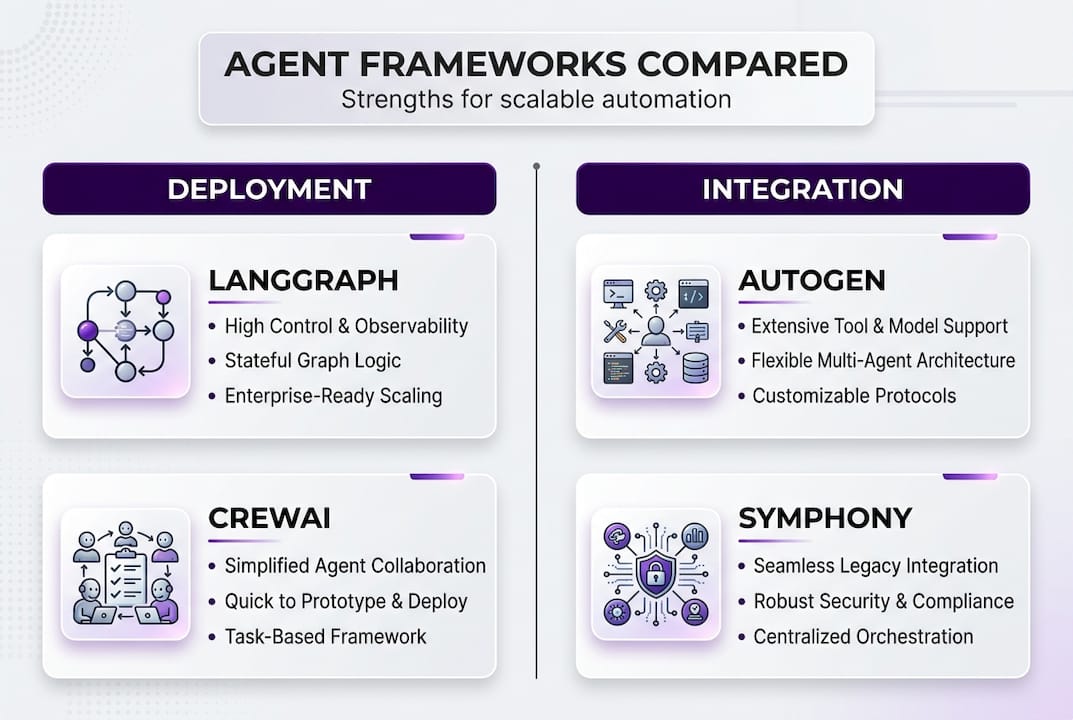
CrewAI prioritizes rapid prototyping with pre-built agent templates and simplified coordination logic. Development teams can deploy basic agentic workflows in days rather than weeks. This speed comes with trade-offs in customization depth and performance optimization for high-volume scenarios. CrewAI works best for pilot projects and proof-of-concept deployments where speed matters more than fine-tuning.
AutoGen specializes in conversational AI workflows where agents interact through natural language exchanges. Its strength lies in customer service automation, internal helpdesk functions, and any scenario requiring nuanced dialogue management. AutoGen handles context switching and multi-turn conversations more gracefully than frameworks optimized for transactional workflows.
OpenAI Symphony leads in multi-agent coordination with 91% efficiency across enterprise integrations. It manages agent communication, resource allocation, and failure recovery across distributed systems. Symphony integrates seamlessly with existing CRM, ERP, and document management platforms through standardized APIs and webhook architectures.
| Framework | Best For | Key Strength | Deployment Speed | Scalability |
|---|---|---|---|---|
| LangGraph | Complex branching workflows | 91% sequential tool use accuracy | Moderate | High |
| CrewAI | Rapid prototyping | Fastest initial deployment | Very Fast | Moderate |
| AutoGen | Conversational AI | Multi-turn dialogue management | Fast | Moderate |
| OpenAI Symphony | Enterprise integration | 91% multi-agent coordination | Moderate | Very High |
Framework choice impacts operational costs beyond initial development. LangGraph and Symphony require specialized expertise but reduce long-term maintenance through robust error handling and monitoring. CrewAI minimizes upfront investment but may need replacement as complexity grows. AutoGen occupies a middle ground with reasonable learning curves and solid performance in its domain.
Exploring future operational AI trends reveals how framework ecosystems evolve. Consider vendor roadmaps, community support, and integration partnerships when making long-term commitments. Enterprises often start with CrewAI for pilots, then migrate to LangGraph or Symphony for production at scale.
Key selection criteria:
- Workflow complexity and branching logic requirements
- Integration needs with existing enterprise systems
- Development team expertise and available training resources
- Budget constraints for initial deployment and ongoing maintenance
- Scalability targets for transaction volumes and concurrent users
Overcoming scalability challenges with hybrid and agent-centric approaches
Scaling agentic AI beyond pilot projects exposes critical infrastructure and design challenges. State persistence failures occur when agents lose context between sessions, forcing workflows to restart and frustrating users. Siloed data across departments prevents agents from accessing the information needed for informed decisions. Reflection token overruns happen when agents enter circular reasoning loops that consume computational resources without progress.

Hybrid automation architectures solve these problems by combining agentic AI for intent recognition and edge case handling with rule-based execution for predictable tasks. Agents identify what needs to happen and route work to the appropriate system, whether another agent, a traditional script, or a human operator. This approach delivers 20-40% cost reduction in back-office operations while maintaining reliability.
For example, accounts payable automation uses agents to interpret invoice formats, validate vendor information against multiple databases, and determine approval routing based on amount and department policies. Once the agent completes analysis, rule-based systems execute the actual payment processing and record updates. This division leverages AI where variability exists and proven automation where consistency matters.
Agent-centric redesign goes further by restructuring workflows around agent capabilities rather than forcing agents into existing processes. This approach yields 2-10x productivity improvements through phased rollouts that progressively expand agent responsibilities. One enterprise reduced audit time by 92% after redesigning compliance workflows to let agents handle document collection, preliminary analysis, and exception flagging while auditors focused on judgment calls.
Successful agent-centric implementations require an Agent OS framework that provides infrastructure for agent lifecycle management, monitoring, and orchestration. Phased rollouts start with low-risk workflows, gather performance data, and expand scope based on measured outcomes. Rushing full automation without validation leads to the 90% pilot failure rate seen across industries.
Pro Tip: Map existing workflows to identify high-variability segments where agents add value versus stable segments where traditional automation suffices. This hybrid design maximizes ROI while minimizing risk.
Common scalability obstacles and solutions:
- State persistence failures: Implement distributed state management with redundant storage and session recovery protocols
- Siloed data access: Deploy unified data layers or API gateways that aggregate information from multiple sources
- Reflection token overruns: Add loop detection logic and token budgets that halt agents before resource exhaustion
- Integration complexity: Use middleware platforms that standardize connections between agents and enterprise systems
- Change resistance: Involve end users early in design and provide transparent monitoring dashboards
Reviewing guides to AI-driven office automation provides additional context on overcoming organizational barriers. Technical solutions alone rarely succeed without addressing process redesign and stakeholder concerns.
Implementing scalable AI automation: best practices and deployment strategies
Successful implementation starts with process audits before introducing any AI agents. Document current workflows, identify pain points, measure baseline performance, and validate that processes actually work as intended. Deploying agents on broken processes amplifies problems rather than solving them. This audit phase reveals whether workflow redesign delivers more value than automation alone.
Change management determines success more than technical capability. Ninety percent of pilots stall on deployment challenges, not technology limitations. Employees need training on working alongside agents, understanding when to intervene, and interpreting agent decisions. Transparent communication about automation goals prevents fear and resistance.
Hybrid approaches should always take priority over full automation replacement. Start by automating 30-40% of workflow tasks where agents show clear advantages. Monitor performance, gather user feedback, and expand gradually. This incremental strategy builds organizational confidence and allows course correction before major resource commitments.
Key metrics during pilot and rollout phases include:
- Task completion rate measuring how often agents finish workflows without human intervention
- Exception handling accuracy tracking whether agents correctly identify and escalate edge cases
- Processing time reduction comparing automated versus manual workflow duration
- Error rate monitoring quality and accuracy of agent outputs
- User satisfaction scores capturing employee and customer experience
- Cost per transaction calculating total automation expenses divided by volume processed
Monitor these metrics weekly during pilots and monthly after production deployment. Set clear thresholds for success and failure that trigger expansion or remediation decisions.
| Common Pitfall | Solution |
|---|---|
| Deploying agents without process fixes | Conduct thorough process audits and remediate broken workflows first |
| Skipping change management | Implement comprehensive training and transparent communication plans |
| Pursuing full automation immediately | Start with hybrid approaches automating 30-40% of tasks |
| Ignoring user feedback | Establish regular feedback loops and act on insights quickly |
| Inadequate monitoring | Deploy real-time dashboards tracking all key performance metrics |
| Underestimating integration complexity | Budget extra time and resources for enterprise system connections |
Deployment timeline expectations vary by organization size and complexity. Mid-sized enterprises typically complete pilot deployments in 8-12 weeks, followed by 3-6 months for production rollout across initial departments. Large enterprises with complex legacy systems may require 12-18 months for comprehensive deployment.
Exploring improvements in business workflows and reviewing AI trends in office operations helps contextualize realistic timelines and resource requirements. Plan for iterative refinement rather than perfect initial deployment.
Explore expert AI automation consulting with Ailerons IT
Implementing scalable agentic AI automation requires expertise in architecture design, framework selection, and organizational change management. Ailerons IT specializes in deploying agentic AI systems that integrate seamlessly with existing enterprise infrastructure while delivering measurable efficiency gains. Our team guides you through process audits, framework evaluation, pilot deployment, and production scaling.
We have helped enterprises across industries achieve significant productivity improvements through intelligent automation. Our managed IT and AI consulting services provide end-to-end support from initial strategy through ongoing optimization. Review our case studies to see how organizations similar to yours have transformed operations with agentic AI. Whether you need help selecting the right framework, designing hybrid architectures, or managing change across your organization, our consultants bring proven methodologies and technical depth to accelerate your automation journey.
Frequently asked questions about scalable AI automation
What is agentic AI and how is it different from traditional RPA?
Agentic AI systems reason through problems, maintain context across sessions, and adapt to exceptions without reprogramming. Traditional RPA executes rigid scripts that break when processes change or unexpected inputs occur. Agentic AI coordinates multiple actions toward goals while RPA simply follows predetermined steps.
How do enterprises ensure AI automation scales without breaking workflows?
Scalability requires Multi-Agent Orchestration with state persistence, secure authentication protocols, and token forecasting to prevent resource overruns. Hybrid architectures combining agentic AI for variability with rule-based execution for predictable tasks maintain reliability while expanding scope. Proper monitoring and phased rollouts catch issues before they impact operations.
What are the risks of deploying fully autonomous agents without hybrid approaches?
Fully autonomous agents without human oversight can make incorrect decisions in edge cases, amplify errors across workflows, and create compliance risks in regulated industries. Hybrid approaches keep humans in the loop for judgment calls while automating routine tasks. This balance maximizes efficiency while maintaining control and accountability. Understanding AI in business process management helps identify where autonomy makes sense versus where oversight remains critical.
How long does a typical AI automation rollout take in mid to large enterprises?
Mid-sized enterprises complete pilot deployments in 8-12 weeks, with production rollout across initial departments taking 3-6 months. Large enterprises with complex legacy systems typically require 12-18 months for comprehensive deployment. Timeline depends on process complexity, integration requirements, and organizational change management effectiveness.
What metrics indicate successful AI automation adoption?
Key success metrics include task completion rates above 85%, exception handling accuracy exceeding 90%, processing time reductions of 40-60%, error rates below 2%, user satisfaction scores above 4 out of 5, and cost per transaction decreasing by 20-40%. Monitor these metrics weekly during pilots and monthly in production to validate ROI and identify optimization opportunities.
Recommended
- Improving Business Workflows with AI: Achieve Automation | Ailerons IT Consulting
- Step-by-Step Guide to AI-Driven Office Automation Success | Ailerons IT Consulting
- 6 Key Tips for Scaling Business Automation in Healthcare | Ailerons IT Consulting
- Master the Administrative Task Automation Process Today | Ailerons IT Consulting