

TL;DR:
- Effective compliance management depends on thorough process mapping and prioritizing controls with high frequency and risk. Automation tools should focus on evidence collection, workflow integration, and continuous monitoring to reduce manual effort and improve accuracy. Long-term success requires strong leadership, cross-team alignment, ongoing review, and cultural commitment to sustain improvements.
Compliance teams are under more pressure than ever. Regulations multiply, evidence requests pile up, and manual workflows consume hours that should go toward risk assessment and strategic decisions. Learning how to streamline compliance tasks is not a nice-to-have. It is the difference between a compliance program that keeps pace with your organization and one that creates constant friction and exposure. This guide walks through every stage of the process, from mapping your obligations to sustaining long-term efficiency, with practical steps you can apply immediately.
Table of Contents
- Key Takeaways
- How to streamline compliance tasks: start with a complete map
- Prioritizing which compliance workflows to address first
- Implementing automation and integration tools
- Organizational and cultural strategies for sustained compliance efficiency
- Monitoring, verifying, and improving over time
- My take on where most compliance programs go wrong
- See how Ailerons clients have improved compliance workflows
- FAQ
Key Takeaways
| Point | Details |
|---|---|
| Map before you automate | Document every regulation, control, and data source before touching any automation tool. |
| Prioritize by frequency | Focus automation on monthly and quarterly controls first to get the highest return on investment. |
| Integrate your data systems | Connect compliance tools to your existing platforms to eliminate manual collection and reduce errors. |
| Culture drives sustainability | Technology alone will not sustain improvements. Executive sponsorship and team adoption are equally important. |
| Monitor continuously | Real-time visibility catches issues early and significantly reduces audit preparation time. |
How to streamline compliance tasks: start with a complete map
You cannot fix what you have not fully documented. Before selecting a single tool or reassigning any task, your team needs a clear picture of every obligation the organization carries. That means cataloging applicable regulations, internal policies, and the controls that address each one.
Start by listing every regulatory requirement relevant to your industry and jurisdiction. Then map each requirement to the specific controls your organization uses to meet it. For many teams, this exercise alone surfaces redundancies. Two separate teams may be collecting the same evidence for different frameworks, or a control may have been designed for a legacy system that no longer exists.
A thorough mapping exercise should also identify where your evidence comes from. Which systems generate the data? Who owns each data source? Process-forward compliance transformation requires mapping laws to risks and controls before any automation work begins, specifically to avoid reinforcing broken processes.
- List every active regulation, policy, and standard your organization must satisfy
- Assign ownership to each control so accountability is clear from the start
- Document the current evidence collection method for every control, whether manual or automated
- Flag duplicate processes where multiple teams handle overlapping obligations
- Identify data sources and confirm whether they can feed directly into a compliance platform
Pro Tip: Use your compliance map as a living document. Review it quarterly and update it whenever regulations change or your technology stack shifts. This keeps your automation targets accurate and prevents drift between your controls and your actual obligations.
Prioritizing which compliance workflows to address first
Not every compliance task deserves the same level of attention or the same automation investment. Trying to automate everything at once is one of the most common mistakes organizations make, and it typically results in delays, cost overruns, and frustrated teams.
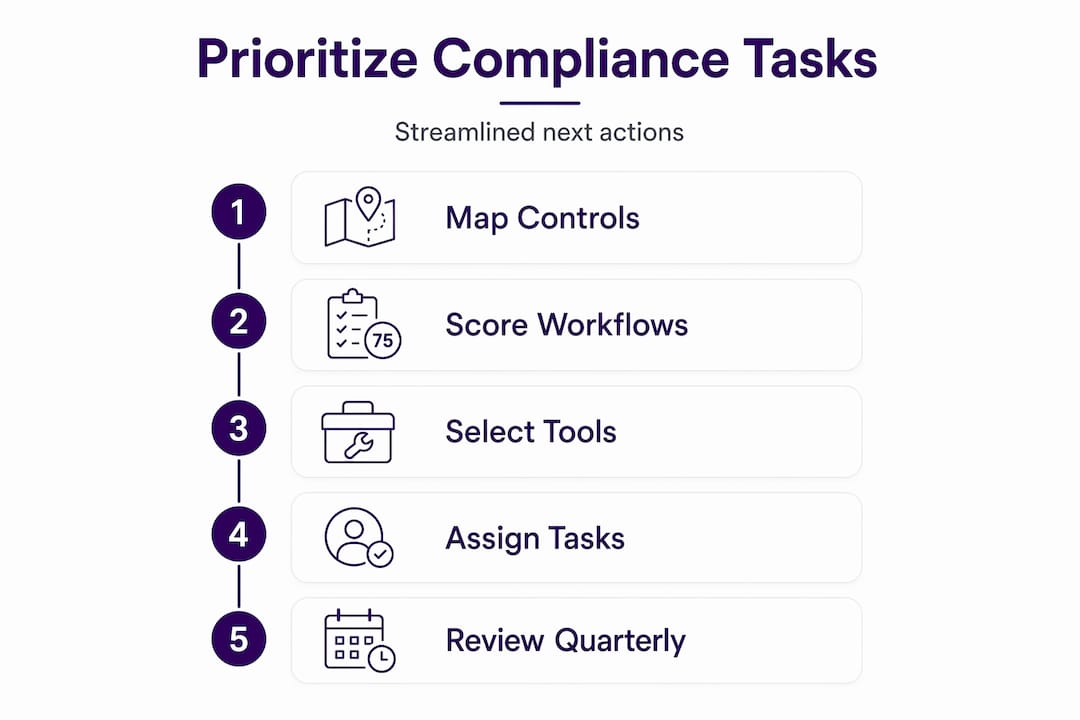
The most reliable approach is to sort controls by two dimensions: how frequently they are tested and how significant the risk impact is if they fail. Controls tested monthly or quarterly are your highest-priority candidates for automation because the ROI for frequent controls is substantially higher than for annual controls with minimal evidence requirements. A monthly access review that requires pulling user lists from three systems and emailing them to a manager is exactly the kind of task that pays back automation investment quickly.
Annual controls, by contrast, often involve judgment-heavy assessments or narrative documentation that does not benefit much from automation. Putting significant resources into automating a once-per-year policy review rarely moves the needle.
- Rank controls by testing frequency: monthly, quarterly, semi-annual, and annual
- Score each control by risk impact if it fails or is executed late
- Target the intersection of high frequency and high risk first
- Hold off on automating low-frequency or highly narrative controls until high-priority items are complete
- Apply a zero-based redesign approach to eliminate legacy structures that exist only out of habit
Pro Tip: Build a simple scoring matrix in a spreadsheet before you commit to any platform purchase. Frequency multiplied by risk score will rank your controls and give you an objective prioritization list that is easy to defend to leadership.
Implementing automation and integration tools
This is where the plan becomes operational. Once you know which controls to target, the focus shifts to selecting the right technology and connecting it to your existing systems. The goal is to reduce the amount of manual effort required to collect evidence, track exceptions, and generate reports.
The types of compliance tasks most suited to automation include:
- Evidence collection from cloud infrastructure, identity management systems, and HRIS platforms. These systems generate logs and reports automatically. The task is connecting them to your compliance platform via API so evidence arrives without anyone having to pull it manually.
- Training completion tracking, where the system monitors who has completed required training and sends reminders or escalations without manual intervention.
- Access review workflows, where user access lists are pulled, routed for manager approval, and documented automatically.
- Policy attestation cycles, where staff receive, acknowledge, and return policy documents through an automated workflow rather than email chains.
- Alert and exception routing, where the system flags anomalies and routes them to the right owner based on predefined rules.
Integration depth matters enormously here. Manual tracking bottlenecks are the primary obstacle to compliance efficiency, and connecting your compliance platform directly to your data sources is the fix. A platform that cannot connect to your cloud provider, your ticketing system, or your HR software will create its own category of manual work.
One benefit that organizations consistently undervalue is continuous monitoring. Automated continuous monitoring cuts audit preparation time by 40 to 60 percent, and yet only 28% of organizations currently use real-time controls monitoring. The shift from point-in-time testing to continuous monitoring changes audit preparation from a multi-week scramble into a reporting exercise.

Automation does not eliminate the need for human judgment. It eliminates the busywork so your team can apply that judgment where it actually matters. Compliance automation removes 60 to 80 percent of repetitive tasks, freeing staff for risk assessment and investigation work that requires contextual understanding. Tasks like third-party risk assessments, regulatory interpretation, and escalation decisions still require a trained professional. Understanding AI tasks suited for automation can help teams draw that line more precisely.
Pro Tip: Choose API-driven integrations over file-based imports wherever possible. File-based processes break when formats change, require scheduled maintenance, and create gaps in evidence continuity. APIs are more reliable and scale with your environment.
Organizational and cultural strategies for sustained compliance efficiency
Technology produces results only when the people using it are aligned with the change. Compliance programs that invest heavily in tools and lightly in adoption typically see initial gains followed by quiet regression back to old habits.
The starting point is executive sponsorship. Leaders who visibly support the program and communicate its value send a signal that this is not another IT project. It is a change to how the organization manages risk. Successful sustainability of compliance improvement depends equally on culture change and technology adoption, with strong executive sponsorship as the critical differentiator.
Cross-functional alignment is equally important. Compliance rarely owns all the systems or teams it depends on. IT, HR, finance, and operations each hold data sources that feed your compliance workflows. Breaking down those silos requires structured communication, shared objectives, and clear agreements about data ownership and access.
- Appoint a compliance efficiency lead who is accountable for adoption metrics, not just technical deployment
- Conduct brief training sessions focused on the specific workflow changes each team will experience
- Create feedback channels so teams can report friction points early, before workarounds become ingrained habits
- Set KPIs for compliance workflow health: average evidence collection time, control failure rates, and remediation cycle times
- Celebrate measurable wins publicly so teams see the direct connection between adoption and reduced workload
Pro Tip: Do not rely solely on training sessions. Build efficiency into the workflow itself. When the automated path is also the easiest path, adoption follows naturally. Design for convenience, not just compliance.
Monitoring, verifying, and improving over time
Deploying automation is not the finish line. Compliance obligations shift, systems change, and new risks emerge. A program built without ongoing verification will drift out of alignment with the regulatory environment it was designed to address.
Real-time dashboards are the most practical tool for maintaining visibility. When control owners can see the current state of their controls at any moment, exceptions get caught early rather than discovered during an audit. The table below outlines the key metrics a compliance team should track on a regular basis.
| Metric | Measurement approach | Review frequency |
|---|---|---|
| Control failure rate | Percentage of controls failing in a given period | Monthly |
| Evidence collection lag | Time between control event and evidence availability | Weekly |
| Remediation cycle time | Average days to close a finding | Monthly |
| Audit preparation time | Hours required to prepare for an internal or external audit | Per audit cycle |
| Automation coverage | Percentage of controls with automated evidence collection | Quarterly |
Review your automation rules whenever a regulation changes or a new framework requirement is introduced. Automated rules that were accurate when written can become inaccurate as systems are updated or business processes change. Build a formal review trigger into your change management process so that system updates automatically prompt a compliance rule review.
Manual review remains important in specific situations. Complex exceptions that fall outside the predefined rules, regulatory guidance that is open to interpretation, and any finding with potential legal or financial significance should always include a trained compliance professional in the decision.
Pro Tip: Share dashboard metrics with business unit leaders, not just the compliance team. When department heads see how their teams’ behavior affects control health scores, they tend to take ownership of outcomes rather than treating compliance as someone else’s problem.
My take on where most compliance programs go wrong
I’ve worked with compliance programs across different industries, and the pattern I see most often is this: organizations buy technology to solve what is actually a process problem.
When a team is drowning in manual evidence collection, the reflex is to find a tool that automates it. But if the underlying process is poorly designed, automating it just means producing the wrong output faster. The foundational step is always process design first, technology second. I’ve seen expensive platforms sit underused because no one cleaned up the workflow before the tool was deployed.
The other thing I’ve observed is that cultural resistance is consistently underestimated. Teams that have operated a certain way for years do not change because a new platform was installed. They change when leadership consistently reinforces the new approach and when the new workflow is genuinely easier than the old one. In my experience, the compliance programs that sustain their efficiency gains are the ones where the chief compliance officer is actively involved in the change, not just the rollout.
The tension between efficiency and effectiveness is real. Moving faster through compliance tasks is only valuable if the quality of evidence and judgment stays high. The best programs I’ve seen treat automation as a floor, not a ceiling. They automate the routine so their team can invest more time in the work that requires genuine expertise.
— Sam
See how Ailerons clients have improved compliance workflows
Organizations that work with Ailerons have achieved measurable reductions in manual compliance workload by deploying agentic AI systems designed to reason through multi-step tasks, not just execute scripts. These systems connect to existing platforms, collect evidence automatically, route exceptions, and update records across tools without requiring staff to manage each step manually.
If you are evaluating how to improve your compliance workflow with AI, reviewing real implementation outcomes is a practical starting point. The Ailerons case studies cover specific scenarios across industries, with documented results on audit preparation time, manual task reduction, and control coverage. Explore the case studies to see which scenarios match your organization’s current challenges.
FAQ
What does it mean to streamline compliance tasks?
Streamlining compliance tasks means reducing the manual effort, redundancy, and delay in how your organization meets regulatory obligations. It typically involves mapping workflows, automating evidence collection, and integrating compliance tools with existing data systems.
Which compliance tasks are easiest to automate first?
Controls tested monthly or quarterly yield the highest automation ROI, including access reviews, training tracking, and evidence collection from cloud systems. Annual or narrative-heavy controls are lower priority for initial automation.
How much time can automation save in compliance management?
Automated continuous monitoring reduces audit preparation time by 40 to 60 percent, and automation removes 60 to 80 percent of repetitive compliance tasks, freeing staff for higher-value work.
Does automating compliance create new risks?
Automation can create risk if applied to poorly designed processes or without ongoing rule maintenance. Human review should remain in place for exceptions, regulatory interpretation, and high-stakes findings to maintain compliance quality.
How do you sustain compliance efficiency over time?
Sustained efficiency requires both technology and cultural alignment. Regular metric reviews, executive sponsorship, cross-team communication, and periodic automation rule updates keep the program accurate as regulations and systems evolve.
Recommended
- AI Compliance in Business: Mitigating Risks for Healthcare Operations | Ailerons IT Consulting
- Process Automation Tutorial for Agentic AI in Compliance Workflows | Ailerons IT Consulting
- Step-by-step workflow automation guide for business leaders | Ailerons IT Consulting
- Secure AI Systems for Compliance: Minimizing Regulatory Risks | Ailerons IT Consulting