

TL;DR:
- Implementing digital Lean tools in mid-sized factories can significantly improve operational metrics and save costs. Successful transformation depends on thorough assessment, combining Lean, Six Sigma, and agentic AI within a strong cultural framework. Ongoing measurement, leadership commitment, and employee engagement are essential for sustaining long-term operational excellence.
A mid-sized factory applied digital Lean tools and improved OEE from 59% to 73%, cut lead time by 25%, reduced scrap by 22%, and saved over $480,000 annually. That kind of result is not reserved for large enterprises with deep pockets. SMBs and mid-market companies can reach similar outcomes when they combine structured improvement frameworks with the right technology. This guide walks you through each step, from assessing your current operations to sustaining gains over time, with agentic AI and Lean principles as the primary tools.
Table of Contents
- Assessing your current operations: What you need to know
- Choosing frameworks and technology: Lean, Six Sigma, and agentic AI
- Executing your improvement plan: Step-by-step instructions
- Measuring results and optimizing: Common mistakes and verification
- Why culture outpaces technology: Our hard-earned lessons
- Explore next steps with Ailerons IT Consulting
- Frequently asked questions
Key Takeaways
| Point | Details |
|---|---|
| Baseline assessment | Collecting operational data upfront lets you measure improvements and spot bottlenecks quickly. |
| Framework synergy | Combining Lean, Six Sigma, and agentic AI brings both speed and sustainability to operational gains. |
| Stepwise execution | Following a clear, step-by-step plan makes complex improvements manageable and repeatable. |
| Culture matters | Sustained efficiency only happens when employees are empowered and leadership drives change. |
| Continuous measurement | Ongoing tracking of KPIs and regular reviews ensures that gains aren’t lost over time. |
Assessing your current operations: What you need to know
Before you can improve anything, you need to know exactly where the problems are. Many operations managers skip this step or rely on gut feel. That approach leads to solutions aimed at the wrong problems, which wastes both time and budget.
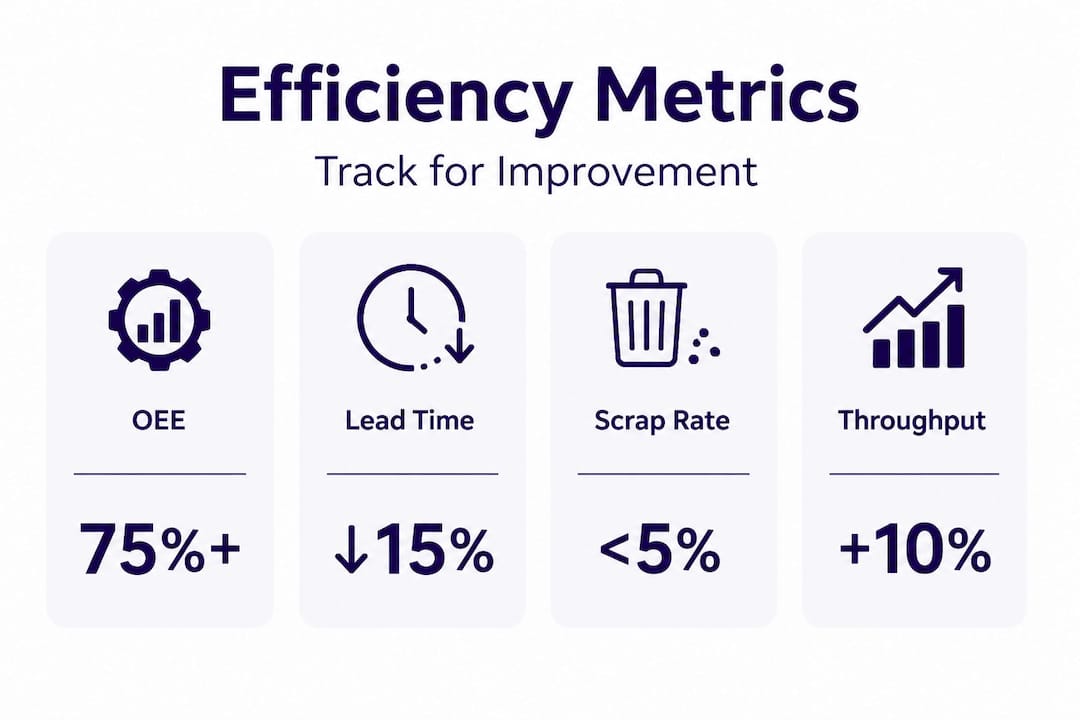
The three most important efficiency indicators to measure are Overall Equipment Effectiveness (OEE), lead time, and scrap or error rates. OEE measures how much of your planned production time is truly productive. Lead time tracks how long it takes to move work from start to finish. Scrap or error rates reveal how much rework, waste, or rejected output your processes generate. Tracking all three together gives you a reliable picture of operational health.
Baseline metrics to collect before you start
| Metric | What it measures | Why it matters |
|---|---|---|
| OEE (%) | Productive uptime vs. planned time | Reveals hidden capacity losses |
| Lead time (days/hours) | Start-to-finish workflow duration | Highlights bottlenecks and delays |
| Scrap/error rate (%) | Rework and rejected output | Quantifies quality and cost waste |
| Cost per unit | Total cost divided by output | Benchmarks process efficiency |
| Employee time on manual tasks | Hours spent on non-value work | Identifies automation opportunities |
To collect this data, you need process mapping and real-time data collection tools. Process mapping means visually tracing every step of a workflow, including handoffs, approvals, and wait times. This can be done with simple flowchart tools or more advanced platforms that connect to your existing systems. Real-time data collection removes the lag that comes with manual reporting and gives you accurate numbers to work with.
Key areas to examine during your assessment:
- Handoff delays: Where does work sit waiting for the next person to act?
- Manual data entry: Which tasks require employees to re-enter information across systems?
- Approval bottlenecks: Which decisions slow down workflows unnecessarily?
- Inconsistent outputs: Where do results vary depending on who is doing the work?
- Redundant steps: Which tasks are duplicated across departments or systems?
Understanding how AI transforms efficiency starts with knowing which of these problems cost you the most. There is no point automating a low-impact task when a higher-impact bottleneck sits upstream.
Combining this assessment with proven digital transformation strategies gives you a roadmap that is both realistic and properly scoped for your organization’s size.
Pro Tip: Collect at least four weeks of baseline data before implementing any new technology. One week is rarely enough to account for normal variation in your operations, and decisions made on thin data often produce changes that do not hold.
Choosing frameworks and technology: Lean, Six Sigma, and agentic AI
Once your current baseline is clear, the next step is to choose the right improvement frameworks and technologies. Three approaches dominate this space: Lean, Six Sigma, and agentic AI. Each has a different focus, and combining them produces better results than using any one in isolation.
Comparing improvement approaches
| Approach | Primary focus | Best suited for | Key limitation |
|---|---|---|---|
| Lean | Eliminating waste and speeding flow | Process streamlining, lead time reduction | Requires sustained cultural commitment |
| Six Sigma | Reducing variation and defects | Quality control, error reduction | Data-intensive and can be slow |
| Agentic AI | Autonomous task execution and coordination | Repetitive workflows, multi-step processes | Requires integration work upfront |
| Combined approach | All of the above, with reinforcing feedback | Operations with multiple problem types | Higher initial complexity |
Lean focuses on removing steps that do not add value to the customer. It is practical and fast to implement at a surface level, but it requires consistent follow-through to sustain. Six Sigma uses statistical methods to identify the root causes of defects and variation. It is more rigorous but also more time-consuming. Agentic AI automates entire workflows, not just single tasks, by reasoning through multi-step processes and making decisions based on context. You can read about the types of AI automation to better understand where each fits in your operations.
The financial case is strong. Lean Six Sigma yields up to 300% ROI for SMBs, with documented examples of $200,000 in savings from a $50,000 investment. Those numbers hold when the implementation is disciplined and focused on high-impact areas.
Security is also a consideration when deploying new technology. Reviewing current security automation trends ensures that efficiency gains are not offset by new vulnerabilities introduced through system integrations.
Key factors when selecting your approach:
- Volume of repetitive tasks: Higher volume favors agentic AI
- Severity of quality issues: Significant defect rates favor Six Sigma
- Process complexity: Multi-department workflows benefit most from Lean combined with AI
- Speed of results needed: Lean produces quicker wins; Six Sigma requires longer timelines
- Available data: AI and Six Sigma both need good data pipelines to function well
Useful AI efficiency tips can help you prioritize where to focus your technology investment for the fastest return.
Pro Tip: Do not treat Lean and AI as competing strategies. Lean identifies which tasks to eliminate or simplify, and agentic AI takes over the tasks that remain. This combination reduces waste and accelerates execution simultaneously.
Executing your improvement plan: Step-by-step instructions
With your frameworks and technologies ready, it is time to take practical action and implement your improvement plan. Execution is where most efficiency projects either gain momentum or stall. The difference usually comes down to how well the team is prepared and how clearly responsibilities are assigned.
-
Define the target workflow. Choose one specific workflow to improve first. Starting broad leads to confusion. A focused first project builds confidence and creates a replicable model.
-
Map the current state in detail. Walk every step of the workflow with the people who actually do the work. Capture wait times, decision points, and system handoffs. This step uncovers hidden inefficiencies that are not visible from a management perspective.
-
Identify the three highest-impact changes. Not every inefficiency deserves equal attention. Focus your first changes on the steps that cause the most delay, cost, or errors.
-
Deploy agentic AI for repeatable tasks. Once you know which steps are stable enough to automate, integrate agentic AI to handle scheduling, document processing, approvals, and record updates. Review an AI-driven operations guide to understand deployment options and integration requirements.
-
Train and involve your team. Explain what the changes are, why they are being made, and how employee roles will shift. Resistance to change is almost always a communication failure, not a technology problem.
-
Run a pilot before full deployment. Test the new process in one team or department before scaling. Pilots catch integration problems and usability issues before they affect the whole organization.
-
Monitor and adjust in real time. Use dashboards connected to your process data to track results from day one. Early signals help you course-correct before small issues become large ones.
Understanding end-to-end AI automation is useful here, particularly for workflows that span multiple systems or departments. Staying current on office operations trends also helps you anticipate what your team will need as the implementation scales.

Compliance matters at every stage. Understanding why automating compliance reduces both risk and administrative burden is relevant when deploying AI in regulated environments.
The culture dimension is often underestimated. The Shingo Model teaches that sustainable operational excellence depends on leading with humility, respecting individuals, applying scientific thinking, and building quality at the source. Without these cultural foundations, Lean tools decay over time even when they produce short-term results.
“Lean alone decays without culture. Operational excellence requires both disciplined tools and a leadership model that sustains them through daily behavior.” — Zephyr Groups Guide to Operational Excellence
Pro Tip: Involve employees in designing the new workflows, not just following them. People who help build a process understand it better and defend it when pressure to cut corners arises.
Measuring results and optimizing: Common mistakes and verification
After implementation, ongoing measurement and course corrections ensure operational gains are sustainable. Many organizations celebrate early wins and then quietly drift back to old habits. Structured measurement prevents that.
KPI tracking framework
| KPI | Measurement frequency | Target benchmark | Review owner |
|---|---|---|---|
| OEE | Weekly | Above 75% | Operations manager |
| Lead time | Weekly | 20-30% reduction from baseline | Process lead |
| Cost per unit | Monthly | Steady decline over 6 months | Finance and ops |
| Error/scrap rate | Weekly | Less than 2% for most processes | Quality lead |
| Employee hours on manual tasks | Monthly | 30-50% reduction after AI deployment | HR and ops |
Track these metrics against your original baseline. The comparison is what makes the improvement visible and credible to leadership and stakeholders. Reviewing your AI integration checklist periodically ensures your systems are still operating as intended after initial deployment.
Common mistakes that derail efficiency projects:
- Measuring too early: Expecting results in week two is unrealistic. Most process changes need six to eight weeks to stabilize.
- Tracking the wrong KPIs: Measuring activity instead of outcomes. Counting how many tasks AI completed matters less than whether lead time actually dropped.
- Ignoring culture signals: Declining participation in process reviews or increasing workarounds are signs that cultural alignment is slipping.
- Over-automating before stabilizing: Adding AI to a broken process speeds up the broken parts. Fix the process first, then automate.
- Skipping retrospectives: Monthly reviews that examine what worked and what did not are the primary mechanism for continuous improvement.
As research on operational excellence confirms, efficiency is contextual, not universal. A practice that works in one supply chain context may not transfer directly to another. This is why measurement must be specific to your workflows, not borrowed from industry averages.
Firms that have used intelligent automation in administrative functions report significant results. One tracked case shows admin overhead cut by 72% after deploying AI across document handling and approval workflows, which illustrates what sustained measurement and iteration can produce.
Pro Tip: Schedule quarterly process reviews that examine both your numbers and your culture. If your KPIs look good but your team is disengaged, you are one reorganization away from losing the gains you worked hard to achieve.
Why culture outpaces technology: Our hard-earned lessons
The conventional narrative around efficiency projects puts technology at the center. Buy the right software, implement the right framework, and results will follow. That framing is incomplete. In practice, technology accelerates gains that culture has already made possible. Without the cultural foundation, even the best tools underperform.
We have observed this pattern repeatedly. Organizations deploy Lean tools with genuine enthusiasm. Early results are strong. Then, over the following 12 to 18 months, the gains erode. Employees find workarounds. Leaders stop reviewing the metrics. The tools are still in place, but the behavior has reverted. This is not a technology failure. It is a culture failure.
The Shingo Model’s emphasis on cultural leadership over tool adoption points to a hard truth: people sustain behaviors when they understand the reasoning behind them and feel respected in the process. Lean alone, deployed as a set of instructions without genuine leadership buy-in, decays. It does not matter how sophisticated the tooling is.
Agentic AI changes the calculus somewhat. Unlike static automation tools, agentic AI can adapt to changing conditions and surface exceptions that require human judgment. This flexibility means it is more resilient than rigid scripts when processes evolve. But even agentic AI requires people to trust it, maintain it, and act on the information it surfaces. That trust is a cultural product.
The uncomfortable lesson is that operations managers who invest the same energy in cultural alignment as they do in technology selection consistently outperform those who do not. This means communicating change clearly, creating channels for employee feedback, celebrating process wins publicly, and holding leaders accountable for modeling the behaviors they expect from their teams.
Understanding the future of operational AI matters, but so does recognizing that the organizations who use it best are the ones where people and AI systems work together rather than around each other.
Technology accelerates. Culture sustains. You need both, in that order.
Explore next steps with Ailerons IT Consulting
If the steps in this guide resonate with where your organization is headed, seeing how these strategies have worked in real deployments can make the path forward clearer. Ailerons.ai designs and deploys agentic AI systems built specifically for office and operational workflows, including document management, approvals, scheduling, billing support, and compliance-driven processes. Our work is grounded in measurable outcomes, not theoretical frameworks. Browse the Ailerons case studies to see how mid-market firms have reduced friction, cut manual workloads, and improved process consistency with agentic AI. When you are ready to discuss your specific workflows, our team is available for a direct consultation.
Frequently asked questions
What are the most important KPIs for operational efficiency?
Key metrics include Overall Equipment Effectiveness, lead time, and cost savings per unit. A documented example shows OEE improving from 59% to 73%, with $480,000 in annual savings from applying these metrics consistently.
How does agentic AI help improve operational efficiency?
Agentic AI automates multi-step workflows, reduces manual task volume, and enables real-time decision-making by reasoning through context rather than following rigid scripts. It can manage approvals, scheduling, and document processing from start to finish without human intervention for routine cases.
What is the typical ROI from Lean Six Sigma in SMBs?
SMBs that implement Lean Six Sigma correctly often see up to 300% ROI, with concrete examples showing $200,000 in savings generated from a $50,000 initial investment.
Why do efficiency projects fail in mid-market firms?
The most common causes are poor cultural alignment, insufficient employee engagement, and an over-reliance on tools without leadership follow-through. As research confirms, Lean tools decay without culture to reinforce them over time.
How often should process optimization be reviewed?
Quarterly reviews are the standard best practice, covering both KPI performance and cultural indicators. This frequency is sufficient to catch drift early and adapt to changes in business conditions without creating review fatigue.
Recommended
- 6 actionable tips for AI-driven operational efficiency | Ailerons IT Consulting
- How AI transforms operational efficiency for SMBs | Ailerons IT Consulting
- AI-driven operations guide: boost efficiency 72% in 2026 | Ailerons IT Consulting
- Step-by-step workflow automation guide for business leaders | Ailerons IT Consulting
- Avtomatizacija prodajnega procesa: povečajte prodajno učinkovitost - ChatTrips
- Operational Efficiency in Manufacturing: Real-Time Impact