

TL;DR:
- Effective healthcare AI requires seamless workflow integration, compliance, usability, and clear ROI.
- Pilot projects show measurable efficiency gains, but organizational adoption needs strategic change management.
- Barriers to routine use include workflow friction, automation bias, poor system integration, and inadequate training.
Healthcare administrators and IT leaders face a difficult reality: AI automation tools are multiplying fast, but identifying which ones actually reduce operational burden and deliver measurable results is genuinely hard. The pressure to improve efficiency is real. Administrative costs account for a significant and growing share of healthcare spending, and manual workflows continue to drain staff time that could be directed toward patient care. This article presents concrete, evidence-backed examples of agentic AI automation in healthcare, with practical comparison data and evaluation criteria to help you make informed decisions about where to invest and what to expect.
Table of Contents
- How to evaluate healthcare AI automation solutions
- Automated patient billing response: Stanford Health Care case
- Medical record automation: OCR + generative AI case study
- Automating prior authorization letter writing: benchmarking insights
- Deployment gap: barriers to adoption and routine use
- The real challenge: From pilot success to organization-wide impact
- See agentic AI automation in action
- Frequently asked questions
Key Takeaways
| Point | Details |
|---|---|
| Usability drives adoption | Solutions only deliver ROI if they fit into real clinical workflows with minimal friction. |
| Quantified pilot results | Pilots like Stanford’s billing response automation saved measurable hours, guiding decision-makers. |
| Medical record automation impact | OCR + generative AI reduced record review time by 40% across hundreds of cases. |
| Error modes are real | AI automation needs benchmarking for accuracy, coding discipline, and documentation completeness. |
| Deployment gap remains | Less than 15% of purchased AI devices end up in routine use because of workflow and usability barriers. |
How to evaluate healthcare AI automation solutions
Selecting the right AI automation solution is not just a technology decision. It is an operational one. The tools that perform well in a vendor demo often behave very differently when deployed inside real clinical and administrative workflows. Before examining specific use cases, it helps to understand the criteria that matter most when evaluating these platforms.
Key evaluation criteria for healthcare AI automation:
- Clinical and administrative workflow integration. The solution must fit how your teams actually work, not how a vendor assumes they work. Integration with existing scheduling, billing, EHR, and document platforms is essential.
- Regulatory compliance and security. Any tool handling patient data must align with HIPAA requirements. Reviewing compliance and security standards before shortlisting vendors saves significant time downstream.
- Usability and interface design. A tool your team avoids using delivers zero value. Usability is not a soft consideration.
- Exception handling and transparency. Can the system recognize when it does not know something and escalate appropriately? Transparency in decision logic matters for audit trails and accountability.
- Return on investment. Define your baseline metrics before piloting. Without a clear before-and-after picture, ROI claims are difficult to verify.
One critical insight from recent clinical AI research: even highly capable AI may fail to deliver efficiency if it does not fit comfortably inside clinicians’ workflows. The deployment gap and human factors such as workflow friction, shadow usage, and automation bias risk can entirely negate expected ROI. This is not a minor footnote. It is one of the most important findings in current AI implementation research, and it should shape how you structure pilots and rollouts.
You can use a detailed AI automation checklist to systematically assess vendors against these dimensions before committing resources.
Pro Tip: Always test automation tools in a limited pilot with real users and real data before broader rollout. Identify workflow friction early, when adjustments are still inexpensive to make.
The goal at evaluation stage is not to find the most technically impressive solution. It is to find the solution that fits your workflows, clears your compliance requirements, and can actually be adopted by the people who will use it daily.
Automated patient billing response: Stanford Health Care case
With evaluation criteria in mind, let’s look at a practical automation use case from Stanford Health Care that illustrates both the potential and the measurable gains that agentic AI can deliver in administrative settings.
Stanford Health Care launched a pilot program in which an AI tool automatically generated draft responses to patient billing inquiries. The pilot involved ten billing representatives and one thousand patient messages. The results were direct and quantifiable.
What the pilot showed:
- Each billing representative saved approximately one minute per message using AI-generated drafts.
- Across one thousand messages, that added up to roughly seventeen hours of saved staff time in the pilot phase alone.
- Representatives could review, edit, and send the AI-generated draft rather than composing responses from scratch, reducing both cognitive load and response time.
- Patient inquiry response rates improved because staff could handle higher message volume without additional headcount.
The Stanford billing pilot is a strong example of targeting a specific, well-defined task: drafting responses to a predictable category of patient messages. This is exactly the kind of automation that scales well. Billing inquiries follow patterns. They reference account numbers, dates, amounts, and coverage questions. An AI system trained on those patterns can generate accurate, useful drafts with high consistency.
Why this type of automation works:
- The task is repetitive and rule-bound, making it highly suitable for AI assistance.
- The output is a draft, not a final action, keeping a human in the loop for quality control.
- Time savings are immediate and measurable, making ROI easy to document.
- Staff adoption is straightforward because the tool reduces effort rather than changing the fundamental nature of the work.
This use case also points to a broader principle in AI for billing workflows: start with low-complexity, high-volume tasks. The combination of frequency and predictability is what makes automation cost-effective in the early stages.
Pro Tip: Automate low-complexity, high-volume tasks first. Early wins build staff confidence, demonstrate ROI clearly, and create organizational momentum for broader automation efforts.
Scaling from a ten-person pilot to an organization-wide deployment does require attention to consistency in AI training data, oversight protocols, and quality review. But the Stanford example demonstrates that measurable efficiency gains are achievable even in a relatively small, controlled pilot.
Medical record automation: OCR + generative AI case study
Another high-impact example involves automating medical record review, specifically the processing of outside medical records (OMR), which are records received from external institutions that must be reviewed and integrated into a patient’s care plan.
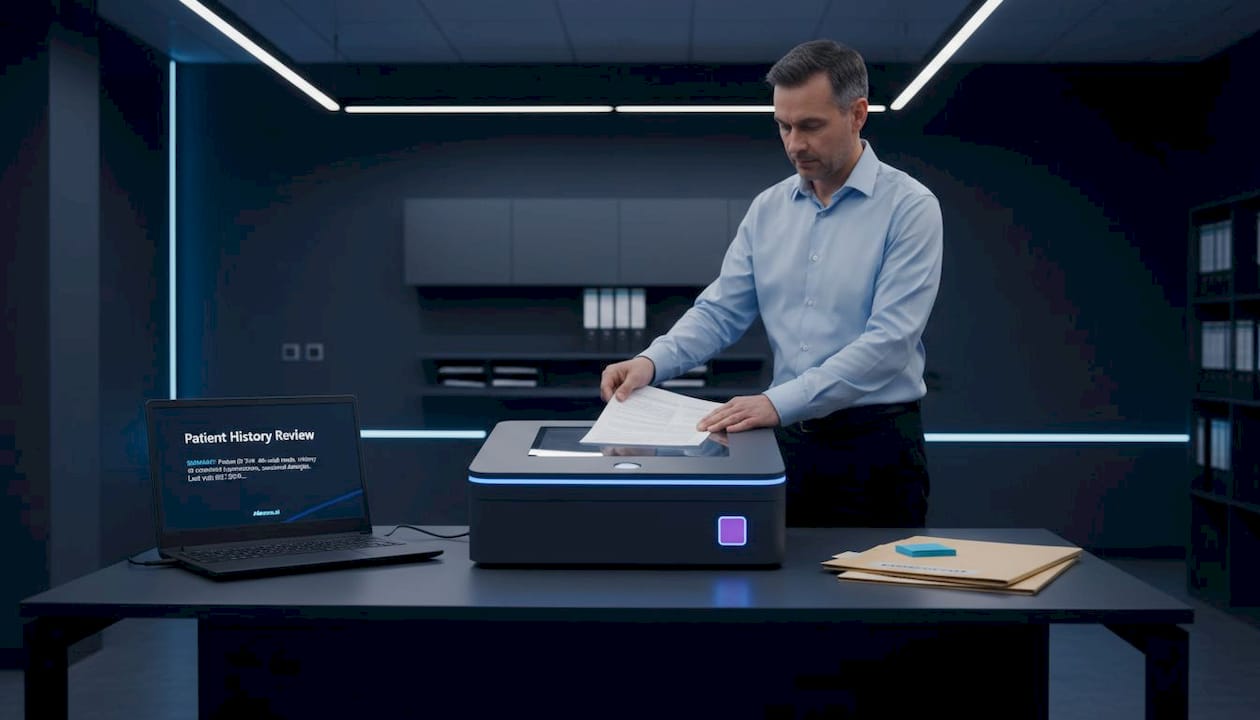
A recent study published in a peer-reviewed journal examined an OCR (optical character recognition) plus generative AI system designed to extract and classify text from scanned medical documents. The system processed 1,303 scanned PDFs from 116 different institutions and delivered measurable efficiency and accuracy results.
Performance metrics from the study:
| Metric | Score |
|---|---|
| Segmentation F1 score | 0.95 |
| Classification F1 score | 0.96 |
| Date extraction F1 score | 0.90 |
| Reduction in OMR review time | 40% |
These numbers matter because they come from real-world documents, not clean test datasets. Medical records from 116 different institutions vary enormously in format, scan quality, and terminology. Achieving an F1 score of 0.95 or higher across segmentation and classification under those conditions reflects a system that performs reliably in practice.
The 40% reduction in OMR review time is operationally significant. Clinicians and administrative staff who spend hours reviewing incoming records from referring institutions can redirect that time toward direct patient interaction, care coordination, or other high-value tasks.
What this type of automation handles well:
- Extracting structured data from unstructured or semi-structured documents
- Classifying document sections such as lab results, imaging reports, and clinical notes
- Identifying and extracting dates, which is critical for building accurate patient timelines
- Reducing manual transcription and review burden across high-volume document workflows
The broader principle here connects to what intelligent automation means in practice: combining rule-based document parsing with generative AI’s ability to interpret context. Neither approach alone is sufficient. Together, they handle the messy, inconsistent documents that arrive from outside institutions.
Pro Tip: Pair automated extraction with structured human review for ambiguous or low-confidence cases. A well-designed confidence scoring system helps staff focus their attention where it is most needed.
Automating prior authorization letter writing: benchmarking insights
Expanding on operational automation, let’s examine the challenges and measurable performance in prior authorization (PA) letter writing, a process that consumes significant staff time and often delays patient care.
Large language models (LLMs, which are AI systems capable of generating human-like text) have been tested for their ability to generate PA letters automatically. A benchmarking study evaluated LLM-generated PA letters across 29 samples. The results revealed both capabilities and clear risks.
Benchmark findings:
- Error rate: 3.5% of statements in generated letters were false or unsupported, a low but clinically relevant figure when documentation accuracy is a compliance and patient safety issue.
- ICD-10 coding accuracy: 79.3% of codes were correct, leaving roughly one in five letters with a coding error that could trigger claim denials.
- Citation validity: 93.1% of citations in the generated letters were valid and traceable to source documentation.
The PA letter benchmarking research makes clear that automation in this area is promising but not yet ready to operate without clinical oversight. Edge cases go beyond accuracy, impacting safety and documentation completeness.
“Edge cases go beyond accuracy, impacting safety and documentation completeness.”
Comparison of automation approaches for PA letter writing:
| Approach | Speed | Accuracy | Oversight needed | Risk level |
|---|---|---|---|---|
| Fully manual | Slow | High (with expertise) | Low | Low |
| AI-assisted draft | Fast | High with review | Moderate | Low to medium |
| Fully automated | Very fast | Variable | Minimal | Medium to high |
The data strongly supports an AI-assisted draft model for prior authorization workflows. The AI handles the time-consuming task of pulling relevant documentation and structuring the letter. A qualified reviewer checks for coding accuracy, false statements, and citation completeness before submission.
This is where agentic workflow automation adds the most value: not by replacing clinical judgment, but by handling the structured, repeatable components of a complex task so that human review time is focused on exceptions and quality control.
Always benchmark automation before deployment in PA workflows. Define acceptable error thresholds for your organization, and build review steps that specifically target the most common failure modes identified in testing.
Deployment gap: barriers to adoption and routine use
Even with promising examples, adopting AI automation isn’t always straightforward. The gap between a successful pilot and routine organizational use is one of the most persistent and underreported challenges in healthcare AI.
A clinical AI audit found that fewer than 15% of purchased FDA-cleared AI-enabled medical devices are used routinely in practice. That figure is striking. Organizations invest in tools, clear the approval process, and then see adoption stall because the tools do not fit comfortably into daily workflows.
“Human factors can negate expected ROI if automation doesn’t fit real workflows.”
Common barriers to routine AI adoption in healthcare:
- Workflow friction. If using the AI tool requires more steps than the existing manual process, staff will default to what they know. Interface design and process integration are not secondary considerations.
- Automation bias. Staff may over-rely on AI outputs without applying appropriate critical review, particularly when they are busy. This is a documented risk in high-pressure clinical environments.
- Training gaps. Tools deployed without adequate user training see lower adoption and higher error rates. Staff need to understand both what the tool does and what it cannot do.
- Integration failures. AI tools that do not connect seamlessly with EHR systems, billing platforms, or scheduling tools create duplicate data entry and reduce rather than increase efficiency.
Strategies to close the deployment gap:
- Engage clinical and administrative end users in the design and testing phase, not just IT and leadership.
- Provide structured onboarding and ongoing training, not a single launch-day briefing.
- Prioritize integration with existing systems from the beginning of the implementation process.
- Use incremental rollout strategies, expanding from pilot to department to organization in controlled stages.
For a detailed look at implementation practices, the tips for scaling automation in healthcare settings covers the operational moves that move organizations from pilot success to sustained daily use.
The deployment gap is not a technology problem. It is an organizational change problem. The most capable AI system still requires the right implementation strategy to deliver consistent results at scale.
The real challenge: From pilot success to organization-wide impact
Pilots succeed regularly. Organization-wide adoption is where most AI automation efforts stall. That gap is not a surprise to anyone who has worked through a healthcare IT implementation, but it is still underestimated when planning budgets and timelines.
The examples in this article illustrate a consistent pattern. Stanford’s billing pilot worked because the task was narrow, the user group was small, and the feedback loop was tight. The medical record automation worked because performance metrics were defined clearly and human review was built into the process. Prior authorization automation showed measurable gains but also real risks that require oversight.
What connects these cases is not the AI technology itself. It is the workflow design around the technology. Organizations that succeed at scaling automation invest as much in change management, training, and integration design as they do in the tools. The ones that struggle tend to treat deployment as an IT project rather than an operational transformation.
There is also a counterintuitive risk worth naming directly: automation that saves time on one task but complicates clinical documentation elsewhere can reduce overall productivity even while showing positive metrics on the targeted workflow. The workflow improvement guide addresses this holistically, covering how to map end-to-end processes before automating individual steps.
The lesson from real-world evidence is clear. Automation capability is necessary but not sufficient. Adoption, integration, and continuous refinement are what determine whether a pilot result translates into sustained operational value.
See agentic AI automation in action
Translating these insights into results requires more than selecting a tool. It requires a structured approach to pilot design, workflow mapping, and integration planning. Ailerons.ai provides access to healthcare automation case studies that show how agentic AI has been applied across billing, records management, document processing, and administrative coordination in real organizations. These examples offer a practical reference point as you evaluate options for your own operations. The IT and AI consulting team at Ailerons.ai works directly with healthcare administrators and IT leaders to design pilots, map workflows, and build deployment strategies that close the gap between proof-of-concept and daily operational use. Connect with the team to discuss your specific workflows and identify where agentic automation can deliver measurable results.
Frequently asked questions
What is agentic AI automation in healthcare?
Agentic AI automation refers to systems that act autonomously within defined guidelines to manage operational tasks such as billing response, records processing, and workflow routing, without requiring manual instruction for each step.
How does AI improve administrative efficiency?
AI saves time by handling repetitive, structured tasks at scale. For example, an OCR and generative AI system reduced OMR review time by 40% by automatically extracting and classifying content from thousands of scanned medical documents.
Why do some AI solutions fail to achieve routine adoption?
Usability issues, workflow friction, and poor system integration are the primary barriers. Research shows fewer than 15% of purchased FDA-cleared AI medical devices are used routinely, even after approval and deployment.
What are common automation error modes in healthcare AI?
Typical failure modes include hallucinated statements, ICD-10 coding mistakes, and incomplete citations, as documented in PA letter benchmarking studies of LLM-generated prior-authorization letters.
Recommended
- Top 5 AI solutions for healthcare administrative tasks 2026 | Ailerons IT Consulting
- 6 Steps for an Effective AI Automation Checklist 2026 | Ailerons IT Consulting
- 6 Key Tips for Scaling Business Automation in Healthcare | Ailerons IT Consulting
- Agentic AI Workflow Automation in Modern Healthcare | Ailerons IT Consulting