

TL;DR:
- Mid-sized companies can achieve significant operational improvements by adopting end-to-end automation that connects all workflow stages through layered AI-driven systems.
- Implementing modular workflows with proper governance, human-in-the-loop checkpoints, and gradual expansion minimizes risks and maximizes ROI.
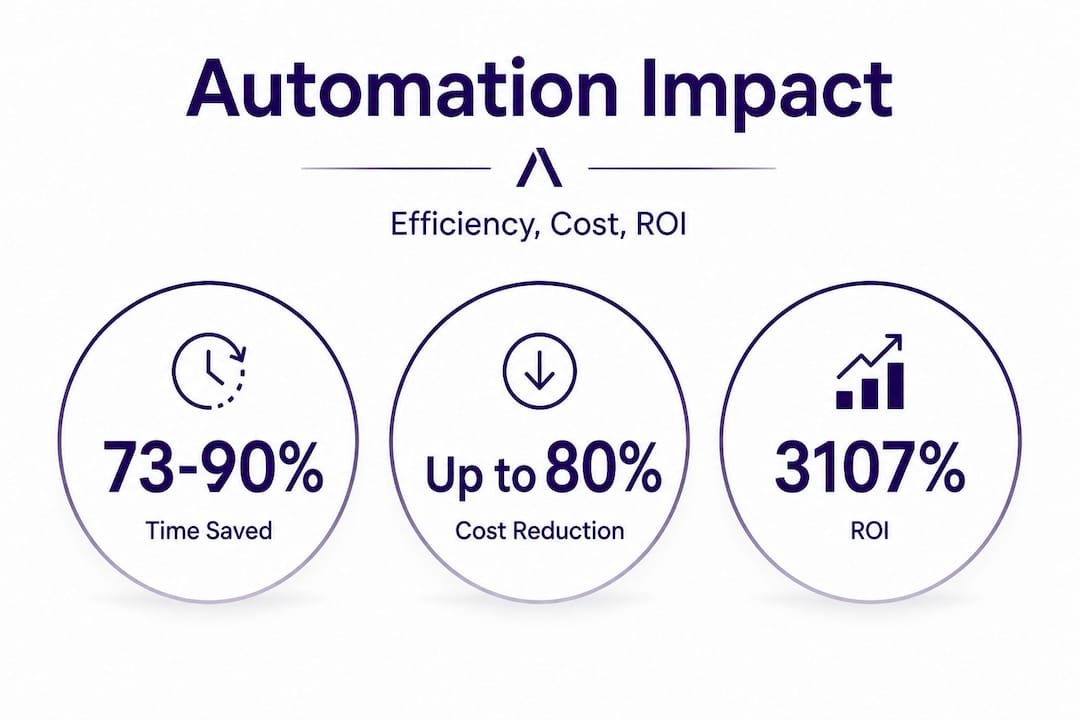
Mid-sized companies are leaving significant operational value on the table by treating automation as a single-step fix rather than a connected system. Benchmarks from real deployments show mid-sized firms achieving 73 to 90% time reductions, 75 to 80% cost cuts, and ROI ranging from 677% to 3107%. Those are not enterprise-scale numbers reserved for Fortune 500 teams with unlimited budgets. They are results achievable by organizations with 50 to 500 employees who take a structured, layered approach to automating their operations from start to finish.
Table of Contents
- What is end-to-end workflow automation?
- How core workflow automation components work
- Agentic AI and adaptive decision-making: The new paradigm
- Implementing end-to-end automation: Practical steps for mid-sized companies
- Risks, limitations, and the path forward
- Our take: Why mid-sized firms should rethink their automation journey
- Explore successful workflow automation with Ailerons IT
- Frequently asked questions
Key Takeaways
| Point | Details |
|---|---|
| Layered automation architecture | True workflow automation covers multiple layers: data ingestion, intelligent decision-making, orchestration, action, and learning. |
| Agentic AI adapts to complexity | AI-driven automation enables dynamic, pattern-driven workflows ideal for evolving business scenarios. |
| Human-in-the-loop is essential | Incorporate HITL for exception handling and reliability, especially in edge cases and regulatory approvals. |
| Quick ROI with modular rollout | Start with rule-based automation and modular workflow design for rapid efficiency gains and manageable risks. |
| Real-world limitations exist | Advanced agentic features carry adoption, governance, and security challenges; manage implementation with realistic expectations. |
What is end-to-end workflow automation?
End-to-end workflow automation means connecting every step of a business process, from the moment work enters the system to the moment it is resolved and recorded, without requiring manual handoffs at each stage. It is not about automating one task in isolation. It is about building a connected sequence where data flows, decisions get made, actions get executed, and results get tracked automatically.
The structure behind this kind of automation is layered. According to a detailed architectural breakdown, end-to-end automation involves five core layers: data ingestion, AI-powered decision-making, orchestration for process logic, action execution across business systems, and continuous learning from operational feedback. Each layer depends on the one before it.
Understanding these workflow automation layers helps clarify what your company is actually building when you invest in automation. You are not buying a single tool. You are creating an interconnected system.
Here is how those five layers compare at a practical level:
| Layer | Function | Example |
|---|---|---|
| Data ingestion | Pulls information from emails, forms, APIs | Incoming invoice scanned and parsed |
| AI intelligence | Applies decision logic and classification | Invoice categorized, vendor matched |
| Orchestration | Routes tasks through defined process logic | Approval request sent to finance team |
| Action execution | Writes to systems, sends notifications | ERP updated, confirmation email sent |
| Continuous learning | Refines rules based on outcomes | Exception patterns flagged for review |
A few things distinguish end-to-end automation from basic task automation:
- It crosses departmental boundaries, connecting sales, finance, operations, and HR in a single workflow
- It handles exceptions without stopping the entire process
- It creates a complete audit trail across all connected systems
- It scales without requiring additional manual oversight at each touchpoint
End-to-end automation does not eliminate human judgment. It routes human judgment to the right moments rather than every moment.
This distinction matters because many mid-sized firms start with point solutions, tools that automate one form or one approval step, and then wonder why efficiency gains plateau. The answer is usually that upstream and downstream steps are still manual, and the bottleneck has simply moved.
How core workflow automation components work
Every end-to-end workflow is built from a common set of components. Understanding how they connect in sequence helps you evaluate where your current processes break down and where automation adds the most value.
Automation steps typically follow this sequence, as outlined in detailed workflow architecture documentation. Workflows start with triggers, move through logic layers, execute actions across tools, incorporate human review where needed, and feed monitoring data back into the system for ongoing improvement.
Here is the step-by-step breakdown of how each component operates:
- Trigger: A workflow starts when a defined event occurs. This could be a form submission, an email arrival, a date reaching a threshold, or a record change in your CRM. The trigger fires the first step without waiting for a person to notice.
- Conditional logic: The system applies rules or AI reasoning to decide what happens next. If an invoice is under $500 from a known vendor, it routes to auto-approval. If it exceeds $5,000 or is from a new vendor, it escalates.
- Action execution: Once the logic resolves, the workflow takes action. It might update a record, generate a document, send a notification, or initiate a payment, all across different platforms simultaneously.
- Human-in-the-loop (HITL): For decisions that carry risk, the workflow pauses and routes the item to a human reviewer. This is not a system failure. It is a designed checkpoint that keeps people in control of high-stakes outcomes.
- Monitoring and feedback: Every step generates data. Completion rates, error flags, processing times, and exception frequencies feed into dashboards that tell your team where the workflow is performing well and where it needs adjustment.
Pro Tip: When designing workflows, map your exception cases first. Most automation failures happen not because the happy path breaks, but because no one planned for the 20% of cases that do not follow the standard route.
The human-in-the-loop component deserves more attention than it usually gets. HITL is not a workaround for immature AI. It is a governance mechanism that keeps your automation system reliable and your organization accountable. Placing HITL checkpoints at the right moments, regulatory approvals, large financial commitments, sensitive customer communications, protects the business while still allowing the majority of work to flow automatically.

Agentic AI and adaptive decision-making: The new paradigm
Rule-based automation works well for predictable, high-volume processes where the inputs are consistent and the rules are clear. But real business operations are rarely that clean. Vendors send invoices in different formats. Customers ask questions that do not fit standard categories. Projects require coordination across teams with different timelines and priorities.
This is where adaptive automation using agentic AI changes the equation. Rather than matching inputs to a fixed script, agentic systems use pattern recognition, natural language processing, and predictive reasoning to handle scenarios they have not seen before. AI-driven automation replaces rigid rules with adaptive intelligence that can manage dynamic, changing conditions.
The difference between “agentish” and fully agentic automation is worth clarifying for mid-sized firms evaluating their options:
| Approach | Decision method | Handles exceptions | Requires manual updates |
|---|---|---|---|
| Rule-based | Fixed if-then logic | Limited | Frequent |
| Agentish | Mostly rules, some AI scoring | Moderate | Occasional |
| Fully agentic | AI reasoning with goal orientation | High | Minimal |
Most mid-sized companies will find agentish automation the most practical starting point. It introduces AI decision logic without requiring full agentic infrastructure, giving teams time to build confidence in automated outputs before expanding autonomy.
Agentic systems excel in uncertainty but require careful boundaries: state persistence so the AI tracks context across steps, failure recovery loops that prevent a single error from breaking an entire workflow, narrow tool access that limits what actions the AI can take autonomously, and continuous evaluation to catch performance drift over time.
Bounded autonomy is the key concept here. The goal is not to give AI unlimited decision-making authority. The goal is to extend AI authority precisely as far as the business can verify and trust its judgment, and no further. Expanding that boundary happens gradually, based on performance data, not enthusiasm for the technology.
Key benefits of agentic automation for mid-sized operations include:
- Handling unstructured inputs like emails, scanned documents, and voice transcripts
- Coordinating multi-department workflows without human routing
- Adapting to process changes without full re-programming
- Identifying process inefficiencies through behavioral pattern analysis
Implementing end-to-end automation: Practical steps for mid-sized companies
Knowing that automation delivers value is not the same as knowing how to build it inside your organization. The implementation path matters as much as the technology itself. Well-documented methodology confirms that successful implementations follow a consistent sequence: process mapping, task prioritization, modular design, pilot deployment, system integration, exception planning, and metric tracking.
Here is a practical framework your team can follow:
- Map current processes end-to-end. Start with workflow mapping before touching any technology. Document every step, every handoff, every decision point, and every exception in your target process. You cannot automate what you have not fully described.
- Identify high-volume, repetitive tasks first. Look for processes where the same steps repeat dozens or hundreds of times per week. Invoice processing, onboarding document collection, meeting scheduling, and status update emails are strong early candidates.
- Design modular workflows. Build each workflow as a self-contained unit that connects to others through defined interfaces. Modular design allows you to update one component without rebuilding the entire system.
- Pilot with a high-impact, low-risk process. Choose a workflow where errors are recoverable and the volume justifies the investment. Track time savings, error rates, and completion speed from day one.
- Integrate with existing systems. Your automation only delivers full value when it connects to your CRM, ERP, accounting platform, and document management tools. Isolated automation creates new silos rather than eliminating old ones.
- Plan for edge cases. Real-world automation must handle exceptions, including roughly 20% of cases that fall outside standard patterns, API failures, incomplete data submissions, and regulatory approval requirements. Build escalation logic and fallback mechanisms before launch, not after.
- Define metrics before you go live. Set baseline measurements for processing time, cost per transaction, error rate, and exception frequency. These numbers tell you whether the automation is working and where to improve it.
Pro Tip: Avoid automating a broken process. If the manual version involves unnecessary steps, unclear ownership, or redundant approvals, fix the process design first. Automation amplifies whatever is already there, including inefficiencies.
The table below shows realistic benchmarks for common automation implementations at mid-sized companies, giving your team a practical target range:
| Process | Typical time reduction | Cost reduction | Implementation timeline |
|---|---|---|---|
| Invoice processing | 70-85% | 60-75% | 6-10 weeks |
| Employee onboarding | 60-80% | 50-65% | 8-12 weeks |
| Contract management | 65-80% | 55-70% | 10-14 weeks |
| Customer support routing | 75-90% | 65-80% | 4-8 weeks |
Tracking automation ROI data from the start allows your team to make evidence-based decisions about where to expand automation investment next.
Risks, limitations, and the path forward
A clear-eyed view of automation includes its current limitations. The technology is advancing rapidly, but several real barriers affect mid-sized companies specifically.
Forrester research highlights that advanced agentic features have adoption rates below 15%, largely due to unresolved ROI clarity and governance gaps. Complex benchmark success rates for fully autonomous agents sit around 3.9%, which reflects how demanding high-stakes, multi-step autonomous execution actually is in production environments.
Key risks to plan for include:
- Reliability gaps: Agentic systems performing well in testing can degrade in production when data patterns shift or systems they depend on change behavior
- Security exposure: Automated systems with broad access credentials create larger attack surfaces if not properly governed
- Black-box opacity: Some AI decision layers are difficult to audit, creating compliance risks in regulated industries
- Over-automation: Removing human judgment from processes that genuinely require contextual reasoning can produce errors that are difficult to detect and slow to correct
- Integration fragility: Workflows that depend on multiple external APIs can fail when any one component changes its behavior or availability
The automation systems that fail most visibly are those built to impress rather than those built to operate reliably under real business conditions.
Managing administrative risks from automation requires governance structures that treat automated workflows as operational infrastructure, not just software tools. That means change management protocols, access controls, exception logging, and regular performance audits built into the system from the start.
The path forward for mid-sized companies is gradual, evidence-based expansion. Start with well-understood processes. Measure outcomes. Expand autonomy incrementally as confidence builds. This approach produces more durable results than large-scale deployments driven by vendor timelines or executive enthusiasm.
Our take: Why mid-sized firms should rethink their automation journey
The conversation around automation in mid-sized companies tends to default to one of two extremes: either aggressive full-automation ambitions that underestimate governance complexity, or overly cautious approaches that limit value to a few isolated task automations. Neither serves the business well.
What actually works, based on repeated operational experience, is a hybrid model where rule-based automation handles the predictable majority of work, and AI reasoning handles the dynamic minority. This is not a compromise. It is a deliberate architecture that matches the right tool to the right problem.
Mid-sized firms often have an advantage over large enterprises here. They can move faster, run tighter pilots, and make governance decisions without months of committee review. That speed is valuable if it is directed toward building reliable, modular systems rather than chasing cutting-edge features that are not yet production-ready.
Governance and HITL checkpoints should be designed before any workflow goes live, not added later when something goes wrong. The organizations that scale automation successfully treat HITL not as a limitation but as a quality control layer that makes the overall system more trustworthy.
Quick wins come from finding the three to five processes in your operation where volume is high, rules are clear, and errors are costly. Automating those well, building in proper monitoring and exception handling, and measuring the results creates organizational confidence that makes the next automation project easier to fund and faster to deploy.
For a practical view of how these principles apply across different industries, agentic workflow use cases in complex regulated environments show what mature, governed automation looks like in practice.
Explore successful workflow automation with Ailerons IT
If the concepts in this article reflect challenges your organization is actively working through, Ailerons.ai can help you move from strategy to operating system. We design and deploy agentic AI workflows for mid-sized companies across office operations, billing, compliance, document management, and administrative coordination. Our implementations connect directly with your existing CRM, ERP, scheduling, and accounting platforms so automation works inside your current infrastructure, not alongside it. Visit ailerons.ai to review our approach, explore how we have helped companies in your sector reduce manual workload, or book a consultation to discuss your specific workflow priorities and where intelligent automation can deliver the clearest return.
Frequently asked questions
What is the difference between rule-based and agentic workflow automation?
Rule-based automation uses predefined if-then logic to route work along fixed paths, while agentic automation uses AI to adapt dynamically to changing scenarios using pattern recognition and predictive reasoning. The practical difference shows up most clearly when inputs are inconsistent or exceptions are frequent.
How much efficiency gain can mid-sized companies expect from end-to-end automation?
Documented benchmarks show 73 to 90% time reductions and up to 80% lower operational costs, with ROI as high as 3107% in well-implemented deployments. Results vary based on process complexity, integration depth, and how consistently the automation is maintained.
What are the major risks of agentic workflow automation?
Advanced agentic features currently see adoption below 15% due to reliability concerns, with complex benchmark success rates around 3.9%, alongside risks including high implementation costs, security vulnerabilities, and limited auditability of AI decisions. Governance planning and bounded autonomy significantly reduce these risks.
How should mid-sized companies start implementing workflow automation?
Proven implementation methodology recommends starting by mapping your current processes in full, identifying repetitive high-volume tasks, designing modular workflows, and running a controlled pilot on a high-impact, low-risk process before scaling to broader integration.
Recommended
- Step-by-step workflow automation guide for business leaders | Ailerons IT Consulting
- Streamline billing with workflow automation: A practical guide | Ailerons IT Consulting
- Improving Business Workflows with AI: Achieve Automation | Ailerons IT Consulting
- Why upgrade office automation: boost ROI and efficiency | Ailerons IT Consulting
- Bürokosten mit optimierten Workflows effizient senken | ProOffice Business Center Blog
- Workflow For Forex Automation: Step-by-Step Trading Setup