

TL;DR:
- Multi-step automation involves coordinating three or more dependent actions across tools or agents, increasing complexity and failure risk. Effective design requires explicit workflows, error handling, and human checkpoints to ensure reliability and auditability in production environments. Choosing appropriate frameworks like orchestration engines, agent architectures, or hybrid models depends on process predictability, input variability, and compliance needs.
Most professionals assume automation means connecting two systems and letting them talk. That assumption breaks down fast when the real work begins. Defining multi-step task automation accurately means understanding that these workflows involve branching logic, context persistence across actions, error recovery, and coordination between multiple tools or agents, not just a linear chain of triggers. This article cuts through the common misconceptions, explains the technical and organizational challenges involved, and gives decision-makers a clear framework for scoping, building, and managing automation that actually holds up in production.
Table of Contents
- Key takeaways
- Defining multi-step task automation
- Challenges in multi-step workflow design
- Technical approaches and frameworks
- Steps for task automation implementation
- Comparing frameworks with real-world examples
- My perspective on where this is actually headed
- How Ailerons approaches multi-step automation
- FAQ
Key takeaways
| Point | Details |
|---|---|
| Multi-step automation is not linear | Real workflows branch, loop, and require error recovery across multiple connected systems. |
| Step count directly affects reliability | Workflows longer than 3-5 steps have exponentially higher failure rates; break them into sessions with human handoffs. |
| Orchestration separates logic from execution | Use deterministic orchestrators to control flow and reserve AI agents for reasoning tasks within each step. |
| Test before you chain | Validate each tool connection individually before combining steps to prevent silent failures from corrupting the full workflow. |
| Human checkpoints are not a weakness | Explicit validation gates catch wrong outputs early and prevent cascading errors in complex automation chains. |
Defining multi-step task automation
Multi-step task automation refers to the coordinated execution of three or more dependent actions across tools, systems, or agents, where the output of one step feeds directly into the next. A single-step automation does one thing: send a notification, update a field, or generate a file. Multi-step automation does a sequence of things, and each step depends on what came before it.
The distinction matters more than it sounds. Single-step automations are predictable and easy to debug. Multi-step workflows introduce state, timing, branching, and failure modes that require deliberate design. Defining process automation at this level means accounting for what happens when step three fails, when a condition branches the workflow in an unexpected direction, or when a downstream system returns an unexpected response.
Here is how the main categories compare:
| Type | Scope | Complexity | Failure Risk | Typical Tools |
|---|---|---|---|---|
| Single-step automation | One discrete action | Low | Contained | Zapier, simple scripts |
| Multi-step automation | Chained dependent actions | Medium to high | Cascading | Workflow engines, agents |
| Process automation | End-to-end business process | High | Systemic | RPA, BPM platforms, agentic AI |
Common task automation techniques used in multi-step contexts include:
- Trigger-action chaining: Each completed action triggers the next step based on predefined conditions.
- Conditional branching: The workflow takes different paths depending on data values or outcomes at a given step.
- State persistence: Intermediate data is stored and passed explicitly between steps to maintain context.
- Error handling and retry logic: Failed steps are caught, logged, and retried or escalated rather than silently dropped.
- Human-in-the-loop gates: Certain steps pause for human review before the workflow continues.
Understanding these mechanics is the starting point for any serious conversation about implementing or optimizing automation in an enterprise setting.
Challenges in multi-step workflow design
The core difficulty in multi-agent systems is not the agents themselves. It is coordination and workflow management. Most teams learn this after their first production failure.
Non-linearity is the default, not the exception. Real workflows branch. A claims processing workflow might take five different paths depending on claim type, policy status, and adjuster availability. Branching needs to be a native concept in automation tools, not bolted on as an afterthought. When tools treat branching as an edge case, workflows become brittle.
Context memory is unreliable across steps. AI agents have context window limits, and multi-step workflows often exceed them. Relying on an agent to “remember” what happened in step one when it is executing step seven is a design flaw. The solution is to design steps as stateless functions with explicit data references passed between them. This makes workflows far more debuggable and resilient.
Silent failures are the most dangerous. Testing tool connections individually before chaining them into a workflow is one of the most underrated practices in automation engineering. A silent failure in a single connection can corrupt the entire chain without triggering an obvious error. By the time you notice the problem, dozens of downstream records may already be wrong.
Scaling complexity compounds errors. Adding a new step does not add linear complexity. It multiplies it. Each new dependency creates new failure modes, new timing considerations, and new coordination requirements.
Pro Tip: Before you build, run your intended workflow manually three to five times end to end. Document every decision point, every data transformation, and every place where you would need to make a judgment call. That map becomes your automation specification.
Additional challenges to account for in your design:
- Coordinating multiple specialized agents without creating circular dependencies
- Managing retry logic without creating duplicate records or actions
- Handling partial completions when a workflow is interrupted mid-run
- Maintaining audit trails across every step for compliance purposes
Technical approaches and frameworks
Getting multi-step automation right requires choosing the right architecture for the complexity level you are managing. There is no single correct approach, but there are clear trade-offs.
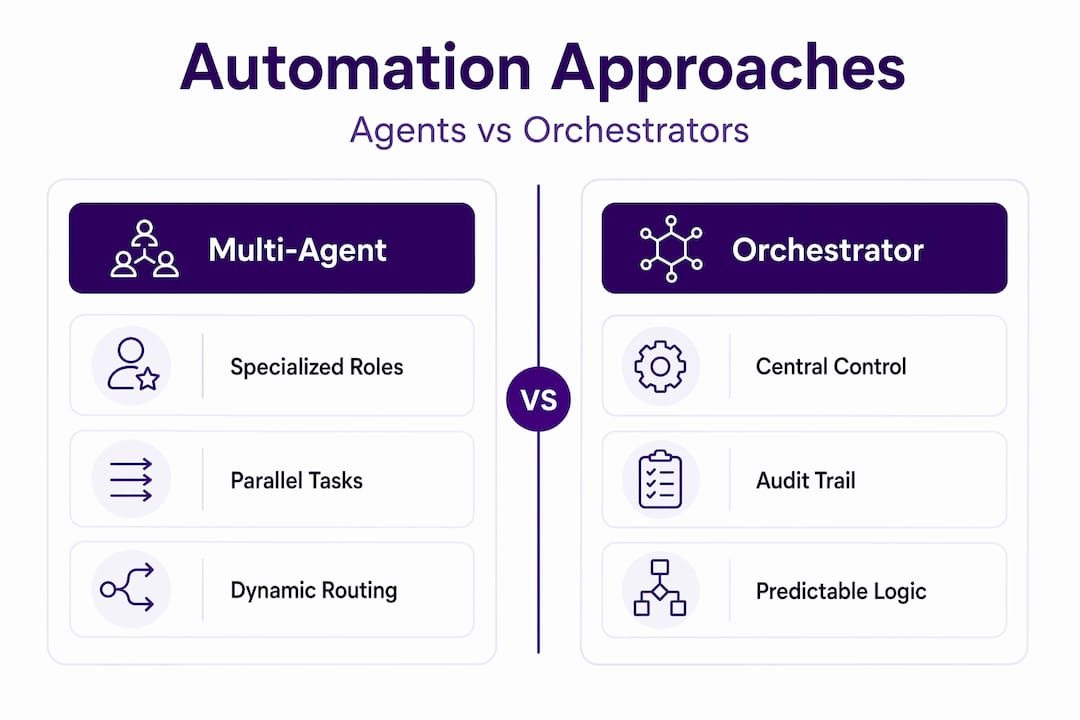
Orchestration tools like AWS Step Functions separate the control flow from the execution logic. The orchestrator decides what runs next, handles failures, and maintains state. The agents or functions handle the actual work. Combining Step Functions with agent runtimes gives you predictable, auditable workflows where you can trace exactly what happened at every step. This is particularly valuable in regulated industries where auditability satisfies compliance requirements.
Multi-agent architectures assign specialized agents to distinct steps or task categories. One agent handles document extraction, another handles validation, a third handles routing. Separating orchestration logic from agent reasoning allows you to swap or upgrade individual agents without rebuilding the entire workflow. This modularity is the practical advantage of a well-designed multi-agent system.
Hybrid advisor strategies are worth understanding for cost management. Routing routine tasks to lower-cost models and escalating complex or ambiguous cases to more capable models keeps automation economically viable at scale. You do not need your most powerful AI agent deciding whether a standard invoice is ready to post.
Here is a practical comparison of framework types by use case:
| Framework | Best For | Key Strength | Key Limitation |
|---|---|---|---|
| Workflow engine (e.g., Step Functions) | Structured, rule-based processes | Auditability, reliability, state management | Requires explicit definition of every path |
| Agentic AI | Complex reasoning tasks, exception handling | Adaptability, contextual decision-making | Less predictable, harder to audit |
| Hybrid orchestration | Enterprise workflows with edge cases | Balances control and flexibility | Higher design and integration complexity |
| RPA + rule engine | Legacy system integration | Works without API access | Fragile to UI changes, difficult to scale |
Key implementation steps for technical teams:
- Define your workflow graph first. Map every step, every branch, and every failure path before writing any code or configuring any tool.
- Choose your orchestrator based on auditability needs. If your industry requires compliance documentation, use a deterministic workflow engine rather than pure agentic execution.
- Instrument every step. Log inputs, outputs, and timing at each node. You cannot debug what you cannot observe.
- Set scheduling cadence deliberately. Minimum scheduling frequency for some agentic routines is one hour, and running workflows too frequently creates cost and noise without adding value. Match recurrence to your actual decision cadence.
- Use intermediate artifacts. Store structured outputs between steps as files or database records rather than relying on in-memory context passing. This makes workflows resumable and auditable.
For teams exploring managed agent runtimes, Claude’s managed agent API represents one direction the industry is moving toward native orchestration support.
Steps for task automation implementation
Translating good intentions into working automation requires a disciplined process. Here is a proven sequence for scoping and deploying multi-step workflows in enterprise environments.
- Write the automation specification in plain language first. Describe what triggers the workflow, what each step does, what data moves between steps, and what the final output looks like. If you cannot explain it plainly, you cannot automate it reliably.
- Limit initial workflows to three to five steps. Workflows longer than five steps carry exponentially higher failure rates. Start with a narrower scope and expand only after the core workflow is stable.
- Test each tool connection individually before chaining. Do not assume that because tool A works and tool B works, the connection between them will work. Silent connection failures corrupt entire chains without obvious errors.
- Insert validation checkpoints between high-risk steps. Explicit human validation at key points prevents wrong outputs from propagating downstream. This is especially important for steps that write data or trigger external actions.
- Run the full workflow manually multiple times before scheduling. Running workflows manually before automation catches logic errors and data formatting issues that only appear with real data.
- Define explicit failure modes for each step. Decide in advance what happens when a step fails: retry, escalate, pause and notify, or terminate. Never leave failure behavior undefined.
- Roll out incrementally. Run the automated workflow in parallel with the manual process for at least one full cycle before cutting over. Compare outputs systematically.
Pro Tip: Design each step as an isolated function with explicit inputs and outputs. Steps that rely on implicit context memory are the single most common source of hard-to-diagnose failures in multi-step automation.
A human-in-the-loop approach is not a concession to imperfect AI. It is a sound design principle for any workflow where errors carry real business consequences.
Comparing frameworks with real-world examples
Choosing between automation approaches is easier when you anchor it to concrete scenarios.
Agentic AI fits well in workflows that require reasoning about ambiguous inputs. Insurance claims intake is a good example. The agent reads unstructured claim documents, extracts relevant fields, cross-references policy terms, and flags anomalies for adjuster review. No rigid rule engine could handle the variability. The trade-off is that the workflow is harder to audit and more likely to behave unexpectedly on edge cases.
Workflow engines are the right choice when you need predictability and a clear audit trail. An e-commerce order fulfillment workflow, where the steps are confirmed order, allocate inventory, generate shipping label, update customer record, and trigger notification, follows a defined path with limited branching. A workflow engine handles this reliably and logs every state transition. You can review that log for compliance or debugging without guesswork.
Hybrid models handle the most common real-world scenario: a mostly structured process with occasional unstructured exceptions. A billing workflow might follow deterministic rules for standard invoices and hand off to an AI agent only when payment terms or dispute notes require interpretation.
Key factors when choosing your approach:
- Auditability requirements: Regulated industries generally need deterministic orchestrators with full step logs.
- Input variability: High variability in inputs favors agentic components. Structured inputs favor rule-based engines.
- Error tolerance: Lower tolerance means more checkpoints and more human review gates.
- Scalability: Hybrid models scale more efficiently by reserving powerful AI for genuinely complex cases.
The administrative task automation process in most office environments falls into the hybrid category. Standard transactions run on autopilot, while exceptions get routed to human review or more capable AI components.
My perspective on where this is actually headed
I’ve worked with enough automation projects to say clearly: the gap between what vendors promise and what teams actually ship is wide, and it is almost always caused by underestimating coordination complexity.
Most current tools still treat branching as an add-on rather than a first-class workflow concept. That means teams end up writing custom logic to handle conditions that the tool should handle natively. It is technical debt baked into the foundation.
What I’ve found works is treating AI agents as composable tools, not autonomous workers. You define the workflow structure explicitly. You assign agents to specific, well-scoped tasks within that structure. You build in checkpoints that require human judgment for anything that carries meaningful risk. The AI orchestration vs. automation distinction is real and it matters practically, not just theoretically.
The organizations that will get the most value from multi-step automation in the next few years are not the ones deploying the most agents. They are the ones who invest in clear workflow definitions, explicit failure handling, and the discipline to keep step counts manageable until they have demonstrated reliability. Complexity can always be added. Recovering from a poorly designed foundation costs far more.
— Sam
How Ailerons approaches multi-step automation
Defining and deploying multi-step task automation at the enterprise level requires more than picking the right tool. It requires workflow architecture, integration expertise, and a clear-eyed view of where AI handles work well and where human judgment still belongs.
Ailerons specializes in exactly this. From agentic AI consulting projects in billing and document management to end-to-end workflow automation for front-office operations, Ailerons designs systems that are auditable, integration-ready, and built to scale without adding proportional overhead. The work spans CRM, ERP, scheduling, accounting, and document platforms, with security and compliance built into the design from the start.
If you are scoping a multi-step automation initiative or trying to stabilize one that is underperforming, Ailerons offers tailored consulting to help you get automation right from the architecture up. Contact the team to book a consultation.
FAQ
What is multi-step task automation?
Multi-step task automation is the coordinated execution of three or more dependent actions across systems or agents, where each step uses the output of the previous one. It differs from single-step automation in complexity, failure risk, and the need for explicit state management and error handling.
How many steps should a workflow have before splitting it?
Workflows longer than 3-5 steps carry exponentially higher failure rates. Breaking larger processes into shorter sessions with human handoffs between them significantly improves reliability and makes debugging far more manageable.
What is the difference between multi-step and process automation?
Multi-step automation refers to chained dependent actions within a specific task sequence. Process automation covers an entire end-to-end business process, often combining multiple multi-step workflows, rule engines, and human decision points across an organization.
Why do multi-step automation workflows fail silently?
Silent failures typically occur when a tool connection works in isolation but fails when chained. The downstream steps receive no data or receive corrupted data and continue executing, producing wrong outputs that are difficult to trace back to the original failure point.
What role should humans play in automated workflows?
Humans should serve as validation gates at high-risk steps, particularly those that write data or trigger irreversible actions. Human-in-the-loop controls are not a design limitation. They are a standard practice for managing error propagation in complex, multi-step automation systems.