

TL;DR:
- Decision logic enables AI systems to make consistent, explainable, and adaptable decisions.
- Hybrid approaches combining rules and machine learning maximize flexibility and compliance.
- Proper safeguards and continuous monitoring are essential for reliable AI automation in real-world workflows.
One AI agent recently cut a 4h41m task to just 14 minutes, a 95% reduction in processing time. That result is not a fluke. It reflects what happens when automation moves beyond simple scripts and gains the ability to reason, plan, and recover from errors. Decision logic is what makes that possible. It is the intelligence layer that tells an AI agent what to do, when to escalate, and how to handle the unexpected. This guide covers the foundations, key frameworks, common pitfalls, and real-world results of applying decision logic in agentic AI systems across office and operational workflows.
Table of Contents
- Understanding decision logic: The foundation of agentic AI
- Key frameworks: Rules-based, machine learning, and hybrid approaches
- Avoiding pitfalls: Mitigating edge cases and errors in automated decision logic
- Proven impact: Real-world examples of AI-powered decision logic in action
- A practical perspective: Why continuous improvement beats static rules
- Accelerate your AI journey with expert support
- Frequently asked questions
Key Takeaways
| Point | Details |
|---|---|
| Hybrid logic is essential | Mixing business rules with machine learning enables flexible, explainable automation. |
| Guard against edge cases | Layered defenses like retries, guardrails, and monitoring keep automation safe and reliable. |
| Measure real results | AI-powered decision logic can cut process time by 95% when properly implemented. |
| Continuous improvement wins | Iterative testing and refinement outperform static rule sets in dynamic business environments. |
Understanding decision logic: The foundation of agentic AI
Decision logic in automation refers to the structured set of rules, models, or policies that guide how an AI agent evaluates a situation and chooses an action. Think of it as the reasoning layer that sits between raw data and actual output. Without it, an automated system can only follow a script. With it, the system can assess context, weigh options, and take the right action even in situations it has never encountered before.
Traditional workflow automation tools rely on fixed if-then rules. These work well for predictable, repetitive tasks. But they break down quickly when conditions change, data is incomplete, or a process requires judgment. That rigidity is the core limitation of rule-only systems. They cannot adapt, and when they fail, they often fail silently or produce incorrect outputs without flagging the issue.
Agentic AI addresses this through a more layered approach. As multi-method agentic AI shows, modern systems combine decision agents that use business rules platforms for consistent and explainable decisions alongside large language model (LLM) based orchestration and policy agents for adaptability. This hybrid structure gives organizations the best of both worlds: predictability where it matters and flexibility where it is needed.
Here is why decision logic is central to any serious automation strategy:
- Consistency: Rules and models apply the same logic every time, reducing human error
- Auditability: Explainable decisions create a clear record for compliance and review
- Speed: Automated decisions execute in milliseconds, not minutes or hours
- Scalability: Logic scales without adding headcount
- Resilience: Layered decision models recover from edge cases rather than stopping entirely
“Decision logic is not just about automating a task. It is about giving the system the ability to make the right call, consistently, at scale, and with a record of why.”
For organizations already working on AI business process management, decision logic is the engine that turns process maps into operational reality. Without it, you have automation in name only.
Key frameworks: Rules-based, machine learning, and hybrid approaches
Now that you understand what decision logic is, let’s examine the main frameworks and how they shape outcomes. Each approach has a distinct profile, and choosing the wrong one for your context can create more problems than it solves.
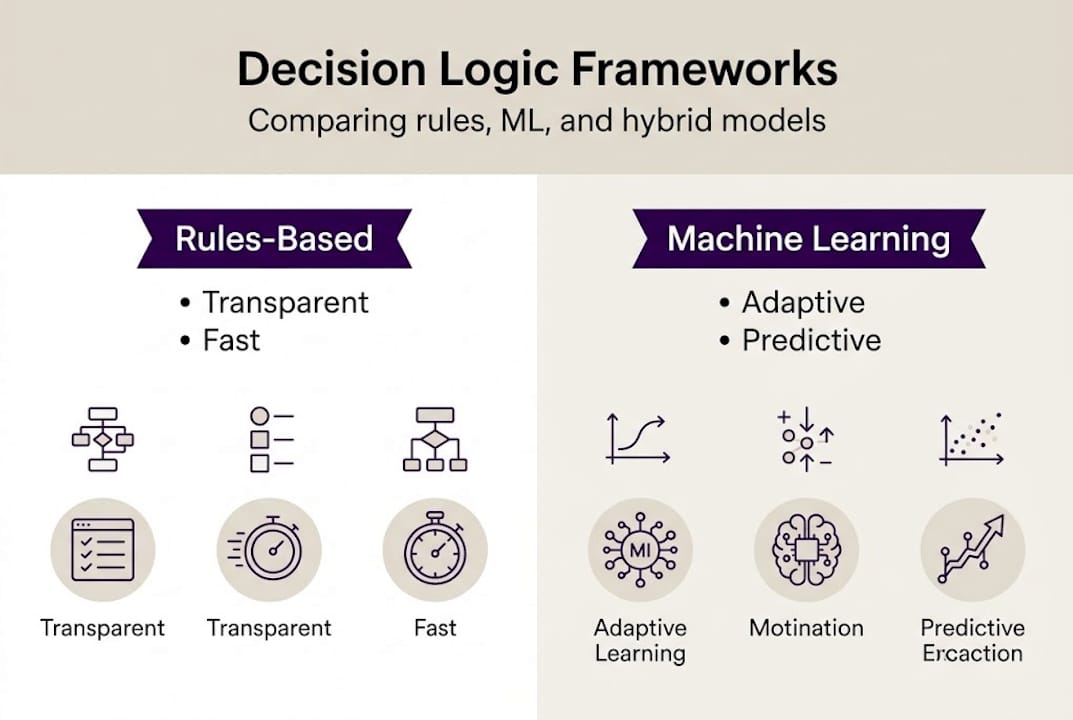
Rules-based systems operate on explicit, predefined conditions. If a vendor invoice exceeds $10,000, route it to a senior approver. These systems are easy to audit, fast to deploy, and fully transparent. The downside is brittleness. Any scenario outside the defined rules requires manual intervention or a rule update.
Machine learning (ML) models learn patterns from historical data and make probabilistic decisions. They adapt over time and handle ambiguity better than fixed rules. The trade-off is explainability. It can be difficult to trace exactly why an ML model made a specific decision, which creates compliance risk in regulated environments.

Hybrid models combine both. Multi-method agentic AI uses rules for high-stakes, auditable decisions and ML or LLM-based agents for tasks that require contextual judgment. This is the approach most mid-market operations benefit from.
| Framework | Strengths | Limitations | Best use case |
|---|---|---|---|
| Rules-based | Transparent, auditable, fast | Rigid, breaks on edge cases | Compliance, approvals, routing |
| Machine learning | Adaptive, handles ambiguity | Less explainable, needs data | Forecasting, anomaly detection |
| Hybrid | Flexible and auditable | More complex to design | End-to-end office workflows |
Pro Tip: Start with rules-based logic for your highest-risk decisions and layer in ML capabilities for tasks where adaptability matters more than strict explainability. This staged approach reduces deployment risk and builds team confidence.
For a broader view of where each model fits, reviewing the types of AI automation available today helps clarify which combination suits your operational needs.
Avoiding pitfalls: Mitigating edge cases and errors in automated decision logic
Implementing decision logic is not without pitfalls. Here is how to navigate and mitigate the most common ones.
Even well-designed agentic AI systems encounter situations they were not built for. Edge cases in AI agents include infinite loops where the agent keeps retrying a failed step, completion misinterpretation where the agent thinks a task is done when it is not, and context overflow where the agent loses track of earlier steps in a long workflow. These are not rare exceptions. They happen in production environments regularly.
The good news is that most failures are preventable with the right safeguards in place before go-live.
- Define explicit completion criteria: Every task must have a clear, testable definition of done. Vague endpoints invite misinterpretation.
- Set iteration limits: Cap the number of retries on any step. This prevents infinite loops from consuming resources or corrupting data.
- Build layered guardrails: Combine rule-based checks, PII (personally identifiable information) filters, and human-in-the-loop (HITL) triggers to catch errors at multiple points.
- Design retry and fallback strategies: When a primary action fails, the agent should have a defined alternative path rather than stopping entirely.
- Deploy fallback agents: A secondary agent can take over when the primary agent reaches a decision boundary it cannot resolve.
“Layered defenses are more effective than trying to anticipate every possible failure scenario before launch. Build for recovery, not just prevention.”
Pro Tip: Adversarial testing, where you deliberately feed your system unusual inputs and edge conditions, reveals failure modes faster than standard QA. Run it before every major workflow update.
Continuous monitoring is equally important. Static testing before launch only validates known scenarios. Real-world workflows surface new edge cases constantly. Organizations operating in regulated industries should also review AI automation compliance requirements to ensure their guardrails meet both technical and regulatory standards.
Proven impact: Real-world examples of AI-powered decision logic in action
Having covered the challenges, let’s look at the tangible benefits and ROI of AI-powered decision logic.
The clearest evidence comes from production deployments. In one documented case, an AI agent reduced processing time from 4 hours and 41 minutes to just 14 minutes through autonomous planning, execution, and error recovery. That is a 95% reduction. The agent did not just run faster. It made decisions, recovered from errors mid-task, and completed the workflow without human intervention.
This kind of result is not limited to data processing. Decision logic delivers measurable ROI across several office workflow categories:
| Workflow area | Impact of agentic AI decision logic |
|---|---|
| Data processing | Up to 95% reduction in task completion time |
| Approval routing | Faster cycle times, fewer manual handoffs |
| Error handling | Autonomous recovery reduces rework and escalations |
| Document management | Consistent classification and routing at scale |
| Compliance checks | Real-time rule enforcement with full audit trail |
Key patterns emerge from these deployments:
- Recovery matters more than perfection: Agents that handle errors autonomously outperform static automation that stops on failure
- Approvals and routing see fast ROI: These are high-frequency, rule-driven tasks where decision logic delivers immediate value
- Data quality improves: Consistent logic reduces the variation that comes from manual processing
- Human effort shifts: Staff move from executing tasks to reviewing exceptions and improving the system
For teams looking to build on these results, the improving business workflows guide provides a practical starting point. The AI-driven operations guide goes deeper into deployment strategy for organizations ready to scale.
A practical perspective: Why continuous improvement beats static rules
Stepping back, here is what experience reveals about thriving with decision logic in the real world.
Many organizations approach agentic AI deployment as a one-time build. They invest heavily in designing rules, testing scenarios, and launching the system. Then they treat it as done. That approach consistently underperforms.
No system is immune to edge cases. Layered defenses, including guardrails, retries, and fallbacks combined with adversarial testing and continuous monitoring, outperform exhaustive pre-launch testing every time. The real world introduces conditions no design phase can fully anticipate.
Static rule sets become obsolete. Business processes change, regulations update, and data patterns shift. A rule that was accurate at launch may produce wrong outputs six months later. The organizations that get the most from agentic AI treat their decision logic as a living system. They monitor outputs, flag anomalies, and refine rules on a regular cycle.
Staged rollout also matters. Deploying decision logic across a single workflow first, measuring results, and then expanding reduces risk and builds institutional knowledge. It also gives your team time to develop the monitoring habits that sustain long-term performance. Teams working on agentic AI in compliance contexts especially benefit from this approach, where auditability and accuracy are non-negotiable.
Accelerate your AI journey with expert support
Ready to see decision logic in action or get expert help? The frameworks and case studies in this guide show what is possible. But translating those insights into a working system for your specific workflows requires more than a plan. It requires the right architecture, the right integrations, and a deployment approach built around your operational reality.
Explore AI automation case studies to see how organizations like yours have applied decision logic to real workflows and measured the results. When you are ready to move from concept to deployment, Ailerons.ai offers consulting and implementation support tailored to mid-market operations. The efficiency gains are real. The right time to capture them is now.
Frequently asked questions
What is decision logic in automation?
Decision logic in automation refers to the rules, algorithms, or models that drive how automated systems and AI agents make consistent, reliable decisions in workflows. Multi-method agentic AI combines business rules platforms with LLM-based agents to deliver both consistency and adaptability.
Why is hybrid decision logic better than rules-only or machine learning-only approaches?
Hybrid logic combines the transparency and consistency of rules with the flexibility and adaptability of machine learning, providing more robust and explainable automation. As multi-method agentic AI demonstrates, this combination handles both high-stakes auditable decisions and context-sensitive tasks effectively.
How can edge cases be handled in agentic AI workflows?
Use layered guardrails, retry strategies, explicit completion criteria, human-in-the-loop triggers, and fallback agents to recover from or prevent common edge case failures. AI agent edge cases such as infinite loops and context overflow are manageable with the right safeguards in place.
What is a real-world impact of decision logic on office workflows?
AI-enabled decision logic can reduce task times by 95%, transforming lengthy manual workflows into rapid, reliable automated processes. The biggest gains appear in data processing, approval routing, and error handling workflows.
Recommended
- Process Automation Tutorial for Agentic AI in Compliance Workflows | Ailerons IT Consulting
- Improving Business Workflows with AI: Achieve Automation | Ailerons IT Consulting
- Agentic AI Workflow Automation in Modern Healthcare | Ailerons IT Consulting
- Step-by-Step Guide to AI-Driven Office Automation Success | Ailerons IT Consulting
- AI-Powered EAs Vs Traditional Robots: Which Dominates Prop Firm Challenges In 2025? | FxShop24 Marketplace