

Finding the right approach to move your systems to the cloud can feel overwhelming when cost savings and productivity are top priorities. Efficient cloud migration starts with a clear assessment of your business needs and IT environment so you avoid common roadblocks and minimize disruptions. This article breaks down cloud readiness evaluation and strategic planning, guiding IT managers through actionable steps for smoother transitions and greater long-term value.
Table of Contents
- Step 1: Assess Business Needs And Cloud Readiness
- Step 2: Design An Optimized Migration Strategy
- Step 3: Prepare Infrastructure And Secure Data
- Step 4: Execute Cloud Migration And Monitor Progress
- Step 5: Verify Migration Success And Optimize Performance
Quick Summary
| Key Point | Explanation |
|---|---|
| 1. Assess Cloud Readiness Thoroughly | Conduct a detailed evaluation of your IT infrastructure and identify workloads suitable for cloud migration. This sets a solid foundation for your strategy. |
| 2. Develop a Structured Migration Strategy | Categorize applications based on complexity and criticality, and choose the appropriate migration technique like rehosting or rebuilding for each one. |
| 3. Prioritize Security in Infrastructure Preparation | Implement robust security measures, such as identity management and data encryption, to protect sensitive information before migration begins. |
| 4. Execute Migration in Phases | Migrate applications incrementally, starting with lower-complexity systems, to minimize disruptions while refining processes and tracking performance. |
| 5. Optimize Post-Migration Performance Continuously | Regularly review resource allocation and implement automated monitoring tools to ensure efficient operation and cost-effectiveness in the cloud environment. |
Step 1: Assess Business Needs and Cloud Readiness
Successfully migrating your business to the cloud starts with a comprehensive readiness assessment. You will evaluate your current IT infrastructure, identify potential challenges, and create a strategic roadmap for cloud adoption.
Begin by conducting a detailed cloud readiness evaluation that examines your organization’s technological landscape. This involves analyzing your existing IT systems, understanding your business objectives, and mapping out which workloads are prime candidates for cloud migration. Look closely at your current applications, data storage requirements, network capabilities, and security protocols. Determine compatibility with cloud platforms and identify potential integration complexities.
While assessing your cloud readiness, focus on creating clear migration goals aligned with your business strategy. Microsoft’s Strategic Migration Assessment tool recommends breaking down your evaluation into key components: workload analysis, risk identification, and objective definition. Prioritize understanding your performance requirements, compliance needs, and budget constraints. This systematic approach helps you develop a pragmatic migration strategy that minimizes disruption and maximizes technological efficiency.
Pro Tip: Schedule a cross-departmental workshop to gather comprehensive insights about your organization’s technological needs and potential cloud migration challenges.
Step 2: Design an Optimized Migration Strategy
Creating an effective cloud migration strategy transforms your IT infrastructure from a potential challenge into a streamlined, powerful business asset. Your goal is to develop a comprehensive roadmap that minimizes disruption while maximizing technological performance.
Strategies for migrating applications require careful planning and a systematic approach. Start by categorizing your applications and workloads based on their complexity, interdependencies, and business criticality. Evaluate each application for potential rehosting (lift and shift), refactoring, or complete rebuilding. Consider factors like performance requirements, security protocols, compliance needs, and potential cost implications. This detailed assessment helps you determine the most appropriate migration technique for each application and creates a targeted, efficient transition plan.
As you design your migration strategy, align technical requirements with broader business objectives. Best practices from telecom sector research suggest developing a phased migration approach that allows for incremental transitions and continuous validation. Prioritize applications with lower complexity first, which helps your team build confidence and expertise before tackling more intricate systems. Incorporate robust testing protocols, establish clear rollback mechanisms, and create comprehensive documentation to support a smooth migration process.
Here’s a summary of key cloud migration strategies and when to use each approach:
| Migration Strategy | Ideal For | Business Benefit |
|---|---|---|
| Rehosting (Lift and Shift) | Simple, legacy apps | Fastest migration, minimal changes |
| Refactoring | Apps needing cloud optimization | Unlocks cloud features, improves scalability |
| Rebuilding | Outdated or inflexible apps | Enables modern functionality, long-term ROI |
| Retiring | Obsolete workloads | Reduces costs, declutters IT portfolio |
| Retaining | Non-migratable apps | Maintains essential on-prem systems |
Pro Tip: Create a detailed migration risk register that identifies potential challenges for each application and develops mitigation strategies before beginning the migration.
Step 3: Prepare Infrastructure and Secure Data
Securing your infrastructure and protecting sensitive data are critical steps in your cloud migration journey. Your objective is to create a robust, resilient environment that safeguards your organization’s digital assets while enabling smooth technological transformation.

Cloud security guidance emphasizes implementing comprehensive security measures before migration begins. Start by conducting a thorough audit of your existing infrastructure, identifying potential vulnerabilities and critical access points. Develop a comprehensive identity and access management strategy that implements zero trust principles. This means verifying every user, device, and application attempting to access your systems, regardless of their location or network connection. Implement multi factor authentication, establish granular access controls, and create detailed permission hierarchies that limit potential security breaches.
As you prepare your infrastructure, focus on data protection throughout its entire lifecycle. Harvard’s data protection best practices recommend encrypting data both in transit and at rest, minimizing collected information, and establishing secure backup protocols. Create comprehensive data classification systems that help you understand sensitivity levels and apply appropriate security controls. Develop clear policies for data handling, storage, and deletion that comply with relevant industry regulations. Configure network segmentation to isolate critical systems and implement continuous monitoring tools that can detect and respond to potential security incidents in real time.
Pro Tip: Create an encrypted asset inventory that tracks all critical data resources, their sensitivity levels, and specific security requirements before beginning migration.
Step 4: Execute Cloud Migration and Monitor Progress
Now comes the critical moment of transforming your carefully planned strategy into actual cloud migration. Your goal is to execute the migration systematically while maintaining continuous visibility into performance, security, and operational effectiveness.
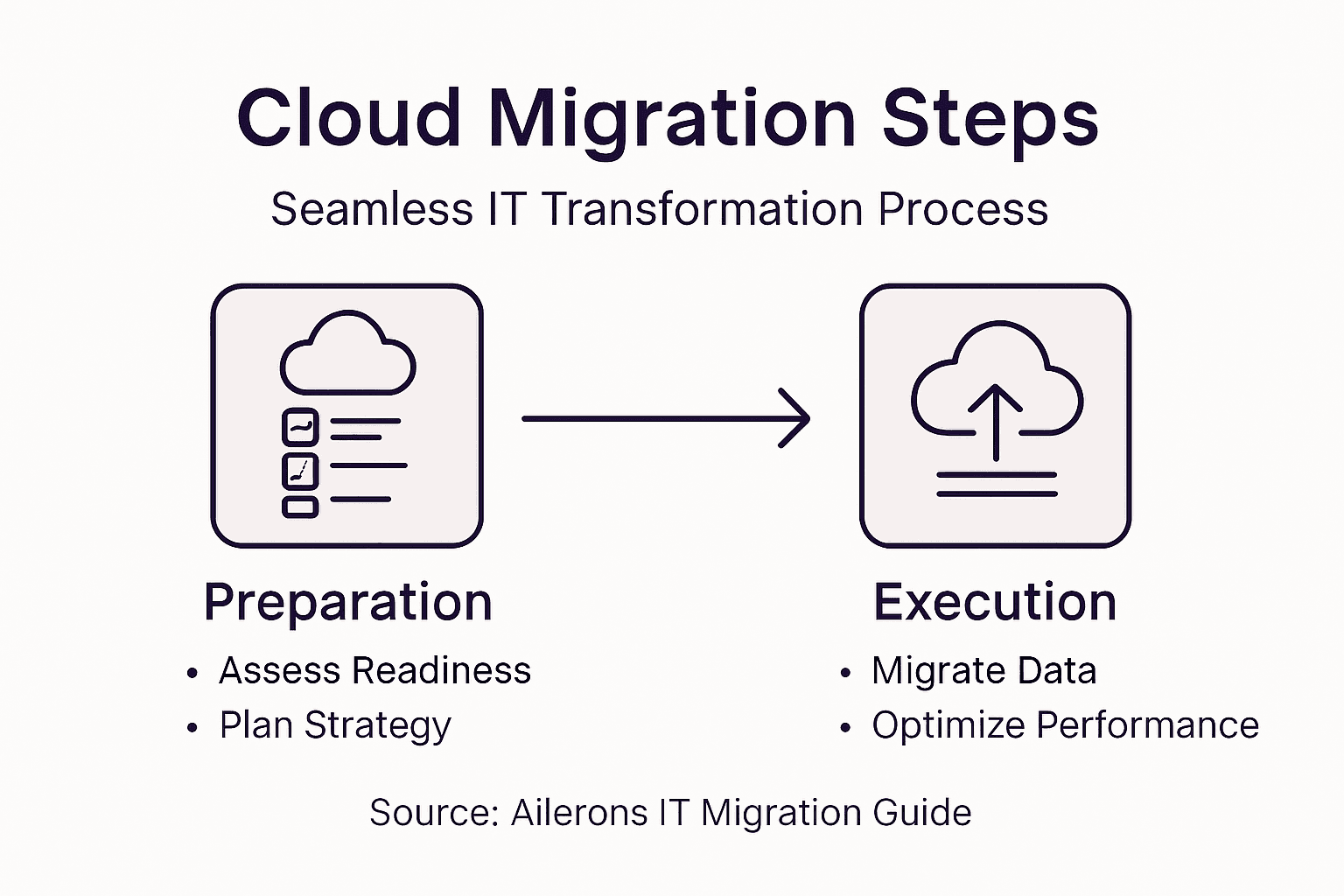
Cloud migration strategies recommend implementing your migration in calculated phases. Begin with less critical applications to build confidence and refine your approach. Use incremental migration techniques that allow for minimal operational disruption. Set up comprehensive monitoring dashboards that track application performance, resource utilization, network latency, and potential security vulnerabilities in real time. This approach enables you to quickly identify and address any issues that emerge during the transition.
AWS migration fundamentals emphasize rigorous testing and validation throughout the migration process. Create detailed migration runbooks that outline specific steps, expected outcomes, and rollback procedures for each application. Implement automated testing protocols that verify application functionality, data integrity, and performance benchmarks immediately after migration. Establish a dedicated migration support team that can quickly respond to unexpected challenges and provide immediate technical assistance during the transition.
Pro Tip: Develop a comprehensive migration dashboard that provides real time visibility into migration status, performance metrics, and potential risks across all migrated systems.
Step 5: Verify Migration Success and Optimize Performance
After executing your cloud migration, the crucial phase of verification and optimization begins. Your objective is to validate the migration’s technical success while continuously improving your cloud infrastructure’s performance, security, and cost effectiveness.
Cloud migration verification guidance recommends conducting comprehensive security and performance audits immediately after migration. Perform thorough functional testing for each migrated application, comparing pre and post migration performance metrics. Validate data integrity, network connectivity, and application responsiveness. Use cloud native monitoring tools to track resource utilization, identify potential bottlenecks, and establish baseline performance benchmarks. Pay special attention to security configurations, ensuring that access controls, encryption protocols, and compliance requirements are fully maintained in the new cloud environment.
Cloud migration optimization strategies emphasize continuous improvement and adaptation. Review your resource allocation strategies, looking for opportunities to right size computing resources and reduce unnecessary expenses. Leverage cloud platform native services that can enhance application performance, improve scalability, and introduce advanced capabilities not available in your previous infrastructure. Create a regular optimization schedule that includes performance reviews, cost analysis, and technology alignment checks to ensure your cloud environment remains efficient and aligned with evolving business needs.
The table below highlights critical post-migration optimization areas and their impact:
| Optimization Focus | Action | Value to Business |
|---|---|---|
| Performance | Monitor and tune workloads | Ensures optimal user experience |
| Security | Review access and encryption | Maintains regulatory compliance |
| Cost Efficiency | Analyze and right-size resources | Lowers ongoing cloud expenses |
| Scalability | Enable autoscaling tools | Supports business growth flexibility |
Pro Tip: Implement automated performance and cost monitoring tools that provide real time insights and generate actionable recommendations for ongoing cloud infrastructure optimization.
Elevate Your Cloud Migration Journey With Expert IT Solutions
Migrating to the cloud can be overwhelming with challenges like ensuring secure data protection, minimizing downtime during execution, and optimizing post migration performance. The article “Cloud Migration Workflow for Seamless IT Transformation” highlights these critical pain points including the need for thorough readiness assessment, strategic phased migration, and continuous optimization to unlock the full value of your cloud investment. You should not have to face these complex steps alone when your business depends on flawless IT transformation.
At Ailerons IT, we specialize in guiding small and medium sized businesses through every stage of their cloud migration journey. Our comprehensive IT consulting and tailored solutions focus on secure infrastructure preparation, smooth migration execution, and ongoing cloud performance improvement. Discover how our professional services can help you manage risks, maximize cost efficiency, and maintain compliance throughout your transition. Learn more on our blog and explore how we turn migration challenges into growth opportunities.
Ready to move forward confidently with your cloud transformation? Visit Ailerons IT now to book a personalized consultation. Take the next step and let us help you unlock seamless cloud migration with expert guidance designed for your business needs.
Frequently Asked Questions
What is the first step in the Cloud Migration Workflow for Seamless IT Transformation?
To start the Cloud Migration Workflow, conduct a comprehensive cloud readiness assessment. Evaluate your current IT infrastructure, identify potential challenges, and outline your business objectives to create a strategic roadmap for cloud adoption.
How do I design an optimized migration strategy for my cloud transition?
Creating an optimized migration strategy involves categorizing applications based on complexity and business importance. Develop a phased approach where you start with simpler applications, allowing for a more manageable and less disruptive migration process.
What security measures should I implement before migrating to the cloud?
Before migration, implement a robust security strategy that includes identity and access management. Ensure you apply zero trust principles, use multi-factor authentication, and encrypt data in transit and at rest to protect sensitive information.
How can I ensure a successful cloud migration and monitor its progress?
To ensure a successful cloud migration, execute your plan in phases and monitor performance in real time. Set up dashboards to track application performance and resource utilization, allowing you to address any issues promptly as they arise during the transition.
What should I evaluate after migrating to the cloud?
After migration, conduct thorough performance and security audits to verify technical success. Compare pre-and post-migration performance metrics to ensure all applications are functioning correctly and maintain compliance with security standards.
How can I optimize cloud performance and efficiency after migration?
To optimize cloud performance post-migration, regularly review resource allocation and utilization. Implement automated monitoring tools that provide insights for performance tuning and cost reduction, helping you adjust resources efficiently for ongoing business needs.